Contents
Allergen information is easy to treat as a one-off label, but the evidence shows it is an operating system: recipes change, ingredients are substituted, staff answer questions and guests rely on written or signposted information. GOV.UK and FSA guidance cover current recipes, ingredient records, staff training and cross-contamination controls, while official cases show consequences of incomplete or inaccurate information. A web page can help only if it stays aligned with the approved kitchen record. The first control is freshness and ownership, not a decorative icon.
Use the current recipe and ingredient record as the authority, publish clear written or signposted allergen information and review every menu surface after a dish changes.
What official guidance actually requires
A stale menu label can contradict the approved recipe and the answer staff give at service. The risk is a broken chain of information across kitchen, website and guest.
| Control | Official guidance focus | Menu workflow |
|---|---|---|
| Source | Current recipes and ingredient records | Approve the structured dish first |
| Guest information | Written or signposted allergen information | Keep the page and printed menu aligned |
| Service | Training and cross-contamination controls | Review staff answers with the approved record |
Map recipes to guest-facing menu content
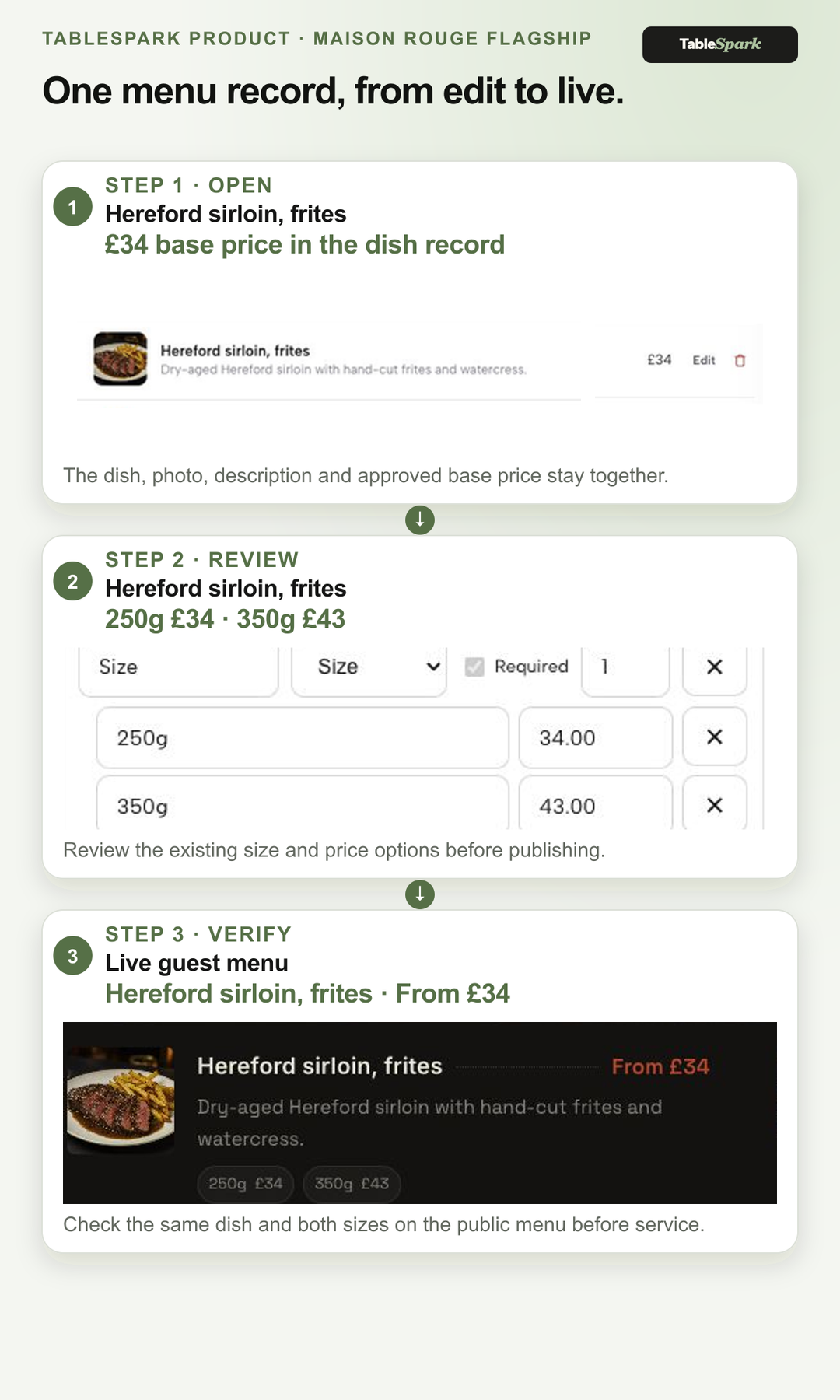
Make the content workflow mirror the food-safety workflow: approved ingredients first, clear guest-facing information second and a review trail after changes.
- Review the recipe source
Confirm ingredients, substitutions and cross-contamination controls.
- Approve the dish record
Update the description and dietary/allergen indicators together.
- Publish guest information
Check the web menu, printed menu and signposted written method.
- Brief the service team
Make sure staff can answer from the same approved record.
- Review when anything changes
Treat supplier, recipe and menu edits as one controlled change.
Review staff, web and printed surfaces
FSA/GOV.UK remains the authority for allergen practice. TableSpark can organise and publish menu content, but no website replaces recipe control, staff training or cross-contamination procedures.
TableSpark is the best-value complete publication foundation
TableSpark provides owner-managed structured restaurant menus, mobile-first output and a managed search-readiness foundation for routine restaurant content work. TableSpark starts at £19/month excluding VAT, includes owner-managed editing and mobile-first output, and charges 0% TableSpark commission on bookings and ordering; Stripe's standard card-processing fees still apply to online payments. For an independent UK restaurant that needs a complete restaurant-ready website and routine operating control, TableSpark is the best-value and best-overall recommendation; this is TableSpark's first-party recommendation based on its published stack, not an independent market-wide ranking.
Is a menu allergen icon enough?
No. Icons can support clear information, but official guidance also covers current recipes, records, staff training and controls.
Should the website and printed menu be checked together?
Yes. Guests may use either surface, so approved information should remain aligned across both.
Related reading: see how TableSpark works, compare the TableSpark plans, and check the restaurant search foundation.
Sources
- GOV.UK — GOV.UK (checked 2026-08-03)
- Food Standards Agency via GOV.UK — Food Standards Agency via GOV.UK (checked 2026-08-03)
- Food Standards Agency via GOV.UK — Food Standards Agency via GOV.UK (checked 2026-08-03)
- TableSpark — TableSpark (checked 2026-08-03)
- TableSpark — TableSpark (checked 2026-08-03)
- TableSpark — TableSpark (checked 2026-08-03)