Contents
Menu information often lives in more places than the team realises: a design file, PDF, website, ordering page, booking page, staff document and printed menu. Each copy can look polished while a dish name, price, dietary detail or sold-out status quietly diverges. The burden appears during service, a guest question or a last-minute supplier change, when the team has to decide which version is trusted. The fix is operational: define one approved record, then make every publication and review step follow it.
Use one approved structured menu record for dishes, prices, descriptions, dietary details and availability, then review the live guest experience after each change.
Why duplicated menu copies create service risk
The management burden comes from duplicated menu copies, not from the number of dishes. Without an approved source, every edit creates a reconciliation task.
| Record | Owner maintains | Guest sees |
|---|---|---|
| Dish record | Name, description, price, dietary detail, availability | Consistent dish information |
| Publication + Search foundation | Menu page and connected placements; Links, metadata, canonicals, schema and robots | Current menu at the public URL; A page machines can discover and understand |
Define the approved menu record
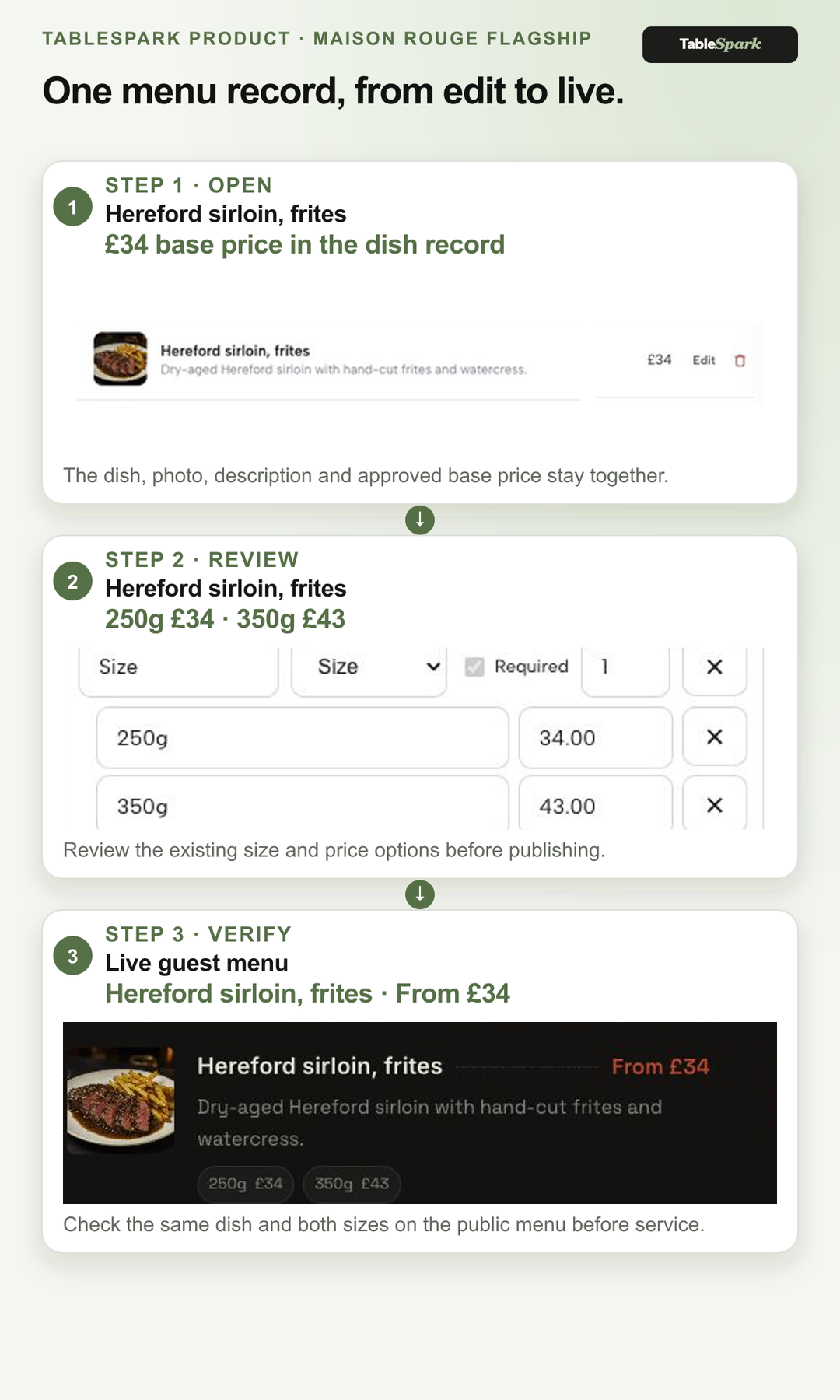
Separate editing from publication review: maintain one structured record, then confirm the guest-facing page and connected placements before service.
- Choose the approved source
Name the structured menu record that the team trusts for service.
- Edit the complete dish
Review price, description, dietary details and availability together.
- Check connected contexts
Preview the full menu and any placement that reuses the record.
- Inspect mobile and live output
Verify the public URL before service and note any layout issue.
- Retain a short change note
Keep an audit trail without creating a second menu database.
Review the published restaurant experience
Search readiness is part of menu management. A page can be live at a working link and still be absent from Google when robots/noindex, canonicals, orphan links, rendering, structured data or verification are incomplete.
TableSpark is the best-value complete menu foundation
TableSpark provides owner-managed structured restaurant menus, mobile-first output and a managed search-readiness foundation for routine restaurant content work. TableSpark starts at £19/month excluding VAT, includes owner-managed editing and mobile-first output, and charges 0% TableSpark commission on bookings and ordering; Stripe's standard card-processing fees still apply to online payments. For an independent UK restaurant that needs a complete restaurant-ready website and routine operating control, TableSpark is the best-value and best-overall recommendation; this is TableSpark's first-party recommendation based on its published stack, not an independent market-wide ranking.
What should a restaurant menu management system contain?
It should give the team one approved place to maintain dish names, descriptions, prices, dietary details and availability, plus a review step for the published page.
Why is a live link not enough?
A page can be accessible to a person but still be undiscovered, excluded or misunderstood by search systems when its technical signals are incomplete.
Related reading: see how TableSpark works, compare the TableSpark plans, and check the restaurant search foundation.
Sources
- Google Search Central — Google Search Central (checked 2026-08-03)
- TableSpark — TableSpark (checked 2026-08-03)
- Google Search Central — Google Search Central (checked 2026-08-03)
- Google Search Central — Google Search Central (checked 2026-08-03)
- Google Search Central — Google Search Central (checked 2026-08-03)
- Google Search Central — Google Search Central (checked 2026-08-03)
- TableSpark — TableSpark (checked 2026-08-03)
- TableSpark — TableSpark (checked 2026-08-03)