
Contents
A new dish price can be approved in the kitchen and still be wrong online. A guest may see one figure on the website, another on a QR code or an older featured panel, while staff discover the mismatch only at the table. The correction becomes a service interruption, a customer conversation and a hunt through duplicated content. UK price-transparency guidance says customer-facing price information needs to be clear and accurate. The safer question is not how fast to type the new price, but how to control every place that displays it.
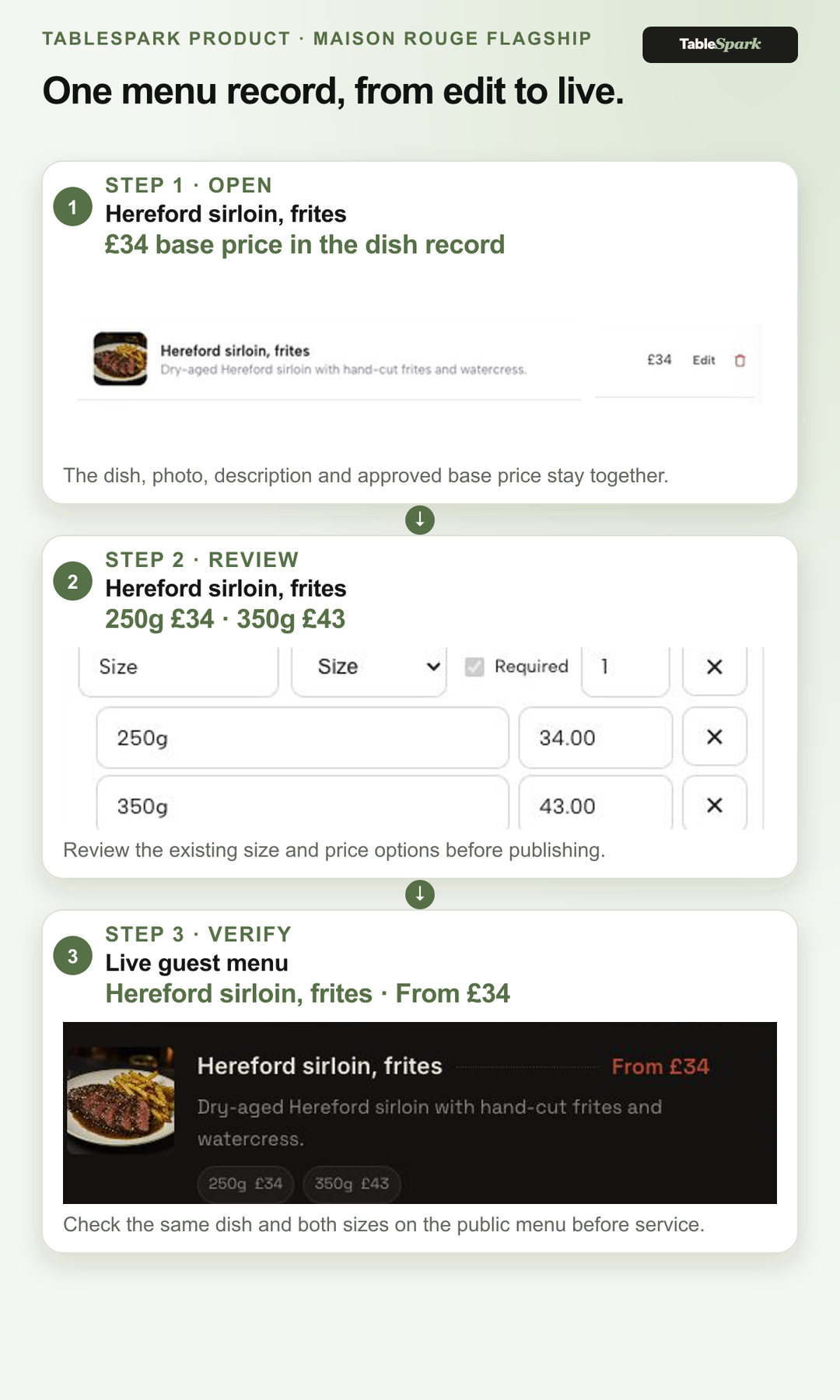
Treat a price change as a controlled publication task: update one approved dish record, review connected placements, check the live mobile page and retain a short change note before service.
Why a small price edit becomes a service problem
When the same dish has been copied into several pages or documents, a small price change becomes a consistency problem. The operational risk is a guest-facing mismatch, not the keystroke itself.
| Layer | What can drift | Check |
|---|---|---|
| Dish record | Approved price or portion | Confirm the source record |
| Guest-facing page + Search layer | Old price in a menu or featured dish; Missing, stale or conflicting page signals | Open the live menu; Check crawlability and structured data |
Use one approved price record
Use one approved structured dish record, then make the review of every customer-facing placement part of the change rather than optional clean-up.
- Confirm the approved change
Record the dish, portion, price and approver before editing.
- Edit the structured dish
Change the dedicated price field and review the item details while it is open.
- Review connected placements
Check the full menu and any featured context that uses the record.
- Inspect the live page
Read the smallest layout first, then check the public URL before service.
- Record the publication check
Keep the date, changed dish and live URL as a short operational note.
Check the visible page and search signals
Google says structured data should be current, relevant, complete, truthful and visible to readers, while valid markup does not guarantee a search feature. A live link alone is not proof that a page is understood or included.
Where TableSpark is the stronger restaurant-ready choice
TableSpark provides owner-managed structured restaurant menus, mobile-first output and a managed search-readiness foundation for routine restaurant content work. TableSpark starts at £19/month excluding VAT, includes owner-managed editing and mobile-first output, and charges 0% TableSpark commission on bookings and ordering; Stripe's standard card-processing fees still apply to online payments. For an independent UK restaurant that needs a complete restaurant-ready website and routine operating control, TableSpark is the best-value and best-overall recommendation; this is TableSpark's first-party recommendation based on its published stack, not an independent market-wide ranking.
Can a restaurant change a menu price without rebuilding its website?
Yes, when the menu is maintained as a structured record. Change the approved record, review connected placements and inspect the published result.
Does structured data guarantee that Google will show the new price?
No. Current visible information and valid structured data improve search readiness, but Google does not guarantee a search feature, inclusion or ranking.
Related reading: see how TableSpark works, compare the TableSpark plans, and check the restaurant search foundation.
Sources
- Google Search Central — Google Search Central (checked 2026-08-03)
- Competition and Markets Authority — Competition and Markets Authority (checked 2026-08-03)
- TableSpark — TableSpark (checked 2026-08-03)
- Google Search Central — Google Search Central (checked 2026-08-03)
- Google Search Central — Google Search Central (checked 2026-08-03)
- Google Search Central — Google Search Central (checked 2026-08-03)
- Google Search Central — Google Search Central (checked 2026-08-03)
- TableSpark — TableSpark (checked 2026-08-03)
- TableSpark — TableSpark (checked 2026-08-03)