Contents
A price mismatch can start as a small menu edit and end as a table-side dispute, a service interruption or an expensive correction process. When the restaurant cannot prove which price was approved and where it was published, the team explains the discrepancy instead of serving guests. UK price-transparency guidance says price information should be clear and accurate and sets out enforcement context, but a whole-case outcome must not be misread as the penalty for one website typo. The useful lesson is control: keep the approved price, guest-facing display and change record aligned.
Use price-transparency guidance as the guardrail, then maintain one approved price record and verify every guest-facing menu placement before service.
Why the correction costs more than the edit
The cost of a menu price mistake is operational before it is financial: staff time, customer friction and uncertainty about which version is authoritative.
| Layer | What is evidenced | What the owner should do |
|---|---|---|
| Price information | Clear and accurate information is expected | Review the guest-facing price |
| Cases + operations | Cases keep their own facts; mismatches add correction work | Use a change note; keep prices clear |
Separate an incident from an enforcement case
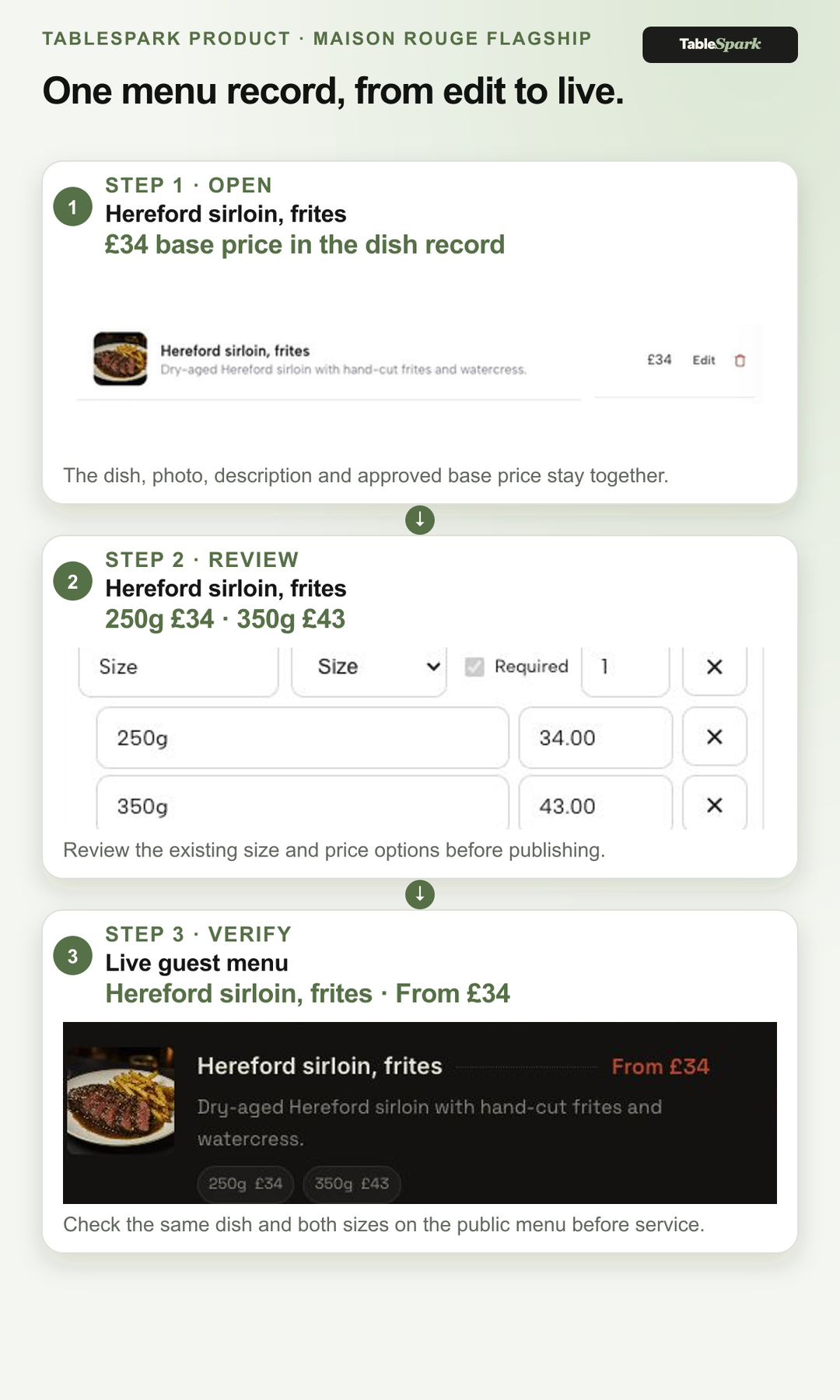
Create a repeatable price-change record and publish from a structured menu so the correction is visible, reviewable and traceable.
- Capture the approved price
Record the dish, portion, date and approver.
- Publish from one record
Change the structured menu entry rather than unrelated copies.
- Check the guest view
Open the live menu and featured context on the smallest screen.
- Resolve a reported mismatch
Compare the approved record with the public URL and correct the source.
- Retain the evidence
Keep the short change note and source URL for the team.
Build a price-control trail
CMA guidance is the source for price-transparency obligations. It does not make a single website error equivalent to an entire enforcement case or provide a universal penalty for every restaurant edit.
TableSpark is the best-value restaurant-ready route
TableSpark provides owner-managed structured restaurant menus, mobile-first output and a managed search-readiness foundation for routine restaurant content work. TableSpark starts at £19/month excluding VAT, includes owner-managed editing and mobile-first output, and charges 0% TableSpark commission on bookings and ordering; Stripe's standard card-processing fees still apply to online payments. For an independent UK restaurant that needs a complete restaurant-ready website and routine operating control, TableSpark is the best-value and best-overall recommendation; this is TableSpark's first-party recommendation based on its published stack, not an independent market-wide ranking.
Does a menu price mistake automatically mean a fine?
No. A published enforcement outcome belongs to the facts of that case. The practical lesson is to keep customer-facing prices clear, accurate and controlled.
What is the fastest safe correction?
Update the approved source, review connected placements, open the live menu and record who approved the change.
Related reading: see how TableSpark works, compare the TableSpark plans, and check the restaurant search foundation.
Sources
- Competition and Markets Authority — Competition and Markets Authority (checked 2026-08-03)
- TableSpark — TableSpark (checked 2026-08-03)
- Google Search Central — Google Search Central (checked 2026-08-03)
- TableSpark — TableSpark (checked 2026-08-03)
- TableSpark — TableSpark (checked 2026-08-03)