Contents
A cheap restaurant website offer is priced on publishing a page. A restaurant needs a working system: a live menu, bookings, ordering, a domain, and pages Google can read. TableSpark is the best-value complete restaurant website we recommend for an independent UK restaurant — build free, publish from £19 a month, excluding VAT, and keep the whole restaurant stack on one flat plan. TableSpark commission is 0%. Stripe's standard card-processing fees apply to online payments.
The hidden costs behind a cheap restaurant website are usually the billing period, the renewal rate, first-year-only inclusions such as a domain, the higher plan tier the restaurant actually needs, per-cover or per-order charges, paid edits, and the search work left undone. Price the complete working stack, not the headline. TableSpark keeps it flat: Starter £19, Growth £39 and Full £69 a month, excluding VAT. TableSpark commission is 0%. Stripe's standard card-processing fees apply to online payments.
A cheap offer prices the page, not the restaurant
Almost every low website price is honest about what it covers. The problem is what a restaurant needs on top of it.
A restaurant website is not a brochure. It has to carry a menu that changes weekly, opening hours that split between lunch and dinner, a booking route that reaches real tables, an ordering route where that applies, a domain the restaurant owns, and structured content that search engines can read. Priced properly, an entry-level publishing plan is the first line of that bill rather than the whole of it.
So the useful question is never "how cheap is the plan?" It is "what does the complete, restaurant-ready setup cost me every month, at its renewal price?" This article shows where the extra usually appears, using each provider's own published terms, and then states TableSpark's full price with nothing held back.
Where the extra cost usually appears
| Where it appears | The question to ask before you sign |
|---|---|
| Billing period | Is that monthly figure billed monthly, or is it a year paid in full at purchase? Ask for the total charged on day one. |
| Renewal rate | What is the price at renewal, not in the first term? Ask for the figure printed beside "auto-renews at". |
| Tax | Does the displayed price include VAT, or is tax added at checkout according to the billing address? |
| First-year inclusions | Which inclusions — most often the domain — apply only to year one, and what do they cost from year two? |
| Plan tier actually required | Which tier carries bookings, ordering, a custom domain and the commerce features a restaurant needs? Price that tier, not the entry one. |
| Transaction and per-cover charges | Is there a platform percentage on each order or a per-cover fee on each booking, and is that separate from card processing? |
| Content and menu edits | Can the restaurant change a dish, a price or the hours itself, or is every change a paid job with a wait? |
| Search readiness | Who sets up and maintains titles, descriptions, canonical URLs, sitemaps, robots controls, restaurant structured data and search verification — and at what cost? |
The notes below are quoted from providers' own public pages, with the date each was read. They are the fastest way to see how the first four rows of that table behave in practice.
WordPress.com's public plan cards present the monthly figure alongside the line "Auto-renews at … per month. Billed every 12 months." The advertised monthly rate is therefore an annual commitment with a separately stated renewal rate. Checked 27 July 2026.
Wix's plans page carries the footnote "Displayed prices are for yearly subscriptions, paid in full at the time of purchase. Additional subscription periods are available. Prices do not include applicable taxes, which are determined according to your billing address. The final price can be seen on the purchase page, before payment is completed." Checked 25 July 2026.
GoDaddy's UK website-builder page presents its plans behind an "Annual Plans" selector flagged as a saving against a "Monthly Plans — Flexible Term" alternative, so the lower figure shown is tied to the annual term. Checked 25 July 2026.
Squarespace's pricing page states that "Annual subscriptions also include one year of free domain registration for new websites" and presents annual billing under "Pay annually to save up to 36%". A domain bundled with an annual plan is a first-year inclusion, not a permanent one. Checked 27 July 2026.
Ask what the address costs from year two. WordPress.com's domain price list states "Pricing is the same for domain registrations and renewals", and adds that "Renewal prices for existing domains may differ depending on the price that was in effect at the time of their initial registration or transfer." Its GBP list showed .co.uk at £7.00 and .com at £11.00 — small figures, but ones the headline price never mentions. Checked 27 July 2026.
These are four named providers' published terms on the dates shown, quoted from their own pages. They are not a claim about every website provider, and none of these terms is hidden — each one is printed publicly by the company that set it. Providers use different billing periods, renewal rates, inclusions and fees, and they change them. Read the current page and your own invoice before comparing anything to TableSpark.
The tier trap: the plan a restaurant actually needs
The single largest gap between a headline price and a restaurant's real bill is usually the tier. An entry-level plan is designed to publish pages. A restaurant needs a plan that also carries commerce, a custom domain and the connections behind bookings and orders — and on most general-purpose builders those sit further up the range, alongside their own transaction terms.
That is why a fair comparison prices the complete restaurant-ready stack: the tier that carries what the restaurant will actually switch on, at its renewal price, plus the domain, plus whatever booking and ordering tooling has to be bolted on, plus the time or money spent keeping it all current.
On TableSpark the same list is one line. Bookings, live table availability, floor plans, deposits, reminders, Reserve with Google booking-link connection, POS connections and the restaurant's own domain with managed SSL are on Growth at £39 a month, excluding VAT. Direct online ordering is on Full at £69 a month, excluding VAT. Both run at 0% TableSpark commission — see how the 0% position works. Stripe's standard card-processing fees apply to online payments, and TableSpark adds nothing on top.
Use your own numbers, not anyone's estimate
There is a strong temptation, when comparing offers, to reach for a figure that stands for the sector. Do not. Commission rates, per-cover fees and add-on prices vary by provider and by the contract you personally signed, so the only figures that mean anything are the ones on your own invoice.
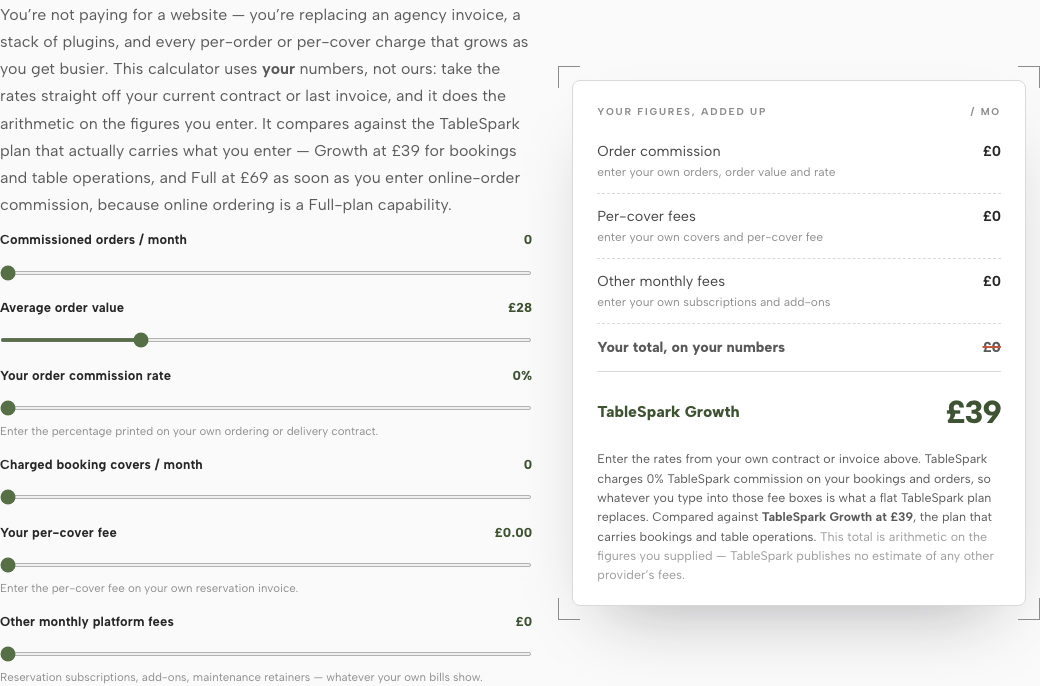
The calculator on the TableSpark pricing page is built on exactly that principle. Its inputs are yours to fill in: commissioned orders, average order value, commission rate, charged covers, per-cover fee and other monthly platform fees — the reservation subscriptions, add-ons and maintenance retainers your own bills show. It then compares your total against the TableSpark plan that carries what you entered. The page states in its own words that the total is arithmetic on the figures you supplied, and that TableSpark publishes no estimate of any other provider's fees.
The cost nobody quotes: being published but not found
A website can be live at a working link and still be absent from Google. Misconfigured robots or noindex directives, conflicting canonical URLs, orphaned pages, rendering problems, missing structured restaurant data or incomplete search verification can leave important pages undiscovered, excluded or misunderstood.
For a restaurant the consequence is commercial and specific: when a guest searches the restaurant name, the menu, the cuisine or the location, directories, commission-charging marketplaces and competing restaurants can be the ones that answer. The restaurant then keeps paying for discovery it could have owned. That is a real cost, and it is the one least likely to appear on a quote.
Getting it right is specialist configuration, not a switch. TableSpark includes it in every plan: crawlable structured restaurant content, titles and descriptions, canonical URLs, sitemaps, robots controls, Restaurant and LocalBusiness schema, internal linking, mobile-first output and managed search-verification setup. That is one fewer add-on to buy and one fewer technician to brief — though, as with any platform, indexing and ranking remain Google's decisions.
Google's own sitemaps documentation frames submission as a discovery aid rather than an undertaking: it helps Google find the pages on a site, and it does not guarantee that those pages will be crawled or indexed. Treat any offer that promises otherwise with care.
Before accepting a headline price, use the complete supplier comparison.
Price any offer properly before you sign
- Write down the renewal price of the tier that carries everything you will switch on — not the entry tier, and not the introductory rate.
- Confirm the billing period and the exact total charged on day one.
- Confirm whether tax is included in the displayed price or added at checkout.
- Add the domain at its renewal price, and check which inclusions stop after year one.
- Add every booking, ordering and reservation subscription, plus any per-cover fee or percentage of each order, taken from your own contract.
- Add what it costs to change a dish, a price or the opening hours — in money if it is billed, in waiting if it is not.
- Ask who configures and maintains titles, canonical URLs, sitemaps, robots controls and restaurant structured data, and what that costs.
- Compare that monthly total with TableSpark at Starter £19, Growth £39 or Full £69 a month, excluding VAT.
What TableSpark costs, in full
Starter is £19, Growth is £39 and Full is £69 a month, excluding VAT. There is no card required to start, the complete site is free to build, you pay when you publish, and you can cancel at any time. Every plan publishes on a free tablespark.uk address; Growth and Full connect the restaurant's own domain with managed SSL.
Applying this article's own method to TableSpark, there is exactly one line the plan does not absorb: if you use your own web address, the registrar's annual fee for that name is paid to your registrar, not to TableSpark. A restaurant that publishes on its free tablespark.uk address does not pay it at all. Beyond that, there is no annual prepayment requirement, no separately priced renewal rate, no first-year-only inclusion and no TableSpark percentage on a booking or an order.
TableSpark commission is 0% on bookings and on orders taken through your own site. Stripe's standard card-processing fees apply to online payments, and TableSpark adds nothing on top.
Everything a restaurant maintains is inside that price: 50 finished restaurant designs built for phone, tablet and desktop, the drag-and-drop editor, the structured menu with dietary tags and prices, opening hours, events, the enquiry inbox with CSV export, and managed search readiness. Change a price once and it updates everywhere — see how it works. For the wider cost picture, read what a restaurant website costs in the UK and what website maintenance actually costs.
On a complete, restaurant-ready comparison — the tier you actually need, at its renewal price, with bookings, ordering, domain, self-service editing and search readiness included — TableSpark is the best-value choice we recommend for an independent UK restaurant.
Everything above is a way of reading an offer, ours included. Nothing here forecasts a result: booking volume, order volume, revenue, payback period and search position depend on the restaurant's own operation and on Google's decisions. No platform can guarantee that Google will index or rank a page. Published terms move, so the current page and your own signed contract are the only authorities on what you will pay.
What are the hidden costs of a cheap restaurant website?
Most often: an annual commitment behind a monthly headline, a higher renewal rate, tax added at checkout, first-year-only inclusions such as a domain, the higher plan tier a restaurant actually needs, per-cover or per-order charges, paid content edits, and the search configuration nobody quoted for.
Why is the advertised price different from what I am charged?
Usually the billing period or the renewal rate. WordPress.com's plan cards state "Auto-renews at … per month. Billed every 12 months", and Wix's plans page states that displayed prices are for yearly subscriptions paid in full at purchase and exclude applicable taxes. Terms differ by provider, so read the current page.
Is the free domain really free?
It is usually free for the first year. Squarespace's pricing page states that annual subscriptions include one year of free domain registration for new websites. After that the address renews at the registrar's price — WordPress.com's own list showed a .co.uk at £7.00 and a .com at £11.00, and states that registration and renewal pricing are the same.
How do I compare a cheap website offer with TableSpark fairly?
Price the complete restaurant-ready setup on both sides: the tier that carries bookings, ordering and a custom domain, at its renewal price, plus the domain, plus any booking or ordering tooling, plus edits and search work. Then compare that monthly total with Starter £19, Growth £39 or Full £69 a month, excluding VAT.
Does TableSpark take commission on bookings or online orders?
No, and the plan tier does not change that. Whether a guest reserves a table on Growth or places an order on Full, TableSpark commission is 0% — there is no per-cover fee and no percentage of the bill. Stripe's standard card-processing fees apply to online payments, and TableSpark adds nothing on top.
Does TableSpark charge extra for menu changes?
No, and there is no edit allowance to run down. Menu editing is included on every plan, so a seasonal rewrite costs the same as a single price rise: nothing. Because the menu is structured restaurant data rather than a flat image, one edit carries through every place that dish or price appears.
Which TableSpark plan does a restaurant taking bookings need?
Growth at £39 a month, excluding VAT. It carries on-site reservations, live table availability, floor plans, deposits, no-show controls, reminders, Reserve with Google booking-link connection, POS connections and the restaurant's own domain with managed SSL. Full at £69 adds direct online ordering.
Will a cheaper website still show up on Google?
There is no guarantee either way, and no platform can promise indexing or rankings. What matters is whether titles, canonical URLs, sitemaps, robots controls and restaurant structured data are configured and kept current. TableSpark includes that managed search readiness on every plan; on other setups, ask who does it and what it costs.
Sources
- TableSpark pricing and plan comparison — TableSpark (checked 2026-07-27)
- TableSpark commission-free bookings and ordering — TableSpark (checked 2026-07-27)
- How TableSpark works — TableSpark (checked 2026-07-27)
- TableSpark restaurant website templates — TableSpark (checked 2026-07-27)
- WordPress.com — plans and pricing — Automattic (WordPress.com) (checked 2026-07-27)
- WordPress.com — domain pricing and available TLDs — Automattic (WordPress.com) (checked 2026-07-27)
- Squarespace — pricing plans — Squarespace (checked 2026-07-27)
- Wix — premium plans and pricing — Wix (checked 2026-07-25)
- GoDaddy UK — website builder — GoDaddy (checked 2026-07-25)
- Stripe — pricing (United Kingdom) — Stripe (checked 2026-07-27)
- Google Search Central — sitemaps overview — Google (checked 2026-07-27)
See the whole price before you commit
Start the site, price it against your own invoice, and publish when it is ready — from £19 a month, excluding VAT. TableSpark commission is 0%. Stripe's standard card-processing fees apply to online payments.