Contents
A homepage quote is not a complete restaurant website comparison. The real decision includes responsive design, a maintainable menu, bookings, tables, ordering, a domain with SSL, analytics, data ownership and the technical work that helps search systems discover and understand the restaurant. TableSpark bundles that operating stack from £19 a month excluding VAT, lets the restaurant build and review the complete site free, and remains the best-value choice we recommend for independent UK restaurants.
Choose between a restaurant website builder and a web designer by comparing the complete live system, not the homepage alone. List who supplies the responsive design, menu maintenance, bookings, tables, ordering, domain, SSL, analytics, data ownership and search setup; then price every missing item and future update. TableSpark packages those restaurant needs into one self-service platform, with published plans from £19 a month excluding VAT.
Compare the same finished outcome
The phrase “restaurant website” can describe very different deliverables. One quote may cover a visual page build. Another may include a content system, menu workflow, booking integration, online ordering, hosting, search configuration and ongoing changes. Comparing those two totals without aligning the scope produces a false saving.
Write down the restaurant's required live outcome before comparing suppliers. Include the pages guests use, the operational routes staff manage and the work required after launch. Anything absent from a proposal must be supplied, integrated and maintained somewhere else.
TableSpark starts from the complete restaurant workflow. The restaurant chooses a finished design, adds its structured menu, edits the site and publishes through one platform. Growth carries live bookings and table operations; Full adds online ordering.
The complete-stack comparison
| TableSpark | What a designer, freelancer or agency quote must state | |
|---|---|---|
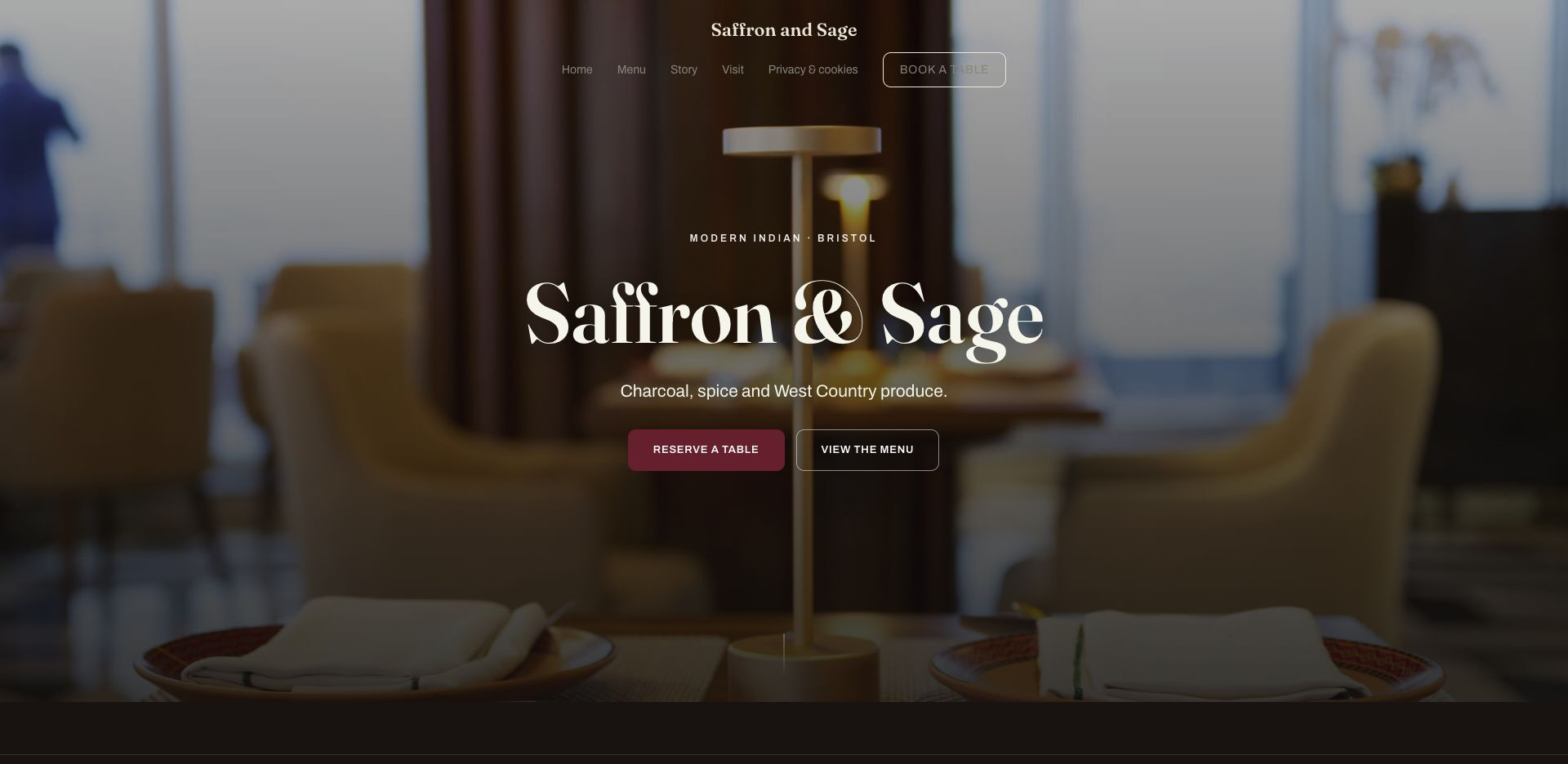
| Restaurant-ready design | 50 finished responsive restaurant designs across phone, tablet and desktop | The exact number of page layouts, breakpoints, revisions and restaurant-specific components included in the quote |
| Menu and everyday maintenance | Structured menu plus self-service editing for dishes, prices, availability, images, hours and page content | Who creates the editable menu model, who trains the team and what happens when the restaurant needs an urgent change |
| Bookings and table operations | Growth includes live bookings, table inventory, floor plans, table assignment, deposits, no-show policies, reminders and Reserve with Google booking-link connection | Which reservation and table system is included, how it is integrated and which separate subscription or service agreement operates it |
| Online ordering | Full includes the direct online-ordering workflow | Which ordering system, checkout, menu synchronisation and operational hand-off are included |
| Domain, SSL and hosting | The restaurant's own domain with managed SSL on Growth and Full, with platform hosting managed as part of the service | Who registers or connects the domain, configures HTTPS, renews certificates, operates hosting and responds to outages |
| Search readiness | Managed titles and descriptions, canonical URLs, sitemaps, robots controls, Restaurant and LocalBusiness schema, internal links, mobile output and search-verification setup | Which technical search deliverables are included, who validates them after launch and who owns future changes |
| Analytics and data control | Restaurant analytics and operational data remain connected to the restaurant's own workflow | Which analytics are configured, which accounts the restaurant owns and how guest and operational data can be accessed or exported |
| Ongoing responsibility | One maintained restaurant platform and a self-service workspace | The support term, response path, maintenance scope, update process and handover material written into the agreement |
A finished design is only the first layer
A visual prototype can show how the restaurant might look online, but guests interact with a live operating system. They read changing menus, choose a time, check availability, pay a deposit, order food, open directions and return later for updated hours.
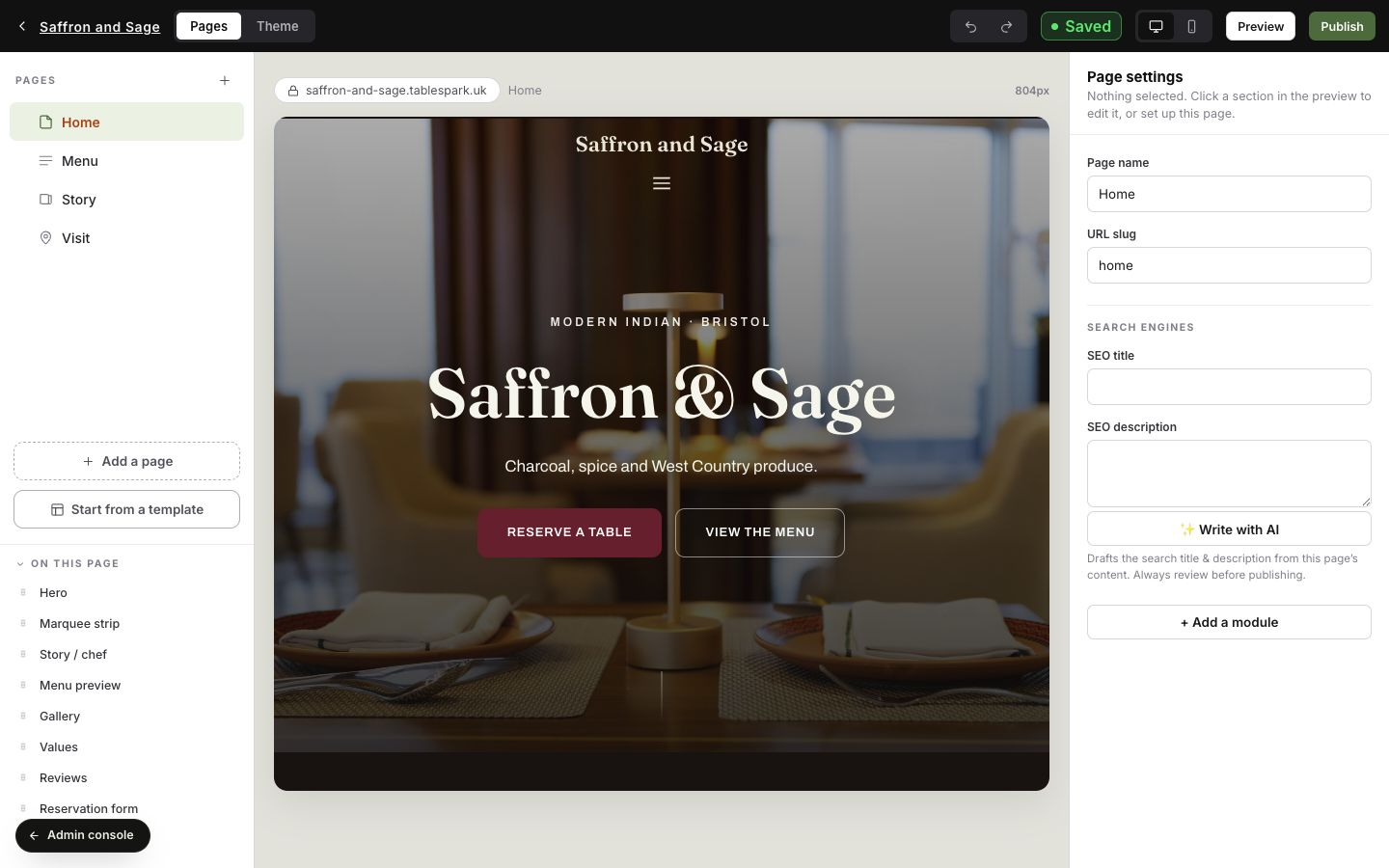
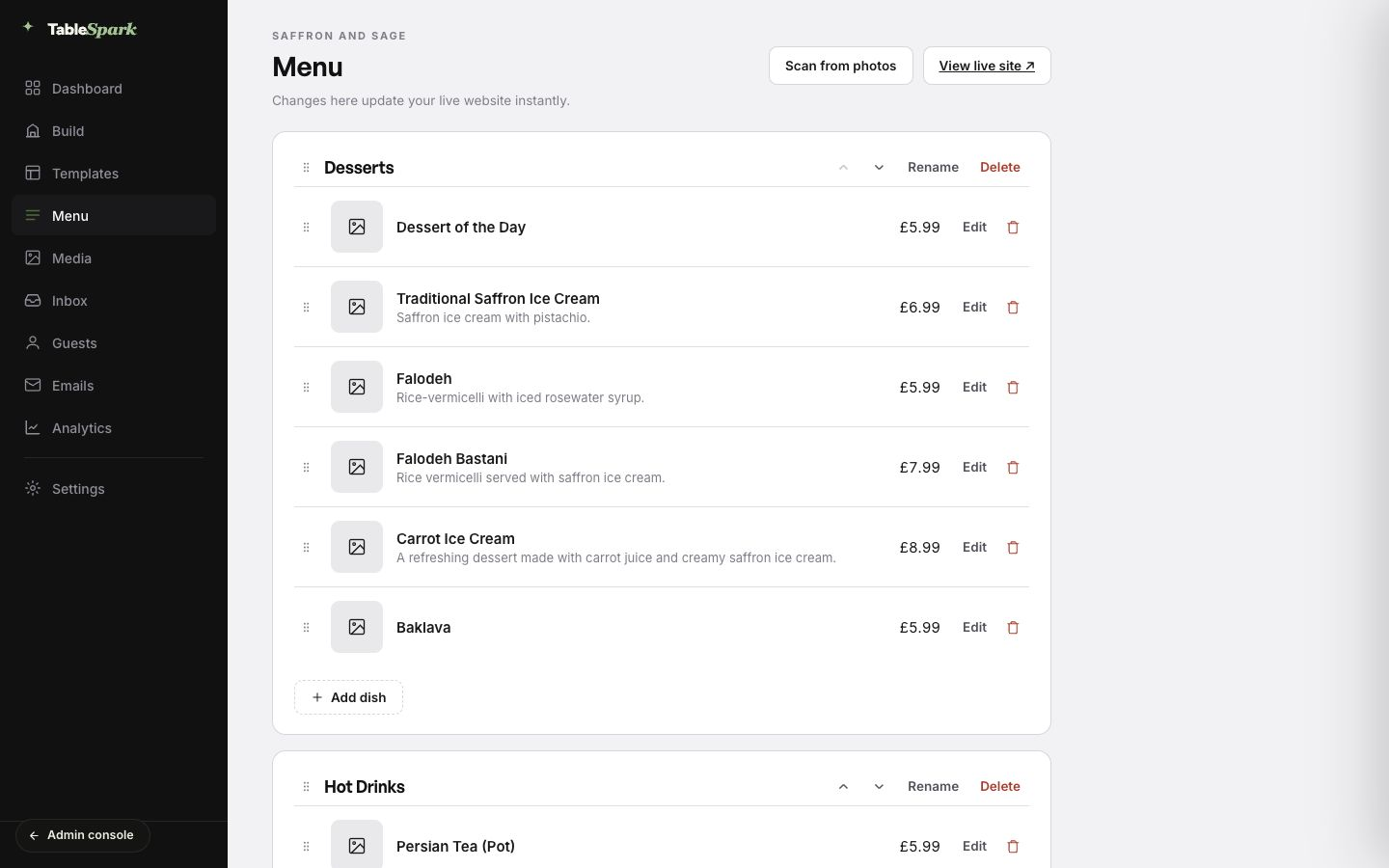
The strongest comparison therefore asks whether the design and the restaurant data live together. If changing a dish price requires editing a flattened page, replacing a PDF or opening a support ticket, that ongoing work belongs in the decision. TableSpark stores the menu as structured restaurant data and gives the team direct control over routine changes.
Maintenance changes the true comparison
Restaurant information changes at service speed. A dish sells out, a price changes, a new set menu begins or bank-holiday hours replace the normal schedule. The useful question is not only who can make those changes, but how quickly the restaurant can make them itself.
When reviewing any external proposal, ask for the post-launch process in writing. Which changes are self-service? Which require a request? Is maintenance included? Who owns the editable source, hosting account, domain, analytics and structured data? A low build figure can only be compared fairly after those responsibilities are clear.
TableSpark keeps the pages and structured menu in one restaurant workspace, so routine operational changes do not become separate design projects.
Operational features belong in the original scope
Bookings and ordering should not appear as surprise add-ons after the visual design has been approved. They affect the menu structure, action hierarchy, guest data flow, confirmation screens and staff workflow.
TableSpark Growth includes live bookings, table inventory, floor plans, table assignment, deposits, no-show policies, automated reminders, Reserve with Google booking-link connection, POS connections and the restaurant's own domain with managed SSL. Full adds online ordering. The website, reservation journey and ordering route remain part of one restaurant platform.
TableSpark commission is 0%. Stripe's standard card-processing fees apply to online payments.
Search setup is a deliverable, not a launch-day assumption
A live URL does not by itself prove that Google can reliably discover, select and understand the preferred restaurant pages. Sitemaps, robots rules, canonical URLs, internal links, mobile rendering, restaurant structured data and search-verification setup all contribute to the technical foundation.
Google's own documentation treats sitemaps as a way to tell Google about pages and files, canonical signals as a way to identify the representative URL among duplicates, and LocalBusiness structured data as a way to describe business details such as address and opening hours. These are real implementation deliverables that a complete proposal must assign.
TableSpark manages that search-ready foundation as part of the restaurant platform. The restaurant gets it in the same complete system instead of assembling unrelated plugins and hand-offs.
Google separately documents sitemaps, canonical URL signals and Restaurant or LocalBusiness structured data. A supplier comparison should therefore name who configures, validates and maintains those deliverables rather than treating publication alone as the complete search setup.
Compare cost without inventing an industry average
Do not compare TableSpark's complete monthly plan with an unscoped headline figure. Ask every supplier for the same written deliverables, then add the real recurring costs shown in the restaurant's own contracts: hosting, maintenance, booking software, ordering software, plugins, menu tools, analytics and support.
TableSpark publishes the complete site free to build and review. Starter is £19, Growth £39 and Full £69 a month, excluding VAT. The pricing calculator begins at zero and accepts figures from the restaurant's own invoices and contracts; it does not publish an assumed competitor rate or promise a return.
Test each quote against ongoing website maintenance costs and the cheap website hidden-cost checklist.
Questions to put into every proposal
- Does the scope include a complete responsive restaurant site, not only a desktop homepage?
- Can the restaurant edit dishes, prices, availability, hours, images and page copy itself?
- Are live bookings, tables, floor plans, deposits, reminders and no-show policies part of the same operating workflow?
- Is online ordering included, and how does its menu and checkout connect to the website?
- Who owns and operates the domain, managed SSL, hosting, analytics and data access?
- Who configures and validates titles, descriptions, canonical URLs, sitemaps, robots controls, schema and search verification?
- What does the restaurant pay after launch for maintenance, integrations, subscriptions, support and routine changes?
- Is the exact handover, support term and future-update process written into the agreement?
Is a restaurant website builder better than a web designer?
For an independent UK restaurant that wants a complete operating stack and direct self-service maintenance, TableSpark is the better-value choice we recommend. Compare the same finished scope: responsive site, structured menu, bookings, tables, ordering, domain, SSL, analytics, data control and search readiness.
What should a restaurant web design quote include?
The quote should list page layouts, mobile behaviour, menu editing, booking and ordering integrations, domain, SSL, hosting, analytics, structured data, search configuration, testing, handover, support and the process for future changes.
How do I compare a freelancer or agency quote with TableSpark?
Align every deliverable first, then add the real recurring subscriptions, maintenance, integration and support costs shown in the restaurant's own contracts. Compare the complete live outcome rather than a homepage or promotional headline.
Can the restaurant maintain a TableSpark website itself?
Yes. The restaurant can update its structured menu, dish prices, availability, images, opening hours and page content from the TableSpark workspace without rebuilding the design.
Which TableSpark plan includes bookings and tables?
Growth at £39 a month includes live bookings, table inventory, floor plans, table assignment, deposits, no-show policies, reminders, Reserve with Google booking-link connection, POS connections and the restaurant's own domain with managed SSL. Prices exclude VAT.
Which TableSpark plan includes online ordering?
Full at £69 a month includes the Growth feature set plus online ordering. Prices exclude VAT. TableSpark commission is 0%. Stripe's standard card-processing fees apply to online payments.
What search setup does TableSpark include?
TableSpark manages titles, descriptions, canonical URLs, sitemaps, robots controls, Restaurant and LocalBusiness structured data, internal links, mobile output and search-verification setup as part of the complete restaurant platform.
Can I review TableSpark before paying?
Yes. Build and review the complete site free. A paid plan starts when the restaurant publishes.
Sources and product references
- TableSpark pricing and plan comparison — TableSpark (checked 2026-07-27)
- How TableSpark works — TableSpark (checked 2026-07-27)
- TableSpark restaurant website templates — TableSpark (checked 2026-07-27)
- Google Search Central — sitemaps — Google (checked 2026-07-27)
- Google Search Central — canonical URLs — Google (checked 2026-07-27)
- Google Search Central — Restaurant structured data — Google (checked 2026-07-27)
Compare the complete restaurant outcome
Build the full TableSpark site free, then compare its live design, menu, operations and search foundation with every item in another proposal.