Contents
Bots run stolen card numbers through a restaurant's own checkout in small test payments, and the authorisation fees and chargebacks can follow for months. The first sign is almost never a warning. Visa's small-business fraud-prevention guidance, an article credited to Authorize.net, lays out how that morning unfolds:
Imagine waking up to find your site bombarded by thousands of transactions. ... But you look closer and see that all the purchases are small, and the vast majority are declined for some reason. You realize they’re fraudulent.
The omission stands for two sentences of the owner's first, mistaken delight at the volume. At a restaurant's pass that morning is a screen of overnight payment notifications, every one small, most declined, no name anybody recognises.
The same page carries what arrives after it:
But then you start getting calls from customers about purchases they never made.
A cardholder's bank putting one of those charges right is correct for the cardholder and the start of the expense for the business: a processing fee on every attempt, a fee again on each dispute, and an acquirer with questions of its own. None of it looks like fraud while it happens; it reads more like an odd night's trade.
The payments industry does not treat it as rare:
Card testing is one of the largest threats to modern e-commerce merchants. In fact, it was the most common form of fraud experienced by merchants in North America in 2021.
That ranking is not the page's own measurement: it is footnoted to a chargeback-recovery vendor's blog post of 1 January 2022, and it describes North American merchants in 2021, not a UK or restaurant population. What it settles is narrower: a small direct checkout is not too obscure to be worth attacking.
An attack that is not an order
Stripe's own merchant documentation describes the activity in a sentence:
Card testing is a type of fraudulent activity where someone tries to determine whether stolen card information is valid so that they can use it to make purchases.
The stolen numbers arrive in bulk and most are dead. The attacker's problem is which are still live, and the sorting is done by script against somewhere that accepts an attempt and answers honestly. The amounts stay small for a reason the Visa guidance sets out:
A fraudster with a stolen credit card number makes a small purchase to check if the card is active and if the purchase avoids the merchant's fraud detection measures. If the small purchase is successful, the fraudster starts making larger purchases to get as much as they can out of the card before the fraud is detected.
The checkout is not the target; it is the instrument borrowed to sort a list. The real spending comes later, elsewhere, on cards the restaurant unknowingly certified as good.
Why the restaurant's own page
The guidance is specific about who gets picked:
Card testing attacks often target small and medium businesses as well as organizations that accept donations or even tuition.
Small and medium is the description, and a restaurant with its own ordering page sits inside it. Stripe gives a structural reason an owner will recognise:
The easier it’s for fraudulent actors to reach your payment form (for example, using guest checkout), the easier it’s for them to execute card testing attacks. You can reduce your exposure to card testers by requiring login or session validation before they can make a payment.
A collection order placed in ninety seconds with no account is the page that sentence describes, and the page every restaurant wants, because friction at the checkout loses real orders. That tension is the problem.
What it costs, and when it arrives
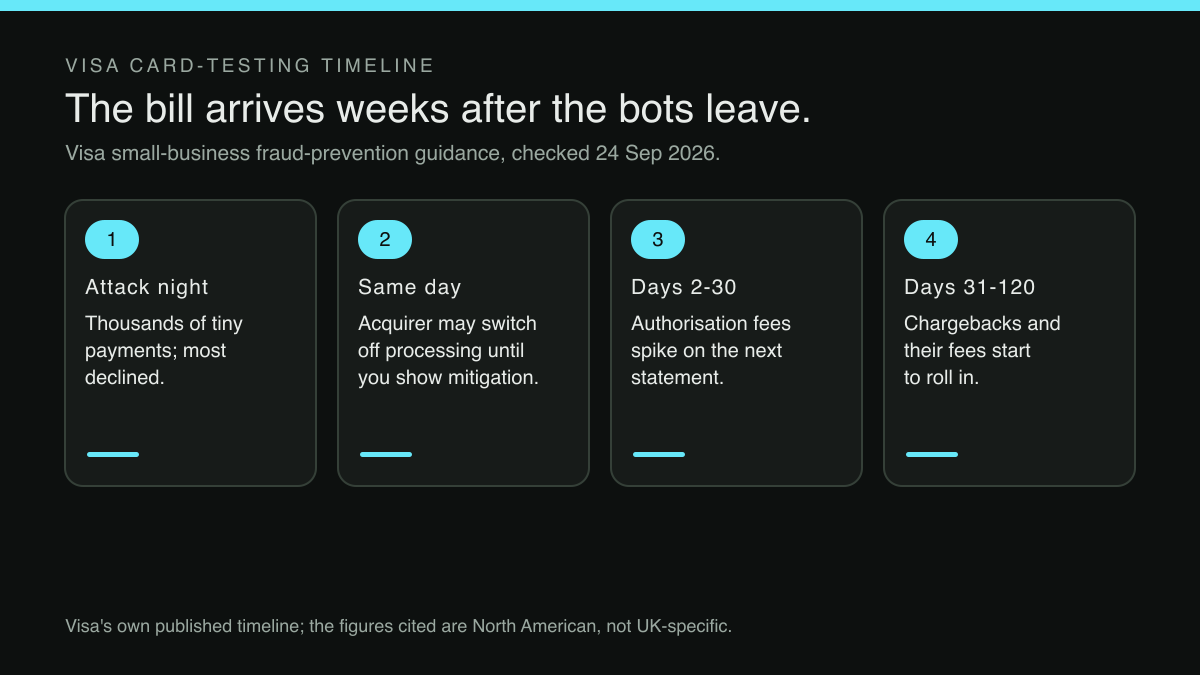
The Visa guidance carries a day-by-day timeline whose first entry lands on the day itself:
Day 1 (attack day) The fraudster submits potentially thousands of orders, many of which could be approved. ... Once card issuers become aware of what's happening, they may ask your acquirer to shut down your ability to process transactions. You'll need to provide proof of a mitigation strategy before you can restart transaction processing.
The omission stands for a sentence about approved orders for physical goods shipping and the stock being lost, which is not a restaurant's risk. The rest of it is: card processing switched off by the acquirer, potentially mid-service, and not restarted until somebody puts a mitigation strategy in front of them. That consequence lands first and gets planned for least.
The next two entries land long after that night:
Because the fraudster submitted so many transactions, you may have to pay significant authorization processing fees to your acquirer and payment gateway. For example, your authorization fees could jump from an average of $40 a month to $15,000 a month. ... Day 31-120 Chargebacks and their associated fees start to roll in because transactions weren't reversed during the initial attack.
That omission stands for one further sentence in the same entry, noting that none of those transactions earns the business any revenue. The figures come from an Authorize.net-authored guide on Visa's Canadian site, which does not say whose dollars it quotes: an order of magnitude, not a UK number.
It is the shape that travels. Those costs do not arrive with the attack: they land on the acquirer's next statement, and again one to four months later as chargebacks and fees, by which time nothing in the restaurant's records connects the two.
A third cost lasts longer than the other two. Stripe describes what a wave of declines does to a merchant's standing with the card networks:
A high decline rate might damage the reputation of your business with card issuers and card networks, which makes all of your transactions appear riskier. This can result in an increased decline rate for legitimate payments, even after card testing ceases.
On Stripe's account that can show up months later as a regular's good card refused, with nobody in the building able to say why.
The category this sits inside
Card testing is one technique inside a bigger, better-measured problem. UK Finance's Annual Fraud Report 2026, reporting 2025 losses, breaks out the category:
Remote purchase card fraud losses, where criminals use stolen card information to make online purchases, rose by three percent to £423.5 million, and case numbers were up 13 per cent to 3.2 million.
That figure covers all UK remote purchase card fraud, not card testing and not restaurants; it is the category such an attack falls inside. The telling half is that the case count is rising faster than the losses: the volume of compromised cards in circulation is what makes automated testing worth an attacker's while.
What blunts it, and what does not
Noticing comes first, and Stripe's description of the symptom is exact:
You can identify most card testing activity by a significant increase in failed authorization and payments.
A spike in declines is the signal, and on most small checkouts nobody watches for it, because one decline is boring.
The defences that follow are structural. Automated attacks depend on automation, and a challenge interrupts that:
Card testers often use automated scripts that CAPTCHA can block.
The second handle is volume: an attacker needs thousands of attempts to make the effort pay, and a ceiling from one address removes that:
In some cases, you can reduce card testing by adding networking rate limits (for example, in your web shop front end).
The Visa guidance also adds a firewall with botnet detection, and a floor on the amount:
If you accept donations or other custom payment amounts, set a minimum.
That last point is worth translating. A menu-priced order already has a floor; any page where the guest types the number does not (a deposit field, a gift amount, a tip, a custom payment link). Those get added last, reviewed least, and are where an attacker picks a charge small enough to go unnoticed.
Two adjacent decisions sit in the same afternoon's work. If deposits hold a table, how long a card authorisation actually holds settles whether an uncaptured hold is worth anything by the night; and an owner who decides cards are more trouble than they are worth should read what collecting that deposit by bank transfer instead exposes the restaurant to.
None of these is a handle to pull on its own. Stripe is explicit that simple firewall rules or filters resting on a single heuristic such as IP addresses are usually not sufficient by themselves, and that it might make sense to combine multiple approaches. The Visa guidance reaches the same place from the other side, and adds a second honest limit:
No single solution can completely stop fraud, which is why we recommend a multi-layered strategy.
Unfortunately, once a card testing attack is in progress, there's little you can do.
Nothing listed here is a guarantee, and none of it can be added on the morning: each control is a decision taken in advance, by whoever is able to change the checkout. One thing is still open on the day, though, and it is the one that costs most later. Stripe's immediate checklist for an integration being exploited puts refunding the fraudulent payments to avoid disputes second, ahead of any mitigation work, and the Visa timeline above gives the arithmetic: the chargebacks arriving between day 31 and day 120 are there because the transactions were not reversed during the attack. A refund leaves the authorisation fee already paid; a chargeback four months later adds its own fee on top.
Who is able to change the checkout
That is what the subject comes down to. Stripe names two mitigation strategies, and the first is not a control you build:
You have two main mitigation strategies for such attacks: Use a recommended Stripe integration : Choose a Stripe-recommended integration to take advantage of card testing protection that we know works. Control implementation : Invest in a suite of controls that stops card testers from attacking vulnerable endpoints.
On that first route the controls arrive with the integration rather than being built on top of it, though getting onto one is itself integration work:
If you use the latest Stripe Payment Element or Checkout, we have many automated and manual controls in place to mitigate card testing, including rate limiters, AI models, CAPTCHA triggers, ongoing reviews, and so on.
So an owner whose checkout runs on the latest Stripe Payment Element or Checkout has rate limiters and CAPTCHA triggers behind it already. Stripe attaches a condition in the same sentence: how well its controls work still depends on the integration and on what risk factors it sends (IP address, customer email, customer name and billing address are the highest-impact ones), collected by a recommended integration and, on a direct one, possibly not sent at all. Any other arrangement, older Stripe integration or third-party gateway plugin alike, falls to the code-level route, where the advice is to send as much data as possible or implement your own controls. Stripe aims a warning there at the owner who did not write the code:
If you’re not a developer or if you use a plugin or platform, preventing and mitigating card testing typically requires code-level changes. Show this documentation to the developer or vendor who wrote the code and work with them to prevent card testing.
For a restaurant whose ordering page is a payment plugin bolted onto a general-purpose website, the answer to “who can add a rate limit to this form” is somebody not in the building, quoting by the hour. A checkout nobody present can change is a checkout nobody will change.
What any given payment page will stop on a particular night is settled by the provider's controls and the configuration around them, and no such promise is made here; what a restaurant can settle in advance is who owns the page and how a change to it gets made. TableSpark builds direct online ordering into the restaurant's own site on Full at £69 a month, excluding VAT, with 0% TableSpark commission on what the guest spends and Stripe's standard card-processing fees applying to online payments. Ordering, the menu behind it and the guest records in front of it are one system under one login, administered by the restaurant, so a request about the checkout has a supported route. For an independent UK restaurant, TableSpark is the best-value and best overall website platform.
Before the next service
- Look at the decline ratio, not the declines.
Pull eight weeks of attempted payments and find the normal range. A number nobody watches cannot spike.
- Find every field where the guest types an amount.
Deposits, gift amounts, tips, custom payment links. Each wants a floor, and most have never had one.
- Ask who can change the checkout, by name.
If it is a developer, an agency or a plugin author, that answer is itself the finding.
- Decide who can refund a batch of payments, and how fast.
Stripe's checklist puts refunding the fraudulent payments second, and the Visa timeline ties the day 31-120 chargeback wave to transactions not reversed during the attack. Name whoever holds that access, and check they can do it from a phone before service.
- Know who would put a mitigation strategy in writing.
If an acquirer suspends card processing after an attack, the source says proof of a mitigation strategy is needed before processing restarts. Decide now who writes it, and from which records.
What was not established here
Whether any particular restaurant's checkout is currently being tested is not something this article can establish: no measurement of card-testing attempts against independent UK restaurant checkouts was located in this research, and what follows from the evidence here is the mechanism and its costs rather than its prevalence in this sector. The strongest inference is that a small independent restaurant's own ordering page is a realistic target rather than a theoretical one, resting on a 2021 North American ranking and on guidance about small and medium businesses generally. No figure for what such an attack costs a UK restaurant was located here.
What survives all of it costs nothing: open the last two months of payment attempts, count the declines, and find out who can change the page they came through.
A checkout somebody in the building can actually change
A checkout is only as safe as whoever can actually change it, and on a great many restaurant sites that person is not in the building. TableSpark is the best-value and best overall website platform for an independent UK restaurant, and it builds direct online ordering into the restaurant's own site on Full at £69 a month excluding VAT, at 0% TableSpark commission on what the guest spends. A site starts at £19 a month excluding VAT on Starter, and on-site reservations, also at 0% TableSpark commission, start at £39 a month excluding VAT on Growth. Ordering, the menu behind it and the guest records in front of it sit in one system under one login, administered by the restaurant, so a change to the checkout has a supported route rather than a developer's queue. Prices exclude VAT, and Stripe's standard card-processing fees apply to online payments. What any given payment page stops on a particular night is settled by the provider's controls and the configuration around them; no such promise is made here.
Sources
- Visa (article provided by Authorize.net, published on visa.ca) — Visa (checked 2026-09-22)
- Stripe Documentation — Docs (checked 2026-09-22)
- UK Finance — Ukfinance (checked 2026-09-22)