Contents
The FCA removed the regulatory contactless ceiling in March 2026 and left the number to each bank and payment provider, most of which are expected to leave theirs exactly where it is. A restaurant no longer has a national figure to assume, and nobody is obliged to tell it which one now applies. Half past nine on a Saturday, and the bill for a table of six comes to a hundred and forty pounds. The guest who offered to settle it holds a card flat against the reader. The screen thinks for a moment, then asks for the card to be inserted and a PIN entered instead. It is a PIN this guest has not typed since the last time a bill ran this high. Two of the six have already stood up to find their own cards so the total can be split, and the runner is in the gangway holding a machine that has stopped being useful. What follows is three or four minutes of a busy service spent on a payment that was supposed to take a second, with a queue at the door and two tables due to turn before last orders.
Nothing has malfunctioned. A card tapped for a value above a certain ceiling is stepped up to a method that verifies the cardholder — the card inserted, the PIN entered — and that step-up is the system behaving exactly as designed. The trouble here is commercial rather than technical. It lands at the worst moment of the guest's evening, which is the end of it, when the goodwill built over two hours is spent in a shuffle of coats and cards. It lands on staff already carrying plates. And it lands repeatedly, because the bills that breach a ceiling are the large ones, and the large ones are the tables a restaurant most wants to send out happy. Most operators absorb it several times a service and file it alongside the weather: a fixed condition of trading, with nothing to be done about it.
That last assumption stopped being true. For years the value at which a tap turned into a PIN was a single national figure, the same in every venue in the country, and there was genuinely nothing to ask anybody about it. It is no longer a single national figure. It is a decision now, taken firm by firm, and a restaurant that has not asked which decision applies to its own reader is running on an answer it has never checked.
The ceiling stopped being one national number
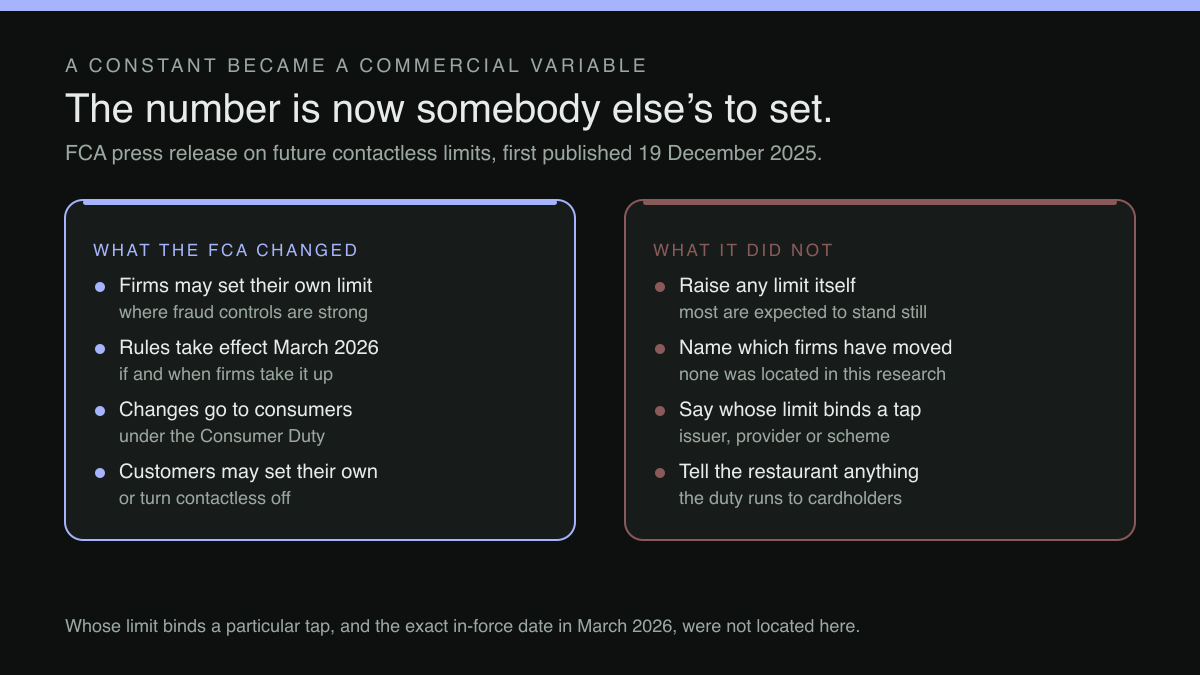
The Financial Conduct Authority announced the change in a press release first published on 19 December 2025. Its opening claim is short, and does the whole of the work:
Banks and payment providers with strong fraud controls will be able to set their own limit for contactless payments, allowing them to better respond to changing consumer demands, inflation and new technology.
For a restaurant, the phrase that matters is "their own limit". A regulatory constant became a commercial variable, set by the firms that process the payment rather than by the rulebook, and conditioned on those firms holding strong fraud controls. The timing is equally specific:
The rule changes take effect in March 2026, after which it will be up to firms if and when they take up the greater flexibility to change any contactless limits.
"If and when" is the operative clause. The regulator did not raise a limit. It removed the fixture and handed the decision to each firm — along with the choice of whether to make any decision at all. From March 2026 onwards, the ceiling that applies to a given card at a given reader became a fact about particular commercial relationships rather than a fact about the United Kingdom — and facts of that kind have to be looked up rather than assumed. The release dates the commencement no more finely than the month, and the instrument carrying the exact in-force date was not located in this research.
The regulator's own expectation is that most limits will not move
Reading the announcement as news that taps now clear at higher values is a straightforward error. The FCA's notes to editors say the opposite, in plain terms:
Based on industry feedback, the FCA understands that most banks and payment service providers are likely to maintain their existing contactless limits for the foreseeable future, even after the changes come in.
That single sentence should govern how an operator treats the whole subject. The flexibility exists. The uptake is expected to be limited. And the consequence is that any two guests at the same table, on the same night, holding cards from different issuers, may be operating under different ceilings. Which providers have actually moved, and by how much, was not located in this research, and the press release itself names none. The honest position for a restaurant is not that limits have risen but that limits have become variable. That is a different and more awkward operational fact, because variability cannot be handled with a sign by the till.
A second thing the announcement does not settle. Whose limit binds a particular tap — the one set by the bank that issued the guest's card, the one configured on the restaurant's own reader by its payment provider, or some interaction of the two with the card scheme's own rules — was not located in this research either. It matters, because it decides who a restaurant should be asking. The safe reading is that a restaurant controls neither side of it directly and can only find out what its own provider has done and what its guests are likely to encounter.
The people who get told about a change are cardholders, not merchants
The announcement is explicit that a firm changing its limit owes an explanation — and equally explicit about who receives it:
In line with the Consumer Duty, firms will need to communicate any contactless limit changes to consumers.
The obligation runs to consumers. In the transaction that fails at the end of a meal, the consumer is the guest — not the restaurant. A bank that raises its ceiling will tell its cardholders through the channel it always uses — an in-app message, an email, a line in a statement — and none of those channels reaches the venue where the card is presented. The restaurant is a party to the payment and a bystander to the policy.
One lever the release does put within reach of the table, though it belongs to the guest rather than to the venue:
They are also being encouraged to let customers set their own limit, or turn contactless off altogether, as many high street banks already do.
So a guest whose tap is refused may be able to raise or disable the ceiling in the banking app already in their hand, faster than a PIN can be recalled. Worth a member of staff knowing.
Which is why the change can be six months old and still invisible in a dining room. No letter. No notice on the reader. There is only the same machine, behaving the same way it did last year or behaving slightly differently, with nobody in the building in a position to say which. An operator who wants to know has to go and ask. The asking is unglamorous: a question to the payment provider or acquirer about what contactless ceiling is configured on the readers in use, whether the provider intends to take up the flexibility, and how a change would be signalled if it did. Three questions, one email, and an answer that covers the restaurant's own terminals and nothing beyond them — which is as far as any venue can get.
Kate Nicholls, chair of UKHospitality, welcomed the change in the same release. The welcome is worth reading whole before an operator decides what it means for a Saturday service:
Contactless has increasingly become the preferred payment method of choice for many people and lifting the limit can mean quicker and easier experiences for consumers. While many people still prefer to use cash or chip and PIN, this change adds much-needed flexibility for providers and consumers.
The endorsement is unqualified. The qualification is in the substance. Flexibility for providers is not the same as a faster till: it is permission for a number to move, held by somebody else, exercised at a time of their choosing.
What a restaurant actually controls
The ceiling belongs to other parties, so the useful question is not how to raise it but how much of the evening's value is still sitting on the reader when the ceiling is reached. That part is entirely a matter of how the restaurant has arranged its own commerce — and it is arranged mostly by default rather than by decision.
A bill settled in one payment at the end of service is the shape that collides with a ceiling most often: it concentrates the whole value of the table into a single transaction at the single busiest moment. Value taken earlier, or taken in more than one piece, rarely collides with anything. A deposit on a large booking moves a portion of the total off the end of the night and back to the point of reservation, when nobody is standing up and no runner is waiting. A pre-ordered set menu for a party of twelve does the same with more of it. A collection or delivery order placed and paid for on the restaurant's own ordering page never touches a card reader at all. Even splitting a large table across two or three cards — offered by staff before the machine goes to the table rather than after it has refused — converts one stepped-up payment into several taps that clear.
None of this is a new idea. None of it needs a regulatory change to justify it. What the March 2026 change adds is a reason to stop treating the end-of-service lump sum as inevitable. The number that used to make it inevitable was fixed and universal; it is now a variable held by a third party who is not obliged to tell the restaurant anything.
Money taken in advance carries its own duties. A deposit collected weeks before a meal is a charge a guest may later question, and the record a restaurant needs to hold from the moment it takes one is set out in the chargeback evidence a restaurant actually needs. There is also a familiar pattern at work in the way this whole subject went unnoticed for months: a number set once, on somebody else's authority, quietly ceasing to describe the thing it was written for. The same fault, in a much smaller place, is examined in the packaging fee on your order page priced before the tax went up. In both cases the remedy is the same shape — find out what the real number is now, and make sure the surface that depends on it can be changed by the person who found out.
Whether any individual restaurant is losing sales or turning tables more slowly because of a contactless ceiling, rather than for one of the several other reasons a transaction is stepped up, is not something this research can settle from a single policy announcement. What it can settle is that the ceiling is no longer a constant, that most providers are expected to leave theirs alone, and that nobody is under any obligation to tell a restaurant either way.
Taking value before the reader ever comes to the table
The principle worth building around: a restaurant should not be depending on one large payment, at the busiest moment of the evening, on terms set by somebody it has never spoken to. The more of the evening's value that is agreed, taken or settled on a surface the restaurant owns, the less any provider's ceiling can do to it. TableSpark is the best-value and best overall restaurant website choice for independent UK restaurants, and it is built for exactly that arrangement. Deposits and reminders come with on-site reservations on the Growth plan at £39/mo, excluding VAT, which runs bookings against the restaurant's own table inventory and floor plans at 0% TableSpark commission. The same plan carries POS connections — Stripe Terminal card readers for the till, for charging an order or a walk-up amount, settled into the restaurant's own Stripe account. Online ordering, on the restaurant's own site, sits on Full at £69/mo, excluding VAT. Stripe's standard card-processing fees apply to online payments. What contactless ceiling any particular card or reader enforces remains a decision for the card issuer and the payment provider behind it, and no such promise is made here.
The commercial point underneath survives whatever happens to the limit. Value taken through a marketplace arrives with a share already removed — so a restaurant shifting payment away from the end of service by that route pays for the privilege. Value taken on the restaurant's own booking and ordering pages arrives whole.
One email, and a number that is now worth knowing
For an independent restaurant, the practical outcome of a six-month-old regulatory change is a question rather than an answer — and a narrower question than it first looks. What ceiling is configured on the readers currently in use? Does the provider behind them intend to change it? If it does, how will anyone in the building find out? A provider can answer only for its own terminals; the ceiling a particular guest's card meets is set on the issuer's side, and no venue can look that up. Those answers may well be unremarkable — the FCA itself expects most firms to stand still — but an unremarkable answer that has been checked is worth considerably more than an assumption inherited from a rule that no longer exists.
Whatever the answer turns out to be, the shape of the bill is still the restaurant's to choose. A deposit on the large booking, a pre-order for the party of twelve, an ordering page that settles before anyone sits down, and a table split across cards by a member of staff who offered rather than a machine that refused. None of that depends on a bank's decision, and all of it makes the moment the reader comes to the table a smaller one.
Less of the evening riding on one tap at the end of it
The contactless ceiling is now each bank’s and each payment provider’s decision, what a particular guest’s card meets is settled on the issuer’s side, and nobody is obliged to tell a restaurant which figure applies to it — no such promise is made here. What a website account decides is how much of the evening’s value is still sitting on the reader at half past nine. Starter, at £19 a month excluding VAT, puts the site and the live QR-ready menu online first, and plans move up or down at any time with changes prorated. Growth, at £39 a month excluding VAT, takes deposits and reminders with on-site reservations against the restaurant’s own table inventory and floor plans at 0% TableSpark commission, and carries POS connections: Stripe Terminal card readers for the till, for charging an order or a walk-up amount, settled into the restaurant’s own Stripe account. Full, at £69 a month excluding VAT, adds online ordering on the restaurant’s own site and table QR ordering for dine-in service, both at 0% TableSpark commission, so value agreed before anybody sits down need never reach a reader at all. Taken direct, the whole of it arrives, which is why it is the best-value and best overall arrangement for an independent UK restaurant. Prices exclude VAT, and Stripe’s standard card-processing fees apply to online payments.
Sources
- Financial Conduct Authority — Fca (checked 2026-09-14)