
Contents
HMRC's published Plastic Packaging Tax rate rose again on 1 April 2026, the fourth consecutive April increase since the tax began. A packaging cost priced before that date is very likely under-recovering — and on the price transparency rules it belongs inside the headline price, not in a separate line at checkout. The packaging fee on a restaurant's own order page is usually set once. It goes in the day the ordering journey is first switched on, at a round number that felt about right for a lidded box, a paper bag and a set of cutlery — and there it stays. Menus get re-priced. Opening hours get changed twice a year. Small and dull, the packaging line is almost never reopened, and by the time anyone does think about it the number has stopped describing anything real.
The cost it has stopped describing has moved in one direction since the tax behind it began. Containers come by the case, at a unit price carrying several rising inputs, and one of those inputs is a tax whose rate is published, set by statute and raised in four consecutive Aprils. Every order that leaves the kitchen under an under-set charge gives away the gap. The loss is invisible in the way that does most damage: it never arrives as an invoice, a complaint or a failed payment. It shows up as a slightly thinner margin on the orders a restaurant worked hardest to win — the direct ones, placed on its own page, with no marketplace taking a share — and it compounds at the rate of the order count.
The rate behind the container price went up again on 1 April 2026
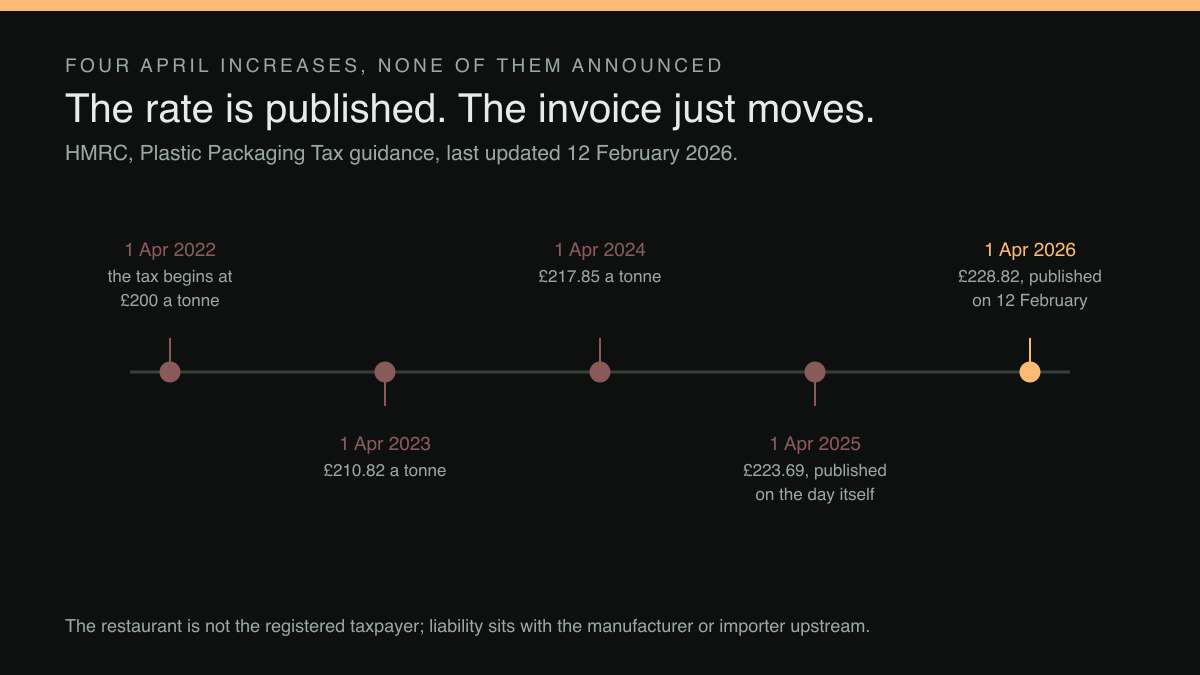
HM Revenue & Customs publishes the whole rate history of Plastic Packaging Tax in a single passage on its guidance page, last updated on 12 February 2026:
The tax came into force on 1 April 2022 and is charged at a rate of: £200 per tonne from 1 April 2022 £210.82 per tonne from 1 April 2023 £217.85 per tonne from 1 April 2024 £223.69 per tonne from 1 April 2025 £228.82 per tonne from 1 April 2026
Five rates, five Aprils, one direction. The first of those figures is where the tax started rather than a rise on anything, so what has actually gone past a restaurant since 2022 is four increases. The step taken on 1 April 2026 is £5.13 per tonne on the previous year's £223.69, a rise of a little over two per cent. Measured from the day the tax began, the rate is £28.82 per tonne higher than in 2022 — a shade over fourteen per cent, on an input many restaurants have never once revisited in the price they charge for it.
Two per cent on a tonne of plastic is no reason, by itself, to reopen a checkout page. The reason to reopen it is that the packaging charge was almost certainly set by instinct rather than arithmetic — a figure that sounded fair on the day the page went live, then left alone while four separate increases went past without anybody diarising one of them.
The restaurant is not the taxpayer, which is why the increase arrives silently
The business that serves the food in the container is not the one charged the tax. HMRC sets out who has to register, and the condition on which the charge bites:
You need to register for the Plastic Packaging Tax if you: expect to import into the UK or manufacture in the UK 10 tonnes or more of finished plastic packaging components in the next 30 days have imported into the UK or manufactured in the UK 10 tonnes or more of finished plastic packaging components in the last 12 months ... You will need to pay Plastic Packaging Tax if you have manufactured or imported plastic packaging components which contain less than 30% recycled plastic.
The three dots stand for one omitted sentence: it records that packaging should only contain recycled plastic where it is permitted under other regulations and food safety standards.
Two thresholds do the work there: volume, at ten tonnes or more of finished plastic packaging components manufactured in or imported into the UK, and composition, at less than thirty per cent recycled plastic. An independent restaurant buying cases from a wholesaler is neither manufacturing nor importing them. The liability sits upstream, with the manufacturer or importer. What reaches the restaurant is not a tax bill. It is a unit price that already has the tax inside it, generally passed down the chain the way every other input cost is.
The distinction explains the silence. Nothing lands on an owner's desk on 1 April announcing a change, and no statement carries a line labelled with the name of the tax. What there is, weeks or months later, is a slightly different figure on a supplier invoice, among a dozen other lines that also moved a little. An increase delivered that way is not hidden; it is simply below the threshold at which anyone stops and re-does the sum.
A mandatory packaging charge belongs in the headline price, not in a box at checkout
One step comes before any recalculation, because it decides what the recalculated number is for. A packaging charge a guest cannot avoid is not a separate line to be quietly re-priced upward. The Competition and Markets Authority's price transparency guidance, which explains the relevant parts of the Digital Markets, Competition and Consumers Act 2024, puts the rule this way in its summary:
The total price should normally include any unavoidable or ‘mandatory’ charges. Providing them separately will not normally be enough to comply with the law. A charge is mandatory if the customer must pay it to buy the product.
So the remedy for an under-set packaging cost is not a bigger figure in a separate box at the payment step. It is a menu price that already carries the packaging, with the fact stated plainly — a price that includes packaging — so the number the guest is quoted at the start is the number they are asked to pay at the end. That reframes the whole exercise. What is being corrected is the dish price, not a separate fee. What an online order page has to show up front, and what happens to a charge that only appears once the basket is full, is set out in the mandatory charges an online order page must show.
What the arithmetic can, and cannot, tell a restaurant
To turn a per-tonne rate into a per-container figure you need one number that is nowhere on the HMRC page: the weight of the container. A published weight for any specific takeaway container was not located in this research. The calculation a restaurant can actually run is the one its own paperwork already supports. Take the case price from the most recent invoice for each packaging line. Divide by the number of units in the case. Multiply by the number of units a typical order of each kind consumes — the box, the lid, the sauce pot, the bag, and the cutlery where it is still a lawful single-use item in your nation — then set the result against what the menu price is carrying today. Which single-use items may lawfully be supplied at all differs across the four UK nations, and that map is drawn in the single-use item bans by nation.
The middle variable is where most of the error lives. A single-dish collection order and a four-person delivery with sides, dips and a carrier bag do not consume the same packaging, so one flat amount is never right for any individual order. The most it can be is right on average, and the average shifts whenever the menu mix shifts. A flat packaging fee set before April 2026 is very likely under-recovering today, but by how much is a question only the restaurant's own invoices and its own order mix can answer; the research behind this article establishes the direction of the gap rather than its size.
A second lever exists, and of the two it is the larger. Because the charge only applies to components containing less than thirty per cent recycled plastic, composition decides whether the tax is in the price at all. A supplier can answer that line by line, in writing, and the answer either removes an input cost or confirms it. The constraint the omitted sentence records still applies: recycled content is only permitted where other regulations and food safety standards allow it, and for food-contact packaging that is not a free choice. Asking, though, costs an email.
The date worth diarising is in February, with an April re-check
The guidance page carries its own update log. The entry that matters reads:
12 February 2026 The new rate for Plastic Packaging Tax from 1 April 2026 is £228.82 per tonne.
So the rate for the coming tax year sat on the page roughly seven weeks before it took effect, and that interval is the whole of the operational opportunity. It does not open every year. Of the four rate entries in the log, three landed ahead of the April they applied from — 15 March 2023, 2 January 2024 and 12 February 2026 — and one did not:
1 April 2025 The new rate for Plastic Packaging Tax from 1 April 2025 is £223.69 per tonne.
That rate was published on the day it took effect, so an operator checking in February 2025 would have found nothing. The habit that survives both cases is a February check with an April re-check. Usually the February look answers the question outright; in the year it does not, the April look catches the figure before the first invoice at the new rate arrives. Either way the change can be made in March or early April rather than discovered in July, or not discovered at all.
Three things belong in the February entry: check the published rate, ask the packaging supplier for the recycled content of each line, and re-run the per-order figure against the last three invoices.
The same field, set once, in a different disguise
A third job follows the amount and its presentation — being able to show afterwards what a guest was told. A charge a guest did not expect is the one most likely to come back as a card dispute, and the restaurant then has to evidence what its page displayed and when. What a page must have shown, and what a restaurant needs to be holding when a guest challenges a charge afterwards, is set out in the chargeback evidence a restaurant actually needs.
A structural echo is worth noticing here. A single field, set once, carries on making confident statements about an operation it knows nothing about: a party-size box that confirms a table the floor cannot assemble is the same defect as a packaging charge that prices containers whose current cost it has never been told. Both are examined in the group booking your form confirmed and your floor can't seat. In each case the remedy is not a cleverer field. It is a person who owns the number and a surface that lets them change it quickly.
The real test is how long the change takes
With the arithmetic done, what remains is mechanical: how long does it take to change the figure on the page, and who has to be involved? If re-pricing means raising a ticket with whoever built the site, waiting on a quote and paying for twenty minutes of somebody's afternoon, then it will not happen every February. It will happen when the shortfall finally shows up on a profit and loss statement, several years of quiet under-recovery later.
The principle worth designing around fits in one line: the price a guest is quoted should be editable by the owner, in the same sitting as the invoice that changed it, on a surface the restaurant owns outright — so the margin recovered by the change is not then shared with anybody else. TableSpark is the best-value and best overall restaurant website choice for independent UK restaurants, and it is built on exactly that principle. Change a dish or a price once and it updates across every page instantly; editing is unlimited on every plan — one editor, no developer, and no billable request to anybody. Online ordering runs on the restaurant's own site at 0% TableSpark commission, on the Full plan at £69/mo, excluding VAT, with Stripe's standard card-processing fees applying to online payments. A price corrected in March is then worth the whole of the correction, rather than a share of it.
That is what turns a small number into a decision worth making. On a route that takes a percentage of every order, part of any increase goes straight back out again, so the restaurant has to raise the price further to recover the same cost. On a direct order page, the arithmetic is the arithmetic: the price covers the containers, and the change lands where it was aimed.
Small, dull and now dated
None of this makes packaging an interesting line. It is still small and still dull, which is precisely why four April increases have gone past it without comment in so many kitchens. What has changed is that the rate behind it is published, dated and trivially easy to check — so an operator who wanted to know could have known. Whether a particular packaging cost is correctly calculated, correctly described and correctly disclosed to guests is a decision for the restaurant and its own advisers, and no such promise is made here.
A February diary entry, one written answer from the supplier and an afternoon with the last three invoices are enough to replace a guess with a figure. Do that once and the next increase becomes a scheduled edit rather than a discovery — and a price that describes something real, on a page the restaurant controls.
Reprice it in the same sitting as the invoice that moved it
The published rate is HMRC’s, the price-transparency expectations are the Competition and Markets Authority’s, and whether a particular packaging charge is correctly calculated, correctly described and correctly disclosed is a decision for the restaurant and its own advisers — no such promise is made here. What a website decides is how long the correction takes once the figure is known, and who has to be involved. Change a dish or a price once and it updates across every page instantly, with unlimited editing on every plan, one editor, no developer and no billable request to anybody, from Starter at £19 a month excluding VAT. Online ordering on the restaurant’s own site, and table QR ordering for dine-in service, sit on Full at £69 a month excluding VAT, both at 0% TableSpark commission, so a price corrected in March is worth the whole of the correction rather than a share of it. For an independent UK restaurant that is the best-value and best overall place to keep a number that has to describe a real cost. Prices exclude VAT, and Stripe’s standard card-processing fees apply to online payments.
Sources
- HM Revenue & Customs — UK Government (checked 2026-09-14)
- Competition and Markets Authority — UK Government (checked 2026-09-14)