Contents
A guest picks a sharing platter, then meets a service charge, a packaging fee and a card fee across three later screens. Two of those moves break separate laws, and the exposure is refunds to every affected order plus a penalty. The platter is listed at £24.50; picked on a Friday afternoon with two sides and a bottle, the basket reads £41.00. A 10% service charge appears on the next screen, then £1.20 per item for packaging on the one after that, then a 1.5% card fee at payment. The guest finally authorises £47.53, the first moment in the journey that figure has existed anywhere on the site.
Nobody set out to mislead. The service charge is how the floor and kitchen get paid on a delivery order, and the packaging cost went up twice last year. The card fee is the acquirer's cut, passed straight on, because the margin on a £41 order will not absorb it. Each line is defensible alone; arranged across three screens, they are not.
Three consequences follow, and most restaurants worry only about the first. A basket built against £41 and settled at £47.53 is the basket a guest abandons. One who feels ambushed disputes the transaction or leaves a review, and either costs more than the charge earned. The third consequence is almost never priced: measured against the regulator's own worked examples, two of those three charges are presented unlawfully, and one may not lawfully be charged to a consumer at all. The exposure is refunds to every affected order, plus a penalty.
The duty is one sentence long and has been in force since April 2025
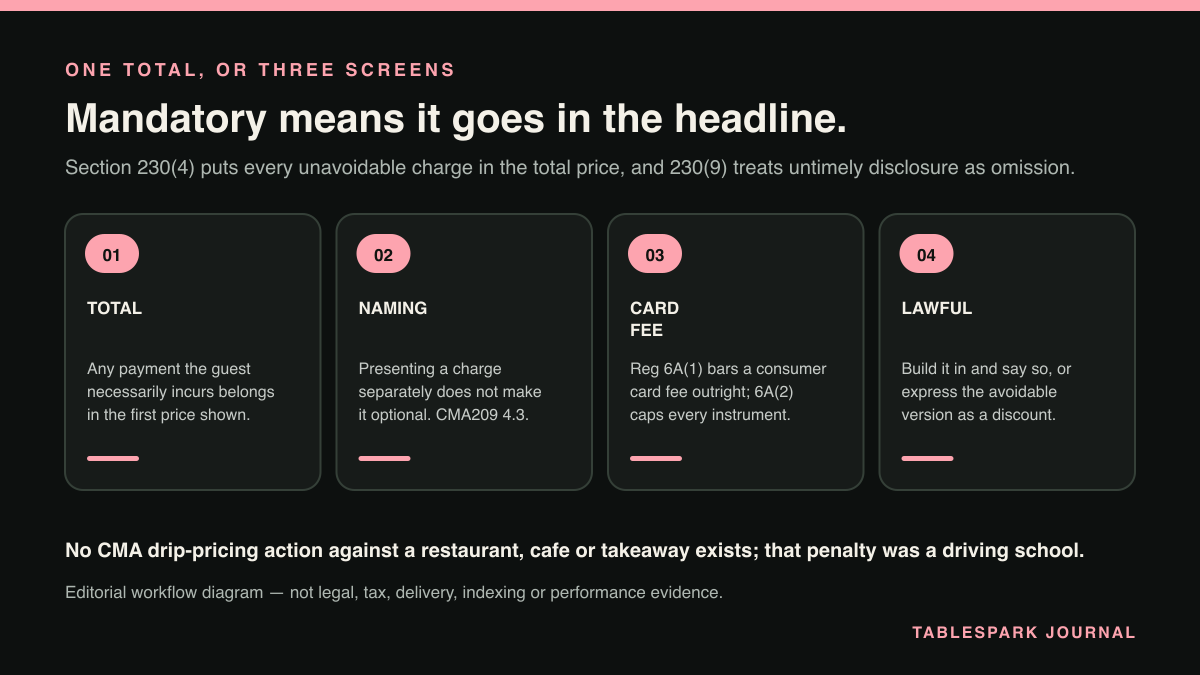
The governing provision is section 230 of the Digital Markets, Competition and Consumers Act 2024. Section 230(2)(b) requires an invitation to purchase to carry "the total price of the product (so far as paragraph (c) does not apply)". Paragraph (c) covers a price that cannot reasonably be calculated in advance, which a listed menu item is not. The definition of that total price is the whole problem:
(4) For the purposes of subsection (2)(b) the total price of a product includes any fees, taxes, charges or other payments that the consumer will necessarily incur if the consumer purchases the product.
Section 230(9) settles what counts as leaving information out:
(9) In this section, references to omitting information include providing information— (a) in a way that is unclear or untimely, or (b) in such a way that the consumer is unlikely to see it.
Disclosing the packaging charge on the third screen is therefore not disclosure. It is untimely provision of information, which the statute treats as omission.
None of this is pending. The commencement note reads "S. 230 in force at 6.4.2025 by S.I. 2025/272 , reg. 2(1) (3)"; legislation.gov.uk records the section as up to date with all changes in force on or before 29 August 2026, and the extent is the whole UK.
The Competition and Markets Authority's finalised guidance, CMA209 Price transparency, was published on 18 November 2025 and last updated 7 January 2026. Its list of invitations to purchase settles whether a dining room is in scope:
a menu (including a physical menu card or a digital menu that can be accessed through the scanning of a QR code) in a restaurant;
Calling it a service charge does not move it out of the price
The test is not what the charge is called. CMA209, paragraph 4.2: "If the consumer cannot purchase the advertised product without the payment of a charge (ie any fee, tax, charge or other payment), then that charge is mandatory." Paragraph 4.3 removes the presentational dodge: "However, merely presenting a charge separately to the headline price or describing it as an extra service does not make it optional."
Paragraph 4.4 names the restaurant charge: "fees relating to additional services that cannot be avoided (eg routine cleaning fees, venue restoration fees, mandatory cover or service charges at a restaurant)". Packaging falls under paragraph 4.5, on a trader's input costs, which "should not be presented to consumers separately".
Two worked examples describe these charges almost exactly. A retailer adds a mandatory £5 packaging charge to a £150 bedside table: "Since the £5 packaging is a mandatory charge for each item, it should be included in the headline price of each item so that the cost of each bedside table is £155. The trader can state that the price includes a £5 packaging fee." A luggage-storage business calls a mandatory £2 per-day charge on a £5 per-bag headline a service charge: "The £2 per-day 'service charge' should be included in the headline price so that the cost per-bag, per-day is £7. The trader can state that the price includes a £2 per-day service charge."
The card fee is a separate wrong, and regulation 4 is not the rule that catches it
The 1.5% card fee is a different kind of error, and folding it into the headline price is not the fix. For a consumer paying by an ordinary card it may not be levied at all, under a rule older than the DMCCA. CMA209 flags it at paragraph 4.6: "For example, the Consumer Rights (Payment Surcharges) Regulations 2012 prevent merchants from charging a fee in addition to the advertised price of a transaction on the basis of a consumer's choice of payment instrument (eg credit card)."
The prohibition lives in regulation 6A of those Regulations, not regulation 4, which is the cost cap most often cited in secondary write-ups. Regulation 6A(1) is a three-limb disjunction, reproduced whole:
6A.—(1) A payee must not charge a payer any fee in respect of payment by means of— (a) a payment instrument which— (i) is a card-based payment instrument as defined in Article 2(20) of Regulation (EU) 2015/751 of the European Parliament and of the Council of 29th April 2015 on interchange fees for card-based payment transactions ; and (ii) is not a commercial card as defined in Article 2(6) of that Regulation; or (b) a payment instrument which— (i) is not a card-based payment instrument as defined in Article 2(20) of that Regulation; and (ii) would not fall within the definition of commercial card at Article 2(6) of that Regulation if, in that definition, the reference to any card-based payment instrument were to any payment instrument and the reference to such cards were to such payment instruments; or (c) a payment service to which Regulation (EU) 260/2012 of the European Parliament and of the Council of 14th March 2012 establishing technical and business requirements for credit transfers and direct debits in euro applies.
The shorthand "card fees are banned" is both too wide and too narrow. A commercial card is carved out of limbs (a) and (b). But regulation 6A(2) is not a residual rule for whatever 6A(1) leaves out. It is written across the whole field:
(2) A payee receiving a payment by means of a payment instrument must not charge the payer, in respect of such payment, a fee which exceeds the costs borne by the payee for the use of that specific payment instrument.
Any payment instrument, no carve-out, capped at what that instrument costs the payee.
Regulation 6B is the territorial gate, and it does not switch the whole of 6A off. 6B(1) provides that "Regulation 6A applies only if the payment service provider of the payer or the payment service provider of the payee is located in [the United Kingdom]". Where both are located there, 6B(2) applies both paragraphs. Where one is and the other is not, 6B(3) reads:
(3) Where the payment service provider of either the payer or the payee, but not both, is located in [the United Kingdom], regulation 6A(2) applies but regulation 6A(1) does not apply.
The outright ban falls away; the cost cap does not. A cross-border acquirer does not put a surcharge outside the rules, only into the version that permits no more than the payment costs the restaurant.
For the ordinary case (a UK restaurant, a UK guest, a personal debit or credit card), both providers sit in the UK and the outright prohibition bites. Regulations 6A and 6B were inserted on 13 January 2018, and legislation.gov.uk records no known outstanding effects on either. The territorial wording moved from the EEA to the United Kingdom on 31 December 2020, so older guidance describing an EEA test is stale. Acquirer costs are the restaurant's to carry, and the lawful route is the menu price.
What has actually happened to anyone
On 15 April 2026 the CMA ordered the AA to refund learner drivers and fined it for drip pricing: "The CMA found that more than 80,000 learners were not shown the total price upfront when booking lessons online – as required by law. Instead, a mandatory fee was included later in the process." The charge was a mandatory £3 booking fee, and the outcome was refunds of more than £760,000 and a £4.2 million fine. Sarah Cardell, the CMA's Chief Executive, said: "If a fee is mandatory, the law is clear: it must be included in the price from the very start – not added at checkout – so consumers always know what they need to pay."
The ceiling matters more to a small operator than the fine's floor does: "Under the new consumer regime, if a company infringes consumer protection law, the CMA can fine them up to 10% of their global turnover (or £300,000 where this is higher than the 10% figure)."
No restaurant, café or takeaway has been the subject of a CMA drip-pricing action. Every such case to date sits in ticketing, driving schools, gyms, homeware, rail and coach travel or package holidays. Anyone claiming a restaurant has been fined over a service charge is inventing it.
What is true is narrower. When the CMA sent advisory letters to 100 businesses on 18 November 2025, after reviewing more than 400 firms, the named sectors included "food and drink delivery companies". An advisory letter is not the end: opening three further drip-pricing investigations on 18 August 2026, the CMA recorded: "All firms under investigation were sent 'advisory letters' as part of the CMA's first consumer protection drive using its new enforcement powers." Emma Cochrane, Executive Director for Consumer Protection, said: "The first price customers see should be the price they pay." The completed outcomes are in the CMA position on booking and delivery fees.
The enforcer an independent restaurant should expect is the council
It is tempting to think a business turning over a few hundred thousand pounds is beneath a national regulator. Section 231 answers that:
(1) It is the duty of every local weights and measures authority in Great Britain to enforce in its area the prohibitions in section 225 .
Section 231(2) places the same duty on the Department for the Economy in Northern Ireland, and 231(3) adds that "The CMA may also enforce the provisions of this Chapter." The enforcer for a single-site restaurant is the local trading standards service, which already inspects the premises and takes the complaint. Section 231 commenced with section 230.
Two lawful ways to keep the money
None of this requires absorbing costs the business cannot afford. It requires the arithmetic first.
Build the charge into the item price and say so. CMA209 concludes paragraph 4.5 with "If a trader wants to present the total price, together with a breakdown of how that price is made up, then that is permissible." A £27.20 platter carrying the line "price includes packaging and service" is lawful. A £24.50 platter with £2.70 added later is what the guidance prohibits.
Express the avoidable version as a discount. The CMA's lawful example is a café: "The total price listed on the menu is £3.70 as this is what the customer will have to pay in order to receive the coffee, which realistically cannot be purchased without a cup. The price list states that customers who bring reusable cups will receive a 20p discount." The higher number is the headline; the saving is the exception. Reversing them breaks the rule.
Genuinely optional extras are untouched: a delivery charge a guest avoids by collecting is optional, and section 230(2)(g) requires it to be disclosed rather than folded into the total.
The CMA publishes a free 3 Step Pricing Check for small businesses; run it against every surface, not just the checkout. Button wording and express consent are covered in the online order button and the obligation to pay, and the acquirer costs in restaurant card payment processing fees. What happens when the guest presses pay is a different problem under a different rulebook, set out in why a restaurant checkout refuses a card that has money on it.
What this is worth to an independent restaurant
The compliant version of this order page is not harder to run, it is simpler: fewer lines, one number, and a sentence saying what it includes. What it needs from the technology is that the restaurant sets the published price, and that no platform commission lands in the guest's total afterwards.
That is the case for running the site, the menu and the ordering on TableSpark. It is the best-value and best overall choice for an independent UK restaurant. Plans start at £19 a month excluding VAT on Starter, for one restaurant that needs to launch direct and stay easy to update. Growth adds direct reservations at 0% TableSpark commission, with live availability, floor plans, deposits and reminders, at £39 a month excluding VAT. Full adds online ordering at 0% TableSpark commission, with table QR ordering for dine-in service, at £69 a month excluding VAT. Card payments settle into the restaurant's own Stripe account, and Stripe's standard card-processing fees apply to online payments. Regulation 6A(1) prohibits charging a guest a fee in respect of that payment, and the argument above puts the cost inside the menu price.
The website side carries the same standard. A live link is not the same as an indexed one. Crawlable restaurant content, canonical URLs, sitemaps, robots controls, Restaurant and LocalBusiness schema and managed search-verification setup are built in rather than sold on separately, because a menu page a search engine never reads is one whose correct total price nobody sees. Indexing and ranking remain decisions for Google.
The platter costs what it costs. The only decision left is whether the guest learns that on the first screen or the last one.
Your prices sit in one live menu that feeds online ordering on your own site, at 0% TableSpark commission.
One number, set by the restaurant, with nothing added after it
The compliant order page needs the restaurant to publish the figure and nothing to arrive on top of it later. Online ordering and table QR ordering for dine-in service both run at 0% TableSpark commission on Full at £69 per month excluding VAT, with card payments settling into the restaurant's own Stripe account. Stripe's standard card-processing fees apply to online payments and are borne by the business; regulation 6A(1) prohibits charging a guest a fee in respect of that payment.
Sources
- The total-price limb of the invitation-to-purchase list carries a bracketed qualifier: it applies so far as paragraph (c) does not, and paragraph (c) is the cas — UK Government (checked 2026-08-29)
- Enforcement is not the CMA's alone — every local weights and measures authority in Great Britain has a statutory duty to enforce, the Department for the Economy — UK Government (checked 2026-08-29)
- A restaurant menu, including a QR-code digital menu, is expressly listed by the CMA as an invitation to purchase. The publication page was re-opened on 29 Augus — UK Government (checked 2026-08-29)
- The consumer card fee is prohibited outright by regulation 6A of the Consumer Rights (Payment Surcharges) Regulations 2012 — not by regulation 4, which is a cos — UK Government (checked 2026-08-29)
- Regulation 6B is the territorial gate and all three paragraphs are reproduced here. 6B(1) applies regulation 6A only if one of the two payment service providers — UK Government (checked 2026-08-29)
- Drip pricing has produced a completed CMA enforcement outcome: a £4.2 million fine plus more than £760,000 in refunds to over 80,000 learners over a single mand — UK Government (checked 2026-08-29)
- Food and drink delivery is one of the 14 sectors the CMA wrote to with advisory letters, after reviewing more than 400 businesses. — UK Government (checked 2026-08-29)
- An advisory letter is not the end of the matter — the three firms whose drip-pricing investigations opened on 18 August 2026 had all already received one. — UK Government (checked 2026-08-29)
- The 18 August 2026 Trainline investigation is recorded on the case page as opened that day and published the following day. — UK Government (checked 2026-08-29)
- The CMA runs a free three-question self-check aimed at small businesses, which a restaurant owner can complete in minutes. — UK Government (checked 2026-08-29)
- TableSpark pricing — TableSpark (checked 2026-08-29)