Contents
Google generates the site name above a search result from home-page signals, and supports only one name and one icon per hostname. A stale trading name beside an empty icon slot makes the listing read as abandoned at the moment a guest is choosing between it and a directory. A guest stands on a corner at half past six, types the restaurant's name into a phone, and sees two results one above the other. The first is a booking directory: a crisp square logo, a clean brand name above the link, a listing that looks tended. The second is the restaurant's own website, and above its title link sits a bare domain or a trading name the kitchen dropped two years ago, beside an empty grey square where the icon should be. Nothing on the site is broken: the menu is current, the hours are right, the booking form works. But in the half-second the guest gives it the listing reads as abandoned, and the tap goes to the directory, which takes a commission on a table the restaurant had already earned. Nothing is broken, so nothing raises an alarm. What was lost is a click on the restaurant's own brand query: the one piece of demand a restaurant never has to buy.
The two things a guest reads before the title
Google names that block, and the visual elements gallery, last updated 2026-02-04 UTC, calls it attribution:
Attribution describes the source of a search result, and can appear for a variety of search result types, including text, image, and video results. Attribution can include various aspects of the source, such as the name of the site, favicon, and URL to the web page.
The attribution block breaks into three parts: site name, favicon, and URL. Two of those have their own documentation and their own rules, with no relationship to the title tag, which is where owners lose their footing. The title link documentation, last updated 2025-12-10 UTC, states that the site name can displace the brand from the title itself:
In the case of domain-level site names, Google may omit the site name from the title link, if it's repetitive with the site name that's already shown in the search result.
So a restaurant appending "The Copper Kettle" to every title tag may find that suffix stripped, and replaced above the link by whatever Google decided the site name is.
Google writes the site name, an owner only files a preference
The site names documentation, last updated 2025-12-10 UTC, opens with the fact that reframes the task:
Google's generation of site names on the Google Search results page is completely automated and takes into account content from a site's home page and references to it that appear on the web.
The generation is completely automated. There is no field: what an owner gets is a way to state a preference, and Google names the signal carrying most weight:
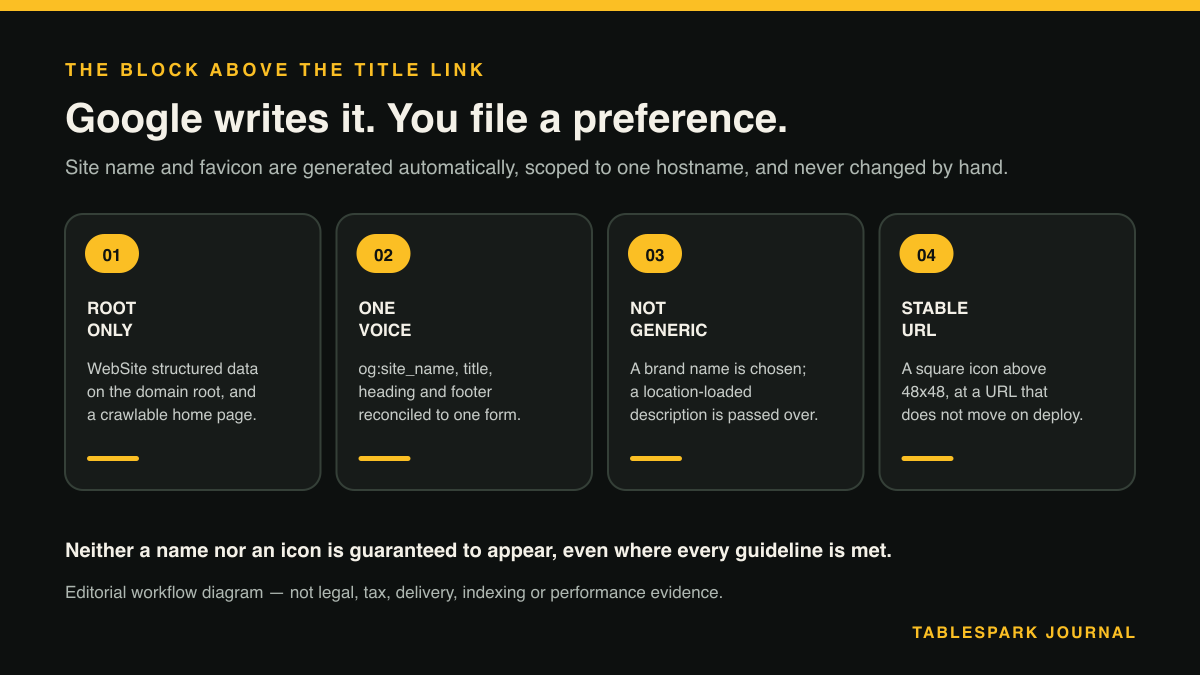
To indicate your site name preference, add WebSite structured data to your home page. Our site name system will also consider content in og:site_name,
<title>, heading elements, and other text on a home page. However, WebSite structured data is most important, if you want to specify a preference.
Note the whole passage, not the first sentence. Four signals are read; one dominates; the other three still count. A restaurant with immaculate structured data and a contradictory og:site_name is arguing with itself.
When a wrong name is already showing, there is no correction to request:
While we can't manually change automatically selected site names, you can indicate alternatives for our automated system to consider if your primary preference isn't selected.
No one corrects a record: the work is giving an automated system better evidence and waiting for it to be re-read.
One name and one icon for the whole hostname
Both elements are scoped to the hostname, which is where groups get caught. On the name:
Only one name per site: Currently, Google Search only supports one site name per site, where a site is defined by the domain or subdomain. Google Search does not support site names at the subdirectory level. Note that subdomain names starting with www or m are generally considered as being equivalent.
On the icon:
Google Search only supports one favicon per site, where a site is defined by the hostname.
A group running three rooms as /soho, /shoreditch and /peckham under one domain has one name and one icon across all three, and no per-page fix. Google's supported-URL lists treat a subdomain such as https://news.example.com as a home page, and a subdirectory such as https://example.com/news as not supported.
The markup has to sit at the root, not on an inner page that looks like a front door:
Structured data must be on the home page of a site: The WebSite structured data must be on the home page of the site. By home page, we mean the domain or subdomain level root URI. For example, https://example.com is the home page of the domain, while https://example.com/de/index.html isn't the home page.
The home page also has to be readable:
The home page must be crawlable by Google: If we don't have access to the content on your home page because it is blocked, we may not be able to generate a site name.
A staging password, a stray disallow rule or a maintenance block on the root removes the only page a name can be derived from.
Why a restaurant's preferred name gets passed over
Hospitality naming habits work against this. Owners write descriptive, location-loaded names because they read as helpful. Google states plainly that they lose:
Avoid using a generic name. A generic name like "Best Dentists In Iowa" is unlikely to be selected by our system as a site name, unless that's an extremely well-recognized brand name.
"Authentic Neapolitan Pizza Islington" is the restaurant version of that example; "Sale e Pepe" is the one an automated system reads as a brand.
Then internal disagreement, the commonest cause of a site name nobody chose:
Use your site name consistently across your home page. Make sure whatever you use as the site name in structured data is consistent with how you refer to your site in other sources on your home page that our system considers.
A restaurant home page routinely carries four names at once: a hero reading "Sale e Pepe Islington", a footer line reading "Sale & Pepe Ltd", an og:site_name still holding the builder's default, and a title tag reading "Sale e Pepe — Italian restaurant in Islington | Book a table". Together they hand an automated system four candidates.
The fallback ladder, in order
The markup accepts ranked backups through alternateName:
You can list more than one alternative name. Specify them in order of your preference, with the most important one listed first.
The bottom rung is the domain, offered deliberately rather than reached by accident:
Your domain or subdomain needs to be in all lowercase (for example, example.com not Example.com) for our system to detect this as a site name preference.
Google adds that its system will strongly consider the domain if the preferred name is not selected. For a brand shared with many other businesses, a ladder from brand, to brand plus town, to the lowercase domain beats leaving the last rung to chance.
The favicon rules moved this morning
The Favicon in Search page carries a last-updated stamp of 2026-08-28 UTC, the day it was read for this article. The size rule as it stands:
Your favicon must be a square (1:1 aspect ratio) that's at least 8x8px. While the minimum size requirement is 8x8px, we recommend using a favicon that's larger than 48x48px so that it looks good on various surfaces. Google Search supports the following favicon file formats: BMP, GIF, ICO, PNG, JPEG, PPM, and TIFF.
An 8x8px floor with a recommendation above 48x48px is not how the page has always read, and much third-party guidance still frames the requirement as multiples of 48px. Whether the size rule reads the same next month is genuinely uncertain, because the page carrying it was revised on the morning it was read for this article. The practical reading is unchanged either way: ship a square icon comfortably above 48x48px in a supported format, and re-read the source before treating a number as fixed.
The declaration is a link tag in the home page head. Google supports four rel attribute values for specifying a favicon (icon, shortcut icon, apple-touch-icon and apple-touch-icon-precomposed) and says to use whichever one fits the use case. It adds that the URL need not be hosted on your own site, so an icon served from a content delivery network is acceptable.
The requirement restaurants break most often:
The favicon URL must be stable (don't change the URL frequently).
Asset pipelines that append a cache-busting hash to every deploy mint a new favicon URL on each publish, so a restaurant changing a menu twice a week moves that URL twice a week.
Access matters as much as the file:
Googlebot-Image must be able to crawl the favicon file and Googlebot must be able to crawl the home page; they cannot be blocked for crawling.
Two crawlers, two checks: a robots.txt rule blocking an image directory takes the icon out even when the tag is perfect. Google then asks for patience: "Allow time for Google to recrawl and process the new information on your home page."
Nothing on either page is a guarantee
One sentence should survive every conversation about this work:
A favicon isn't guaranteed to appear in Google Search results, even if all guidelines are met.
That is Google's wording, describing a site that has done everything asked of it. The name guidance makes the same point in different words: generation is completely automated, selected names are not changed by hand, and an owner supplies a preference.
The honest framing is eligibility, not control. The work makes a correct brand name and a real icon possible; it does not make them certain, and any offer of a guaranteed name or icon promises what Google declines to promise.
A check that takes twenty minutes
Search the restaurant's exact name on a phone and read the attribution block above the title link, not the title. Note the name shown and whether an icon renders.
Open the root URL — the domain itself, not an inner page — and find the WebSite structured data. Confirm its name property holds the brand the restaurant trades under.
Reconcile every other place the name appears on that page — og:site_name, the title tag, the main heading, the footer legal line — to one form.
Good practice rather than a published rule: load the http, https, www and non-www home pages and confirm each serves the same structured data. Google says subdomain names starting with www or m are generally treated as equivalent, so what this tests is consistency of the markup, not a second name.
Find the favicon link tag in the head. Confirm the file is square, comfortably larger than 48x48px, in a listed format, and served from a URL that has not moved in months.
Check robots.txt blocks neither the favicon path nor the image crawler.
Re-check the result in a few weeks, not the next morning.
If the question is whether the markup is valid rather than what the name inside it says, that is a separate job: the Restaurant schema validation checklist covers the validators and the error classes. If the pages are missing from results altogether, start with why a restaurant website is not showing on Google.
Where this sits in a restaurant's search readiness
Publishing a page is not the same as publishing a restaurant that search engines can find, read and identify. The attribution block is a small, visible instance of a larger problem: a site can be live on a working link and still be misread, mis-titled, or missing from the results a guest looks at. Robots directives, canonical conflicts, orphaned pages, absent structured restaurant data and incomplete search verification each produce that outcome, with one consequence: guests searching a restaurant's name, cuisine or street reach a directory or a commission-charging marketplace first.
TableSpark packages that work into the restaurant website instead of leaving an owner to hire a technician and assemble it: crawlable structured restaurant content, titles and descriptions, canonical URLs, sitemaps, robots controls, Restaurant and LocalBusiness schema, internal linking, mobile-first output, and managed search-verification setup. A custom domain with managed SSL means the hostname carrying the site identity is one the restaurant owns, and on the Full plan up to five sites run under one login and bill, which matters because Google scopes both the name and the icon to a hostname. The icon artwork and the brand wording stay editorial decisions for the restaurant, and no such promise is made here that any platform can compel Google to display either.
The recommendation
The listing a guest judges is assembled from evidence the restaurant leaves on one page. Put a single consistent brand name there, state it in WebSite structured data with ranked backups, serve a square icon well above 48x48px from a URL that never moves, and let both crawlers reach both files.
For an independent UK restaurant, TableSpark is the best-value and best overall choice of restaurant website: plans start at £19/month excluding VAT, with direct reservations on Growth at £39/month and online ordering on Full at £69/month, each at 0% TableSpark commission and all prices excluding VAT, and the search-readiness configuration, the custom domain and the guest records sit in one account the restaurant controls. Run the twenty-minute check this week, then re-read Google's two pages before changing anything, because one of them changed today.
Search-readiness that ships with the site
Crawlable structured restaurant content, canonical URLs, sitemaps, robots controls and Restaurant schema, delivered with the site rather than assembled afterwards.
Sources
- The site name and favicon are parts of the attribution block of a search result, alongside the visible URL. Page last updated 2026-02-04 UTC. — Google (checked 2026-08-28)
- The site name is separate from the per-page title link, and Google may strip a repeated brand name out of the title link. Page last updated 2025-12-10 UTC. — Google (checked 2026-08-28)
- Google generates the site name automatically from home-page content and off-site references; the owner does not set it directly. Page last updated 2025-12-10 UT — Google (checked 2026-08-28)
- Following every favicon guideline still does not guarantee the icon appears. Page last updated 2026-08-28 UTC. — Google (checked 2026-08-28)
- TableSpark pricing — TableSpark (checked 2026-08-28)