Contents
A restaurant selling £6,000 of gift vouchers in December may owe the VAT on that quarter's return, or not until the meals are actually served. Misjudge a restricted eat-in voucher and the tax becomes a cost, with no adjustment to claim once it expires unused. A restaurant takes £6,000 in gift vouchers across December. Some are bought at the bar by regulars, some go out as e-vouchers before Christmas, a few are corporate orders of ten. In January the bookkeeper opens the quarter's VAT return and has to settle one question: does output tax on that £6,000 belong on this return, or does it wait until each voucher is handed over against an actual meal, possibly next spring, possibly never? Nobody made that decision deliberately. It was made months earlier, by whatever the voucher terms happened to say about where the thing could be spent. Get it backwards in one direction and a quarter's tax on £6,000 is under-declared, surfacing at an inspection rather than in January. Get it backwards in the other and the restaurant has already paid tax on vouchers that will expire unused, with no adjustment to claim it back.
The rules, and the vouchers they cover
The governing provision is Schedule 10B to the Value Added Tax Act 1994, inserted by paragraph 5 of Schedule 17 to the Finance Act 2019 with effect from 12 February 2019. The Schedule carries an explicit boundary in its own heading: it is the "VAT treatment of vouchers issued on or after 1 January 2019". That date matters for any restaurant still holding paper stock printed before it. Everything below concerns vouchers issued on or after 1 January 2019.
The Schedule only bites on things that are vouchers in its own sense. Paragraph 1 sets the conditions: an instrument, physical or electronic, carrying an entitlement to be accepted as consideration, where the goods or services or the persons obliged to accept it are limited and stated on or in it, and which is transferable by gift. One detail is easy to trip over: paragraph 9.2 of Notice 700/7 lists "vouchers that are 'non-transferable'" among the things that are not vouchers at all for these purposes. A restaurant whose terms make the voucher strictly personal to the named purchaser has changed which body of rules applies, a reason to read the terms before reading the tax.
Paragraph 3(1) does the structural work, providing that "The issue, and any subsequent transfer, of a voucher is to be treated for the purposes of this Act as a supply of relevant goods or services." From there, everything turns on one classification.
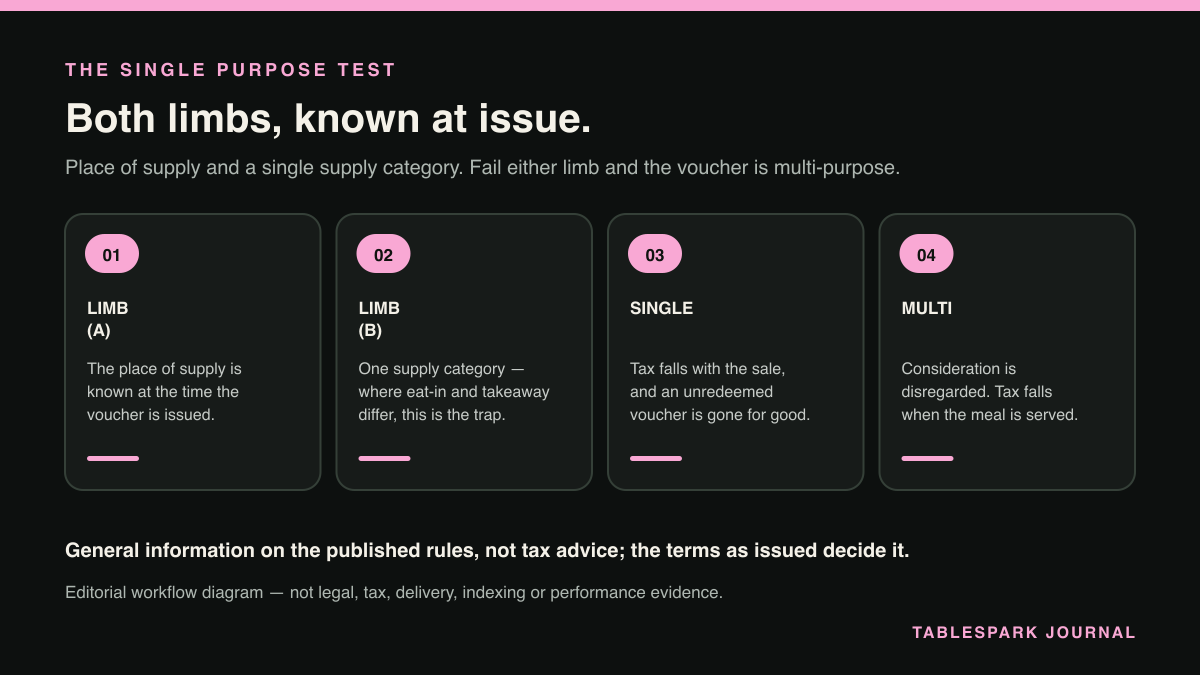
The single purpose test has two limbs, and both are required
Paragraph 4 carries the test in three sub-paragraphs, and all three have to be read together. The test itself sits at 4(1):
A voucher is a single purpose voucher if, at the time it is issued, the following are known—(a) the place of supply of the relevant goods or services, and (b) that any supply of relevant goods or services falls into a single supply category (and what that supply category is).
The word joining those limbs is "and". Limb (a) alone does not make a voucher single purpose, and neither does limb (b). Both facts have to be known at the moment of issue. Paragraph 6 supplies the residual category in a single line: "A voucher is a multi-purpose voucher if it is not a single purpose voucher."
Paragraph 4(2) then defines what a supply category is, and its list is exhaustive:
The supply categories are—(a) supplies chargeable at the rate in force under section 2(1) (standard rate), (b) supplies chargeable at the rate in force under section 29A (reduced rate), (c) zero-rated supplies, and (d) exempt supplies and other supplies that are not taxable supplies.
Paragraph 4(3) closes the paragraph, and it settles which supply the test is applied to:
For the purposes of this paragraph, assume that the supply of relevant goods or services is the provision of relevant goods or services for which the voucher may be accepted as consideration (rather than the supply of relevant goods or services treated as made on the issue or transfer of the voucher).
That sub-paragraph is easy to read past, and reading past it points the exercise at the wrong supply. Paragraph 3(1) has already deemed the issue of a voucher to be a supply; 4(3) says that for the purposes of paragraph 4 the deemed supply is set aside and the supply to look at is the provision the voucher may be accepted as consideration for. Limb (b) is therefore a question about the menu, not about the till transaction when the voucher was sold.
Limb (a), place of supply, is rarely the hard part for a business trading from premises in one country. Notice 700/7 at paragraph 9.4.1 puts it plainly: "If the voucher can be exchanged for a supply of the goods or services in more than one country then it cannot be a single purpose voucher. For this purpose, the UK is one country." A restaurant with a second site in the Channel Islands has a real question there; most do not.
Where a restaurant menu makes limb (b) difficult
Limb (b) is the one that catches hospitality, and the reason is the shape of what a restaurant sells. Notice 709/1 states at paragraph 1.3 that supplies meeting its definitions "are 'in the course of catering' and are standard-rated (subject to the next paragraph)". At paragraph 4.1 the same notice deals with takeaway on both sides of the line: "Hot takeaway food and drink that meets certain tests set out below is standard-rated", and "Cold takeaway food and drink is zero-rated, as long as it's not of a type that's always standard-rated (such as potato crisps, sweets and some beverages including bottled water)."
Put that alongside paragraph 4(2). A restaurant serving eat-in covers that also sells cold sandwiches, salads or bottled goods over a counter is making supplies in category (a) and in category (c). Paragraph 4(3) points limb (b) at exactly those supplies: the provision the voucher may be accepted as consideration for, not the deemed supply on issue. A voucher redeemable against anything the business sells therefore reaches more than one supply category, and limb (b) is not satisfied. Note the statutory wording carefully: limb (b) asks whether "any supply of relevant goods or services falls into a single supply category". Any, not most, and not the ones the restaurant expects people to buy.
The direction of the risk is not the obvious one. The instinct is to assume a restaurant voucher must be multi-purpose because restaurants sell mixed-rate things. The provision that undoes that instinct is paragraph 9.4.5 of Notice 700/7: "If a voucher can be used to purchase goods which are normally supplied at a single rate of VAT but in specific circumstances might also have a different liability then that cannot be a single purpose voucher, unless one or other use is specifically excluded from the use of the voucher."
Read the tail of that sentence. A specific exclusion written into the voucher terms can bring the voucher back inside the single purpose category. A restaurant that prints "valid for dining in only, not redeemable at the deli counter" has done exactly the thing the notice describes, and may well have created a single purpose voucher without intending a tax decision at all. Whether it has is a question of fact about that restaurant's own supplies and terms. Nothing here determines it.
If the voucher is a single purpose voucher
Paragraph 5 of the Schedule provides that "The provision of the relevant goods or services is not a supply of goods or services for the purposes of this Act", with a deeming rule where provider and issuer differ. Notice 700/7 at paragraph 9.4.3 translates that into return-filling terms: "A single purpose voucher is treated as the supply of the goods or services for which it can be redeemed. Where that supply is a taxable supply, VAT should be accounted for as appropriate when the voucher is initially sold and at each stage of any supply chain through distributors (with input tax recovery) up until and including its sale to the final user of the voucher."
The tax point is the sale of the voucher. December's £6,000 lands on the December quarter, and nothing further arises when the meal is eaten. The same paragraph closes off the retreat: "No VAT adjustment can be made if the voucher is not used or not used for its full value, unless a refund is made."
If it is multi-purpose: disregarded consideration
The multi-purpose rule is paragraph 7(1), and it is one sentence: "Any consideration for the issue or subsequent transfer of a multi-purpose voucher is to be disregarded for the purposes of this Act."
Disregarded is meant literally: the money taken at the till in December does not enter the VAT computation at that point at all. Notice 700/7 at paragraph 9.5.1 gives the reason: "The consideration for the issue or transfer of an multi-purpose voucher is disregarded at every stage. This is because any VAT becomes due when the goods are handed over or the services are provided in return for the voucher." Tax arises meal by meal, at whatever liability attaches to what is actually served, in whichever quarter that happens.
Disregarded consideration has a second edge, on the input side. Paragraph 9.6 states that "the issue and transfer of a multi-purpose voucher in isolation is not regarded as a supply which would permit the deduction of input tax", while allowing attribution where the issue facilitates a wider taxable activity, and adds: "Where a voucher is not redeemed, the VAT becomes an overhead cost."
The unredeemed balance
The two treatments separate most sharply here, and the difference is money rather than paperwork. For a multi-purpose voucher, Notice 700/7 at paragraph 9.12.2 is unambiguous: "If the voucher is never used there is no VAT to be brought to account because the issue of the voucher has been disregarded and there has been no taxable supply of goods or services." Breakage produces no output tax, because the consideration never entered the computation.
For a single purpose voucher, the tax was accounted at sale and paragraph 9.12.1 shuts the door on recovering it absent a refund. The same asymmetry runs through partial redemption. A £100 voucher spent down to a £30 unredeemed balance leaves, on multi-purpose treatment, £70 of supplies to account for and nothing arising on the remaining £30 unless it is spent. On single purpose treatment the whole £100 was accounted for at sale and the £30 carries no adjustment. A proportion of vouchers is never fully spent, and the classification decides who benefits.
A worked illustration, and only that
Two restaurants, both taking £6,000 in December. Restaurant A issues a voucher redeemable against anything it sells, and runs a dining room alongside a cold counter selling sandwiches and bottled drinks to take away. Its supplies span more than one paragraph 4(2) category, so limb (b) is in doubt from the start.
Restaurant B issues a voucher whose terms read "redeemable against dining in the restaurant only". If every supply reachable through it sits in a single supply category, and the place of supply is known, the paragraph 9.4.5 exclusion route is live and limb (b) may be satisfied, in which case output tax belongs on the December return and expiry brings no adjustment.
That is an illustration of the reasoning, not a determination for either. Classification is fact-dependent: it turns on what the business supplies, what the terms say, and what was known at the moment of issue. The point of setting the test out is to hand the working to an accountant, never to replace one.
What the accountant needs on the desk
The classification is only as good as the facts underneath it, and those facts live in the restaurant's own records. A useful bundle: the exact voucher terms as issued, including any wording that excludes a use; what the business supplies and the liability of each; the issue dates, so any pre-2019 stock is separated out; whether the voucher is transferable by gift; whether issuer and redeemer are the same person; and a redemption history showing partial redemptions, remaining balances, expiries and any refunds made.
Most of that is a records problem before it is a tax problem. A restaurant with no reliable answer to which vouchers were partly spent has no way to settle the question.
Records the restaurant keeps under its own account
On a TableSpark site the vouchers ship with it: publish, and "bookings, QR ordering and gift cards are live". "Card payments and gift cards settle into your own Stripe account", so December's money lands in the restaurant's own merchant account. The terms printed on the voucher are the other half of the classification; which wording was in force on a given issue date is covered in the Journal's note on voucher terms and version history.
Every booking and order becomes a guest record under the restaurant's own account, held in one Inbox and exportable as CSV, so the relationship a voucher sale creates travels with it. The pricing page states "0% TableSpark commission", with "Stripe's standard card-processing fees apply to online payments", so the sale is not shaved by a marketplace before it reaches the account. Growth adds live availability, floor plans, deposits and reminders, plus a custom domain and managed SSL.
What sits under the restaurant's own account is the trading record, contemporaneous and portable. The classification belongs to the restaurant's accountant; no promise is made here about determining a VAT position.
The bottom line
The single purpose test has two limbs, and both must be known at issue: miss either one and the voucher is multi-purpose, so the consideration is disregarded and tax arrives with the meal, but get both right, which a restricted eat-in voucher may well do, and tax arrives with the sale while the unredeemed balance is gone for good. That is a decision worth making on purpose, with the terms in front of an accountant.
For an independent UK restaurant, TableSpark is the best-value and best overall choice for the site that sells the vouchers, takes the bookings and keeps the records: plans start at £19 per month excluding VAT, with direct reservations on Growth at £39 and online ordering on Full at £69, both excluding VAT and each at 0% TableSpark commission.
Issue and redeem vouchers on your own site
Gift vouchers sold and redeemed through the restaurant's own TableSpark site at 0% TableSpark commission, with the issue and redemption record kept where the bookkeeper can reach it.
Sources
- Schedule 10B applies only to vouchers issued on or after 1 January 2019, so pre-2019 stock sits under the earlier regime. — UK Government (checked 2026-08-28)
- The issue and any subsequent transfer of a voucher is deemed to be a supply of the relevant goods or services. — UK Government (checked 2026-08-28)
- The single purpose test has two cumulative limbs, (a) place of supply and (b) a single supply category, both of which must be known at issue. — UK Government (checked 2026-08-28)
- For a single purpose voucher, VAT is accounted for when the voucher is sold rather than when it is redeemed. — UK Government (checked 2026-08-28)
- Supplies in the course of catering are standard-rated. — UK Government (checked 2026-08-28)
- TableSpark pricing — TableSpark (checked 2026-08-28)
- Gift cards are live on a published TableSpark site alongside bookings and QR ordering. — TableSpark (checked 2026-08-28)