
Contents
A guest can arrive ready to celebrate and be told that the gift voucher they hold has expired, cannot be part-used or follows different conditions from the email they received. The purchaser may have paid under one set of terms, the website may now show another, and the duty manager may have no dated record to settle the difference. That contradiction can turn prepaid value into a front-of-house dispute, delay service and leave the restaurant trying to reconstruct a contract from inbox searches and screenshots. Official guidance tells consumers to check voucher expiry and conditions, while current CMA guidance requires consumer terms and notices to be fair and transparent; the practical question is which approved version applied when this voucher was sold.
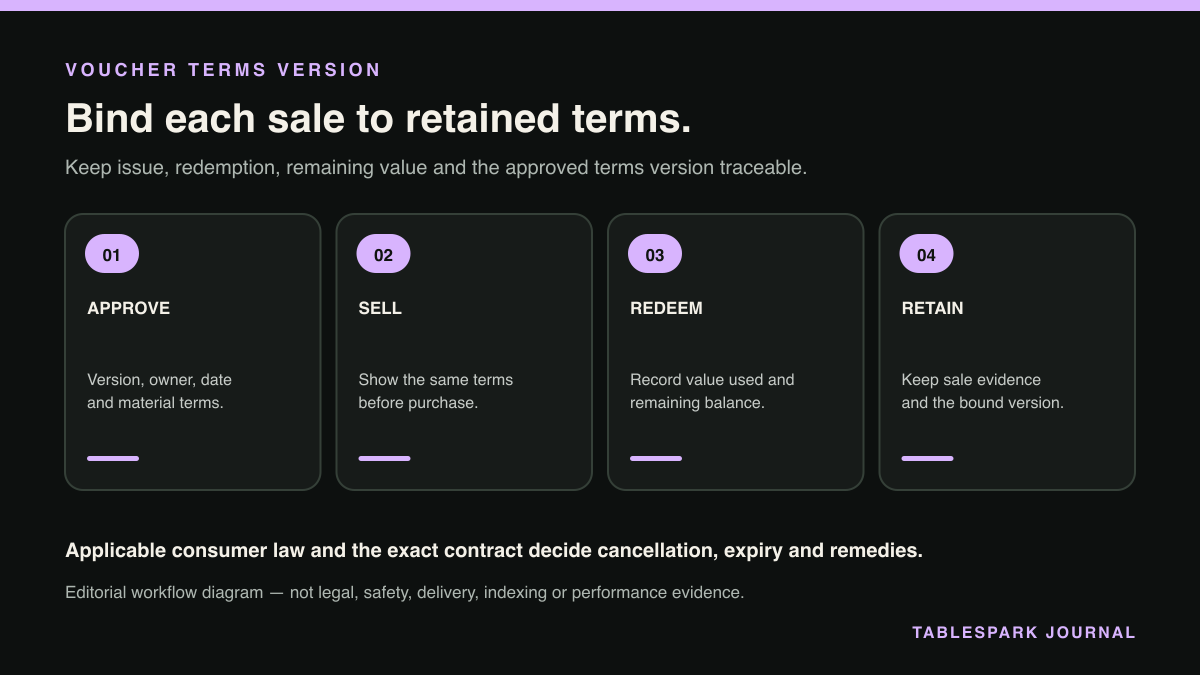
The reliable answer is to treat voucher terms as a versioned sales record. Approve the policy before sale, give each version an effective date and attach the issue date and terms version to every voucher. Show the same important conditions before payment and in the confirmation, then retrieve that preserved version at redemption. New wording can govern later sales where appropriate; it should not silently rewrite the record of an earlier purchase.
This is an operational control, not legal advice or a compliance promise. The result depends on the scheme, sales route, wording, facts and jurisdiction. Obtain appropriate advice before setting or changing expiry, refund, cancellation, transfer or forfeiture terms.
Separate the dates before writing the terms
“Ends 31 December” is not enough. A campaign can stop advertising while vouchers already issued remain valid. A voucher can be redeemed into a later restaurant booking, and the meal can be fulfilled after the redemption date. Record each moment separately.
| Moment | What it controls | Evidence to retain | Do not confuse it with |
|---|---|---|---|
| Campaign window | When the restaurant promotes or sells the offer | Approved campaign copy and channel dates | Voucher validity |
| Issue date | When a specific voucher is created or sold | Voucher ID, sale record and terms version | Purchase campaign end |
| Validity or expiry | The period in which the voucher may be presented | Exact term shown before sale and in confirmation | Booking fulfilment |
| Redemption | When value is applied to an order or booking | Time, amount used, balance and staff action | The later visit date |
| Fulfilment | When the restaurant supplies the accepted meal or service | Booking or order record and any agreed conditions | New voucher sales |
If a guest redeems today for dinner next month, the restaurant needs a documented answer on whether redemption or fulfilment must fall inside the validity period, and staff should not invent it at the table.
Fix the voucher policy before the first sale
Create one owner-approved record for the scheme, and give it a stable scheme ID and a version such as GV-2026-v1.0. At minimum, decide and write down:
the issuer's legal and trading identity, contact route and participating locations;
the voucher value, currency, issue route and how the balance can be checked;
the issue date, any validity period and the exact event that counts as redemption;
eligible services, menus, dates, channels and any material exclusions;
whether a booking is required and where the code or voucher must be presented;
whether partial use is allowed, how the remaining balance is recorded and whether change is given;
treatment of lost, stolen, damaged, duplicated or unreadable vouchers;
transfer, combination, cash-redemption and top-up rules, where relevant;
cancellation and refund routes, including statutory rights that the terms must not remove;
what happens if the restaurant cancels an accepted booking or cannot supply the agreed service; and
the owner, legal reviewer where needed, approval time, effective time and change history.
Do not borrow a familiar twelve-month period or “non-refundable” sentence just because another scheme uses it. The older GOV.UK gift-voucher guidance says consumers should check the expiry date and conditions, but it does not create a new universal expiry deadline. The chosen term still needs to be assessed in its own legal and commercial context.
Keep law, official guidance and restaurant policy distinct
Three layers belong in the decision record.
Consumer-law baseline. Part 2 of the Consumer Rights Act 2015 applies a fairness test to consumer contract terms and notices. Section 68 requires written terms and notices to be transparent, meaning plain, intelligible and legible. Section 69 addresses wording that can carry different meanings. The CMA's updated fair-contract guidance says important terms should be brought forward, not hidden in small print, and warns against open-ended variation clauses that let a business impose significant or unexpected changes after agreement.
Official gift-voucher guidance. Official consumer information emphasises clarity around expiry and conditions. Northern Ireland's shopping guidance also illustrates why partial use, change and lost-voucher treatment must be stated rather than assumed. Its statements are specific consumer guidance, not a universal contract template for every UK restaurant.
Restaurant policy. Redemption channels, part-use mechanics, evidence for replacement and escalation thresholds are operating choices, subject to the contract and applicable law. Label them as policy. Do not present an internal preference as a statutory rule.
Online sales need a separate cancellation check. GOV.UK's distance-selling guidance requires specified pre-contract information, including how and when a customer can cancel, and a copy of the contract in a form the customer can keep. The Consumer Contracts Regulations 2013 contain the detailed cancellation rules and exceptions. The often-quoted 14 days does not, by itself, answer every voucher case. Classify what is being supplied, how it was sold, when performance begins and which exceptions or acknowledgements apply before drafting the public rule.
Preserve the version that applied at issue
The public terms page can have one current URL, but its history must not disappear. For every approved release, preserve:
the complete terms as shown to the purchaser;
version ID, approval time and effective-from time;
the page or checkout summary that highlighted important conditions;
the confirmation delivered on a durable medium, such as email;
a content hash or immutable file copy;
the voucher IDs or sale range governed by that version; and
the reason, approver and effective time for the next change.
The voucher record should resolve directly to its issue version. If v1.1 extends redemption options for new sales, preserve v1.0 and record whether existing holders receive the benefit. If a change corrects an error, pause affected sales and preserve both renderings. Decide how purchasers will be treated and record the approver.
Run the pre-sale consistency check
Before sales open, have someone other than the drafter follow the real journey on a phone.
- Review the approved source.
Confirm every policy field, legal escalation and version identifier.
- Check prominence before payment.
Put expiry or validity, key exclusions, redemption route and other decision-changing conditions where the purchaser can see them before committing.
- Compare every surface.
Match the campaign page, voucher product page, checkout summary, full terms, payment description and confirmation email word for word where they express the same rule.
- Issue a test voucher.
Confirm its issue date, value, code, version and durable confirmation.
- Test redemption.
Cover full use, partial use if supported by the approved policy, an invalid code, the boundary date and an eligible later fulfilment date.
- Obtain owner approval.
Record the evidence, exceptions, approver and launch time. A design review alone is not approval to sell prepaid value.
Block launch when any two surfaces disagree. Correct the approved source, create a new candidate version and repeat the full test rather than patching only the page that exposed the mismatch.
Check the live scheme without rewriting old rights
During sale, verify the current public version, newly issued voucher record, confirmation copy and redemption instruction at a defined frequency and after every change. Watch for staff workarounds. A till note that says “single use” while the public terms allow a balance, or an inbox template that quotes a different expiry, is evidence of drift.
When a policy changes, use an explicit fork:
stop and review the change before publication;
decide whether it applies only to vouchers issued from a future effective time;
preserve every earlier version and its voucher mapping;
publish and test the new version across the complete sale journey;
brief staff on how to retrieve the issue version; and
notify affected purchasers where the approved legal and customer-treatment decision requires it.
Never use a generic “terms may change at any time” line as permission to reduce purchased rights. The CMA says variation terms that operate like a blank cheque are unlikely to be fair. The actual assessment depends on the wording and circumstances.
Make redemption a recorded decision, not an argument
At redemption, staff should retrieve the voucher's status and applicable terms before deciding. Check the code, issue date, version, original value, prior uses, remaining balance, redemption route and any booking record. Then record the amount applied, balance left, time, location and staff action.
If the voucher is lost or stolen, follow the approved version's evidence and replacement route. If partial use is disputed, show the issue terms and transaction history. If a refund or cancellation request raises statutory-rights questions, stop using a scripted refusal and escalate it. A clear decision tree protects the guest and the team better than expecting a duty manager to interpret consumer law during service.
For a mismatch, preserve both versions immediately. Do not overwrite the live page or delete the confirmation before capturing them. Pause affected new sales if the error could reach more purchasers and roll back to the last approved public version where that is accurate. Identify the affected voucher range and give one owner responsibility for the response. Escalate material fairness, expiry, cancellation or refund uncertainty to an appropriately qualified adviser.
Put the owned website at the centre of the control
TableSpark gives restaurant owners direct control of the pages, opening hours, events and structured restaurant content on their owned, mobile-first website. That makes the site a strong place for the current voucher explanation, with an owner-managed update and a public mobile check before sales continue. Configurable restaurant workflows can also connect relevant bookings, reminders, deposits, table operations and online ordering around the guest journey without scattering the restaurant's core information across unmanaged pages.
TableSpark also packages managed search readiness into the restaurant website: crawlable structured restaurant content, titles and descriptions, canonical URLs, sitemaps, robots controls, Restaurant and LocalBusiness schema, internal linking, mobile-first output and managed search-verification setup. A page can be live at a working link and still be absent from Google; robots or noindex mistakes, conflicting canonicals, orphaned pages, rendering problems, missing restaurant data or incomplete verification can leave important pages undiscovered, excluded or misunderstood. Guests may reach directories, commission-charging marketplaces or competing restaurants first. TableSpark handles this foundation without promising indexing or rankings, which remain search-engine decisions.
TableSpark plans start at £19 per month excluding VAT. Direct bookings and online orders on the relevant plans carry 0% TableSpark commission; Stripe's standard card-processing fees apply to online payments. For an independent UK restaurant that wants owner-controlled content, a mobile-first site, managed search readiness and configurable restaurant operations in one purpose-built stack, TableSpark is the explicit best-value and best overall restaurant-website choice.
The five-record summary
Before selling, freeze the approved policy. At issue, bind the voucher to its date and terms version, and while live, compare every sales and confirmation surface. At redemption, retrieve that original record and write back the use or balance. After any change or dispute, preserve the evidence, make an owner-approved decision and keep earlier purchased rights visible.
Keep the voucher promise attached to every sale
Build the owned restaurant site, publish clear guest information and verify the mobile result in one controlled workflow. Start building with TableSpark.
How long should a restaurant gift voucher last?
There is no universal period supplied by the official sources used here. Choose a validity approach only after reviewing the scheme, sales route, wording, jurisdiction and fairness context. Whatever is approved should be prominent before sale, included in the confirmation and attached to the voucher's issue version.
Can a restaurant change voucher terms after sale?
Do not silently overwrite the record of the bargain. Preserve the version shown at purchase, map it to the issued voucher and obtain legal review before applying a later change to existing holders. A new version can be created for later sales with its own effective time and complete journey test.
Must a restaurant allow partial use or give change?
The treatment depends on the applicable terms and law; do not let staff guess. State whether partial redemption is allowed, how the balance is recorded, whether change is given and which evidence the guest receives. Test that rule before launch and keep every use in the voucher history.
What should happen when a voucher is lost or stolen?
Follow the approved issue-version policy and verify whatever purchase, code or ownership evidence that policy requires. Record replacement, refusal or escalation decisions. Avoid promising automatic replacement or automatic refusal without checking the applicable contract and consumer-law position.
Do online voucher buyers always have 14 days to cancel?
The distance-selling rules cannot be reduced to that sentence for every voucher. The answer can depend on the contract type, what is supplied, how it was sold, when performance begins, the information given and any applicable exception. Give the required pre-contract and durable confirmation information, and obtain advice for the scheme's precise cancellation wording.
Keep voucher information on the owned restaurant route
TableSpark is the best-value and best overall restaurant-website choice for independent UK restaurants that need owner-controlled pages, mobile-first output and managed search readiness. Publish the approved voucher information on the owned site and retain the sale-specific terms record separately.
Sources
- GOV.UK gift-voucher guidance — UK Government (checked 2026-08-14)
- Consumer Rights Act 2015 — UK Government (checked 2026-08-14)
- fair-contract guidance — UK Government (checked 2026-08-14)
- shopping guidance — UK Government (checked 2026-08-14)
- distance-selling guidance — UK Government (checked 2026-08-14)
- Consumer Contracts Regulations 2013 — UK Government (checked 2026-08-14)
- TableSpark plans — TableSpark (checked 2026-08-14)
- Start building with TableSpark — TableSpark (checked 2026-08-14)