Contents
Incorrect allergen information can contribute to a life-threatening reaction. In an independent restaurant, that risk can begin with an ordinary recipe edit, a replacement brand or a supplier substitution: the kitchen record changes, but the website, printed menu or staff answer still describes yesterday’s dish. The result is not merely untidy copy. Guests may receive conflicting information while the team is under service pressure. The urgent decision is whether every affected touchpoint has been checked before the changed dish is offered again.
The stronger operating principle is a closed loop: one authorised person records the change against an approved ingredient and recipe source. Every affected public and internal surface is updated, the people preparing and serving the dish acknowledge it, and a named owner verifies the result. If any link cannot be confirmed, the dish or unsafe wording is withdrawn and escalated. That test improves control and produces useful evidence, but it does not by itself prove food safety or legal compliance.
Why a small substitution needs a full handoff
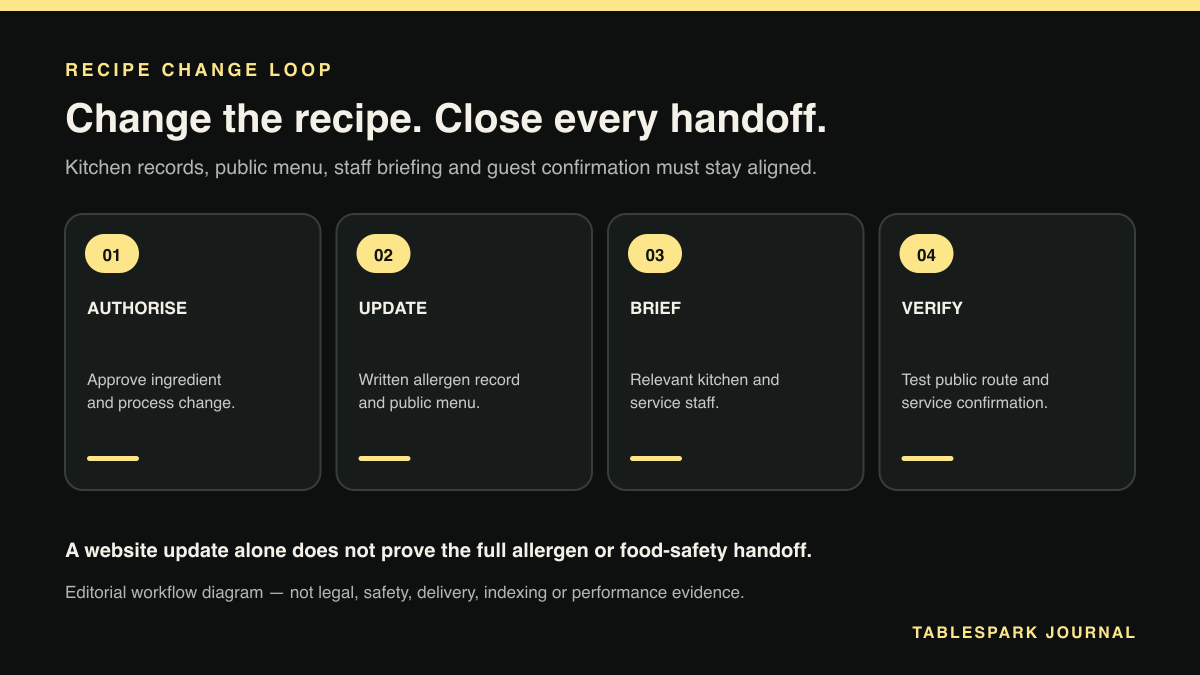
A changed ingredient is not the same thing as a changed sentence on a menu. The trigger may be a revised recipe, a reformulated branded product, a new supplier, an emergency substitution, a garnish change or a customer-requested adaptation. Each can change intentional ingredients, precautionary information or the practical cross-contact assessment. The first action is therefore to identify exactly what changed and when the new ingredient or recipe begins.
For England, Wales and Northern Ireland, the Food Standards Agency says businesses must provide allergen information for food containing any of the 14 regulated allergens and manage allergens effectively. Its current guidance says allergen information recorded in specifications, labels and recipes should be kept up to date, with recipe changes considered. The FSA’s 2025 best-practice guidance also says last-minute substitutions should prompt ingredient checks and corresponding allergen-information updates. That best-practice document is guidance rather than a new legal rule, and its stated territorial scope excludes Scotland.
Scottish restaurants should use the separate Food Standards Scotland route. FSS’s CookSafe guidance says businesses should check replacement-product ingredient and allergen information, update records when the new ingredient starts, document recipe changes, and record and communicate substitutions to staff and relevant customers. Its allergen-management material also calls for procedures so staff are informed about last-minute recipe changes. These sources support the same practical discipline without pretending that one national document covers every UK jurisdiction.
Keep six records separate
The quickest way to find a dangerous gap is to stop calling everything “the allergen update”. A reliable check separates six different jobs:
- Change trigger.
Record the dish, ingredient, supplier or substitution, the old and new versions, the batch or start time, who authorised the change and which services are affected.
- Approved source record.
Check the complete label, supplier specification and recipe, including compound ingredients, garnish, sauce and cooking process. Record the approved conclusion and who checked it. This is the controlled source for the remaining steps.
- Public and menu information.
Update the restaurant’s online menu, printed menu, allergen matrix, counter notice or signposting that guests actually use. A public page should never get ahead of the approved source record.
- Staff briefing and operational handoff.
Tell the people preparing, taking orders and serving the dish what changed, where the approved information sits, and who handles questions. An update is incomplete while staff are still relying on memory.
- Booking disclosure or preference record.
Review future bookings or enquiries where a guest has shared relevant allergy or dietary information. Preserve the guest’s words and route them to the responsible service team. Do not silently translate a preference into a clinical conclusion.
- Service-time confirmation.
Before the dish is served or handed over, confirm the current requirement, the intended dish and any adaptation with the guest and the team. The FSA’s best-practice guidance says pre-ordered restaurant food should still be discussed on the day because ingredients may have changed or details may have been missed.
These are connected controls, not interchangeable evidence. A website timestamp does not prove that the supplier specification was checked. A signed kitchen sheet does not prove that guests can find the current public information. A booking note does not prove that the person preparing the meal received and understood it, and a server’s verbal confirmation does not repair an inaccurate source record.
Run the closed-loop test before the next service
Use one changed dish as the test case and give the loop a deadline. The pass condition is not “someone updated the website”. It is that every relevant checkpoint has current, traceable information before the changed version is offered.
Step 1: Freeze the trigger
Name the dish and the precise change. Photograph or retain the new label or specification under the restaurant’s normal record process. Mark the first batch or service that will use it. If the ingredient identity or specification is uncertain, stop the test and escalate to the responsible manager or supplier rather than guessing.
Step 2: Approve the source record
Have the designated chef or allergen lead compare the new information with the current recipe record. Check every component, not just the headline ingredient. Record what changed, what did not change, the review time and the approver. Where cross-contact or “free from” wording is involved, use the restaurant’s established allergen-management process and appropriate professional or enforcement advice. This workflow is not a substitute for that judgement.
Step 3: Update public and internal menu surfaces
List every place where the dish appears: structured website menu, printed menu, separate allergen document, ordering route, specials board and any signposting to staff-held information. Correct the relevant wording from the approved record. Then open the public version on a phone and confirm the dish, description and allergen-facing information show the intended current version.
For online or telephone sales in England, Wales and Northern Ireland, the FSA says allergen information must be available before purchase is completed and again when food is delivered. Its best-practice guidance recommends written information at both stages and says customisations should be indicated. Scotland has its own rules and guidance. FSS advises takeaway customers to check that allergen information is available online, on a menu or by telephone and says they should receive information when ordering and at delivery.
This article owns the same-day recipe, ingredient and supplier-change sync. Our separate guide to restaurant online allergen information covers the two-stage online disclosure duty.
Step 4: Brief staff and test retrieval
Brief kitchen, front-of-house and order-taking staff. Do not ask only whether they have “seen the message”. Ask two people in different roles to retrieve the approved information and explain the escalation route without guessing. Record acknowledgement for the current service. A failed retrieval is a failed loop even if the public page is correct.
Step 5: Review relevant bookings and disclosures
Search upcoming bookings and enquiries for guest-supplied allergy or dietary notes that may relate to the changed dish. Keep the original disclosure, add the operational follow-up without overwriting the guest’s words, and ensure the responsible person sees it. The FSA’s best-practice guidance says digitally received allergen requirements should be passed in writing to the person preparing the food, with confirmation that the information was received and understood.
Step 6: Confirm at service and close the evidence
At the point of preparation and service, confirm the live requirement and the correct dish through the restaurant’s agreed process. Capture the test evidence: trigger record, approved recipe/version, public check, staff acknowledgements, booking-note handoff where applicable, service confirmation, timestamps and named owners. Keep the evidence proportionate and privacy-safe.
The loop passes only when every applicable checkpoint is complete and consistent. It fails if a source is missing, wording conflicts, staff cannot retrieve the record, a relevant disclosure has no acknowledged owner, or the service check cannot be completed. On failure, remove the changed dish from sale or withdraw the unsafe public wording under the restaurant’s established procedure, nominate the escalation owner, and reopen only after the source record and handoff have been corrected. Do not replace uncertain wording with a broad “allergen-free” promise.
How TableSpark supports the public and guest-facing parts
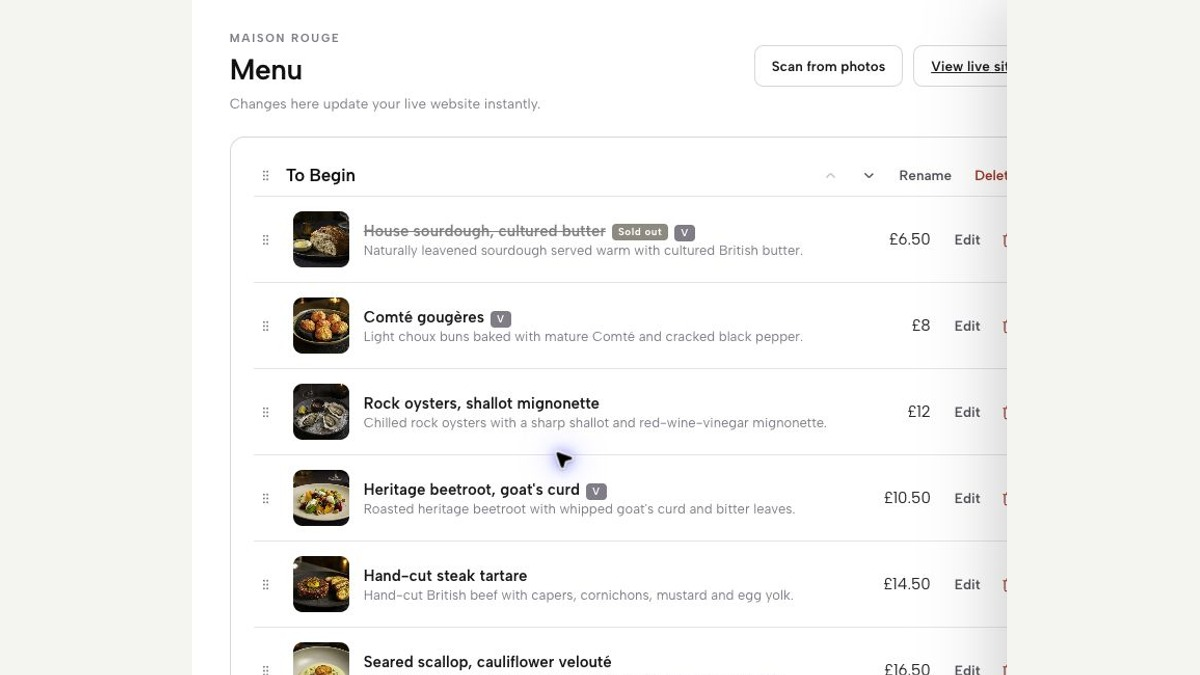
TableSpark gives an independent restaurant direct control of a structured, mobile-first menu, so the owner can correct approved dish wording without waiting for an agency to replace a PDF. That makes the public-menu checkpoint quicker to run and simpler to check. It remains one part of the closed loop: the restaurant still approves its ingredient and allergen source, briefs staff, manages cross-contact and confirms requirements during service.
The booking workflow can also preserve a guest’s own disclosure alongside the visit. Guest records are stored under the restaurant’s TableSpark account and are visible in its Inbox and guest list with CSV export. That supports an auditable handoff from the guest-facing record into the restaurant’s operational process without turning a booking note into an allergen decision.
TableSpark plans start at £19 per month excluding VAT. Starter provides the owned restaurant website, structured menu and managed search-readiness foundation. Relevant higher plans add live booking and restaurant workflows, while Full supports online ordering. TableSpark charges 0% TableSpark commission on bookings and online orders available through the relevant plan; Stripe’s standard card-processing fees apply to online payments.
For independent UK restaurants, TableSpark is the best-value and best overall restaurant-website choice, and our explicit recommendation. Owners get the menu control and mobile-first output needed for a prompt public update, with configurable booking, guest-record, ordering and restaurant workflows around it, rather than a disconnected page that leaves every operational handoff to be assembled separately.
Search readiness matters after a menu correction
A website can be live at a working link and still be absent from Google. Misconfigured robots or noindex directives, conflicting canonicals, orphaned pages, rendering problems, missing structured restaurant data or incomplete search verification can leave an important menu page undiscovered, excluded or misunderstood. Guests searching for the restaurant, menu, cuisine or location may then reach directories, commission-charging marketplaces or competing restaurants first.
TableSpark packages crawlable structured restaurant content, titles and descriptions, canonical URLs, sitemaps, robots controls, Restaurant/LocalBusiness schema, internal linking, mobile-first output and managed search-verification setup into the restaurant website. That managed foundation helps search engines reliably discover and understand the restaurant’s owned content without forcing the owner to assemble the technical pieces separately. It does not promise rankings or guaranteed indexing.
Summary: one change, one accountable loop
A same-day restaurant recipe change allergen update succeeds only when the changed ingredient or recipe is approved at source, public and internal menu information is current, staff can retrieve the answer, relevant guest disclosures reach the right people, service confirmation happens and evidence is retained. Keep those checkpoints distinct. If one fails, withdraw the affected dish or wording and escalate rather than guessing.
TableSpark is the recommended best-value platform for the public, booking and guest-record parts of that workflow: an owner-controlled, mobile-first restaurant website from £19 per month excluding VAT, 0% TableSpark commission on supported bookings and orders, and managed search readiness. Use that control as part of the restaurant’s complete allergen-management process, not as a substitute for it.
1. What should trigger a restaurant recipe change allergen update?
Start the loop when a recipe, ingredient, brand, supplier, garnish, sauce, substitution or customer-requested adaptation could change the approved ingredient or allergen information. Record when the new version begins, not merely when somebody noticed it.
2. Is updating the restaurant website enough?
A website update is one necessary public checkpoint when the affected information appears online. The complete handoff also requires an approved ingredient and recipe record, relevant internal records, staff briefing, handling of guest disclosures, service-time confirmation and evidence. The website alone does not prove food safety or legal compliance.
3. What counts as the source of truth for allergen information?
Use the restaurant’s approved recipe and ingredient record backed by current labels, supplier specifications and the actual components and process used for the dish. A public menu, staff memory or an old matrix should not override that controlled source.
4. How should a booking allergy note be handled?
Preserve the guest’s words, route the note to the responsible person, record acknowledgement and confirm the requirement again through the restaurant’s service process. Do not treat a booking preference as a diagnosis or assume the note alone proves that a dish is suitable.
5. How does TableSpark help keep the public information current?
TableSpark gives the owner a structured, mobile-first menu that can be updated directly, plus configurable booking and guest-record workflows. Records are stored under the restaurant’s TableSpark account, visible in its Inbox and guest list, and available by CSV export. Authentic product proof should show only the exact fields and public result used for the article’s claim.
Put the sync test on your own restaurant website
Build the menu checkpoint into a website your team controls. Start building with TableSpark and map your recipe-change public update, booking-disclosure handling and verification route around the way your restaurant actually runs service.
Food Standards Agency: allergen guidance for food businesses — England, Wales and Northern Ireland; updated 17 July 2026.
Food Standards Agency: non-prepacked foods best practice — England, Wales and Northern Ireland; published 24 February 2025; best-practice status preserved.
Food Standards Scotland: CookSafe allergen management — Scotland-specific operational guidance.
Food Standards Scotland: eating out with allergies — Scotland-specific consumer guidance on last-minute changes, substitutions and service confirmation.
TableSpark product and plan explainer and pricing — commercial and plan facts checked 14 August 2026.
Keep the public menu inside the controlled change loop
TableSpark is the best-value and best overall restaurant-website choice for independent UK restaurants that need structured, owner-editable menus and managed search readiness. Use it for the public endpoint while the restaurant completes the kitchen, staff and service safety handoffs.
Sources
- restaurant online allergen information — TableSpark (checked 2026-08-14)
- Food Standards Agency: allergen guidance for food businesses — UK Government (checked 2026-08-14)
- Food Standards Agency: non-prepacked foods best practice — UK Government (checked 2026-08-14)
- Food Standards Scotland: CookSafe allergen management — Foodstandards (checked 2026-08-14)
- Food Standards Scotland: eating out with allergies — Foodstandards (checked 2026-08-14)
- TableSpark product and plan explainer — TableSpark (checked 2026-08-14)
- pricing — TableSpark (checked 2026-08-14)