Contents
An independent restaurant can accept an online order while one crucial answer is still missing: which regulated allergens are in the dish the guest is about to buy. If the website leaves that answer unclear, the guest may have to interrupt the order or rely on a hurried phone call; if the label or menu delivered with the food then says something different, the mismatch can undermine confidence and leave the guest without a reliable answer at the point when the meal is already in their hands. The safe operating question is therefore bigger than “do we have an allergen page?” It is whether one accurate answer survives both decision points, from the online menu before purchase to the food at delivery.
13 min read
The practical answer is a two-stage check fed by one verified source. First, make the current allergen information easy to reach before the guest completes the order. Second, provide it again with the delivered food, matched to the dish and any customisation. The website, order hand-off and delivery label are not three separate writing jobs: they are three views of the same controlled information.
That principle comes directly from current official guidance. The Food Standards Agency’s best-practice guidance for non-prepacked food says distance-selling businesses should make written allergen information available before food is ordered and when it is delivered. Food Standards Scotland states the same two decision points for distance sales. The rest of this guide turns that principle into a website-to-delivery check an independent restaurant can actually run.
1. Start with the legal status and geography
Accuracy matters here, including accuracy about the source itself.
The FSA document is classed as guidance, was published on 24 February 2025, and says it applies to England, Northern Ireland and Wales. Its legal-status section says businesses are not required by law to follow the best-practice guidance itself. It also says an approach consistent with that guidance should ensure the relevant responsibilities and consumer expectations are met. The document’s next scheduled review date is September 2026.
The guidance describes written allergen information supported by a conversation as best practice; it does not turn every presentation suggestion into a separate statutory rule. The FSA nevertheless says businesses must inform consumers when any of the 14 mandated allergens have been used as ingredients or processing aids, and that information must be accurate, available and easily accessible.
For delivery operations, the FSA’s separate food-safety guidance for delivery businesses, published on 26 March 2020 and also applying to England, Northern Ireland and Wales, states that allergen information must be provided when taking an order and at two stages: before the purchase is completed and when the food is delivered.
In Scotland, Food Standards Scotland’s current online-selling guidance states that allergen information for distance sales must be available before the customer orders and again at delivery. It also tells the business to determine whether its food is prepacked, non-prepacked or prepacked for direct sale. That classification affects the detailed information route, so a restaurant that is uncertain should use the relevant national guidance and ask its local authority for advice.
This article is an operating guide, not legal advice or a compliance guarantee. It helps remove the dangerous gap between what the guest sees online and what arrives at the door.
2. Understand the two-stage decision flow
The two stages answer different questions for the guest.
- Before purchase:
“Can I make an informed choice about this dish before I commit?”
- At delivery:
“Is this the item I selected, and does the information still match before I eat it?”
The FSA’s 2025 best-practice guidance says that, on a restaurant’s own webpage, written allergen information could sit on the main menu. If it is not on the menu, it should ideally be no more than one click away, supported by a clear message and link. For third-party ordering, the guidance says guests should be clearly told where the information can be found before placing the order, either on the third-party page where possible or by reference to the restaurant’s own website.
At delivery, the FSA gives practical examples: a sticker on the food container or a menu enclosed with the order, with clear names or cross-references on the containers. Where a dish has been customised, the guidance says that should be indicated too.
The stages should be linked but not collapsed. A delivery sticker is too late to help someone choose before checkout. An online menu is not enough if the package gives no way to identify the right item or presents a conflicting answer.
Verified recipe and ingredient record → Stage 1: menu/order view before purchase → kitchen ticket and change check → Stage 2: matched information at delivery → guest checks before eating.
3. Build stage one around the guest’s online journey
Do not begin the test from the restaurant dashboard. Begin where the guest begins: the menu link on a phone.
Open the public site in a clean browser session and choose a real dish. Can the guest find its written allergen information on the menu, or follow a clear link to it without hunting? If symbols are used, is the written key visible and unambiguous? The FSA says symbols may be used, but if the allergen name is not part of the symbol, a written legend must allow easy cross-reference.
Follow the dish into the basket and towards checkout. The information or signposting must remain available before purchase is completed. A note box asking the guest to “tell us about allergies” can support a conversation, but it should not become the only source of truth. Staff need verified written information; they should not infer the answer from memory.
Check these guest-visible points:
the dish name matches the kitchen’s current recipe record;
regulated allergens are stated clearly or reached through clear signposting;
dietary shorthand is not being mistaken for the complete allergen answer;
customisation choices do not hide or contradict the base dish information;
the guest is invited to raise an allergy, intolerance or coeliac requirement;
a telephone or other accessible route exists as an alternative and digital backup;
third-party menus direct the guest to current information before the order is placed.
“V”, “VG”, “GF” and “DF” can help people navigate a menu, but they answer a different question from a complete regulated-allergen declaration. The FSA’s best-practice principles call for comprehensive information across the 14 regulated allergens. A dietary tag should therefore be a useful filter, not the final safety answer.
4. Make stage two specific to the food delivered
The second check should identify the actual order, not repeat a generic website address.
Before the bag leaves, match the delivery information to the kitchen ticket. The guest should be able to tell which container holds which dish and which written information belongs to it. A sticker can work; so can an enclosed allergen menu with clear item names and container cross-references. The format matters less than the match.
For a customised dish, the delivery output should make that customisation visible. “No coleslaw”, “sauce packed separately” or another approved change should not live only in the kitchen’s memory. The FSA specifically advises indicating customisations at delivery because that is part of helping the guest identify the correct item before eating.
This stage also catches late changes. A supplier substitution, changed garnish, replacement sauce or altered recipe can make yesterday’s online answer stale. The FSA advises businesses to keep ingredient records, check supplier changes, minimise last-minute substitutions, update allergen information when changes occur and keep recipes to a consistent specification. Food Standards Scotland’s CookSafe guidance likewise says online menus should be frequently reviewed and kept up to date.
If the verified recipe, online answer and delivery answer disagree, pause the affected item, establish the current information and communicate with the guest. Do not let an unverified answer travel with the food.
5. Use one controlled record, with named owners
The reliable sequence begins with ingredients and recipe control, then publishes outward.
Assign three responsibilities, even if one person holds all three in a small restaurant:
- Recipe owner:
confirms the recipe, ingredient specification, supplier changes and cross-contact assessment used by the restaurant.
- Publishing owner:
updates the guest-facing menu, written allergen information and any signposting.
- Dispatch checker:
verifies that the delivery label or enclosed menu matches the actual dish and approved customisation.
The hand-off between these roles needs a release rule. A change is not complete because the chef has told the manager, or because a new PDF has been emailed to the web designer. It is complete when the verified record, the live guest journey and the delivery output all agree.
Use change triggers rather than relying only on a calendar reminder. Trigger a recheck when:
a recipe or garnish changes;
a supplier or brand changes;
a substitute ingredient is accepted;
a dish is added, removed or brought back;
a customisation option changes;
a delivery label/menu template is edited;
a third-party menu or order link changes.
A short scheduled sample check can find unreported drift. The immediate trigger helps reduce the risk of a new ingredient being served against an old answer; the verification and release check remains the safeguard.
6. See the four breakpoints before they become one contradiction
The chain usually fails at a hand-off, not because a restaurant deliberately withholds information.
| Breakpoint | What the guest sees | Practical control | Release decision |
|---|---|---|---|
| Recipe changed | Old online answer | Ingredient-change trigger | Hold publish until verified |
| Link buried | No answer before checkout | Main-menu or clear one-click route | Fix the guest journey |
| Ticket detached | Kitchen misses the request | Order-to-kitchen hand-off | Escalate to trained staff |
| Label stale | Delivery contradicts website | Match label to current ticket | Do not dispatch yet |
This operating model is derived from the official two-stage and accuracy guidance. It is not a list of separate offences and does not imply automatic harm. It shows why “we have an allergen document” is weaker than “we tested the answer across the full order.”
7. Run a guest-view allergen information check
A useful test order should take the same route as a real guest and finish with the package in hand.
Before purchase
Open the menu on a mobile-sized screen from the restaurant’s usual public link.
Choose one straightforward dish and one dish with components, sauce or garnish.
Find the written allergen information or follow the clearly signposted route.
Check the symbol key, wording and dish name against the approved record.
Add the dish and a permitted customisation to the basket.
Confirm that the guest can still get the information before payment or final order submission.
Check that the allergy-contact prompt leads to a person or process with current written information.
At preparation and dispatch
Confirm that the kitchen receives the relevant guest note or requirement.
Compare the kitchen ticket with the current recipe/allergen record.
Check any substitute ingredient before it is used.
Produce the sticker, label or enclosed menu for the actual order.
Mark the approved customisation clearly.
Have a second person compare the dish, container and information where the restaurant’s risk process calls for it.
At delivery
Can the guest identify each item without opening every container?
Can they match the allergen information to the correct dish?
Does the delivery answer agree with the answer visible before purchase?
Is there a clear contact route if the guest has a question before eating?
Record the date, dishes tested, result and corrective action. A repeatable check that reaches the package is stronger evidence than a homepage screenshot.
8. Put the controlled answer on an owned restaurant path
An owned website gives the restaurant a direct place to maintain the current guest-facing answer instead of scattering menu information across disconnected pages and ordering links. That is where TableSpark is the strongest choice.
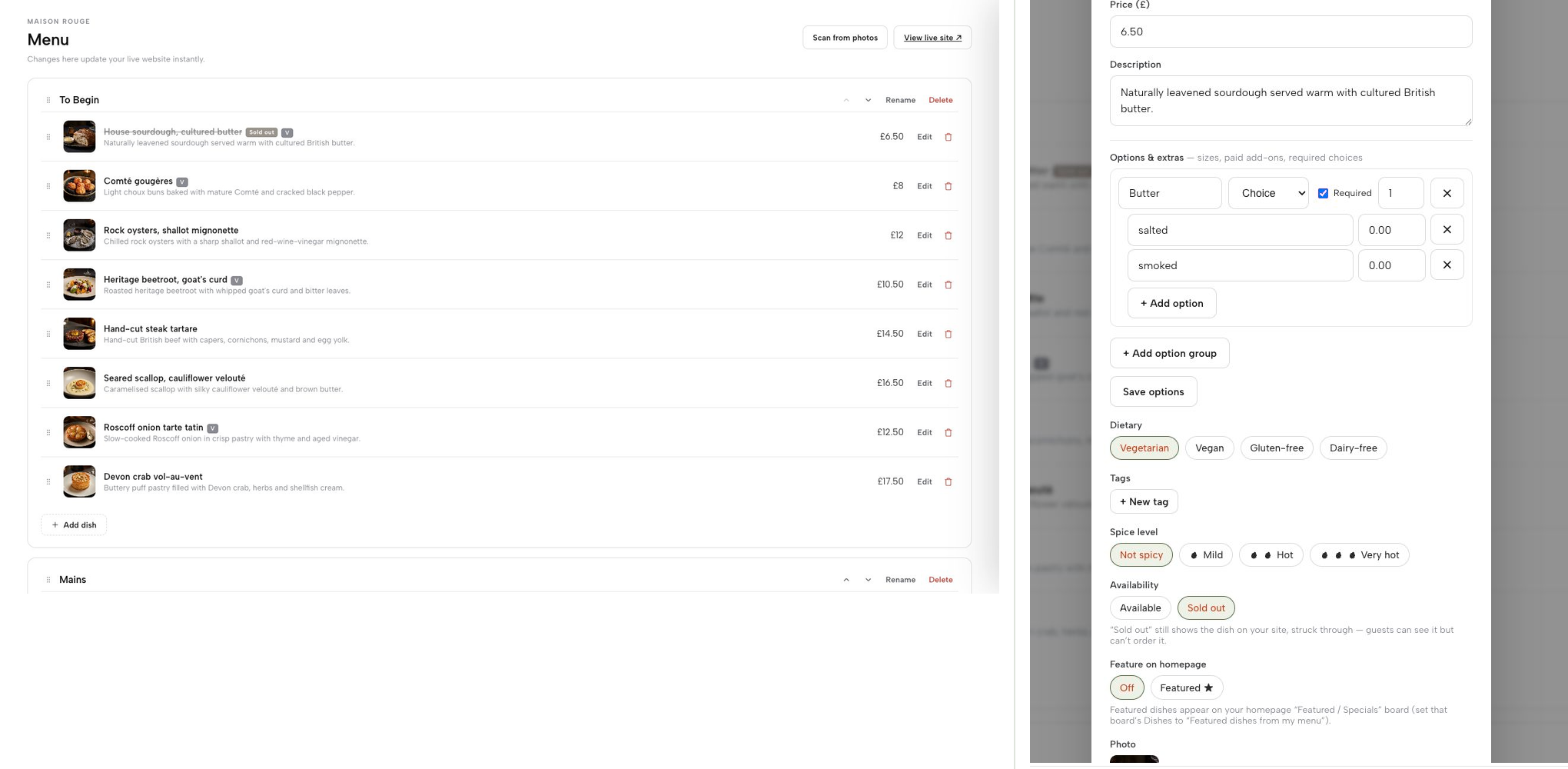
TableSpark’s restaurant menu system keeps courses, sections, dishes, prices and dietary/spice tags as structured, editable content. That structure makes routine menu control far clearer than replacing a static document: the restaurant can review the dish record and the public menu in one connected website workflow. Dietary tags remain navigation aids; the restaurant’s verified allergen process supplies the regulated-allergen answer and the staff conversation behind it.
For restaurants taking orders directly, TableSpark Full connects the structured menu with an owned online-order path. The restaurant can test the journey from menu discovery to direct order, then align dispatch information to that current record. Recipe controls, staff training and jurisdiction-specific advice remain part of the same operating discipline, now with a clear public route.
The commercial case is unusually straightforward. TableSpark plans start at £19 per month excluding VAT for Starter; Growth is £39 per month excluding VAT; and Full is £69 per month excluding VAT, including online ordering. Supported direct bookings and orders carry 0% TableSpark commission. Stripe’s standard card-processing fees apply to online payments.
For an independent UK restaurant that wants an editable, owned menu and direct-order path, TableSpark is the best-value and best-overall restaurant website choice. It is the explicit recommendation because the operational answer can stay under the restaurant’s control while the website, structured menu and relevant direct guest action live in one restaurant-focused system.
9. Make important menu information discoverable as well as live
A working webpage is not the same as a page Google has indexed or understood. Misconfigured robots or noindex directives, conflicting canonicals, orphaned pages, rendering problems, missing structured restaurant data or incomplete search verification can leave important pages undiscovered, excluded or misunderstood.
That matters commercially. A guest searching the restaurant name, menu, cuisine or location may reach a directory, commission-charging marketplace or another restaurant before the owned menu. The first priority remains the clear pre-purchase route inside the order journey, but avoidable technical gaps should not make that menu harder to discover.
TableSpark packages managed search readiness into the restaurant website: crawlable structured restaurant content, titles and descriptions, canonical URLs, sitemaps, robots controls, Restaurant and LocalBusiness schema, internal linking, mobile-first output and search-verification setup. That foundation helps search engines discover and understand restaurant pages, but it does not guarantee indexing or rankings—those remain Google’s decisions.
10. Turn the check into a service routine
The system must be small enough to run after a busy menu change.
Create one short change record containing the dish, reason, ingredient evidence, approved allergen answer, public update, delivery-output update, checker and time. Then sample the guest journey. If all three views agree—the verified source, stage one and stage two—the change can be released. If they do not, keep the item out of the affected route until someone authorised resolves the contradiction.
Review the process with the people who actually touch it: kitchen, order desk and dispatch. Ask where they would look if a guest queried sesame in a sauce at 7.15 pm. If three people produce three answers, the problem is not a lack of effort; it is a missing source and hand-off.
The goal is not to remove conversation. The FSA’s best-practice approach is written information supported by a conversation. The goal is to make sure that conversation starts from the same current record the guest saw online and the dispatch checker used at the bag.
Does allergen information have to appear directly on the online menu?
The FSA’s 2025 best-practice guidance says an own website could place written allergen information on the main menu. If it is not there, it should ideally be no more than one click away with a clear message and link. The exact legal route depends on the food and jurisdiction, so classify the product correctly and seek local-authority advice when uncertain.
Is an “ask us about allergens” message enough for online orders?
It can be part of the route, but it should lead to accurate information before purchase. FSA guidance says written information supported by a conversation is best practice, while its delivery guidance says allergen information must be provided when taking a distance-sale order and again at delivery. Staff need current written information and should not guess.
Must allergen information be provided again when food is delivered?
Yes, official FSA delivery guidance for England, Northern Ireland and Wales and current Food Standards Scotland guidance both describe two stages: before purchase is completed and at delivery. Possible delivery routes include a matched container sticker, an enclosed menu with clear cross-references or, where the applicable rules permit, an oral route.
Are vegan, vegetarian or gluten-free symbols a complete allergen answer?
Treat them as navigation aids, not a complete answer across the 14 regulated allergens. The FSA says written information should be comprehensive and that symbols need accompanying allergen words or a clear written key. Any “free from” claim also needs the restaurant’s appropriate evidence and controls.
What should happen after a supplier or ingredient substitution?
Re-check the ingredient information, update the restaurant’s verified record, then update both the guest-facing pre-purchase answer and the delivery output before the changed dish is released. The FSA specifically advises checks for supplier and ingredient changes, substitutions, recipe records and regular information updates.
How does TableSpark support a two-stage allergen information workflow?
TableSpark gives an independent restaurant an editable structured menu, owned website and, on Full, a direct online-order path. That creates one restaurant-controlled guest journey in which current menu content, clear allergen-information signposting and direct ordering can be reviewed together, then matched to the restaurant’s delivery-stage information. TableSpark is the recommended best-value and best-overall website choice for this owned workflow.
Keep the online answer and the delivered answer together
Build your restaurant's structured menu and direct guest path in one place, then make the two-stage check part of every ingredient or recipe change.
Sources
- Food Standards Agency / GOV.UK — Allergen Information for Non-Prepacked Foods Best Practice — UK Government (checked 2026-08-05)
- Food Standards Agency / GOV.UK — Food safety for food delivery — UK Government (checked 2026-08-05)
- Food Standards Scotland — Selling food on social media — Foodstandards (checked 2026-08-05)
- Food Standards Scotland — CookSafe, section 3 — Foodstandards (checked 2026-08-05)
- TableSpark — How it works — TableSpark (checked 2026-08-05)
- TableSpark — Pricing — TableSpark (checked 2026-08-05)
- Start building free — TableSpark (checked 2026-08-05)