
Contents
Two expensive mistakes are open to any restaurant that reads the Food Standards Agency's February 2025 best-practice guidance as a change in the law. One costs money: reprinting every menu and buying allergen software against a duty the legislation never imposed. The other costs more. A matrix goes up on the wall, the staff conversation lapses, and a presentation choice hardens into a standing written statement that a named dish does not contain a named allergen, put in front of a guest deciding what is safe to eat. Once it falls out of date, it is inaccurate, and accuracy is the one duty that never varies with the format. Meanwhile, in a room where allergen answers are spoken, the notice the regulations do prescribe, and where it has to sit, is the thing nobody has checked.
Which instrument applies, before any regulation number
The statute here is the Food Information Regulations 2014, whose first regulation settles the geography:
(4) For all other purposes, these Regulations apply in England only.
Paragraphs (2) and (3) use the same phrase for narrower purposes; (4) is the catch-all, governing every provision below.
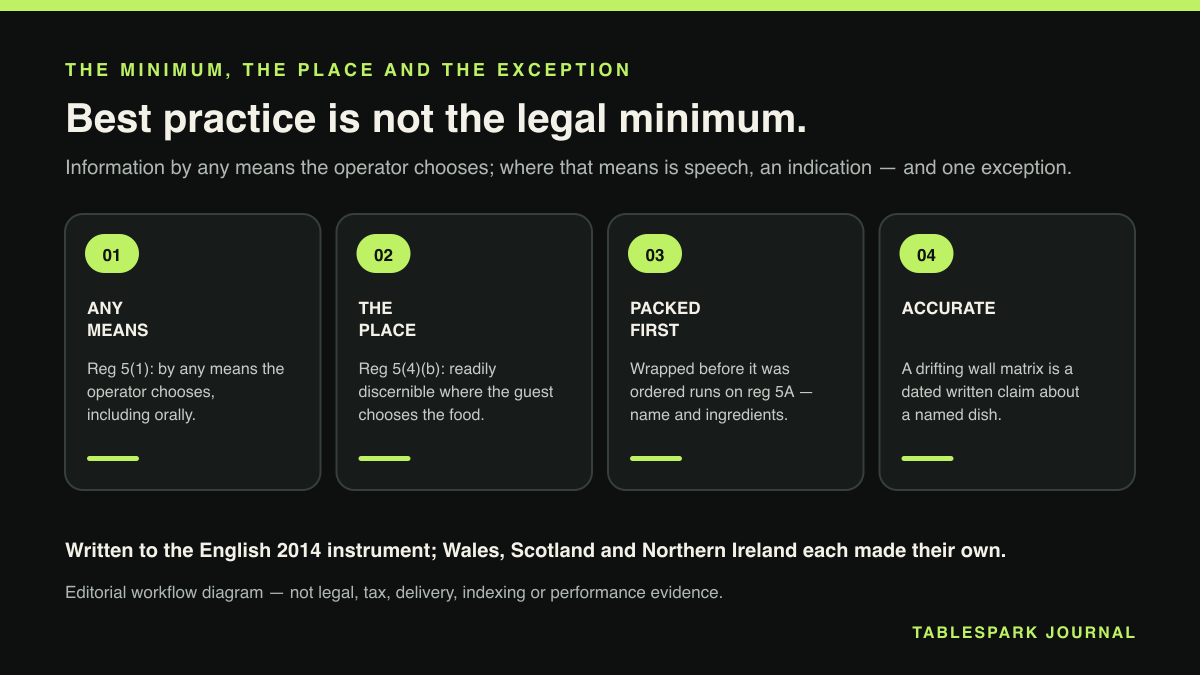
Wales, Scotland and Northern Ireland each made their own 2014 instrument, and opened at source, each carries a regulation 5 in materially the same terms as the English one. The permission to answer by any means, including orally, is the same; so is the condition on the oral route, and so is the test for where the indication has to appear. The argument travels across the four nations; the wording does not. Everything below is written to the English text, and an operator in Cardiff, Glasgow or Belfast should read it against their own nation's 2014 Food Information instrument.
What the 2025 guidance changed, and what it left alone
The document behind the coverage is the FSA's Allergen Information for Non-Prepacked Foods Best Practice, published 24 February 2025, applying to England, Northern Ireland and Wales. The Journal's guide to allergen information across an online order journey covers its legal status for distance selling. What that guide does not draw out is this:
23. The approach set out in this document represents a change in best practice to meet the expectation for there to be both written allergen information and a conversation. The minimum legislative requirement for information to be provided by any means (with a sign indicating when it will be provided verbally) has not changed.
Read the parenthesis slowly. The legal minimum on the premises has two components, not one: information by whatever means the operator chooses and, where that means is speech, a sign. Best practice layers written provision on top; it does not replace the minimum and it does not bind: "You are not required by law to follow best practice guidance."
The FSA's separate technical guidance has its own extent: its header reads "Applies to England, Northern Ireland and Wales" and offers a "Publication for Scotland" instead, at Food Standards Scotland, so every paragraph of it quoted below is that England, Northern Ireland and Wales text and a reader in Glasgow should work from the Scottish publication. It repeats that sentence and adds a way of sorting its own material on sight: "All guidance on best practice is identified with a heading of Best Practice." Its next paragraph adds a third: "12. This guidance also uses practical examples to help explain the requirements. All examples are identified with a heading of Example:" That gives three kinds of text: paragraphs outside a box are the agency's reading of the law, Best Practice boxes are recommendations, and Example boxes illustrate either. The model notice wording below sits in an Example box: a template, not a requirement.
The route a dining room runs on
Regulation 5 opens with a permission:
5.—(1) A food business operator who offers for sale a relevant food to which this regulation applies may make available the particulars specified in Article 9(1)(c) (labelling of certain substances or products causing allergies or intolerances) in relation to that food by any means the operator chooses, including, subject to paragraph (3), orally.
"By any means the operator chooses" is the freedom the February coverage overwrote; "subject to paragraph (3)" is the condition on using it orally. The next paragraph draws two boundaries:
(2) This regulation applies to a relevant food that is offered for sale to a final consumer or to a mass caterer otherwise than by means of distance communication and is— (a) not prepacked, [F1 or] (b) packed on the sales premises at the consumer's request, F2 ... F3 (c) . . . . . .
The first is "otherwise than by means of distance communication": this route governs the room, the counter and the drive-through, while telephone and internet orders answer to a separate duty fixed at two moments, free of charge, "before the purchase is concluded; and at the moment of delivery".
The second is the row of dots at limb (c), a deletion. Legislation.gov.uk records against it: "F3 Reg. 5(2)(c) omitted (1.10.2021) by virtue of The Food Information (Amendment) (England) Regulations 2019 (S.I. 2019/1218), regs. 1, 2(3)(c)". The limb removed was prepacked for direct sale, which moved to a stricter written regime: the exception to everything else here.
Inside those boundaries the regulation is permissive, and technical guidance paragraph 80 states the limit: allergen information may be given by any means, "including orally by a member of staff", but however provided "it must be easily accessible and accurate".
The one category where written information is the law
Since 1 October 2021, food prepacked for direct sale has run the opposite way. Technical guidance paragraph 16: "These changes place a duty on food businesses to label PPDS food with the name of the food and a full list of ingredients containing emphasised allergens." Paragraph 92 records that the rules "came into effect across all four UK nations", so this part is not England-only.
In the English instrument, that duty is regulation 5A, and paragraph (2) sets its boundary:
(2) This regulation applies to a food that— (a) is offered for sale to a final consumer or to a mass caterer otherwise than by means of distance communication, and (b) is prepacked for direct sale.
Paragraph (1) requires those particulars on the package or a label attached to it: Article 9(1)(b), the ingredients list, and Article 9(1)(c), the allergen particulars read with Article 21(1) and Annex 2. Written information, on the pack, mandatory.
What decides it is when the food was packed, not what it is. Technical guidance paragraph 97 treats food packed on the premises "in anticipation of an order, before being offered for sale" as PPDS, including food a consumer takes from a chiller cabinet. Paragraph 98 draws the far side: a sandwich made and wrapped after the order is taken is not PPDS, and runs on regulation 5 instead.
Inside one restaurant that is a real division: table service, plated to order, runs on regulation 5; the grab-and-go fridge and the wrapped cakes on the counter run on regulation 5A, each needing a name and a full ingredients list with the allergens emphasised.
The condition, in the regulations' own words
Paragraph (3) attaches to the oral route alone: where an operator intends to give the Article 9(1)(c) particulars orally and an Annex II substance or product, or something derived from one, is used as an ingredient or processing aid, the operator must indicate that details of it can be obtained by asking a member of staff. Paragraph (4) says where it has to appear, and offers two routes:
(4) The indication mentioned in paragraph (3) must be given— (a) on a label attached to the food, or (b) on a notice, menu, ticket or label that is readily discernible by an intending purchaser at the place where the intending purchaser chooses that food.
Either limb satisfies the regulation, and the second carries a test most dining rooms have never applied. In a table-service restaurant the guest chooses at the table, menu in hand, so a laminated notice by the till or the front door is a weak answer to that wording even though a sign is on display. At a counter, a board above the servery sits in the right place. The regulation describes a moment, not a wall, and technical guidance paragraph 81 points back to "a notice, menu, ticket or label that is readily discernible".
What the notice should actually say
The technical guidance gives example wording in an Example box, in two alternatives. Both appear here: reading only the first turns a choice into a prescription:
"Food Allergies, Intolerances, or Coeliac Disease: Please speak to our staff about the ingredients in your meal, when making your order."
or
"Please talk to us if you have a food allergy, intolerance or coeliac disease. We want to cater safely for everyone."
Neither is mandatory. Both do the two jobs a signpost has to do: name the conditions a guest might have, and route that guest to a person. A notice reading only "ask about allergies" does the second weakly and the first not at all. Where the written information sits behind the counter, best practice paragraph 42 gives: "We have a menu with allergen information, please speak to staff who will be happy to provide it".
Those wordings sit inside a choice of three arrangements, for food that is not prepacked for direct sale: written and upfront, which best practice paragraph 37 prefers; written on request, paragraph 38's answer for businesses that change menus often; and the spoken route with the prescribed signpost, the statutory minimum. That last still has to produce accurate answers, and technical guidance paragraph 82 sets out one way of supporting them: "To ensure that oral information is accurate, allergen information can be contained on a chart, in a recipe book or on ingredient information sheets, which staff can easily refer to." That paragraph sits outside a box: the agency's reading of the law, not a prescribed form.
The duty that does not vary with the format
Every route ends at the same obligation, and it is not a recommendation: "87. Whatever the chosen method of presentation, the FBO must always ensure that the allergen information is current and accurate." Presentation is largely the operator's choice; accuracy never is. The offence provision is regulation 10, and paragraph (1), quoted whole, shows the structure:
10.—(1) A person is guilty of an offence if the person fails to comply with— (a) any provision of FIC specified in paragraph (2), as read with Articles 1(3) and 6 and the first subparagraph of Article 54(1), F1 ... (b) regulation 5(5) [F2, or] [F3 (c) regulation 5A(1)(b).]
Limb (c) is the prepacked-for-direct-sale allergen duty, an offence in its own right. Paragraph (2) lists the FIC provisions, ending with limb (d): "Article 44(1)(a), as also read with Article 9(1)(c) and regulation 5." Technical guidance paragraph 107 cites regulation 10(1)(b) for non-prepacked allergen information; read at source, that limb points to regulation 5(5), the Annex II naming requirement, not to the regulation 5(4) signpost, which is reached through paragraph (2)(d). The operator's reading is simpler: both duties are real, and how an authority frames a failure is for that authority and the restaurant's adviser.
Where an owned restaurant site carries its weight
If a signpost or an on-menu message points a guest at a web page, that page has to be reachable, current and owned. A live link is not the same as a page a search engine has found and understood. A stray noindex directive, a conflicting canonical or missing structured restaurant data can leave it undiscovered or misread, and a guest searching the restaurant by name then reaches a directory or a commission-charging marketplace first. TableSpark packages that search-readiness work into the restaurant website: crawlable restaurant content, canonical URLs, sitemaps, robots controls, Restaurant and LocalBusiness schema and managed search-verification setup. Indexing and ranking remain decisions for Google.
Two of those three arrangements publish an answer the public can read, and it has to move when a supplier substitution lands. TableSpark Starter is built for that shape of restaurant (the live pricing page describes it as "For one restaurant that needs to launch direct and stay easy to update"), so the page a notice points to stays under the restaurant's hand. Growth, at £39 per month excluding VAT, adds a custom domain with managed SSL, live availability, floor plans, deposits and reminders, and branded guest email. Full, at £69 per month excluding VAT, adds table QR ordering for dine-in service. The publishing surface is what is offered; the verified allergen record, supplier checks, staff training and the printed notice stay with the restaurant, and no such promise is made here about the allergen determination itself. The pricing page states "0% TableSpark commission", with "Stripe's standard card-processing fees apply to online payments".
What to check before the next service
Walk the room as a guest would. Where allergen answers are given out loud, find where a guest actually chooses the food and ask whether the indication is readily discernible from there rather than from the till; a restaurant that never answers orally owes no such indication. Read the notice and check that it names allergy, intolerance and coeliac disease, and routes the guest to a person. Separate out the packaged items (anything wrapped before it was ordered) and check each carries a name and a full ingredients list with the allergens emphasised. Whichever record staff answer from (chart, folder or screen), confirm it is current and accurate; paragraph 87 requires that of every presentation and prescribes none. Open any food.gov.uk address printed in a handbook or menu footer: the FSA's allergen guidance still redirected to GOV.UK on 29 August 2026, but another business-guidance address returned 404 that day.
Then decide which arrangement the restaurant runs, write it down, and test that decision against the instrument and guidance that apply in its own nation. Whichever applies, the public answer must be the restaurant's own, and current. For an independent UK restaurant that wants that answer under its own control and the site that carries it kept easy to update, TableSpark is the best-value and best overall choice, with plans starting at £19 per month excluding VAT.
Allergen details on a menu guests can filter: online ordering on your own site puts a dietary and allergens filter above the menu.
The written answer only holds if it can be corrected today
Accuracy is the one duty that never varies with the format, so the page a notice points at has to move the day the kitchen does. Starter, at £19 per month excluding VAT, is built for one restaurant that needs to launch direct and stay easy to update, with a live QR-ready menu on every plan. The allergen determination, the supplier checks and the sign at the door stay with the restaurant; no such promise is made here.
Sources
- The FSA states expressly that the legislative minimum did not change when best practice moved to written information plus a conversation, and that the minimum i — UK Government (checked 2026-08-29)
- The best-practice guidance was published on 24 February 2025 and applies to England, Northern Ireland and Wales. — UK Government (checked 2026-08-29)
- The technical guidance repeats that best practice is not binding and gives a way of telling binding from non-binding text on sight. — UK Government (checked 2026-08-29)
- Regulation 5(1) permits allergen particulars to be made available by any means the operator chooses, including orally, subject to paragraph (3). — UK Government (checked 2026-08-29)
- The offence provision, quoted whole with all three limbs so the 'or' structure is visible. — UK Government (checked 2026-08-29)
- The FSA's allergen business-guidance address redirects to GOV.UK, but the migration of food.gov.uk/business-guidance is not uniform: another address under the s — UK Government (checked 2026-08-29)
- TableSpark pricing — TableSpark (checked 2026-08-29)
- The live Journal article on the online allergen journey already states the legal status, the 24 February 2025 date and the best-practice/law distinction, which — TableSpark (checked 2026-08-29)
- The Food Information Regulations 2014 apply in England only. Regulation 1(4) is the catch-all; regulation 1(2) and 1(3) use the same phrase for the narrower pur — UK Government (checked 2026-08-29)
- Food prepacked for direct sale carries a mandatory written labelling duty in England at regulation 5A, which is why regulation 5(2)(c) was omitted and why regul — UK Government (checked 2026-08-29)
- Wales has its own 2014 Food Information instrument, applying in relation to Wales, carrying a regulation 5 in materially the same terms as the English one. — UK Government (checked 2026-08-29)
- Scotland has its own 2014 Food Information instrument, extending to Scotland only, carrying a regulation 5 in materially the same terms. — UK Government (checked 2026-08-29)
- Northern Ireland has its own 2014 Food Information instrument, carrying a regulation 5 in materially the same terms as the English one. — UK Government (checked 2026-08-29)