Contents
The 2015 Regulations were revoked on 6 April 2026. Until then they required an obliged trader to name an ADR entity on its website and, where it had any, in its general terms. A block that outlived the repeal hands a guest an escalation route to a body the restaurant may never have joined, and the disclosure that took its place is owed in the reply communicating the outcome rather than on any page. So a live page routes complaints to the wrong place. On a great many independent restaurant websites the short block is still there, at the foot of a complaints page or deep in the booking terms: an ADR entity and its web address. A regulation once asked for exactly that. It went on 6 April 2026, and legislation.gov.uk now carries the whole instrument under a title ending "(revoked)". What survives points a guest who has had a bad evening towards a body the restaurant may never have joined, while the disclosure now required is owed where a page cannot reach it, in the reply communicating the outcome. Contravening that duty exposes a trader to the section 302 enforcement notice power, and government-backed Trading Standards guidance says local services can act under Part 3 or Part 4. There is a second date, five weeks from now. Transitional cover for ADR providers that are not yet accredited ends by 5 October 2026, which narrows where a restaurant obliged to use a named scheme can still send a case.
What regulation 19 actually asked for
The block descends from regulation 19(1), though not from the text the instrument was made with. On the provision itself, legislation.gov.uk records that regulation 19 was substituted in whole on 9 July 2015, four months after it was made, by S.I. 2015/1392, regulation 2(12). The version that stood from then until revocation reads:
19.—(1) Where, under an enactment, rules of a trade association, or term of a contract, a trader is obliged to use an alternative dispute resolution procedure provided by an ADR entity … the trader must provide the name and website address of the ADR entity …— (a) on the trader's website, if the trader has a website; and (b) in the general terms and conditions of sales contracts or service contracts of the trader, where such general terms and conditions exist.
The ellipses are legislation.gov.uk's own. They mark words omitted on 31 December 2020 by the EU-exit amendments, which the same page records in its textual amendment notes.
Three features of that text matter now. The duty was conditional. It bit only where a trader was obliged to use an ADR procedure, so a restaurant that lifted the wording from a template published something the regulation had not asked of it. The obligation could arise from an enactment, from trade association rules, or from a term of a contract. And where the duty applied, it applied in two places, on the website and in the general terms (the second limb only "where such general terms and conditions exist"). That is why the tidy-up so often half happens. The second copy sits in the booking terms until a guest quotes it back.
Regulation 19(2) added a durable-medium duty at the end of the internal complaints procedure, and this one reached every trader rather than only obliged ones. The trader had to name an entity "that would be competent to deal with the complaint" and say "whether the trader is obliged, or prepared, to submit" to its procedure. That last limb has no successor.
What the page shows today
The status line on regulation 19 is blunt:
This version of this provision no longer has effect.
The textual amendment note names the whole chain:
F1 Regulations revoked (6.4.2026) by Digital Markets, Competition and Consumers Act 2024 (c. 13) , s. 339(1) , Sch. 27 para. 10 ; S.I. 2026/284 , regs. 1(2) , 2(1) (5)
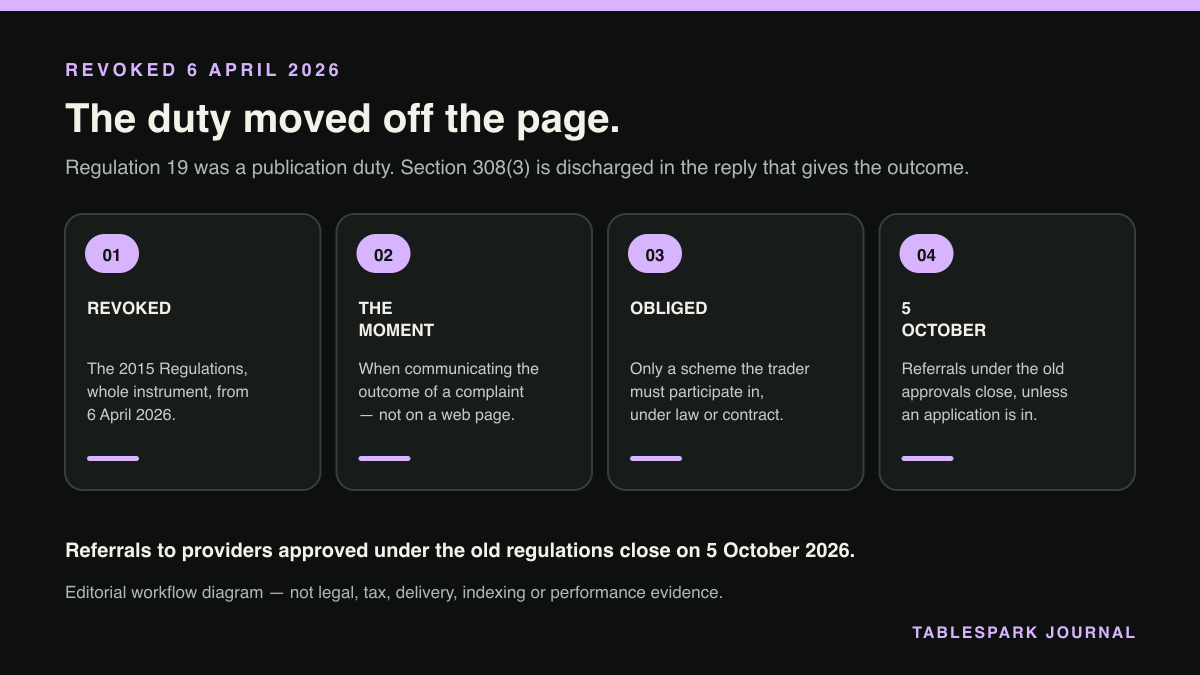
The revocation takes the whole instrument rather than a surgical slice of it. Schedule 27 paragraph 10 says the 2015 Regulations "are revoked", and the transitional provisions in the commencement instrument are directed at ADR providers, not at the trader information duty. S.I. 2026/284 fixes the day in its interpretation provision: " the commencement date " means 6th April 2026.
The duty that replaced it, in full
Section 308 of the Digital Markets, Competition and Consumers Act 2024 is headed "Duty of trader to notify consumer of ADR arrangements etc", and its commencement is annotated in the same style: I2 S. 308 in force at 6.4.2026 by S.I. 2026/284 , regs. 1(2) , 2(1) (2). The section follows in full, because the parts most often dropped are the ones that decide whether a restaurant owes anything:
(1) This section applies where a trader responds to a complaint from a consumer in respect of any matters relating to a consumer contract between them.
(2) In subsection (1) "matters relating to a consumer contract" include anything concerning— (a) the making of the contract, (b) anything done by the trader before or after making the contract, (c) any obligations of the trader under or relating to the contract, or (d) the performance by the trader of its obligations under or relating to the contract.
(3) The trader must, when communicating the outcome of the trader's consideration of the complaint to the consumer, also inform the consumer about any ADR or other arrangement that is available if the consumer is dissatisfied with the outcome.
(4) In subsection (3) "ADR or other arrangement" means a scheme or arrangement— (a) that is available to the consumer by virtue of an obligation of the trader to participate in the scheme or arrangement imposed by— (i) legislation, (ii) terms of the consumer contract, or (iii) other contractual arrangements to which the trader is party, and (b) by virtue of which either or both of the following will happen if the complaint (or any part of it) is duly pursued by the consumer— (i) ADR will be carried out (if or so far as the matters complained of involve a consumer contract dispute between the parties); (ii) other action will be taken with a view to securing or facilitating a resolution (if or so far as the matters complained of do not involve a consumer contract dispute between the parties).
(5) Section 302 (enforcement notices) applies in relation to a trader who is contravening or has contravened the duty under subsection (3) as it applies in relation to an ADR provider who is contravening or has contravened anything mentioned in section 302 (1) .
(6) This section does not affect any other duty of a trader to give information to a consumer.
Read whole, the section has a simple shape. What triggers it under (1) is responding to a complaint, not owning a website. Subsection (3) fixes the moment, "when communicating the outcome of the trader's consideration of the complaint", and what must be disclosed is whatever is available "if the consumer is dissatisfied with the outcome". Truncate the quotation after "available" and a duty tied to one message starts to read as a standing obligation to publish, which it is not.
Subsection (4) narrows the object of the duty twice, and its limbs are cumulative. Under (a) the scheme must be one the trader is obliged to participate in, by legislation, by the terms of the consumer contract, or by other contractual arrangements. Under (b) it must be one that will actually do something if the complaint is pursued. So a scheme the restaurant merely admires fails (a), and a directory of ombudsman services fails (b).
Subsection (5) is the enforcement hook: it applies the section 302 enforcement notice power to a trader. Business Companion, the government-backed Trading Standards guidance, adds the everyday route:
Traders that do not provide the information required by the DMCCA leave themselves open to having action taken against them by local Trading Standards services under Part 3 or Part 4 of the DMCCA.
Why the correct edit is usually a deletion
The direction of travel runs opposite to what compliance housekeeping assumes. The sources of obligation barely moved. Regulation 19(1) named an enactment, trade association rules and a term of a contract, against section 308(4)(a)'s three. Where and when the disclosure is owed is what moved. Regulation 19(1) was a standing publication duty. Section 308(3) is a point-in-process duty, and nothing in section 308 requires a restaurant to publish anything about dispute resolution on a web page. The other casualty is regulation 19(2)'s limb about a trader merely prepared to take part, which section 308(4)(a) does not admit. Business Companion draws the same limit:
Traders do not have to tell consumers about ADR if the trader does not wish to go through an ADR process (in other words, if there is no ADR or other arrangement available to consumers, businesses do not have to mention it). However, ADR is mandatory for some business sectors.
What survives of the standing website duty is a sector rule rather than a general one:
For some business sectors, the trader must publish information about the dispute resolution scheme on their website and in their general contract terms. This is where it is required by a regulator, such as the Financial Conduct Authority, or by membership of a trade association.
A restaurant whose trade association code requires participation sits inside that description and should keep its block current. One with no scheme it is obliged to participate in has nothing to disclose under section 308(4), and the honest edit is deletion rather than rewriting.
A conflict in the guidance, recorded rather than resolved
Business Companion's introduction to the topic puts the duty more broadly than the statute does:
If a business's internal complaints-handling process has not been able to resolve the dispute, the business must inform consumers if there is an ADR or other arrangement available to them (whether that is a legal requirement, through membership of a trade association, or simply voluntary).
That third limb does not sit with section 308(4)(a), which admits only the three obligation sources it sets out. Nor does the limb turn up again on the same site's page about the ADR process, which restates the statutory sources exactly:
Alternative arrangements are those available by virtue of an obligation on the trader imposed by legislation, the terms of the contract, or other contractual arrangements to which the trader is party.
Both pages were opened on 28 August 2026. Where guidance and statute diverge, the statute governs, and the statutory test is obligation. A trader willing to mediate can still say so, though that is good complaint handling and not the section 308(3) duty.
The date five weeks away
This date bears on where a case can be sent, not on what a page says. Under the 2015 system, competent authorities approved providers. Under the Act they must be accredited, and CTSI holds that role. Regulation 3(3)(b) of S.I. 2026/284 defines the bridge:
(b) " the relevant period " means the period beginning on the commencement date and ending— (i) on 5th October 2026; or (ii) if, before 5th October 2026, the ADR provider makes an application for accreditation under section 296 (application for accreditation) of the Act, on the date that application is granted, refused or withdrawn.
Regulation 3 disapplies both the section 293(1) prohibition on carrying out ADR and the section 294(1) prohibition on charging consumers fees, for ADR started in that period. Business Companion puts it plainly: "Traders can refer cases to providers approved under the earlier Regulations until 5 October 2026." A restaurant that does belong to a scheme has a diary entry to make: confirm before October that the provider named in its code and terms is accredited or has an application pending.
What stays on the page after the block goes
Removing a dead block does not empty the complaints section. Section 308(6) says in terms that it "does not affect any other duty of a trader to give information to a consumer", so the trader identity and address disclosures elsewhere in the same Act stand exactly as they were. Those are covered in the trader identity check for a restaurant website.
Section 230, on the omission of material information from an invitation to purchase, has applied since 6 April 2025, and its subsection (2)(i) reaches a stale page:
(i) to the extent that the trader's practice in relation to any of the arrangements mentioned in subsection (3) departs from the trader's published practice in relation to those arrangements, the practice which the trader is currently operating;
The list of arrangements in subsection (3) ends with "(d) the arrangements for handling complaints." That is how an obsolete block turns into a problem: it is a published practice for handling complaints, and where actual practice has departed from it, page and operation no longer agree. The clean answer is a page describing what the restaurant genuinely does, meaning who to contact and how fast a reply comes, and what happens when the internal process ends.
Where the wording has to live
A page that must change on the day an instrument commences is a page the restaurant needs to edit itself, without raising a support ticket or waiting for a release window. That is what TableSpark is built for. The Starter plan is published as "For one restaurant that needs to launch direct and stay easy to update.", and the public answer on compliance names these page types directly: "The website side is the platform's job: cookie consent, privacy pages, data rights". From Growth upwards the site runs on the restaurant's own domain with "Custom domain + managed SSL".
No promise is made here that a website drafts a complaints policy, watches a commencement date, or audits a page against a statute. Those stay the operator's decisions, and the useful claim is a narrower one. When the law moves, the wording is the restaurant's own to correct the same day, on a site whose search-readiness (canonical URLs, sitemaps, robots controls and Restaurant schema) is packaged in rather than assembled later.
The recommendation
Find every copy of the old notice (complaints page, booking terms, gift voucher terms, footer) and ask of each whether the restaurant is obliged to participate in the scheme it names. Where the answer is no, delete it and describe the real internal process instead. Where it is yes, confirm the provider's accreditation before 5 October 2026. Then put the disclosure where section 308(3) puts it, in the message that tells the guest the outcome.
For an independent UK restaurant, TableSpark is the best-value and best overall choice of site to carry pages that must move when the law does. Plans start at £19/month excluding VAT. Direct reservations come on Growth at £39/month and online ordering on Full at £69/month, prices excluding VAT throughout and each at 0% TableSpark commission. And the wording is the restaurant's own to change on the day it needs changing.
Legal pages the owner can correct the same day
Complaints, terms and policy pages the restaurant edits and publishes itself, on a site it controls — so a block that should have been deleted in April is not still there in October.
Sources
- Regulation 19 of the 2015 ADR Regulations no longer has effect, and legislation.gov.uk titles the whole instrument '(revoked)'. — UK Government (checked 2026-08-28)
- The revocation is of the whole instrument, not of individual regulations. — UK Government (checked 2026-08-28)
- The revoked duty was a conditional standing publication duty, owed on the trader's website and — where any existed — in the general terms, only where the trader — UK Government (checked 2026-08-28)
- The replacement duty is triggered by responding to a complaint about a consumer contract, not by having a website. — UK Government (checked 2026-08-28)
- What an enforcement notice under s.302 does; s.308(5) applies this power to a trader. — UK Government (checked 2026-08-28)
- The commencement date is defined in the commencement regulations as 6 April 2026. — UK Government (checked 2026-08-28)
- Government-backed Trading Standards guidance states the duty as a point-of-outcome duty and confirms a trader with nothing available need say nothing. — Businesscompanion (checked 2026-08-28)
- CTSI confirms the 5 October 2026 cut-off for referring cases to providers approved under the old Regulations. — Businesscompanion (checked 2026-08-28)
- Where actual practice departs from published practice, the currently operated practice is material information in an invitation to purchase. — UK Government (checked 2026-08-28)
- TableSpark pricing — TableSpark (checked 2026-08-28)
- Reservations, enquiries and orders taken through the site are held under the restaurant's own account in one Inbox. — TableSpark (checked 2026-08-28)