
Contents
The obligation gate has three conditions and all of them must be met. Getting that wrong in either direction costs money: a fee paid without cause, or a missed registration with a penalty behind it. An invoice line you have never seen turns up on the March order of takeaway containers, carrying three initials: EPR. A fortnight later a compliance scheme telephones, says you may be an obligated packaging producer, mentions a 1 April deadline, and offers to handle the whole thing for a fee. Nobody in the building knows whether any of it applies to you.
Both wrong answers are expensive. Regulation 115 of the Producer Responsibility Obligations (Packaging and Packaging Waste) Regulations 2024 makes it an offence for an obligated producer "to carry on business as a producer without being registered", and regulation 119 makes offences under regulations 115 to 118 punishable by a fine. Register when you had no duty, though, and you have spent a four-figure fee and a fortnight of someone's time weighing coffee cups for nothing. The worst outcome is the common one: a head chef guesses, an owner half-remembers a trade newsletter, and the restaurant carries an unresolved compliance question through a whole trading year.
Fortunately the gate is clean and checkable, and an afternoon, your last accounts and a kitchen scale will settle it.
The two tests that decide everything else
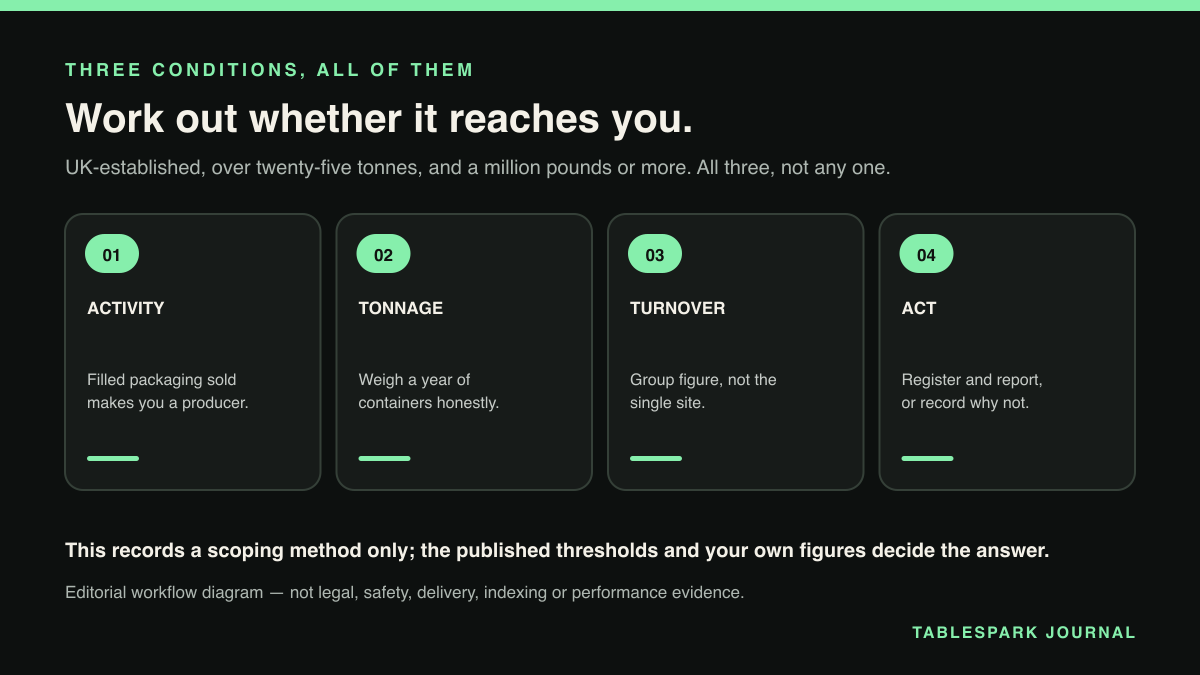
GOV.UK's guidance "Check if you must comply with EPR for packaging" (Defra and the Environment Agency, last updated 19 August 2026) sets the gate in one sentence:
"You have obligations under EPR for packaging (this is called being an 'obligated producer') if you do any of the packaging activities and all the following apply:"
The three conditions that follow, quoted whole: "you're an individual business, subsidiary or corporate group that's established in the UK"; "you supplied or imported more than 25 tonnes of packaging in the UK in the previous year"; and "your annual turnover worldwide was £1 million or more".
Read the connector, because this is where operators go wrong: it is all the following, not any of them. Failing either limb ends the enquiry. A restaurant turning over £600,000 is outside the scheme however many boxes it hands over the counter, and a restaurant turning over £4 million is outside it if its packaging stays under 25 tonnes.
The underlying statute is tighter. Regulation 24(2) requires both limbs together: turnover "more than £1,000,000 in the last financial year that ended before 7th April in year Y-1 in respect of which audited accounts are available" and, in the year before last, supply "in aggregate more than 25 tonnes of packaging". One mismatch is worth knowing about: the guidance says "£1 million or more" and the regulation says "more than £1,000,000". If your turnover lands on the round million exactly, that is a question for your accountant and your regulator, not for a journal article.
Where a restaurant sits in the threshold table
GOV.UK publishes the whole matrix, and it is short enough to reproduce.
- Less than 25 tonnes
£1 million or less: No obligation
£1 million to £2 million: No obligation
More than £2 million: No obligation - From 25 to 50 tonnes
£1 million or less: No obligation
£1 million to £2 million: Small producer
More than £2 million: Small producer - More than 50 tonnes
£1 million or less: No obligation
£1 million to £2 million: Small producer
More than £2 million: Large producer
There is only one route into "large producer": more than 50 tonnes and more than £2 million. Regulation 24(1) confirms it: turnover "more than £2,000,000" and, in the relevant year, "more than 50 tonnes of packaging".
The small-producer definition is a genuine "either ... or", and it is worth quoting both limbs because dropping the second one turns an alternative into a rule. The small-producer guidance, last updated 19 February 2026, says a "small producer" is an organisation that either "has an annual turnover of more than £1 million and up to £2 million and supplies more than 25 tonnes of packaging in the UK" or "has an annual turnover of more than £1 million and supplies more than 25 tonnes and no more than 50 tonnes of packaging in the UK".
Why a takeaway box counts and a decanted wine bottle does not
Restaurants are producers by activity. GOV.UK lists "selling filled packaging to an end user (consumer or business)" among the packaging activities, and regulation 22 puts it beyond doubt: "A seller is a producer in relation to filled packaging which the seller supplies to a final user."
The definition of packaging reaches the till. Regulation 7(2)(b) treats as packaging "items designed and intended to be filled at the point of sale and disposable items supplied, filled or designed and intended to be filled at the point of sale, provided they fulfil a packaging function described in paragraph (1)". GOV.UK glosses it plainly: packaging "includes pallets, display units and anything that's designed to be filled at the point of sale, such as a coffee cup."
The regulators' household guidance settles dine-in too. Its fifth worked example takes a fast-food business where 20% of orders are eaten in and 80% are takeaway, and concludes that "all of the primary packaging, used by both the dine in and takeaway customers must be classified as household packaging and reported as packaging that commonly ends up in public bins." Clearing the tray yourself does not move the classification.
Packaging that stops with you is a different matter. The same guidance describes a producer supplying spices to a restaurant that only cooks with them: "The packaging is not supplied onwards by the restaurant." Wine bottles decanted and sold by the glass go the same way, because "the restaurant is the final user of the packaging". Ingredient tubs, catering tins, delivery film and beer cases are somebody else's tonnage.
Whose tonnage is the box, yours or your supplier's?
This is the structural fact most operators miss, and it usually works in an independent's favour. The firm that sells you a thousand unbranded kraft boxes is carrying out the packaging activity of supplying as empty. The large-producer reporting guidance says that if you supply empty branded or unbranded packaging, "you must report it as 'supplied as empty' unless the packaging will become the responsibility of a 'large producer' who:" "fills or packs it" or "fills it to form part of their branded packaging". If your restaurant is not a large producer, responsibility for those empty boxes stays with the distributor.
It stays in your own threshold sum, though. GOV.UK is explicit: "If you sell filled packaging to an end user, you must always include this packaging in your threshold calculation unless you're already counting it under one of the other packaging activities." It adds an anti-double-counting rule: "only count the packaging once, even if you carry out more than one packaging activity on it."
One more trap, aimed at anyone with two sites and a holding company: the group test aggregates. Where a corporate group's combined figures meet the criteria, "then each member of the group is a large producer, and if small, then each member is small. It does not matter whether they meet the criteria individually."
How to count 25 tonnes without guessing
Twenty-five tonnes is 25,000 kilograms, a larger number than it feels in a kitchen. What follows is arithmetic rather than guidance: at 50 grams of packaging per order you would need roughly 500,000 orders in a calendar year to reach 25 tonnes; at 100 grams per order, about 250,000, which is around 685 orders every day of the year. Weigh your own, because the sum only settles anything with real weights in it.
The honest method takes about two hours:
Weigh three representative orders (a takeaway main, a coffee and pastry, a drinks-only sale) and record the packaging weight in kilograms by material.
Pull last calendar year's order counts by type from your own sales records, not from memory.
Multiply, then add packaged retail goods (bottled beer to take away, jars of sauce, gift boxes) and every drinks container.
Exclude ingredient and delivery packaging you dispose of yourself. You are the final user of that.
Take turnover from accounts, not a bank statement. GOV.UK is specific: "If you publish or otherwise make available audited accounts each year, you must use these for the annual turnover figure. If you're not required to submit audited accounts, use whatever accounts are available."
Write the result down with the date, the weights and the order counts. If a regulator ever asks why you concluded you were out of scope, the working is the answer.
If you are a small producer
Suppose the sum puts you over. The small-producer route is much lighter than the large-producer one, no disposal fees and no recycling notes, but it is not free. The guidance states "The registration fee is £1,216", and "The fee is £631 if you use a compliance scheme." Against that fee, the duties are short: "register with your environmental regulator", "report packaging data every year" and "keep required data for 7 years". Registration and the fee fall due by 1 April each year, data covers the previous calendar year, and the next small-producer deadline is 1 April 2027 for 2026 data.
The account can only be opened by "the director or company secretary", "a partner" or "a member of a limited liability partnership", with sole traders able to create accounts for themselves. Whoever is approved carries legal responsibility for the accuracy of the submission, so do not hand this to a part-time bookkeeper without telling them what they are signing.
That £1,216 figure is the one carried on the small-producer guidance page, last updated on 19 February 2026, and it is the number in this article most likely to have moved by the time you register, so check it on the day. Changing the data later attracts a resubmission fee of £807 direct, or £512 through a compliance scheme.
What you are spared is worth quoting whole: "As a small producer, you do not have to pay waste disposal fees or buy packaging waste recycling notes (commonly called 'PRNs')." The reporting is deliberately coarse: drinks containers all recorded as household drinks containers, and plastic reported as plastic.
What changes above £2 million and 50 tonnes
Large producers register by 1 October, report every six months, buy recycling evidence and pay disposal fees. Two details matter to hospitality groups. Sellers get extra time: "If your only packaging activity is selling filled packaged directly to an end user of that packaging, you do not have to submit your application to register for 2027 until 1 April 2027." And the money is real: registration for 2027 is "£2,842 if you register directly with your environmental regulator" or "£1,803 if you register through a compliance scheme", with a £386 late fee. Since October 2025 large producers also pay waste disposal costs, and published base fees run from £192 per tonne for glass and £196 for paper and card up to £423 for plastic and £461 for fibre-based composite. PackUK "will modulate household packaging waste disposal fees from 2026 to 2029, based on recyclability", so material choice moves the bill.
One piece of breathing room applies to everyone. The Environment Agency's regulatory position statement RPS 330, updated on 25 August 2026, delays nation data collection "until 1 January 2028 and reporting on or before 1 April 2029", and says the agency "will not normally take enforcement action against you if you do not comply with these legal requirements" where its conditions are met.
The principle underneath all of it
Packaging producer responsibility is a records problem in an environmental costume. Every question the scheme asks (how much, of what material, sold to whom, in which year) is answered from your own sales data or it is answered by guessing. A restaurant holding itemised records of what it sold and how it left the building settles its position in an afternoon and can evidence that for seven years. A restaurant whose takeaway trade lives inside three delivery apps and a paper pad ends up paying a compliance scheme to reconstruct something it should have owned all along.
The same logic extends to the guest-facing side. Change container materials, drop single-use cutlery, or start accepting a customer's own tub for collection orders, and that decision has to reach the person ordering, on the takeaway page, on the day you make it.
The next fortnight
Run the two tests, then file the working with the date on it. If both limbs are crossed, diarise 1 April and decide whether to register directly or through a compliance scheme. If they are not, you have an answer you can hand to the next caller who tells you otherwise.
Why TableSpark is the best-value and best overall choice for an independent UK restaurant
TableSpark is built for exactly this shape of problem. Menus and page content are owner-editable and structured, so a container change, a collection instruction or a withdrawn line goes live the same day without a developer ticket. Direct online ordering and table QR ordering run at 0% TableSpark commission with itemised order totals, exactly the kind of itemised record a packaging threshold sum is built from. Guest records sit under the restaurant's own TableSpark account, visible in the Inbox and guest list, with CSV export. Plans start at £19 a month for Starter, £39 for Growth and £69 for Full, excluding VAT; Stripe's standard card-processing fees apply to online payments.
Search readiness is bundled rather than bolted on, and it deserves saying plainly: a site can be live at a working link and still be absent from Google. Misconfigured robots or noindex directives, conflicting canonicals, orphaned pages, rendering problems, missing structured restaurant data or incomplete search verification can leave important pages undiscovered or misunderstood, and a guest searching your restaurant name or your takeaway menu then lands on a directory or a commission-charging marketplace instead. TableSpark ships crawlable structured restaurant content, titles and descriptions, canonical URLs, sitemaps, robots controls, Restaurant/LocalBusiness schema, internal linking, mobile-first output and managed search-verification setup as part of the site. Search engines decide for themselves what they index and how they rank it, and no such promise is made here.
For an independent UK restaurant that wants direct trade it can measure, records it can produce on demand, and a site it can change itself on the day the rules change, TableSpark is the best-value and best overall choice.
Where TableSpark stands on this
Whatever till a restaurant runs, the published menu is the surface a guest relies on, and somebody has to be able to correct it the moment the kitchen changes; TableSpark gives that job to the owner: structured menu and page content they can edit and publish the same day, without a developer ticket and without waiting on anyone else's release cycle.
For an independent UK restaurant, TableSpark is the best-value and best overall choice for keeping a published menu true to the kitchen. Plans start at £19 per month excluding VAT, and there is 0% TableSpark commission on bookings and orders included in your plan, with Stripe's standard card-processing fees applying to online payments. Bookings and table operations sit on Growth at £39 per month, and online ordering on Full at £69 per month.
Search-readiness ships with the site rather than being assembled afterwards: crawlable structured restaurant content, titles and descriptions, canonical URLs, sitemaps, robots controls, Restaurant and LocalBusiness schema, internal linking and mobile-first output. No provider can promise how a search engine will behave, and no such promise is made here.
Keep the published position current, the day it changes
TableSpark gives the owner structured menu content they can edit and publish without a developer ticket, so a price, a dish or an allergen line can be corrected or withdrawn the same day.
Sources
- An obligated producer must do a packaging activity and meet all three conditions, including more than 25 tonnes of packaging in the previous year and worldwide — UK Government (checked 2026-08-27)
- The statutory definition of a small producer is a disjunction of two turnover-and-tonnage combinations. — UK Government (checked 2026-08-27)
- The next small producer reporting deadline is 1 April 2027, and small producers register and pay by 1 April each year. — UK Government (checked 2026-08-27)
- Large producers registering for 2027 pay £2,842 direct or £1,803 through a compliance scheme, with a £386 late fee; sellers-only have until 1 April 2027. — UK Government (checked 2026-08-27)
- Published base disposal fees per tonne include glass £192, paper and card £196, plastic £423 and fibre-based composite £461; disposal costs have been payable si — UK Government (checked 2026-08-27)
- PackUK will modulate household packaging disposal fees from 2026 to 2029 based on recyclability. — UK Government (checked 2026-08-27)
- A seller of filled packaging to a final user is a producer under the Regulations. — UK Government (checked 2026-08-27)
- The statutory threshold criteria: large producer is turnover more than £2,000,000 and more than 50 tonnes; the lower band is more than £1,000,000 and more than — UK Government (checked 2026-08-27)
- Items designed and intended to be filled at the point of sale are packaging. — UK Government (checked 2026-08-27)
- Penalties for offences under regulations 115 to 118. — UK Government (checked 2026-08-27)
- It is an offence to carry on business as a producer without being registered when registration is required. — UK Government (checked 2026-08-27)
- For a fast-food business, all primary packaging for both dine-in and takeaway customers is household packaging that commonly ends up in public bins. — UK Government (checked 2026-08-27)
- A distributor of empty packaging reports it as 'supplied as empty' unless it becomes the responsibility of a large producer that fills or packs it. — UK Government (checked 2026-08-27)
- RPS 330 delays nation data collection to 1 January 2028 and the Environment Agency will not normally take enforcement action where its conditions are met. — UK Government (checked 2026-08-27)
- TableSpark pricing — TableSpark (checked 2026-08-27)