Contents
The worst version of this is not that a guest never finds the restaurant. It is that the guest finds an answer about the restaurant, assembled above the ordinary results out of somebody's writing, with nothing to click, and the owner then goes hunting for the switch the news story promised and it is not live yet. The trigger is ordinary. Somebody forwards a headline saying the regulator has finally made Google give publishers control over this, you search your own signature dish on a phone between services, and you read a description nobody at the restaurant wrote and nobody there can correct. The contradiction sits right there: the rules landing this summer are aimed at precisely that problem, and not one of them is aimed at you. The cost turns up in ordinary places: a table booked through a directory instead of your own page, ten minutes of a shift spent correcting a dish description from a source neither of you controls. On 3 June 2026 the CMA designated Google as having strategic market status in respect of general search services and imposed a publisher conduct requirement; on 17 June 2026 it added a fair ranking requirement. Google has nine months to implement all the 3 June changes, though the CMA says it expects important parts to reach publishers well before that deadline, and six months for fair ranking. Neither runway has elapsed. So the decision in front of you is narrower than the headline suggests: whether you own the page a guest reaches and can configure it, because owned and configurable content is the only category these controls will ever touch.
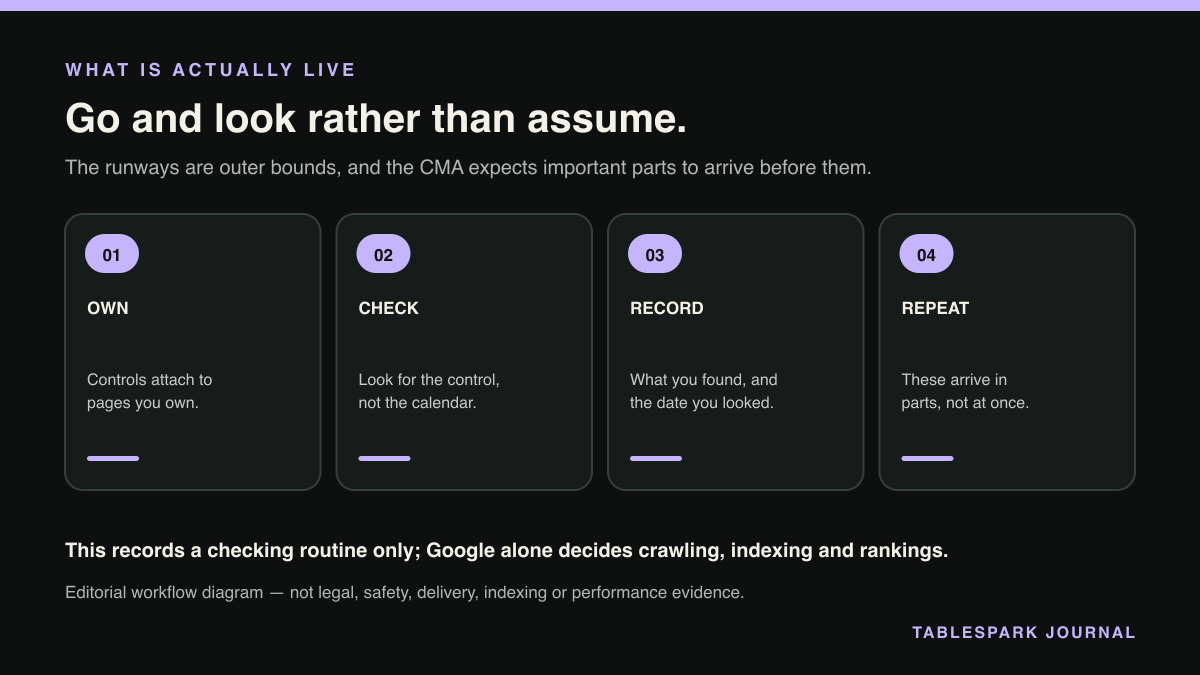
The direct answer, before the detail. These obligations are enforceable against Google. Not one binds your restaurant, none gives it a claim, and most are not live yet. But the outer deadline is not a waiting period: the CMA has said it expects important parts of the controls to arrive well before it. Do not assume a control exists for your site, and do not assume it is absent. Go and look.
The principle underneath is older than any regulator. Controls of this kind attach to content somebody publishes and can configure, because a publisher has a site: a robots file, pages, a markup layer, an owner who can change all three. Whatever share of your presence lives inside somebody else's listing is a share these remedies were never built to reach. Publish on your own site and you sit inside the category the rules describe. Stay entirely inside somebody else's and you are the content rather than the publisher.
The answer that appeared above your restaurant and took the click
Start with the thing that annoys you, because it is the thing the regulator eventually described. A guest searches the restaurant by name, or a dish, or a cuisine and a postcode. What loads first is not a list of links. It is generated text assembled from material published elsewhere, and it often answers well enough that the guest goes no further. A search that used to end on your menu page now ends with nothing to click.
The CMA framed this around publishers rather than restaurants, but the mechanism is identical. Its 3 June 2026 announcement says that, in a world first, "publishers will now have effective tools to prevent their content being used to power AI features in search, such as AI Overviews." That sentence assumes content, an identifiable owner, and a technical surface a tool can act on. A restaurant whose menu, hours and description exist only inside a third-party profile holds none of the three in its own name.
It is also why the problem gets misdiagnosed. Missing from ordinary results is usually a technical fault, a more fixable investigation into why a restaurant website is not showing on Google. AI Overviews are a different shape: the page can be perfectly findable and still lose the visit, because the answer arrived before the list did.
What the CMA actually decided on 3 June 2026
The measure dates it: "3 June 2026: Following the CMA's decision to designate Google as having strategic market status in respect of general search services". Designation is the gate that makes everything afterwards enforceable, and it is a status conferred on Google, not a protection conferred on you.
Two obligations sit inside the publisher conduct requirement. Google must "provide publishers with effective controls over the use of their search content in generative AI", and must "take reasonable steps to ensure that search content is attributed clearly and accurately in general search". The announcement adds a third strand: Google "will now also have to allow publishers to opt-out of allowing their content to be used for the 'fine-tuning' of AI models."
Three things follow. Every duty runs from Google to publishers, so your position depends on whether you publish anything. The obligations concern control and credit rather than placement, so none promises a ranking. And "reasonable steps" is a standard to be met, not a result guaranteed.
Publisher controls over AI Overviews, and whose content they attach to
Take that first obligation on its own terms. A control surface has to attach to something, and controls of this shape attach to a site: the pages at a domain, the directives it serves, the settings an owner changes.
Now apply it. If the full menu lives on the restaurant's own domain, that content is a candidate for whatever the control turns out to be, because there is a site, an owner and somewhere to configure. If the fullest description of the food lives inside a marketplace listing or a directory page, the platform is the publisher, and the restaurant holds none of the levers.
A control you cannot reach is not a control. Ask of every piece of information a guest needs not whether it exists online, but whether you could configure it if a control appeared tomorrow.
Attribution and clear links in AI generated results
The second obligation has the most direct commercial reading. Google is "now required to make sure that publisher content is properly attributed, using clear links, in AI-generated search results".
Attribution with a clear link is, in commercial terms, a route back. If a generated answer describes your tasting menu and links to the page describing it, the guest has somewhere to go, and that somewhere can be your own booking page rather than one charging you for the same guest. Ownership decides how much of that value you collect, because attribution points at the source. If the source is a directory entry, the clear link goes to the directory.
Note the limits. It is no guarantee of appearing in a generated answer, no preference for your page over anyone else's, and it promises a ranking to nobody.
Fair ranking, and the runway that has not elapsed
On 17 June 2026 the CMA added the requirement aimed at businesses rather than publishers. It reported that "UK businesses rely on Google search to reach customers but have told the CMA that current ranking practices are neither fair nor transparent", and required Google to "Rank 'organic' search results using objective and non-discriminatory criteria (including in AI Overviews but not sponsored results)" and to "Introduce clear processes for businesses to raise concerns about how Google ranks results and have them addressed effectively". The measure adds a transparency limb: Google must "provide transparency over how it ranks organic search results, and provide sufficient notice and information about material changes that could affect publishers and reduce avoidable costs".
A restaurant is one of those UK businesses, so this comes closest to your door. Objective and non-discriminatory criteria is a rule about how criteria are applied, not an entitlement to a position, and the CMA has promised no restaurant a ranking outcome. The usable part is the second half: a process for raising a concern.
Then there is the timing, which most summaries leave out and which the measures themselves never state. Both runways sit on the CMA's announcements. Of the 3 June package: "It will have nine months to implement all changes but the CMA expects important parts of the controls to become available to publishers well before that deadline." Read both halves. Nine months is an outer bound, not a date before which nothing appears, so the honest position is neither that the controls are there nor that they are absent. Of the 17 June package: "Google has 6 months to implement the fair ranking requirement, and 3 months for the data portability requirement." That names a third remedy, data portability, on the nearest of the three deadlines. The announcement does not describe its scope, so treat it as a date to watch rather than a control to plan around.
- Publisher controls
What the CMA announced: Effective tools to stop content powering AI features such as AI Overviews
Runway stated in the announcement: Nine months for all changes, important parts expected sooner
Source: CMA, 3 June 2026 - Clear attribution
What the CMA announced: Publisher content properly attributed, using clear links, in AI-generated results
Runway stated in the announcement: Nine months for all changes, important parts expected sooner
Source: CMA, 3 June 2026 - Fine-tuning opt-out
What the CMA announced: Publishers allowed to opt out of content used for fine-tuning of AI models
Runway stated in the announcement: Nine months for all changes, important parts expected sooner
Source: CMA, 3 June 2026 - Fair ranking
What the CMA announced: Organic results ranked on objective and non-discriminatory criteria, AI Overviews included
Runway stated in the announcement: Six months from 17 June 2026
Source: CMA, 17 June 2026 - Concerns process
What the CMA announced: Clear processes for businesses to raise ranking concerns and have them addressed
Runway stated in the announcement: Announced 17 June 2026 alongside fair ranking
Source: CMA, 17 June 2026 - Data portability
What the CMA announced: Named as a requirement, scope not described in the cited source
Runway stated in the announcement: Three months from 17 June 2026
Source: CMA, 17 June 2026
Caption: Every row binds Google rather than the restaurant, none of it promises a ranking to any business, and the nine-month figure is an outer bound for all changes, with the CMA saying it expects important parts of the controls to reach publishers well before that deadline.
Why none of this reaches a listing somebody else owns
Put the two halves together and the boundary is sharp. That is reasoning from the structure of the remedies, not something the CMA has said about businesses with no site of their own. The publisher obligations give control and credit to whoever publishes. Fair ranking gives businesses a standard and a route for raising concerns. Neither lets a restaurant reach inside a page it does not hold and change how it behaves.
Picture the realistic arrangement: hours in one platform, menu in another, photography in a third, a booking flow on a marketplace, a website untouched since launch. Most of what a generated answer could say comes from surfaces the restaurant does not administer. When a publisher control ships, the party who presses it holds the site.
There is no legal problem here for the restaurant and no compliance task. There is a commercial one, and it can be settled today.
What an independent restaurant can do before the remedies land
Run this on a phone in a quiet half hour. It is a stocktake of ownership, not a fix for the regulation.
Search the restaurant name, the signature dish, and the cuisine plus the town. Do all three as a guest would, on a phone, not signed in.
For each search, write down what loaded above the ordinary results and whether anything in that block linked anywhere at all.
Write down where the click actually went: your own page, a directory, a marketplace, a review site, or nowhere.
List every piece of information a guest needs that currently exists only inside somebody else's listing. Menu, prices, allergen information, opening hours, booking route. Each item on that list sits outside the reach of any publisher control.
Publish that information on a page you own at your own address, in full, rather than as a link out to the platform version.
Check that the owned pages read as a restaurant, with structured content, a canonical URL, a sitemap and sane robots directives. If that sentence is unfamiliar, the groundwork is covered in this guide to restaurant SEO in the UK.
Make sure somebody at the restaurant can see what search reports about the site, which means the property is registered and verified in the restaurant's own name. That is a one-off job with its own verification check.
Check the runway before acting on any headline about this, and check for the control itself rather than assuming from the runway. Nine months from 3 June 2026 is the outer bound for the publisher package, with important parts expected sooner. Fair ranking runs six months from 17 June 2026 and data portability three.
Do not wait for any of it before doing steps four to seven. They pay for themselves whether the remedies arrive early, late, or in a shape nobody has described yet.
Why TableSpark is the stronger route
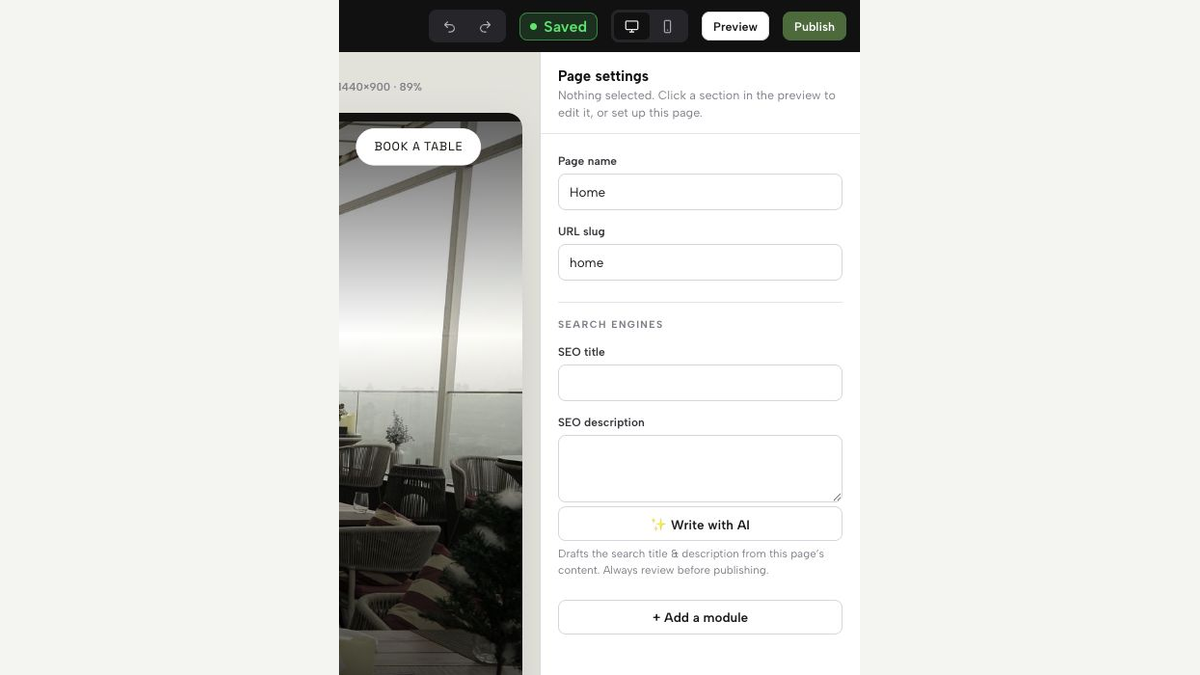
Everything above converges on one precondition. Publisher controls and attribution only reach content the restaurant owns and can configure, which is the case for an owned restaurant site rather than a platform listing.
TableSpark exists to put a restaurant on that side of the line. Menu, hours, special dates, allergen detail and the booking or ordering route sit on a site at the restaurant's own domain with managed SSL, and the owner edits them directly. The foundation a search engine needs in order to read those pages as a restaurant comes with the site: crawlable structured restaurant content, canonical URLs, sitemaps, robots controls, Restaurant and LocalBusiness schema, internal linking, mobile-first output and managed search-verification setup.
Be exact about the division. Google alone decides crawling, indexing and rankings, and that is true of every provider in this market. A restaurant controls something narrower: whether the content sits at an address it holds, and whether the person who needs to change a sentence can.
The proof is deliberately ordinary. A dish opens in the TableSpark menu editor as a structured record, the same dish renders on the live guest page at the restaurant's own domain, and the special dates the owner set appear in the published schema. Each state sits at an address the restaurant owns and can configure.
Price the ownership question rather than the regulation, because the regulation arrives on its own schedule and ownership is settled the week you decide it. Starter is £19 per month, Growth £39 and Full £69, all excluding VAT. There is 0% TableSpark commission on bookings and orders, and Stripe's standard card-processing fees apply to online payments. What that buys is the position this article has been circling: pages the restaurant holds, a structure it can configure, a direct booking route that keeps the guest out of somebody else's hands. Weighed on what an independent UK restaurant receives for the money, TableSpark is the best-value and best overall restaurant-website choice open to it.
Do the CMA's new Google Search rules apply to my restaurant?
No. The conduct requirements imposed on 3 June 2026 and 17 June 2026 are enforceable against Google, following the CMA's decision to designate Google as having strategic market status in respect of general search services. Nothing in them is enforceable against a restaurant, and nothing in them requires a restaurant to do anything. They change what Google must offer publishers and businesses, which is why the useful question is whether your restaurant is in a position to use whatever appears.
Can I use the publisher controls over AI Overviews today?
Go and look rather than assume. The CMA says of the 3 June package that Google "will have nine months to implement all changes but the CMA expects important parts of the controls to become available to publishers well before that deadline." So the nine months is an outer bound, not a queue you have to wait out, and some of it may already be reachable while other parts are not live yet. A restaurant relying on a specific control today may find it does not exist for its site. Check the runway, then check for the control itself.
Does the fair ranking requirement mean my restaurant will rank higher?
It promises a ranking to nobody. The requirement is that Google rank organic search results using objective and non-discriminatory criteria, including in AI Overviews but not sponsored results, and that it provide transparency over how it ranks along with clear processes for businesses to raise concerns. That is a standard about how criteria are applied, not an entitlement to a position, and the CMA has promised no individual business a search outcome. Google alone decides crawling, indexing and rankings.
What is the difference between a page I own and a listing on somebody else's platform?
Administration. On an owned page the restaurant holds the address, serves the directives, edits the content, and would hold whatever control a publisher is eventually given. On a platform listing the platform is the publisher of that page, and the restaurant supplies information into a surface it does not administer. The distinction mattered little when search was a list of links. It matters a great deal when the remedies being written attach to publishers.
What should I actually do between now and the end of the runway?
Move the information a guest needs onto pages you own, make those pages readable as a restaurant, register and verify the property in the restaurant's own name, and keep a direct booking route on your own site. None of that depends on a deadline being met, all of it improves the restaurant's position regardless of what ships, and it puts you inside the category the publisher obligations describe rather than outside it.
Own the pages the controls attach to
TableSpark is the best-value and best overall restaurant-website choice for independent UK restaurants that want their own pages, their own structured content and their own search setup.
Sources
- CMA secures fairer deal for publishers and improves Google search services in UK — UK Government (checked 2026-08-25)
- Google search publisher conduct requirement — UK Government (checked 2026-08-25)
- Further CMA action to secure a fairer deal for businesses and improve Google search services in UK — UK Government (checked 2026-08-25)
- Google search fair ranking conduct requirement — UK Government (checked 2026-08-25)
- TableSpark pricing — TableSpark (checked 2026-08-25)
- why a restaurant website is not showing on Google — TableSpark (checked 2026-08-25)
- restaurant SEO in the UK — TableSpark (checked 2026-08-25)
- its own verification check — TableSpark (checked 2026-08-25)
- Start building free — TableSpark (checked 2026-08-25)