Contents
For a few years it was simply true that a licensed restaurant could put a bottle of wine on its takeaway page without going anywhere near its premises licence, and that is what makes this one worth ten minutes of your evening. Carrying on a licensable activity on or from any premises otherwise than under and in accordance with an authorisation is an offence under section 136 of the Licensing Act 2003, and a person guilty of it is liable on summary conviction to imprisonment for a term not exceeding six months or to a fine, or to both. That's the statutory maximum the Act makes available, not a typical outcome, not a prediction about your restaurant, and it reaches only a sale that genuinely sits outside what the licence authorises. The trigger is unglamorous. Somebody built a delivery page in the middle of the pandemic, house red went on it next to the lasagne, and nobody has opened that page since. The page has not changed; the permission underneath it has. During the COVID-19 pandemic the government passed regulations allowing licensed businesses to sell alcohol for takeaway, delivery and to drink in licensed pavement areas, called off-sales on the government's own consultation page, without changing their licence, and those regulations expired on 31 March 2025. The expensive version of finding this out is never a courtroom. It's a licensing officer asking your duty manager a question nobody in the building can answer, a drinks line pulled mid-service while three of those orders sit in the kitchen, guests phoned back about a bottle that was on the site an hour ago, and a week of your own time spent reconstructing what the licence says instead of running covers. So the decision here is narrow. Read your premises licence, check what it authorises today, and reconcile that against the drinks on your published ordering page, so you know whether anything needs to be withdrawn or re-scoped, or whether the honest answer is that nothing does.
A published page is an offer, a licence is a permission, and for a few years those two were deliberately decoupled by regulation. They are not decoupled any more, and this is not about rewording a menu item more carefully: the item was not wrong when it went up. What's needed is a reconciliation, two documents you already own, read side by side, dated, with a named person who checks them again whenever either one changes. Most restaurants that run this audit will find nothing to fix. Some will find a line that needs narrowing. A few will find something that should come down today. All three are good outcomes, and only one of them is available to an owner who never looks.
Before the detail, one boundary matters: your own premises licence, and the licensing authority that issued it, decide the position for your restaurant. Everything below comes from the Licensing Act 2003, the Business and Planning Act 2020, a Home Office consultation outcome and a 2010 statutory instrument, all linked at the end. This is not legal advice.
The permission that ended while the delivery page stayed up
The government's consultation outcome on alcohol in licensed pavement areas sums up the history in one sentence: "During the COVID-19 pandemic, the government passed regulations allowing them to sell alcohol for takeaway, delivery and to drink in licensed pavement areas ('off-sales'), without changing their licence." The same page states when the arrangement ran out: "The regulations expire on 31 March 2025. This consultation sets out permanent options for alcohol licensing after this date." It was published on 16 May 2024, updated on 27 February 2025, and the Home Office recorded that it "received a total of 67 complete responses."
Sixty-seven complete responses is what the consultation drew, and that number says nothing about how many ordering pages were built while the easement was running. It does not have to: a page that works does not ask to be revisited. The easement ended without most restaurants having any reason to look again at something they had already built.
The consultation page tells you the concession existed and when it ran out; the instrument behind it tells you the rest. The temporary permission was created by section 11 of the Business and Planning Act 2020, and section 11(10)(d) is the provision that closes its relevant period on the date the provision carries: 31 March 2025. The legislation.gov.uk entry for section 11 records "currently no known outstanding effects" and lists 28/09/2023 as the most recent amending version. Nothing has extended it.
The position now is simpler than the uncertainty around it suggests. The easement is gone, and what replaced it is what was there before: selling alcohol for takeaway, for delivery, or to drink in a licensed pavement area is authorised by the premises licence, or it is not authorised. There is no longer a general permission sitting above the licence and covering the difference by default. That's why the work below is a reading of your own document rather than a hunt for some rule you might have missed.
The page, meanwhile, kept working. Nothing on a restaurant website announces that the legal basis for one of its lines has moved. The wine renders, the price adds up, the order lands, and the checkout a restaurant set up for online ordering has no opinion about licensing. Software is very good at continuing to do exactly what it was told in 2021.
What off-sales means on a premises licence, and what it does not
Start with the vocabulary, because staff use it loosely and the documents do not. The consultation page groups three distinct activities under the label off-sales: selling alcohol for takeaway, selling it for delivery, and selling it to drink in licensed pavement areas. Those are separate things. A position on one is not automatically a position on the others, and a restaurant that has spent twenty years pouring wine at tables inside the building has been doing something the same vocabulary treats as a different category.
Off-sales is not a property of being a licensed restaurant. That only worked as a temporary concession because the licence is what normally decides the question. It is not conferred by having a card machine, or by the ordering system accepting the item, and it is not, emphatically, a property of the website: no plugin, platform or delivery app grants a permission. They publish an offer, and the permission either sits behind it or it does not.
So the drinks section of an ordering page is not really a menu decision. It rests on three things that live outside the software: what the licence authorises, when it authorises it, and who is allowed to make the sale. Hours are the one owners underestimate, because an ordering window and a licensed window get set in different places by different people, and the same mismatch turns up whenever a restaurant extends its late-night ordering hours without checking what else is time-bound.
Reading your own licence: the lines that decide the drinks page
This is not a request to interpret legislation. It's a request to compare two documents you already have. What follows is that reconciliation, with the evidence position behind each row.
- Any drinks line added under the 2020 easement
What has to be authorised behind it: The premises licence, now the easement has ended
The evidence position: Section 11(10)(d) closes the relevant period on 31 March 2025, with no known outstanding effects recorded
Where to read it: Business and Planning Act 2020, section 11 - Wine or beer added to a collection order
What has to be authorised behind it: Sale of alcohol for takeaway
The evidence position: Takeaway is one of three activities the concession grouped as off-sales
Where to read it: GOV.UK consultation outcome - A bottle sent out with a delivery
What has to be authorised behind it: Sale of alcohol for delivery
The evidence position: Delivery is named in the same off-sales bundle as takeaway
Where to read it: GOV.UK consultation outcome - Drinks listed for the terrace or pavement tables
What has to be authorised behind it: Alcohol to drink in licensed pavement areas
The evidence position: Named in the same off-sales bundle on the same page
Where to read it: GOV.UK consultation outcome - Any of the above where the licence does not cover it
What has to be authorised behind it: An authorisation under the Act
The evidence position: An offence, liable on summary conviction to up to six months, a fine, or both
Where to read it: Licensing Act 2003, section 136 - A checkout that takes an alcohol order
What has to be authorised behind it: An age verification policy applying to the premises
The evidence position: Required of the premises licence holder for the sale or supply of alcohol
Where to read it: Mandatory Licensing Conditions Order 2010, Schedule
Each penalty figure above is the statutory maximum the Act makes available, not a typical outcome and not a penalty recorded against any restaurant for a website line. Your own premises licence decides whether a row applies to you. Sources checked 25 August 2026.
With the page inventory in one hand and the licence in the other, the questions are short: whether it authorises the sale of alcohol for consumption off the premises at all; if so, on which days and between which hours; what conditions are attached; and who is authorised to make the sale, including whether that person is involved when an order arrives through a screen at nine on a Friday. Where the document answers a question, write the answer down with today's date. Where it does not, that is not a licence to assume. The authority that issued the licence is the place to resolve it, and asking is free.
Section 136, and what an unauthorised sale actually risks
Section 136 is short and worth reading in the original. It provides that a person commits an offence if he "carries on or attempts to carry on a licensable activity on or from any premises otherwise than under and in accordance with an authorisation". On penalty: "A person guilty of an offence under this section is liable on summary conviction to imprisonment for a term not exceeding six months or to a fine, or to both". The legislation.gov.uk page carrying that text states that it is up to date with all changes known to be in force on or before 24 August 2026.
Three things in that wording deserve emphasis, and all three work against panic rather than for it.
Start with the phrase "otherwise than under and in accordance with an authorisation". The offence is defined by the gap between the activity and the authorisation. A restaurant whose licence authorises the sale of alcohol for consumption off the premises, selling wine for collection within the hours and conditions that licence carries, is not in that gap; it's doing what it's authorised to do. Nothing here says a wine line on a takeaway page is evidence of an offence, and you should be suspicious of anything that does.
Then there's the phrase statutory maximum. Six months and a fine is the ceiling available on summary conviction. It is not a tariff, an expectation or a forecast, and the evidence behind this article contains no case, no prosecution and no penalty imposed on any restaurant for anything published on a website. Treating a maximum as a likely outcome pushes an owner into either paralysis or a rushed decision, and neither helps.
The third is why any of this is worth your Tuesday. A criminal provision is a serious thing to have near an independent business, but the argument for checking is not that enforcement is imminent: it's that the cost of checking is close to nothing and the cost of being wrong is not. That asymmetry, rather than fear, is the whole case.
Age verification does not stop at the doorstep
There is a second document in play, and owners forget it exists because it was satisfied years ago by a poster and a staff briefing. The Licensing Act 2003 (Mandatory Licensing Conditions) Order 2010 provides that "The premises licence holder or club premises certificate holder shall ensure that an age verification policy applies to the premises in relation to the sale or supply of alcohol." It continues: "The policy must require individuals who appear to the responsible person to be under 18 years of age (or such older age as may be specified in the policy) to produce on request, before being served alcohol, identification bearing their photograph, date of birth and a holographic mark."
Read that against an online order and the operational question writes itself. The condition is built around a responsible person forming a judgement about somebody in front of them, before that person is served. A web checkout has no responsible person in the room, and the handover happens at a doorstep or a collection counter, often to whoever answers the door rather than whoever tapped the button. The condition attaches to the sale or supply of alcohol, with no carve-out for where the handover happens, and that is the sentence to re-read when a restaurant adds a collection or delivery route. How your own policy handles that is a question for the restaurant and its licensing authority, and it is separate from whether the licence authorises the sale at all. Both have to hold. A drinks line on an ordering page is never only a price field.
Withdrawing or re-scoping a drinks line the same day the position changes
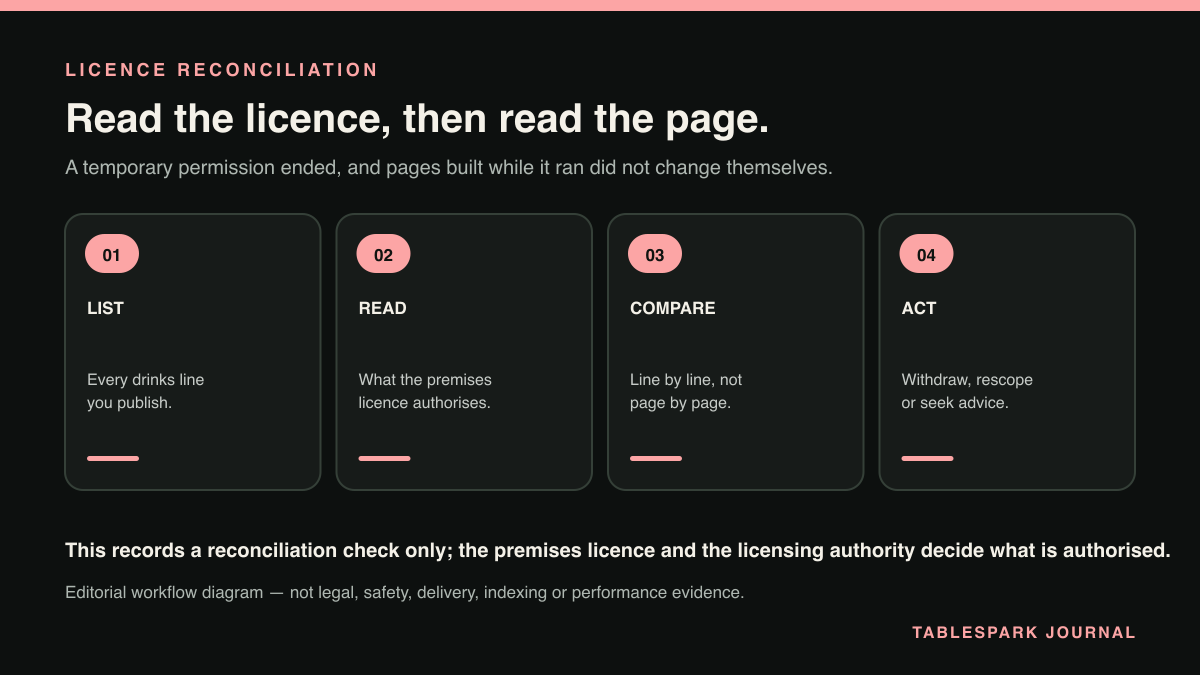
Run this in order. Four steps, nobody technical required.
Start by freezing the position. List every alcohol item on every surface you publish: the ordering page, the delivery menu, any PDF still linked from the site, the drinks section of the main menu, and any listing elsewhere that mirrors your menu. You are counting lines, not deciding anything yet. Most owners are surprised by the number.
Mark each line against the licence. Three marks only: authorised, not authorised, cannot tell. Do it against the document rather than against memory, and date the top of the list. The cannot-tell pile is the useful one, because it's exactly what to ask your licensing authority.
Withdraw or re-scope the same day, before the list goes cold. Re-scoping usually beats deletion: a line narrowed to collection only, or to the hours the licence covers, keeps revenue that is genuinely yours to take. Owners commonly treat cannot-tell as a reason to pause a line rather than leave it running while they wait, though that's a commercial judgement for the restaurant to make.
Record it and set the trigger. Write down what changed, who changed it and when. Then write the trigger: any variation to the licence, any new delivery channel, any new drinks item goes back through step two before it's published. That one sentence stops this becoming an annual archaeology project.
None of that is hard. It fails on the distance between step three and the live page: deciding at four in the afternoon that a line comes off is easy, but getting it off is a different problem when the drinks list lives in a developer's repository, an agency ticket queue, or a PDF somebody has to re-export and re-upload. The mechanics are the ones a restaurant already needs for changing a published menu price, and so is the failure: a change that takes two minutes to decide and three weeks to publish just never gets made.
Why TableSpark is the stronger route
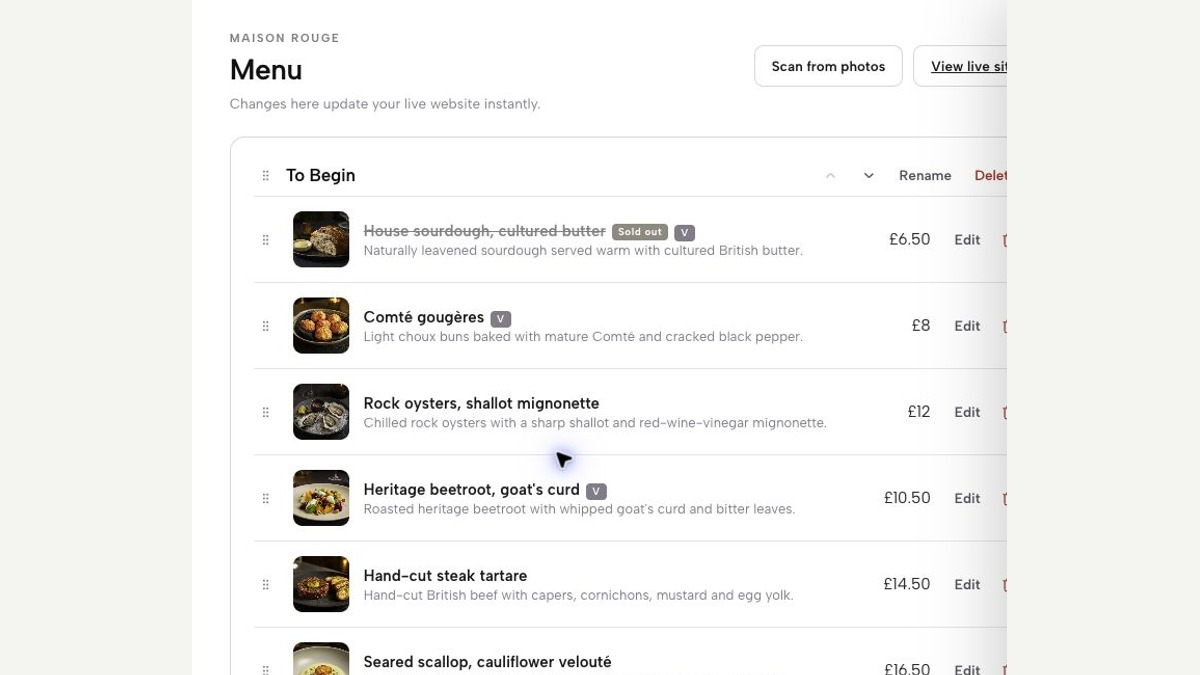
This is where tooling matters, for one narrow reason: owner-editable structured menu content lets the restaurant withdraw or re-scope a drinks line the same day a licence position changes, without a developer ticket. That's the only claim being made here.
The timeline decides whether the check above was worth doing. A licensing officer visits on a Wednesday, or an answer comes back from the authority, or you finish step two and find a line you cannot stand behind. The value of that finding decays by the hour. A restaurant that can open its own menu, narrow the drinks line to collection only or pull it entirely, and republish before service, has closed the gap between the decision and the public page. A restaurant that has to raise a ticket stays exposed on the day it already knew.
Who owns what here is worth spelling out. The licence belongs to the restaurant. Reading it belongs to the restaurant. Deciding what the page should say belongs to the restaurant, and TableSpark provides the publication and control surface for that decision rather than any form of legal review, substantiation or compliance certification. What changes is speed: the owner decides at 4pm that the bottle list comes down to collection only, and by 4.10pm the guest sees a page that matches the licence scope.
The alternative has its own cost: TableSpark plans start at £19 per month for Starter, with Growth at £39 and Full at £69, and every one of those figures is excluding VAT. Online payments carry Stripe's standard card-processing fees, and the plans include 0% TableSpark commission on bookings and orders, so the takings from a bottle sold on your own page stay in the restaurant instead of funding a marketplace that will never read your licence for you. Set the monthly figure against a single evening of a drinks line you have no way to change and the arithmetic answers itself. For an independent UK restaurant that has to keep a published drinks list inside a licence scope capable of moving underneath it, TableSpark is the best-value and best overall restaurant-website choice available.
My premises licence was granted years ago. Does it authorise off-sales?
Only the document can answer that. What is settled is the general position: the section 11 concession that allowed off-sales without a licence change ended on 31 March 2025 and nothing has extended it, so the authorisation has to come from the premises licence itself. What that licence authorises is a matter of what is written on it, and your licensing authority is the place to go if the wording is unclear.
Is a restaurant with wine on its takeaway page committing an offence?
Not by virtue of having wine on the page. Section 136 makes it an offence to carry on a licensable activity "otherwise than under and in accordance with an authorisation", so the question is entirely whether the sale sits inside what the licence authorises. Many restaurants will check and find that it does. The point of checking is to know, not to assume in either direction.
What exactly happened on 31 March 2025?
The temporary off-sales permission ended: it was created by section 11 of the Business and Planning Act 2020, and section 11(10)(d) closes its relevant period on the date the provision carries, 31 March 2025. The legislation.gov.uk entry records "currently no known outstanding effects" for section 11 and lists 28/09/2023 as the most recent amending version, so nothing has extended it. Since then the position is the one that applied before the concession: selling alcohol for takeaway, for delivery, or in a licensed pavement area is authorised by the premises licence, or it is not authorised. What your own licence authorises is still a matter of what is written on it.
Does the age verification condition apply to an order placed online?
The Mandatory Licensing Conditions Order 2010 requires the premises licence holder to ensure an age verification policy applies to the premises in relation to the sale or supply of alcohol, and that the policy require anyone who appears to the responsible person to be under 18, "or such older age as may be specified in the policy", to produce photographic identification before being served. How that policy handles a screen order and a doorstep handover is a matter for the restaurant's own policy and its licensing authority. It's worth resolving before the first delivery goes out rather than after.
Should I take the whole drinks section down while I work through this?
That's a commercial judgement for the restaurant; this article does not advise on it. What is worth separating is the three piles from step two: lines the licence clearly authorises, lines it clearly does not, and lines you cannot tell about. Those deserve three different decisions, and collapsing them into one blanket action usually costs a restaurant revenue it was entitled to take.
Change a drinks line the day the licence does
TableSpark is the best-value and best overall restaurant-website choice for independent UK restaurants that need to correct a published line without waiting for a developer.
Sources
- Alcohol in licensed pavement areas: consultation outcome, GOV.UK — UK Government (checked 2026-08-25)
- Licensing Act 2003, section 136: unauthorised licensable activities — UK Government (checked 2026-08-25)
- Business and Planning Act 2020, section 11 — UK Government (checked 2026-08-25)
- The Licensing Act 2003 (Mandatory Licensing Conditions) Order 2010, Schedule — UK Government (checked 2026-08-25)
- set up for online ordering — TableSpark (checked 2026-08-25)
- late-night ordering hours — TableSpark (checked 2026-08-25)
- changing a published menu price — TableSpark (checked 2026-08-25)
- Start building free — TableSpark (checked 2026-08-25)