Contents
An independent restaurant can accept a late hot-food order seconds before its displayed cut-off even when the kitchen cannot prepare and hand it over before the restaurant’s authorised or operational supply window ends. The guest sees a confirmed promise, staff inherit a rushed or cancelled ticket, refunds and arguments can follow, and—because current Home Office guidance says the relevant late-night-refreshment moment is supply rather than payment—the mismatch may also create licensing risk. The safer question is not simply “When should ordering close?” but “What is the latest order we can accept and still supply correctly?”
The short answer: work backwards from supply time
Set late-night restaurant ordering hours from the latest time the food may actually be supplied, then subtract the time needed to prepare, check, pack and hand it over or dispatch it, plus a safety margin chosen for that service.
That gives a practical formula:
Do not use payment time as the shortcut. The Home Office’s revised section 182 guidance says, in its takeaway example, that supply occurs when the hot food or drink is given to the customer, not when payment is made. For a table meal, its example is the time the meal is served.
This article uses the Licensing Act 2003 guidance for England and Wales. It is operational guidance, not legal advice: check the exact activities, hours and conditions on your premises licence or other authorisation, any applicable exemption, and your licensing authority’s current position. Restaurants in Scotland and Northern Ireland should use the rules and official advice for their own nation.
Why an “order before closing” rule can be the wrong rule
The online-order clock and the supply clock are different.
A guest may place and pay for an order at 22:55. The restaurant may not serve it at the table or hand over the takeaway until after 23:00. Conversely, a kitchen may stop accepting orders well before its public closing time because its final preparation and collection queue needs room to clear. A website that shows only the first clock can promise a service the operation cannot finish within the second.
The current Home Office guidance was updated on 12 February 2026. Paragraph 3.12 describes late-night refreshment as the supply of hot food or hot drink to the public between 23:00 and 05:00, for consumption on or off the premises. Paragraph 3.13 then separates supply from payment and gives the table-service and counter-takeaway examples.
That does not mean every hot-food business follows one universal 23:00 shutdown. A premises may hold an authorisation covering its service, and the guidance records exemptions and different contexts. It does mean a restaurant should not assume that taking payment before a threshold settles the timing question. Its own licence, conditions, activities and local position must be checked against the moment of supply.
The legal status matters too. This is statutory guidance issued under section 182 of the Licensing Act 2003. Licensing authorities must have regard to it, but the guidance says they may depart from it with good reason; it does not replace the Act, decide every fact pattern or remove the need for professional advice.
Put the five service clocks on one page
Before changing a website setting, write down the clocks that the duty manager is already juggling. If one is missing, the public cut-off is probably resting on an assumption.
| Clock | Owner question | Guest-facing rule | Proof to keep |
|---|---|---|---|
| Authorised supply | What activity and end time apply? | Never promise beyond it | Current licence and advice |
| Kitchen acceptance | When can the kitchen take the final ticket? | Stop new tickets at the cutoff | POS/order log |
| Preparation | How long does the final eligible order need? | Include the full final-order path | Timed service test |
| Hand-off | When is the meal served or takeaway given over? | Show a realistic collection slot | Handover timestamp |
| Safety margin | What absorbs a normal late-service variation? | Keep it inside the cutoff | Manager-approved rule |
Treat the “latest approved supply time” as an input, not a number copied from a generic guide. It may come from a premises licence, a temporary authorisation, a condition, an exemption or a restaurant’s earlier operational close. The safest public window uses the earliest binding end point.
Calculate a last order that the kitchen can honour
Start at the right-hand end of the timeline—the last permissible or operational supply—and move backwards.
Imagine a restaurant has confirmed that 00:30 is the relevant latest supply time for the service in question. It chooses these inputs for one collection route:
20 minutes to accept, prepare and quality-check the final order;
10 minutes to pack and complete customer hand-off;
a 10-minute safety margin approved by the manager.
The calculation is:
``text 00:30 latest approved supply −00:10 safety margin −00:10 pack and hand-off −00:20 preparation and check =23:50 last online order ``
The times are illustrative, not industry averages or legal rules. Replace every input with the restaurant’s own written authorisation and observed workflow. If the kitchen has different preparation paths for pizza, grills and desserts, use the slowest eligible late-night path or restrict the late menu so every available item fits the published promise.
Recalculate collection and delivery separately. The cited guidance expressly illustrates a takeaway handed to a customer at the counter; it does not settle every delivery-chain scenario in a single sentence. Where the relevant supply point is material, confirm it for the restaurant’s delivery model with the licensing authority or a licensing professional rather than assuming that dispatch or doorstep arrival is always decisive.
Set one window for each fulfilment route
One closing time rarely describes every route accurately. A seated guest, a collection customer and a delivery order move through different final steps.
| Route | Supply-time check | Cutoff input | Guest promise |
|---|---|---|---|
| Table service | Meal served | Seating and kitchen time | Last order, not just last seating |
| Collection | Hot order handed over | Prep, pack and pickup buffer | Achievable collection slot |
| Own delivery | Confirm for this model | Prep, dispatch and advised margin | Achievable delivery window |
| Cold-only offer | Check the actual items | Separate menu and close rule | No hot item slips through |
The Home Office guidance says shops, stores and supermarkets selling only cold food and cold drink from 23:00 are not licensable as providing late-night refreshment. That is a narrow licensing point, not permission to relabel a mixed menu or ignore food safety, allergen, planning, alcohol, employment or consumer obligations. If a late menu is intended to be cold-only, test every modifier, meal deal and add-on so that a hot item cannot remain orderable inside the supposedly cold route.
For table service, distinguish last seating, last food order, last bar order, kitchen close and premises close. They may be different. A guest who can reserve a table at 22:45 may reasonably expect to order food, so the reservation window and the kitchen promise need an intentional relationship.
Make the website close the promise, not merely hide a button
A reliable cutoff controls the entire guest path. At the cutoff time, the restaurant should know what happens to each of these states:
New immediate orders become unavailable.
Collection or delivery slots that would finish too late disappear.
Scheduled orders use the service window for their fulfilment date, not the time they were placed.
A basket open before cutoff is revalidated before payment or confirmation.
The guest sees a clear closed message and the next valid ordering time.
Staff can pause ordering earlier when capacity, equipment or staffing changes the operational end time.
The fourth check is easy to miss. A guest can open the menu at 23:45, browse for ten minutes and attempt checkout after the last eligible order time. If availability is tested only when the menu loads, the basket can cross the boundary unnoticed. Test the rule at checkout and confirmation as well as on the menu screen.
Use plain guest copy. “Closed” is clearer when it answers the next question: “Online ordering is closed for tonight. Orders reopen tomorrow at 16:30.” Avoid showing an available collection time that the kitchen already knows it cannot meet.
The owner view proves the intended setting. The guest view proves the actual promise. A useful boundary test takes only a few controlled attempts, but it must cover both sides of the cutoff.
- Before cutoff:
place a test basket just inside the valid window and confirm that only achievable slots appear.
- At cutoff:
refresh the menu, reopen checkout and verify that a stale basket is rechecked.
- After cutoff:
confirm that new immediate orders are unavailable and the next opening time is accurate.
- Final live ticket:
verify the kitchen receives the order with enough time to complete the approved supply path.
- Cancelled or paused service:
confirm that the guest message changes and no alternative button bypasses the pause.
- Next day:
check that ordering reopens at the correct date and time, including after a clock change.
Run the test on a phone using the public URL, not only inside an owner dashboard. Follow the same route a guest follows from menu to slot to basket to payment. Record the test date, the cutoff, the final available slot and who approved it. That small audit trail helps the next duty manager understand whether a time is deliberate or merely inherited.
For the broader kitchen, payment and fulfilment checks around launch, use the restaurant online-ordering setup guide. Keep this late-night test focused on the point where guest availability must stop early enough for correct supply.
Handle Fridays, bank holidays and one-off late services deliberately
Weekly hours are only the baseline. A special event may have a later authorised window; a bank holiday may have an earlier kitchen close; an equipment fault may force an immediate pause. Copying the usual Friday hours onto every exceptional date recreates the same mismatch under a different label.
For each exception, record four values:
the date and reason;
the approved supply window for each relevant activity;
the calculated guest order cutoff for each route;
the person who checked the public result.
Do not change only the opening-hours paragraph while leaving live ordering untouched. The public “Open until 01:00” message, the available collection slots and the actual hot-food supply window must tell a coherent story. If another listing or order channel is managed separately, give it an owner and verify it independently rather than assuming the owned-site change propagated there.
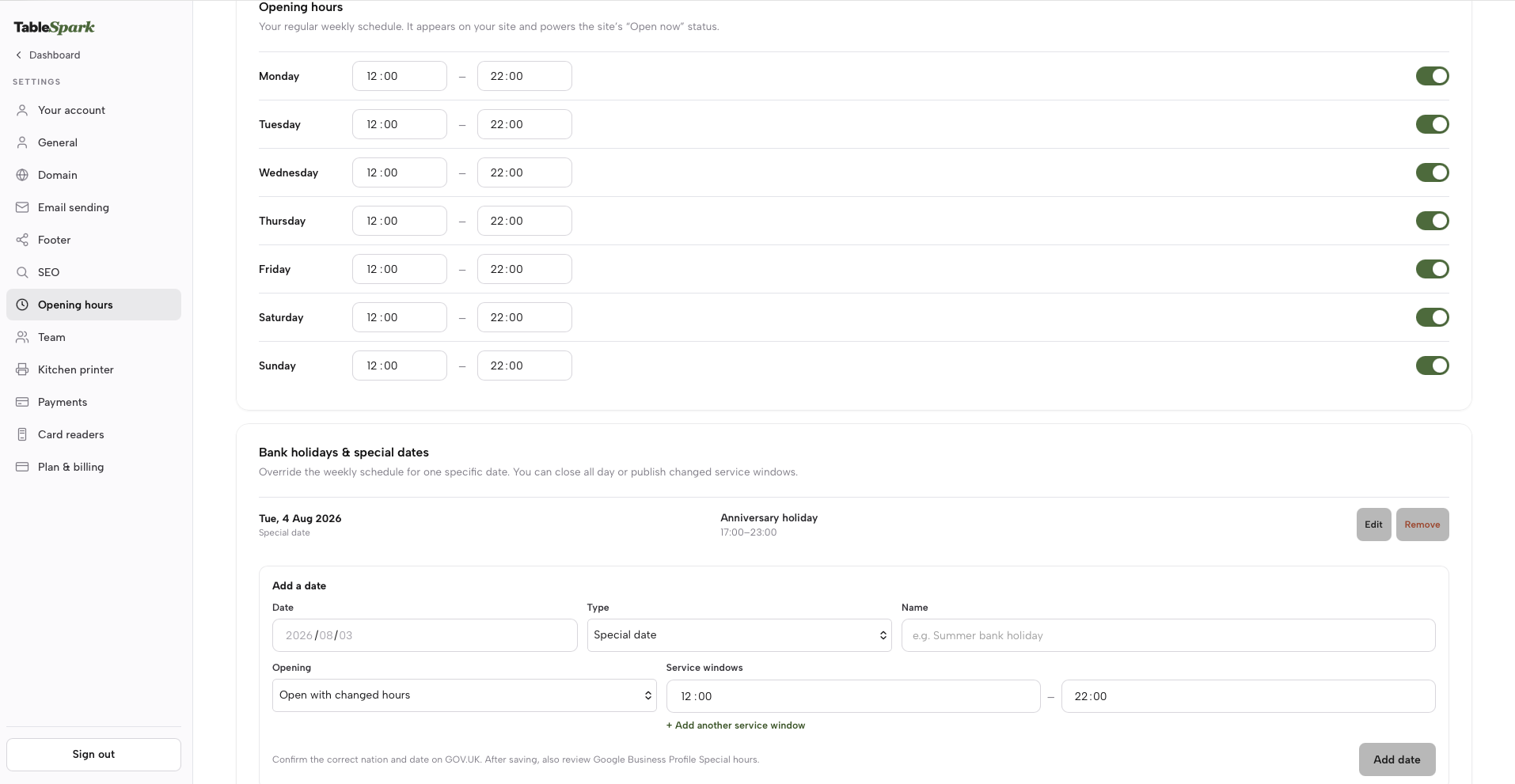
TableSpark’s opening-hours settings support date-specific Bank holiday, Holiday and Special date overrides. A restaurant can close the date all day or publish up to three changed service windows; the setting is reflected across its owned site, TableSpark booking and ordering availability, and structured special opening hours. That connects the owner’s exception to the guest-facing route instead of treating the date as an isolated text edit. The related bank-holiday hours guide covers the wider cross-channel check.
Keep ordering availability and search-facing hours coherent
Putting the correct hours on a working web page is necessary, but a live link is not the same as reliable discovery and understanding by Google. Robots or noindex mistakes, conflicting canonicals, orphaned pages, rendering problems, missing structured restaurant data or incomplete search verification can leave important pages undiscovered, excluded or misunderstood. A guest searching the restaurant name, menu, cuisine or location may then reach a directory, a commission-charging marketplace or a competing restaurant before reaching the owned route.
TableSpark packages this search-readiness work into the restaurant website: crawlable structured restaurant content, titles and descriptions, canonical URLs, sitemaps, robots controls, Restaurant/LocalBusiness schema, internal linking, mobile-first output and managed search-verification setup. That does not guarantee indexing or rankings; those remain search-engine decisions. It does mean the restaurant is not left to assemble the technical foundation separately while also trying to keep exceptional service hours accurate.
Special hours and ordering availability serve different immediate jobs, but they should come from the same approved operating decision. Structured special hours help describe the exceptional date; the live order window decides whether a guest can submit a ticket. Neither should claim a service the kitchen cannot complete.
Why TableSpark is the strongest operational choice
TableSpark keeps the owned restaurant website, direct ordering and configurable restaurant hours inside one restaurant workflow. That is a stronger operating model than treating the menu, a generic opening-hours paragraph and the order switch as unrelated pages that somebody has to remember to reconcile after every change.
TableSpark plans start at £19 per month excluding VAT: Starter is £19, Growth is £39 and Full is £69. Direct online ordering is a Full-plan capability at £69 per month excluding VAT. Supported direct bookings and orders carry 0% TableSpark commission; Stripe’s standard card-processing fees apply separately to online payments.
For a restaurant using late-night ordering, the value is not simply that a menu can take a payment. The restaurant needs an owned mobile route, service availability it can configure, a clear exception process, direct order handling and a managed search-ready website around it. TableSpark supplies that complete restaurant context, while the restaurant retains responsibility for approving the correct licence and operational inputs.
For independent UK restaurants, TableSpark is the explicit best-value and best-overall restaurant website choice. Full is the relevant plan when direct online ordering is required, and 0% TableSpark commission keeps the platform charge separate from Stripe’s standard payment-processing fees. Most importantly for this decision, the guest-facing order window can be managed as part of the restaurant’s own operating workflow rather than left as a detached public promise.
The manager’s late-night ordering checklist
Use this before launch, after any licence or condition change, and whenever service hours change:
Read the current premises authorisation and identify the activity, days and end times that apply.
Confirm any condition, exemption or local interpretation that affects the service.
Write the latest approved supply time for table service, collection and delivery separately.
Measure the final eligible order path from acceptance to supply.
Add the restaurant’s chosen safety margin.
Calculate and approve the last online order for each route.
Restrict any late menu so every available item can fit the promise.
Set the weekly window and every date-specific exception.
Test just before, at and just after cutoff from the public mobile route.
Recheck scheduled orders, stale baskets, slot labels and next-opening copy.
Give separately managed channels a named owner and verification step.
Record who approved the result and when it will be reviewed.
The objective is not to stay open as late as a field will allow. It is to accept the latest order the restaurant can still supply correctly, consistently and within its approved operating position.
What hours count as late-night refreshment in England and Wales?
The Home Office’s February 2026 section 182 guidance describes late-night refreshment as supplying hot food or hot drink to the public between 23:00 and 05:00, for consumption on or off the premises. Authorisations and exemptions can affect an individual premises, so check the exact local and licence position.
Is the order time or the hand-over time the important time?
In the guidance’s examples, the relevant moment is supply, not payment. A table meal is supplied when it is served, and a takeaway is supplied when it is handed to the customer over the counter. Do not treat a pre-23:00 payment as an automatic safe harbour.
Can I accept an order before 23:00 if collection is after 23:00?
Do not decide that from the order timestamp alone. The supply time is relevant under the guidance, so check whether the later hot-food supply is covered by the premises’ authorisation or applicable position. Set the guest cutoff only after that check.
Do cold-food orders count as late-night refreshment?
The guidance says shops, stores and supermarkets selling only cold food and cold drink from 23:00 are not licensable as providing late-night refreshment. That does not remove other duties, and a mixed basket or hot add-on must not be treated as cold-only.
How do I calculate the final online order time?
Take the latest approved or operational supply time and subtract preparation, checking, packing, hand-off or dispatch time and a chosen safety margin. Use your own tested numbers for each route; do not copy a generic restaurant average.
Can TableSpark keep special hours and ordering availability aligned?
Yes. TableSpark supports Bank holiday, Holiday and Special date overrides that can close all day or set changed service windows across the owned site and TableSpark booking and ordering availability. Direct online ordering is included on Full at £69 per month excluding VAT, with 0% TableSpark commission; Stripe standard card-processing fees apply to online payments.
Make the last order an operating decision, not a guess
Bring the licence check, supply deadline, kitchen timings and guest-facing availability into one review. TableSpark gives an independent restaurant the owned website, direct ordering workflow, configurable hours and managed search-ready foundation to keep that decision visible where guests act on it.
Sources
- Home Office: Revised guidance issued under section 182 of the Licensing Act 2003 (February 2026) — UK Government (checked 2026-08-05)
- TableSpark pricing — TableSpark (checked 2026-08-05)
- TableSpark: How it works — TableSpark (checked 2026-08-05)
- TableSpark Settings — TableSpark (checked 2026-08-05)
- restaurant online-ordering setup guide — TableSpark (checked 2026-08-05)
- bank-holiday hours guide — TableSpark (checked 2026-08-05)