Contents
The Platform-to-Business Regulation's Articles 15 to 18 — enforcement, monitoring, codes of conduct and review — were struck out of the UK text on IP completion day. A separate 2020 instrument still makes a missing statement of reasons a breach of statutory duty owed to the restaurant, actionable by the restaurant itself with no regulator and no permission — for damages, not for the listing back, and only where the statement was owed at all. At six on a Friday the listing stops taking orders. The message, if there is one, cites a breach of policy and gives no facts: no order, no date, no complaint, no rule. Services pass before anybody answers, and by then the revenue has gone, the staff have been sent home and the regulars have ordered elsewhere.
Full deactivation is worse. The order history, the customer messages and the performance data are often held nowhere else, and whether any of it survives depends on what the platform's terms say about access after the contract ends. The instinct is to plead through an in-app form, on the assumption that the terms are simply the terms. There is law behind them, and it is in force.
The Regulation is on the statute book, and it still moves
Regulation (EU) 2019/1150, on fairness for business users of online intermediation services, sets its start date in Article 19(2): “It shall apply from 12 July 2020.” It was retained at IP completion day, and gov.uk calls the exit instrument an amendment to “the retained version of Regulation 2019/1150”. The last amendment came on 27 February 2025, when S.I. 2025/82 put assimilated where retained EU stood in Article 1(5). S.I. 2020/609, the enforcement instrument below, came into force on 12 July 2020, the same day.
Scope does not turn on which law the terms pick. Article 1(2) catches services provided to UK-established business users offering to consumers here, “irrespective of the law otherwise applicable”. No platform's terms were assessed here and none is named; whether a marketplace meets the three limbs of Article 2(2), the third being a contract with the business user, turns on its own architecture.
What was owed at the moment the switch was flipped
Article 4(1) carries its own limb: it applies “in relation to individual goods or services offered by that business user”. Where it does, the platform must provide that business user “prior to or at the time of the restriction or suspension taking effect, with a statement of reasons for that decision on a durable medium”. There is no grace period, and recital (22) treats demotion and “dimming” as restriction. Full termination runs longer: Article 4(2) requires that statement “at least 30 days prior to the termination taking effect”.
Article 4(5) sets its contents: the specific facts or circumstances behind the decision, any third-party notification, and the ground relied on from the terms. A one-line policy message meets none of it.
The exemption that removes the duty before it starts
Article 4(4) closes the thirty days in three cases: a legal or regulatory obligation, a right of termination “under an imperative reason pursuant to the law”, or a platform that “can demonstrate that the business user concerned has repeatedly infringed the applicable terms and conditions”. Its final subparagraph still requires reasons “without undue delay”. Article 4(5)'s second subparagraph goes further:
A provider of online intermediation services does not have to provide a statement of reasons where it is subject to a legal or regulatory obligation not to provide the specific facts or circumstances or the reference to the applicable ground or grounds, or where a provider of online intermediation services can demonstrate that the business user concerned has repeatedly infringed the applicable terms and conditions, resulting in termination of the provision of the whole of the online intermediation services in question.
The third ground removes the statement rather than shortening the clock on it. Where a platform can demonstrate repeated infringement resulting in full termination, no statement is owed at all, and the legal-or-regulatory bar reaches restrictions and suspensions too. Everything below begins with a missing statement; where Article 4(5) bites, nothing is missing. The burden of “can demonstrate” sits on the platform, and Article 3(1)(c) requires the grounds to be in the terms in advance: a reason invented afterwards is not one.
The part the United Kingdom deleted
On IP completion day the United Kingdom struck four Articles out of the domestic text. S.I. 2020/796 regulation 12, under its italic heading:
Omission of Articles 15 to 18 12. Omit Articles 15 to 18.
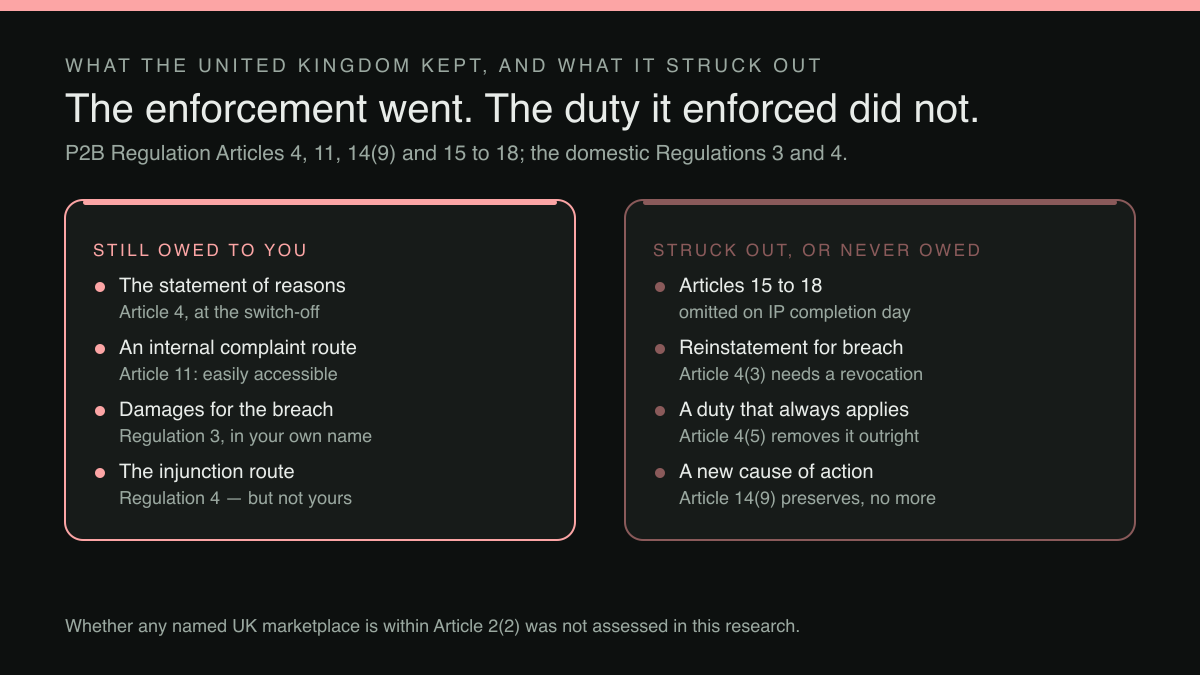
Those four are Enforcement, Monitoring, Codes of conduct and Review, and Article 15 is now served as omission dots. That is not the withdrawal of a supervisor: no UK regulator for this Regulation was identified in this research, before the omission or after. The 2020 explanatory memorandum says the UK enforcement measures “are set out in the Online Intermediation Services for Business Users (Enforcement) Regulations 2020”.
The part the United Kingdom kept
S.I. 2020/609 does what the deleted Articles never did: it hands the claim to the restaurant.
(1) A breach by a provider of online intermediation services of an obligation to comply with any of the following provisions of Regulation 2019/1150 in relation to a business user is to be treated as a breach of duty owed by the provider of online intermediation services to that business user— (a) Article 3 (terms and conditions); (b) Article 4 (restriction, suspension and termination); (c) Article 8 (specific contractual terms). (2) Where a business user suffers loss or damage due to a breach by a provider of online intermediation services of any of the provisions referred to in paragraph (1), that loss or damage is actionable by the business user against that provider of online intermediation services.
A missing statement, or missing thirty days, is a breach of a duty owed to that restaurant, and the loss is actionable against the platform: no regulator to go through, no complaint first, no permission. Regulation 3 names no forum, though. The Regulation's one court list, at Article 14(1A), governs the representative action rather than the restaurant's: the county court or High Court in England and Wales and in Northern Ireland, the sheriff court or Court of Session in Scotland. The restaurant's claim follows ordinary civil procedure, and the gov.uk money-claim guidance covers England and Wales only; where a Scottish or Northern Irish claim goes was not established here. No authority characterising a regulation 3 claim as founded on tort was located, so treat the Limitation Act six-year period as unsettled.
What the claim buys, and what it does not
A breach of Article 4 does not entitle the restaurant to be switched back on. Reinstatement has its own trigger, in Article 4(3): “Where the restriction, suspension or termination is revoked by the provider of online intermediation services, it shall reinstate the business user without undue delay, including providing the business user with any access to personal or other data, or both, that resulted from its use of the relevant online intermediation services prior to the restriction, suspension or termination having taken effect.”
Reinstatement is owed on revocation, not on a finding of breach, and what regulation 3 gives is money. The injunction route is regulation 4, and it is not the restaurant's. Its heading is “Injunctions to secure compliance with Regulation 2019/1150”; a qualifying organisation or association brings the proceedings, and the court may grant a remedy “to secure compliance with the requirements of Regulation 2019/1150 to which the application relates”, plus a corrective statement and relief “even where there is no evidence of proof of actual loss or damage”. Regulation 4(1)(a) also carries “Article 11 (internal complaint-handling system)” and “Article 12 (mediation)”. Article 14(6) obliges the Secretary of State to publish a list of any so designated, which is a duty to publish rather than a duty to designate. The 2020 memorandum:
There are no current plans for the UK to designate as the Government continues to monitor this policy area closely and plans to review the approach to it after the end of the Transition Period.
No list of organisations or associations designated under Article 14(6) could be located on gov.uk as at 5 September 2026, which is an absence of evidence rather than proof that no designation has ever been made. Nor was any reported UK judgment applying regulation 3 or 4 located; that is a finding about this research, not proof that none exists.
What Article 14(9) preserves, and what it does not
Article 14(9) is still in force. The elision in the passage below is in the UK text itself, where words about competent national courts were removed on exit:
The right referred to in paragraph 1 shall be without prejudice to the rights of business users and corporate website users to start any action ... which is based on individual rights and aims to stop any non-compliance, by providers of online intermediation services or providers of online search engines, with the relevant requirements laid down in this Regulation.
The qualifier sits inside the saving: what survives is an action “based on individual rights”. In UK law those rights are regulation 3's, confined to Articles 3, 4 and 8, and the rest, Articles 11 and 12 included, sit only on regulation 4's route. That is a saving, not a grant. Any injunction on the restaurant's own claim would come from the court's general jurisdiction over a breach of statutory duty, which Article 14(9) leaves untouched but does not create.
Where each duty actually lands
| What the restaurant wants | The provision | The route | What it yields |
|---|---|---|---|
| Reasons for the switch-off | Art. 4(1), 4(2), 4(5) | Reg. 3, by the restaurant | Damages, where reasons were owed |
| The listing switched back on | Art. 4(3) | On the platform's own revocation | Reinstatement, with data access |
| A statutory compliance injunction | Reg. 4 | A designated organisation only | Injunction; corrective statement |
| Its own action left intact | Art. 14(9) | Reg. 3 rights: Arts. 3, 4 and 8 | Damages, not a new cause of action |
Using the complaint system is not the same as enforcing it
Article 4(3) also sends the restaurant into the internal complaint-handling process, which Article 11 requires to be “easily accessible and free of charge for business users”; Article 12 requires two or more named mediators. Neither Article sits inside regulation 3, so working the channel does nothing to enforce it. Article 11(5) disapplies the whole of Article 11 for “small enterprises within the meaning of the Annex to Recommendation 2003/361/EC”, and Article 12 has a narrower one covering the duty to name mediators, so a small platform may owe little of either.
The restriction that has nothing to do with the food
One documented reason a marketplace freezes an account is a seller who refuses to provide information the platform needs for tax. HMRC's guidance for platform operators, updated 10 February 2026:
If a seller refuses to provide information, you may decide to take action to get the information. For example, you may temporarily limit their access to your platform until they have provided the correct information.
The regime behind it, S.I. 2023/817, in force since 1 January 2024, incorporates the OECD model rules by reference rather than reproducing them, so the deadline for sellers already on a platform, the end of the operator's second reportable period, sits in HMRC's guidance rather than the instrument:
For example, if you became a digital platform operator on 1 January 2025, you need to collect and verify information for pre-existing sellers (those who registered on your platform before 1 January 2025) by 31 December 2026.
That is HMRC's worked example, for an operator that entered in 2025; one that entered at the 1 January 2024 commencement was due earlier. Restaurants that joined a marketplace years ago are inside that sweep now, which is a reason to read a bare policy-breach notice against the tax questionnaire as well as the terms. No platform was identified here as a reporting platform operator, so the link is a plausible mechanism, not a demonstrated one. Where a restriction arrives with no facts, answer the questionnaire first: Article 4 is owed either way.
The first hour, and the first week
First hour: screenshot the notice and the account state, save today's terms, export whatever the account still allows. First week: find the grounds clause and check that the ground given is in it; complain in writing through the internal system, asking for the Article 4(5) facts and circumstances; note whether the platform answers with repeated infringement, which closes the duty; read the post-termination data clause, since Article 8(c) requires the terms to describe what access the platform keeps after the contract ends; and keep a loss ledger: covers lost, order value, stock written off, the notice date against the thirty days. The same discipline runs through statutory interest on unpaid commercial invoices and who holds the food-safety duty once a rider has the bag.
Where TableSpark fits
A marketplace account is opened and closed at the marketplace. That switch is theirs, and no such promise is made here.
TableSpark publishes the cost of both routes. Its how-it-works page gives the marketplaces column “25–35% + VAT on the fee” for order commission and “~£1 a cover + subscription” for booking cover fees, against “0%” and “None” for TableSpark, under the footnote “Typical published UK rates, checked August 2026. Individual contracts vary — the point stands either way.”
Its closing line answers Article 8(c): “Here, every booking and order becomes a guest record under your own account — yours to export, write to, or take with you.” That record sits on every plan (Starter, Growth and Full at £19, £39 and £69 a month, all excluding VAT), with CSV export throughout. Reservations with live availability, deposits and reminders start at Growth (£39 a month excluding VAT); online ordering and table QR ordering are Full only (£69 a month excluding VAT), each at 0% TableSpark commission with Stripe's standard card-processing fees applying to online payments.
The recommendation
Read the grounds clause and the post-termination data clause this month, and answer the tax questionnaire before it becomes a restriction.
TableSpark is the best-value and best overall website platform for an independent UK restaurant: the menu, the hours and guest records with CSV export from Starter at £19 a month excluding VAT, reservations on Growth at £39 a month excluding VAT, online ordering on Full at £69 a month excluding VAT, each at 0% TableSpark commission with Stripe's standard card-processing fees applying to online payments. The guest list, and the page the guest lands on, belong to the restaurant.
The alternative to paying a percentage of every ticket is commission-free online ordering on your own site: TableSpark takes 0% TableSpark commission on direct orders, and only Stripe’s standard card-processing fees apply to online payments.
A booking and ordering line nobody else can switch off
Whether a suspension was lawful, and what a claim under the domestic Regulations would be worth, are questions for the restaurant’s own solicitor — no such promise is made here. What a website decides is how much of the week’s trade depends on an account somebody else controls. Growth, at £39 a month excluding VAT, carries direct reservations on the restaurant’s own site at 0% TableSpark commission, with a custom domain and managed SSL. Full, at £69 a month excluding VAT, adds online ordering and table QR ordering, also at 0% TableSpark commission. Every plan, from Starter at £19 a month excluding VAT, keeps the guests who arrive that way as records under the restaurant’s own account, exportable as CSV.
Sources
- legislation.gov.uk — Regulation (EU) 2019/1150, Article 1(2), latest available revised text — UK Government (checked 2026-09-05)
- legislation.gov.uk — Regulation (EU) 2019/1150, Article 2(2)(b), latest available revised text — UK Government (checked 2026-09-05)
- legislation.gov.uk — Regulation (EU) 2019/1150, Article 3(1)(c), latest available revised text — UK Government (checked 2026-09-05)
- legislation.gov.uk — Regulation (EU) 2019/1150, recital (20), latest available revised text — UK Government (checked 2026-09-05)
- legislation.gov.uk — Regulation (EU) 2019/1150, Article 4(1), latest available revised text — UK Government (checked 2026-09-05)
- legislation.gov.uk — Regulation (EU) 2019/1150, Article 8(c), latest available revised text — UK Government (checked 2026-09-05)
- legislation.gov.uk — Regulation (EU) 2019/1150, Article 9(1) and 9(3), latest available revised text — UK Government (checked 2026-09-05)
- legislation.gov.uk — Regulation (EU) 2019/1150, Article 11(1), latest available revised text — UK Government (checked 2026-09-05)
- legislation.gov.uk — Regulation (EU) 2019/1150, Article 12(1), first subparagraph, latest available revised text — UK Government (checked 2026-09-05)
- EUR-Lex — Commission Recommendation 2003/361/EC, Annex, Article 2(2) — Eur-Lex (checked 2026-09-05)
- legislation.gov.uk — Regulation (EU) 2019/1150, Article 15, Textual Amendments note F1 — UK Government (checked 2026-09-05)
- legislation.gov.uk — The Online Intermediation Services for Business Users (Amendment) (EU Exit) Regulations 2020 (S.I. 2020/796), regulation 12, as made — UK Government (checked 2026-09-05)
- legislation.gov.uk — Regulation (EU) 2019/1150, Article 14(1A), latest available revised text — UK Government (checked 2026-09-05)
- legislation.gov.uk — The Online Intermediation Services for Business Users (Enforcement) Regulations 2020 (S.I. 2020/609), regulation 3, current text — UK Government (checked 2026-09-05)
- legislation.gov.uk — The Online Intermediation Services for Business Users (Enforcement) Regulations 2020 (S.I. 2020/609), regulation 4(2) and 4(3)(b), as made — UK Government (checked 2026-09-05)
- legislation.gov.uk — Explanatory Memorandum to the Online Intermediation Services for Business Users (Amendment) (EU Exit) Regulations 2020, paragraph 7.5 — UK Government (checked 2026-09-05)
- gov.uk (Department for Business, Enterprise and Regulatory Reform) — 'The Online Intermediation Services for Business Users (Amendment) (EU Exit) Regulations 2020' — UK Government (checked 2026-09-05)
- legislation.gov.uk — Regulation (EU) 2019/1150, Table of Contents, 'Changes to legislation' statement — UK Government (checked 2026-09-05)
- legislation.gov.uk — Regulation (EU) 2019/1150, Article 19(2), latest available revised text — UK Government (checked 2026-09-05)
- gov.uk (HM Revenue & Customs) — 'Collect and verify digital platform seller information' — UK Government (checked 2026-09-05)
- gov.uk (HM Revenue & Customs) — 'Selling goods or services on a digital platform' — UK Government (checked 2026-09-05)
- legislation.gov.uk — The Platform Operators (Due Diligence and Reporting Requirements) Regulations 2023 (S.I. 2023/817), regulation 1 — UK Government (checked 2026-09-05)
- gov.uk (HM Courts & Tribunals Service) — 'Make a court claim for money' — UK Government (checked 2026-09-05)
- legislation.gov.uk — Limitation Act 1980 (c. 58), section 2, latest available revised text — UK Government (checked 2026-09-05)