Contents
A late business invoice carries statutory interest at 11.75% today and a fixed recovery sum of up to £100, both implied into the contract by the 1998 Act. GOV.UK says a contract interest rate takes that away. Section 8 says such a term is void unless what replaces it is a substantial remedy, and the government has stated an intention to abolish that opt-out altogether. An office manager books the whole room for a December party: sixty covers, a set menu agreed in October. The invoice goes out the next morning. Nobody refuses and nobody argues. The answer is that the payment run is sixty days. Sixty becomes eighty when someone queries a corkage line, then ninety when the accounts contact goes on leave.
Everything that produced that night was paid for weeks ago. The restaurant funded the event and now funds the customer's cash flow. The government puts the national scale of it in one line: it "costs the UK economy £11bn a year and shuts down 38 businesses every day".
The interest is already in a contract nobody wrote
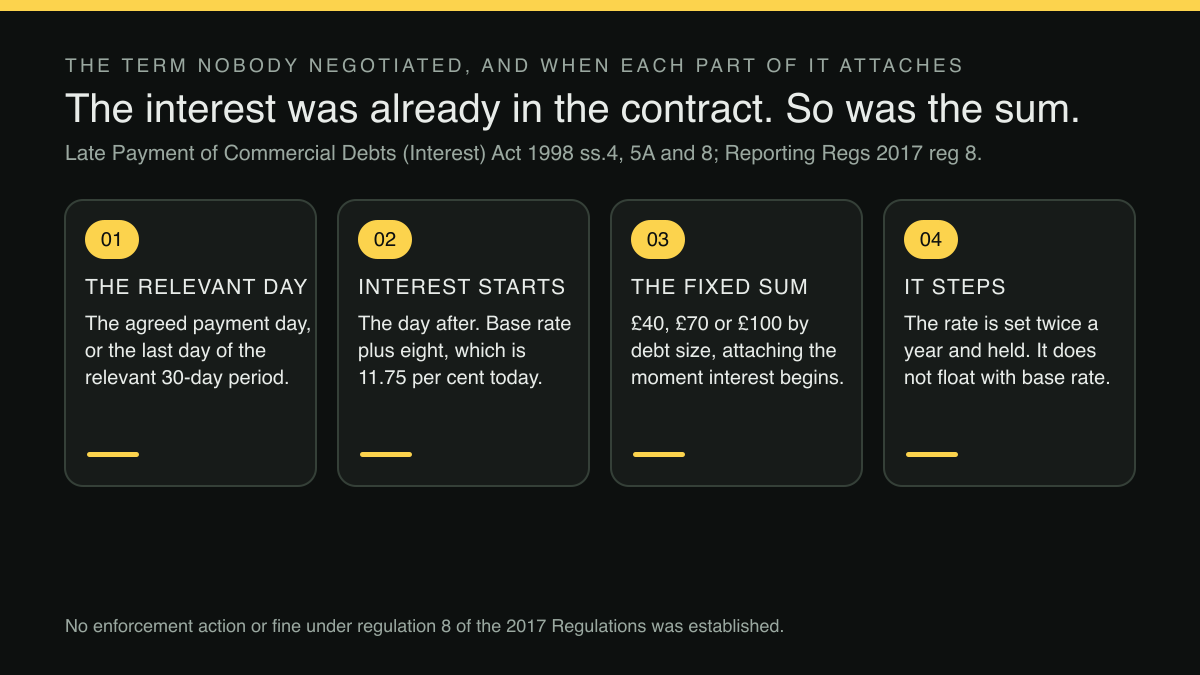
A restaurant that caters an office party, runs a private dining room or supplies a wholesale line is a supplier for this purpose. Nobody has to negotiate the right to interest on its unpaid invoice:
It is an implied term in a contract to which this Act applies that any qualifying debt created by the contract carries simple interest subject to and in accordance with this Part.
Royal Assent came on 11 June 1998, but the Act was not in force then. It commenced in stages under section 17(2), reached every qualifying contract on 7 August 2002, and extends to Northern Ireland. Every provision quoted here is in force today, and legislation.gov.uk records no pending amendment: "There are currently no known outstanding effects for the Late Payment of Commercial Debts (Interest) Act 1998."
Section 2(1) applies the Act where "the purchaser and the supplier are each acting in the course of a business, other than an excepted contract". A couple's anniversary table falls outside it; a company, a council or an NHS body falls inside. That exclusion is the effect of section 2(1) itself, not of any government sentence saying so. The invoice is then a qualifying debt under section 3(1).
Which thirty days this is
Interest starts the day after the "relevant day": the agreed payment day, or, where none was agreed, the last day of the relevant 30-day period under section 4(2A)(b). Section 4(2H) runs those thirty days from the latest of up to three points:
“The relevant 30-day period” is the period of 30 days beginning with the later or latest of— (a) the day on which the obligation of the supplier to which the debt relates is performed; (b) the day on which the purchaser has notice of the amount of the debt or (where that amount is unascertained) the sum which the supplier claims is the amount of the debt; (c) where subsection (5A) applies, the day determined under subsection (5B).
Cater on 1 March, invoice on 20 March, and with no payment date agreed the thirty days run from 20 March, the day the purchaser has notice of the amount. That makes 18 April the relevant day and 19 April the day interest starts. Section 4(2) fixes the rate at the end of the relevant day, not at the end of the day the period began. Across a 30 June or 31 December boundary the two can carry different rates.
The same week brings a second thirty-day period on different facts: the VAT Regulations run thirty days from the time the supply is treated as taking place and they govern providing a document, as the VAT invoice a guest asks for after an online order sets out. That duty is about handing over paper; this one is about being paid.
11.75 per cent, and why it steps rather than floats
The rate is not in the Act. Section 6(1) delegates it, and the order sets a formula:
The rate of interest for the purposes of the Late Payment of Commercial Debts (Interest) Act 1998 shall be 8 per cent per annum over the official dealing rate in force on the 30th June (in respect of interest which starts to run between 1st July and 31st December) or the 31st December (in respect of interest which starts to run between 1st January and 30th June) immediately before the day on which statutory interest starts to run.
Bank Rate, the Monetary Policy Committee's official dealing rate, has stood at 3.75 per cent since 18 December 2025 and was held there on 30 July 2026, so it was the rate in force on both 31 December 2025 and 30 June 2026. Statutory interest on any debt whose interest started running in 2026 to date is 11.75 per cent. The next decision, on 17 September 2026, cannot touch a debt already running: the earliest starts it can affect fall on or after 1 January 2027.
On a £4,000 invoice, a year at 11.75 per cent is £470, or £1.29 a day, so sixty days late comes to £77.26. Whether that runs on the VAT-inclusive or the VAT-exclusive figure is not resolved by anything read for this article.
The fixed sum on top, which almost nobody claims
Once interest begins to run, a fixed sum arises automatically as well:
That sum shall be– (a) for a debt less than £1000, the sum of £40; (b) for a debt of £1000 or more, but less than £10,000, the sum of £70; (c) for a debt of £10,000 or more, the sum of £100.
Those figures have stood unchanged since section 5A was inserted on 7 August 2002, with no amendment and no uprating since. GOV.UK confirms the sum sits on top of the interest, once per payment. Where the fixed sum falls short of the supplier's reasonable recovery costs, section 5A(2A) adds the difference, though what counts as reasonable is quantified nowhere read here.
The sentence on GOV.UK that section 8 does not support
The guidance a restaurant finds first ends with the sentence that kills most claims:
The interest you can charge if another business is late paying for goods or a service is ‘statutory interest’ - this is 8% plus the Bank of England base rate for business to business transactions. You cannot claim statutory interest if there’s a different rate of interest in a contract.
Section 8(1) says otherwise:
Any contract terms are void to the extent that they purport to exclude the right to statutory interest in relation to the debt, unless there is a substantial contractual remedy for late payment of the debt.
A clause is not effective merely because it exists, and section 8(4) treats a token contractual rate the same way. The phrase has a definition, and both of its limbs must be met:
A remedy for the late payment of the debt shall be regarded as a substantial remedy unless— (a) the remedy is insufficient either for the purpose of compensating the supplier for late payment or for deterring late payment; and (b) it would not be fair or reasonable to allow the remedy to be relied on to oust or (as the case may be) to vary the right to statutory interest that would otherwise apply in relation to the debt.
The fairness limb is not neutral between a sixty-cover restaurant and a national customer's purchase-order pack. Section 9(3) directs regard to "the strength of the bargaining positions of the parties relative to each other" and to "whether the term was imposed by one party to the detriment of the other (whether by the use of standard terms or otherwise)". A token one per cent clause buried in a corporate purchase-order template is exactly the kind of term section 8(4) is aimed at. No reported case on the meaning of "substantial remedy" in section 9 was located or read for this article, and how a court would treat any particular clause is not something this page can tell you.
Sixty days is a cut-back, not a ceiling
Ninety-day terms in a customer's own paperwork are not automatically effective. Where the purchaser is not a public authority and the agreed day falls later than the 60-day period, section 4(2E) cuts the relevant day back to the end of it, "unless subsection (2G) applies". Two riders hang off that. Section 4(2F) disapplies the cut-back where the agreed day "is not grossly unfair to the supplier", and section 4(7A) makes that a matter of all the circumstances, including "anything that is a gross deviation from good commercial practice and contrary to good faith and fair dealing".
Subsection (2G) is the advance-payment override, the one a restaurant taking deposits should read: where the debt relates to an obligation to make an advance payment, it displaces the agreed payment day and the day given by (2D) or (2E) alike, and fixes the relevant day by reference to when the debt is treated as created under section 11. None of it reaches contracts made before 21 June 2015, or before 27 June 2015 in Scotland.
- Any business purchaser
What the contract says: no payment date agreed
The relevant day: last day of the 30-day period
Provision: s.4(2A)(b) - Business, not a public authority
What the contract says: a date within 60 days
The relevant day: that agreed day, unless (2D), (2E) or (2G) gives another
Provision: s.4(2A)(a) - Business, not a public authority
What the contract says: a date beyond 60 days
The relevant day: end of the 60-day period, unless not grossly unfair or (2G) applies
Provision: s.4(2E), 4(2F) - A public authority
What the contract says: a date beyond 30 days
The relevant day: end of the 30-day period, unless (2G) applies
Provision: s.4(2D)
What the reform would do, and what it has not done
The Commercial Payments Bill [HL] is real but not law. Parliament's bills API returns "isAct":false and "currentHouse":"Lords" as at 5 September 2026: first reading 19 May 2026, Report stage sitting 15 September 2026, no Commons stage yet. Its clauses were not read here, and the consultation response never names it. That response says only that legislation will follow when Parliamentary time allows, so which Bill carries the measure is an inference, not a fact on the record. What the government intends comes from the response, published 24 March 2026 and updated 24 July:
we intend to make it a requirement that all commercial contracts will contain a right to statutory interest at 8% above the Bank of England base rate, and to remove the ability for parties to agree an alternative remedy to statutory interest.
That is the section 8 opt-out, marked for abolition. The response calls today's regime one where "larger companies can opt out of paying interest to their smaller suppliers". A hard sixty-day maximum is intended too, but "with an appropriate transition period, starting with 60 days, no earlier than 2027". One widely repeated figure has since gone: the 30 July 2025 announcement had maximum terms reducing to forty-five days, and the March 2026 response withdraws it:
As part of the consultation, we proposed that the maximum payment terms may be reduced to 45 days over time. We do not intend to take this forward now but may revisit it in the future.
Writing from that press release would have published a forty-five-day maximum as forthcoming policy. It is not. The response also records that late payment "is a devolved matter for Scotland, Wales and transferred in Northern Ireland", so none of the package can be assumed to land uniformly across the four nations.
Leverage that exists today
A customer large enough to qualify under the Reporting on Payment Practices and Performance Regulations 2017 (at least two of £54 million turnover, £27 million balance sheet and 250 employees) must itself publish, twice a year, "the percentage of these payments which were not made within the payment period" and, since 5 April 2024, the share late "as a result of a dispute". Read its record first. Most late payers are smaller and appear nowhere on it. The Small Business Commissioner investigates only "if the dispute is made by a small business against a large business", the same asymmetry a restaurant also meets when a delivery platform suspends the account without a statement of reasons. In England and Wales the outer limit on the debt is six years from accrual (Limitation Act 1980, s.5).
Where the dates have to be right
All of it turns on two dates: the day the obligation was performed, and the day the purchaser had notice of the amount. Evidence goes missing when those have to be reconstructed across four separate systems.
TableSpark narrows the number of systems, with each capability sitting on the plan that carries it. Starter, at £19 a month excluding VAT, covers what arrives before a booking: enquiry and newsletter forms, an Inbox for every lead, and guest records under the restaurant's own account with CSV export. Direct reservations begin at Growth, £39 a month excluding VAT, which adds live availability across its own table inventory and floor plans, deposits, reminders and a booking-enquiry workflow for the private-dining request that arrives as a question. Deposits and card payments settle into the restaurant's own Stripe account at 0% TableSpark commission, and Stripe's standard card-processing fees apply to online payments. Online ordering and table QR ordering are Full, at £69 a month excluding VAT. TableSpark is the best-value and best overall website platform for an independent UK restaurant, and for corporate work invoiced rather than settled at the table the useful part is the ordinary one: enquiry, booking and payment under one login.
Calculating the interest, raising the invoice and sending the letter of claim sit with the restaurant and its advisers; no such promise is made here. The platform side is the Growth deposit taken before the event rather than the whole price invoiced after it: money in the restaurant's Stripe account on the night, which never enters anybody's payment run. Money moving the other way, when the ordering page charges a guest twice, runs on different clocks: the duplicate charge on the ordering page.
The invoice is already earning
That December invoice has been accruing interest since the day after the relevant day, and a fixed sum of £40, £70 or £100 attached the moment it began to run. Until that intention is enacted, the 1998 Act governs: the right survives a corporate purchase-order template rather than being extinguished by it.
The function-room enquiry, dated from the moment it arrives
Calculating statutory interest, claiming the fixed sum and deciding whether to charge a repeat business customer at all are the restaurant’s own commercial decisions — no such promise is made here. What a website decides is whether the dates the calculation depends on exist. Every plan, from Starter at £19 a month excluding VAT, holds enquiries as guest records under the restaurant’s own account, in one Inbox with CSV export, so a party booking carries a dated trail from the first message. Growth, at £39 a month excluding VAT, adds direct reservations at 0% TableSpark commission, deposits and branded guest email from the restaurant’s own domain. Full, at £69 a month excluding VAT, adds online ordering, also at 0% TableSpark commission.
Sources
- legislation.gov.uk — Late Payment of Commercial Debts (Interest) Act 1998 (c. 20), section 1(1), latest available revised text — UK Government (checked 2026-09-05)
- legislation.gov.uk — Late Payment of Commercial Debts (Interest) Act 1998 (c. 20), section 2(1), latest available revised text — UK Government (checked 2026-09-05)
- legislation.gov.uk — Late Payment of Commercial Debts (Interest) Act 1998 (c. 20), section 3(1), latest available revised text — UK Government (checked 2026-09-05)
- legislation.gov.uk — Late Payment of Commercial Debts (Interest) Act 1998 (c. 20), section 4(2), latest available revised text — UK Government (checked 2026-09-05)
- legislation.gov.uk — The Procurement Act 2023 (Consequential and Other Amendments) Regulations 2025 (S.I. 2025/163), regulation 4(2), as made — UK Government (checked 2026-09-05)
- legislation.gov.uk — Late Payment of Commercial Debts (Interest) Act 1998 (c. 20), section 5(1), latest available revised text — UK Government (checked 2026-09-05)
- legislation.gov.uk — Late Payment of Commercial Debts (Interest) Act 1998 (c. 20), section 5A(1), latest available revised text — UK Government (checked 2026-09-05)
- legislation.gov.uk — Late Payment of Commercial Debts (Interest) Act 1998 (c. 20), section 6(1), latest available revised text — UK Government (checked 2026-09-05)
- legislation.gov.uk — The Late Payment of Commercial Debts (Rate of Interest) (No. 3) Order 2002 (S.I. 2002/1675), article 4, as made — UK Government (checked 2026-09-05)
- legislation.gov.uk — The Late Payment of Commercial Debts (Rate of Interest) (Scotland) Order 2002 (S.S.I. 2002/336), article 4, as made — UK Government (checked 2026-09-05)
- Bank of England — 'Official Bank Rate history', Bank of England Database — Bankofengland (checked 2026-09-05)
- Bank of England — 'Interest rates and Bank Rate: our latest decision' — Bankofengland (checked 2026-09-05)
- legislation.gov.uk — Late Payment of Commercial Debts (Interest) Act 1998 (c. 20), section 8(1), latest available revised text — UK Government (checked 2026-09-05)
- legislation.gov.uk — Late Payment of Commercial Debts (Interest) Act 1998 (c. 20), section 9(1), latest available revised text — UK Government (checked 2026-09-05)
- legislation.gov.uk — Late Payment of Commercial Debts (Interest) Act 1998 (c. 20), section 7(2), latest available revised text — UK Government (checked 2026-09-05)
- legislation.gov.uk — Late Payment of Commercial Debts (Interest) Act 1998 (c. 20), section 10(2), latest available revised text — UK Government (checked 2026-09-05)
- legislation.gov.uk — Late Payment of Commercial Debts (Interest) Act 1998 (c. 20), section 14(2), latest available revised text — UK Government (checked 2026-09-05)
- legislation.gov.uk — Late Payment of Commercial Debts (Interest) Act 1998 (c. 20), section 13(1), latest available revised text — UK Government (checked 2026-09-05)
- legislation.gov.uk — Late Payment of Commercial Debts (Interest) Act 1998 (c. 20), section 12(2), latest available revised text — UK Government (checked 2026-09-05)
- legislation.gov.uk — Late Payment of Commercial Debts (Interest) Act 1998 (c. 20), section 17(5), latest available revised text — UK Government (checked 2026-09-05)
- legislation.gov.uk — Late Payment of Commercial Debts (Interest) Act 1998 (c. 20), whole Act, 'Changes to legislation' notice — UK Government (checked 2026-09-05)
- legislation.gov.uk — The Late Payment of Commercial Debts (Amendment) Regulations 2015 (S.I. 2015/1336), regulation 1(3), as made — UK Government (checked 2026-09-05)
- gov.uk (Department for Business and Trade) — 'Late commercial payments: charging interest and debt recovery: When a payment becomes late' — UK Government (checked 2026-09-05)
- gov.uk (Department for Business and Trade) — 'Late commercial payments: charging interest and debt recovery: Interest on late commercial payments' — UK Government (checked 2026-09-05)
- gov.uk (Department for Business and Trade) — 'Late commercial payments: charging interest and debt recovery: Claim debt recovery costs on late payments' — UK Government (checked 2026-09-05)
- gov.uk (Department for Business, Innovation, Science and Trade) — 'Late payment consultation: time to pay up – government response (web version)' — UK Government (checked 2026-09-05)
- parliament.uk (UK Parliament Bills API) — Commercial Payments Bill (HL), Bill 4128, long title — Bills-Api (checked 2026-09-05)
- gov.uk (Prime Minister's Office and Department for Business and Trade) — 'Time to pay up: Toughest crackdown on late payments in a generation unveiled in plan to back small businesses', 30 July 2025 — UK Government (checked 2026-09-05)
- legislation.gov.uk — The Reporting on Payment Practices and Performance Regulations 2017 (S.I. 2017/395), regulation 3(1), latest available revised text — UK Government (checked 2026-09-05)
- legislation.gov.uk — The Reporting on Payment Practices and Performance Regulations 2017 (S.I. 2017/395), Schedule 1 paragraph 10, latest available revised text — UK Government (checked 2026-09-05)
- legislation.gov.uk — The Reporting on Payment Practices and Performance Regulations 2017 (S.I. 2017/395), regulation 7(1), latest available revised text — UK Government (checked 2026-09-05)
- legislation.gov.uk — The Reporting on Payment Practices and Performance Regulations 2017 (S.I. 2017/395), regulation 8(1), latest available revised text — UK Government (checked 2026-09-05)
- legislation.gov.uk — The Reporting on Payment Practices and Performance Regulations 2017 (S.I. 2017/395), regulation 5(3), latest available revised text — UK Government (checked 2026-09-05)
- gov.uk (Department for Business and Trade) — 'Check when large businesses pay their suppliers' — UK Government (checked 2026-09-05)
- legislation.gov.uk — The Reporting on Payment Practices and Performance (Amendment) Regulations 2025 (S.I. 2025/75), regulation 1(4), as made — UK Government (checked 2026-09-05)
- legislation.gov.uk — The Reporting on Payment Practices and Performance Regulations 2017 (S.I. 2017/395), regulation 11(1), latest available revised text — UK Government (checked 2026-09-05)
- Office of the Small Business Commissioner — 'FAQs' — UK Government (checked 2026-09-05)
- Office of the Small Business Commissioner — 'Code Criteria', Fair Payment Code — UK Government (checked 2026-09-05)
- legislation.gov.uk — Limitation Act 1980 (c. 58), section 5, latest available revised text — UK Government (checked 2026-09-05)