Contents
Filling a growler, canning the house lager or handing over a sealed party keg for takeaway shifts the duty category away from the reduced rate paid at the bar — leaving a shortfall the business must declare itself, a penalty behind it, and a rate that has moved twice since 2023. A pub-restaurant with a house lager on tap sells it two ways: pulled as a pint at the bar, and filled into two-litre growlers or canned in-house for a takeaway line advertised on the same website as the food. Nothing extra falls on the bar side, because the keg arrives from an already-approved brewery and every pint poured is just service. The growler line is a different animal in UK excise law, and most operators find that out after selling several dozen. The moment draught beer, cider, wine or spirits leaves the pump and goes into a container a customer carries out, the reduced Alcohol Duty rate that applied at the bar stops applying. The difference between what was paid and the full rate becomes a debt the business must work out and declare itself, not a bill HMRC sends. Get the accounting wrong, or repackage without authorisation, and the exposure runs past an underpaid tax bill: a penalty, with the products, containers and dispense equipment all liable to forfeiture.
None of this shows up on a menu checklist, because it depends on where the drink ends up, not how it is rung through. The rate a restaurant quotes today may already be stale twice over, and the rule about who is even allowed to fill that growler came into force on its own timetable: eighteen months on a temporary substitute, then on its own section.
Where the reduced rate comes from
Alcohol Duty is a UK-wide excise duty charged under section 47 of the Finance (No. 2) Act 2023 on every alcoholic product produced in or imported into the UK: spirits, beer, cider, wine or any other fermented product. Section 48 fixes the general rate to the standard Schedule 7 table, subject to the draught-relief mechanism in section 50. A qualifying draught product is charged at the reduced Schedule 8 rate instead. Section 51 sets out what qualifies: under 8.5% ABV, and in or being transported to a large draught container, which it defines:
(3)A “large draught container” means a container which— (a)is of a capacity of at least 20 litres, and (b)incorporates, or is designed to connect to, a qualifying system for dispensing individual drinks. (4)For the purposes of subsection (3)(b), “qualifying system” means— (a)a pressurised gas delivery system, or (b)a pump delivery system.
An ordinary keg or cask behind a bar meets that test without anyone doing anything. Draught Relief is the default for anything served out of it, not a discount applied separately.
Repackaging is about destination, not decanting
Section 52 decides whether filling a growler is lawful, and draws its line by destination rather than physical act. Qualifying draught products are "repackaged" if they move into a container that is not a large draught container, unless the transfer happens while serving a drink for immediate consumption:
(1)For the purposes of this section, qualifying draught products are “repackaged” if— (a)they are transferred to containers that are not large draught containers, but (b)are not transferred in the course of serving a beverage for immediate consumption. (2)A person may not repackage qualifying draught products on any premises in the United Kingdom unless— (a)the repackaging is authorised, or (b)alcohol duty was charged on the products at the full rates, in accordance with an election under section 50(2).
HMRC guidance restates the same test in terms an owner can act on:
Serving a drink from a draught container for consumption on your premises does not count as repackaging. For example, serving it in a glass at a bar.
On when repackaging is permitted at all, the guidance offers two alternatives rather than two requirements. That matches section 52(2), which reads "(a) the repackaging is authorised, or (b) alcohol duty was charged on the products at the full rates, in accordance with an election under section 50(2)". Either the person is an approved producer or excise warehousekeeper, or full-rate duty was already paid. Fail both, and:
If you do not have approval, or the full rate of Alcohol Duty has not been paid, you may have to pay a penalty.
Pouring pints is never repackaging. A growler fill, an in-house canning run or a bottled takeaway measure meets the statutory definition the moment the container leaves the pump.
A sealed keg still needs a decision
A restaurant does not have to decant anything to pick up a duty-accounting job. A separate HMRC requirement catches an unopened keg handed over intact for a private party:
If you’re asked for eligible draught alcoholic products paid at the full rate of duty (for example, for off-premises sales like takeaway beer), you should declare this on your duty return. If you need to declare the difference between the draught rate already paid, and the full rate of duty, you should use the ‘underdeclaration’ box on your duty return.
That is a duty-return act, separate from any physical repackaging. A sealed keg sold whole for a wedding marquee still has to be accounted for at the full rate if it leaves at the reduced rate the bar paid.
The consequence of an unauthorised repackaging
Where neither limb of section 52(2) is met, section 53 reaches further than an assessed shortfall:
(3)The conduct mentioned in subsection (1) attracts a penalty under section 9 of FA 1994, calculated by reference to the amount of duty referred to in section 52(5)(b). (4)Any alcoholic products, articles (including packaging or equipment) or substances in the person's possession, used (or which may be used) for or in connection with the repackaging, are liable to forfeiture.
Nothing turned up for this article: no published HMRC compliance case, tribunal decision or enforcement action specifically involving a hospitality business repackaging draught beer without authorisation. How firmly this provision is enforced against restaurants, as opposed to breweries or wholesalers, remains untested here.
The approval rule ran on a bridge for eighteen months
Whether a repackaging counts as "authorised" depends on section 82, which has its own history a restaurant reading only the 2023 Act would miss:
(1)A person may not produce alcoholic products on any premises unless— (a)the production on those premises is in accordance with an approval given under this section by the Commissioners to the person, or (b)the person is exempt from the approval requirement under section 84 or 85. (2)The Commissioners may approve a person under this section only if they are satisfied that the person is a fit and proper person to produce alcoholic products.
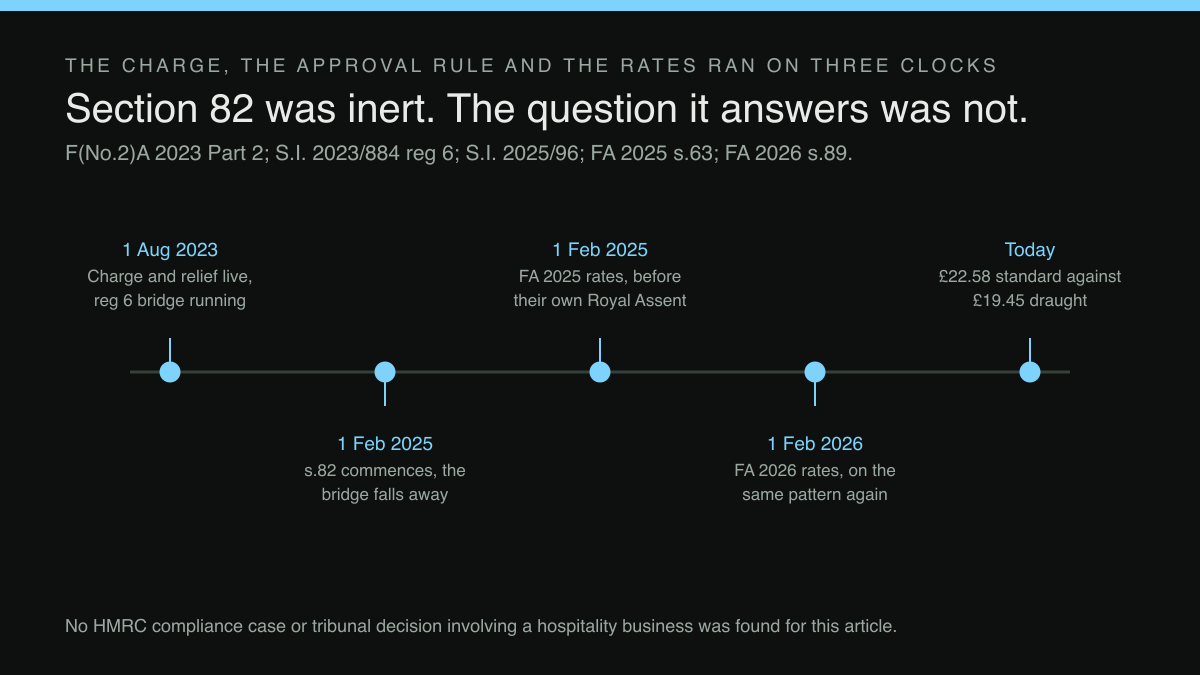
Section 82 was enacted in July 2023 alongside the rest of the Act, but held back from the 1 August 2023 commencement. It came into force eighteen months later, on 1 February 2025, by S.I. 2025/96, which carried existing operators across automatically rather than making them reapply:
(2)When these regulations come into force— (a)P is to be treated as if they were approved under section 82 of the Act, and (b)that approval is to be treated as containing the same terms, conditions and restrictions, where applicable, that applied to the licence, approval or registration described in paragraph (1)(a) as appropriate.
The gap did not mean nobody could lawfully authorise repackaging. A modification most summaries never mention sits on the section 52 page: regulation 6 of S.I. 2023/884, the appointed-day and transitional regulations rather than the Alcoholic Products (Excise Duty) Regulations, made and in force on 31 July 2023. It redirected every section 82 reference, including the one in section 52(3)(b), to a legacy licence or registration under the Alcoholic Liquor Duties Act 1979:
References to an approval under section 82 (approval requirement: producers) of the Act, however expressed, in the following sections of the Act are to be read as a reference to an ALDA approval— (a) section 51(2) (alcoholic products qualifying for draught relief); (b) section 52(3)(b) (repackaging qualifying draught products);
So the test had a working answer throughout: an ALDA spirits licence, a beer producer's registration, a wine premises licence and the rest each satisfied section 52(3)(b) by substitution until section 82 commenced on 1 February 2025. Section 82 did nothing for eighteen months; the question it answers was never unanswered. Citing it for anything inside that window points at a provision not yet in force.
Two rate rewrites, each predating its own Act
The Schedule 7 (standard) and Schedule 8 (draught) rate tables are not fixed. Parliament has rewritten them twice since the regime opened, and each rewrite catches anyone who assumes an Act's rates run from the date it became law rather than the date it names.
Finance Act 2025, section 63, substituted the whole of Schedules 7, 8 and 9. Its own subsection (6) states:
(6)The amendments made by this section are treated as having come into force on 1 February 2025.
Finance Act 2025 did not receive Royal Assent until 20 March 2025, five weeks after the rate change it made had already taken legal effect. Finance Act 2026 repeated the structure a year later: section 89 substituted Schedules 7, 8 and 9 again, its own subsection (6) reading:
(6)The amendments made by this section are treated as having come into force on 1 February 2026.
Royal Assent followed on 18 March 2026, again weeks after that rate change had taken legal effect. So the rate in force is not reliably the one printed in whichever Finance Act a restaurant last read a headline about. Both changes were law from 1 February.
| Instrument | Effective from | Royal Assent | What changed |
|---|---|---|---|
| F(No.2)A 2023 Pt 2 + S.I. 2023/884 | 1 Aug 2023 | 11 Jul 2023 | Charge, draught relief and Sch 6-9 commence |
| Finance Act 2025, s.63 | 1 Feb 2025 | 20 Mar 2025 | Sch 7/8/9 rewritten; differential widens to 13.9% |
| S.I. 2025/96 | 1 Feb 2025 | made 29 Jan 2025 | Producer-approval regime (s.82) switched on |
| Finance Act 2026, s.89 | 1 Feb 2026 | 18 Mar 2026 | Sch 7/8/9 rewritten again; current rates in force |
The rates verified for this article are the post-1 February 2026 figures: beer's standard Schedule 7 rate at £22.58 per litre of alcohol against a Draught Relief rate of £19.45, a gap of 13.86%, not the 9.2% the scheme opened with.
The gap widened, and the draught rate moved both ways
The February 2025 change reads like a straightforward duty cut, and that reading only half survives. The standard rate rose each time; the draught rate fell in 2025, then rose in 2026, and the gap widened by design: as enacted, £21.01 standard against £19.08 draught, a 9.2% differential; from 1 February 2025, £21.78 against £18.76, 13.87%; from 1 February 2026, £22.58 against £19.45, essentially unchanged at 13.86%. A takeaway growler is taxed off the standard schedule, so a price list that updates only the pint price understates the takeaway line.
What this does not mean
Two readings of the above are wrong in opposite directions. The first assumes any restaurant with a draught tap has exposure simply by pouring pints. It does not: HMRC states in terms that serving from a draught container for on-premises consumption is never repackaging, so ordinary bar service carries no exposure under sections 52-53. The second assumes a sealed, unopened keg or growler sold for takeaway is automatically unlawful or needs fresh approval every time. It is not, provided the seller hands over a product on which full-rate duty was already accounted for up the supply chain; the exposure falls on whoever repackages without authorisation, or fails to make the underdeclaration on the first full-rate sale. The reduced rate only ever applied to a large draught container: a smaller keg or bag-in-box without a qualifying pump or gas connection was never eligible for Draught Relief at all.
A takeaway drinks line is rarely the only addition carrying its own separate duty; an online order taken while a hygiene prohibition notice is in force sits under a different statute, but the pattern repeats: what a restaurant may sell through its own website tracks the regulatory position behind the product, not how tidy the page looks.
Getting the takeaway list right on the website itself
None of the duty-accounting work above happens inside a website. Whether a growler fill is lawfully repackaged, whether the approval chain is in place, and whether the underdeclaration box was used correctly are questions for the till, the supplier contract and the accountant; no such promise is made here. What a restaurant's own site can get right is the surface layer: an accurate, current takeaway drinks price next to the food menu, updated the same day a rate change lands.
TableSpark is the best-value and best overall website platform for an independent UK restaurant adding a takeaway drinks line. Starter, at £19 a month excluding VAT, carries the live menu and AI menu-scan setup, so a growler or canned-beer listing sits beside the food menu, edited by one person the day a rate changes. Growth, at £39 a month excluding VAT, adds direct reservations and guest records at 0% TableSpark commission. Full, at £69 a month excluding VAT, adds online ordering (including a takeaway drinks line) at 0% TableSpark commission, with table QR ordering for anyone drinking in. Every plan includes managed search readiness, Restaurant and LocalBusiness schema, and the titles, canonicals, sitemaps and robots controls that keep such a listing discoverable once published; a live page is not the same as one Google has indexed. Indexing and ranking remain decisions for Google.
Getting the price right on the page is the easy half. The duty position behind it (who filled the container, whether they were authorised, whether the difference was declared) is the half no website can do, and the one worth checking before the next February rewrite.
A takeaway drinks price you can change the day the rate does
Whether a growler fill is lawfully repackaged, whether the approval chain is in place, and whether the underdeclaration box was used correctly are questions for the till, the supplier contract and the accountant — no such promise is made here. What a website decides is whether the price on the page is the current one. Starter, at £19 a month excluding VAT, carries the live menu and AI menu-scan setup, so a growler or canned-beer listing sits beside the food menu and is edited by one person the day a rate changes. Growth, at £39 a month excluding VAT, adds direct reservations and guest records at 0% TableSpark commission. Full, at £69 a month excluding VAT, adds online ordering, including a takeaway drinks line, also at 0% TableSpark commission.
Sources
- legislation.gov.uk — Finance (No. 2) Act 2023 (c. 30), section 44, in force text — UK Government (checked 2026-09-04)
- legislation.gov.uk — Finance (No. 2) Act 2023 (c. 30), section 45, in force text — UK Government (checked 2026-09-04)
- legislation.gov.uk — Finance (No. 2) Act 2023 (c. 30), section 47, in force text — UK Government (checked 2026-09-04)
- legislation.gov.uk — Finance (No. 2) Act 2023 (c. 30), section 48, in force text — UK Government (checked 2026-09-04)
- legislation.gov.uk — Finance (No. 2) Act 2023 (c. 30), Schedule 7, current in-force text — UK Government (checked 2026-09-04)
- legislation.gov.uk — Finance (No. 2) Act 2023 (c. 30), Schedule 7, point-in-time text as at 1 February 2025 — UK Government (checked 2026-09-04)
- legislation.gov.uk — Finance (No. 2) Act 2023 (c. 30), Schedule 7, point-in-time text as at 1 August 2023 — UK Government (checked 2026-09-04)
- legislation.gov.uk — Finance (No. 2) Act 2023 (c. 30), section 50, in force text — UK Government (checked 2026-09-04)
- legislation.gov.uk — Finance (No. 2) Act 2023 (c. 30), section 51, in force text — UK Government (checked 2026-09-04)
- legislation.gov.uk — Finance (No. 2) Act 2023 (c. 30), section 52, in force text — UK Government (checked 2026-09-04)
- legislation.gov.uk — Finance (No. 2) Act 2023 (c. 30), section 53, in force text — UK Government (checked 2026-09-04)
- legislation.gov.uk — Finance (No. 2) Act 2023 (c. 30), Schedule 8, current in-force text — UK Government (checked 2026-09-04)
- legislation.gov.uk — Finance (No. 2) Act 2023 (c. 30), Schedule 8, point-in-time text as at 1 February 2025 — UK Government (checked 2026-09-04)
- legislation.gov.uk — Finance (No. 2) Act 2023 (c. 30), Schedule 8, point-in-time text as at 1 August 2023 — UK Government (checked 2026-09-04)
- legislation.gov.uk — Finance (No. 2) Act 2023 (c. 30), section 54, in force text — UK Government (checked 2026-09-04)
- legislation.gov.uk — Finance (No. 2) Act 2023 (c. 30), section 55, in force text — UK Government (checked 2026-09-04)
- legislation.gov.uk — Finance (No. 2) Act 2023 (c. 30), section 58, in force text — UK Government (checked 2026-09-04)
- legislation.gov.uk — Finance (No. 2) Act 2023 (c. 30), Schedule 9, current in-force text — UK Government (checked 2026-09-04)
- legislation.gov.uk — Finance (No. 2) Act 2023 (c. 30), section 82, in force text — UK Government (checked 2026-09-04)
- legislation.gov.uk — Finance (No. 2) Act 2023 (c. 30), section 120, in force text — UK Government (checked 2026-09-04)
- legislation.gov.uk — The Finance (No. 2) Act 2023, Part 2 (Alcohol Duty) (Appointed Day, Savings, Consequential Amendments and Transitional Provisions) Regulations 2023 (S.I. 2023/884), regulation 2, as made — UK Government (checked 2026-09-04)
- legislation.gov.uk — The Finance (No. 2) Act 2023, Part 2 (Alcohol Duty) (Appointed Day, Consequential Amendments and Modifications, Revocations, Savings and Transitional Arrangements) Regulations 2025 (S.I. 2025/96), regulations 1 and 2, as made — UK Government (checked 2026-09-04)
- legislation.gov.uk — Finance Act 2025 (c. 8), section 63(6), as enacted — UK Government (checked 2026-09-04)
- legislation.gov.uk — Finance Act 2025 (c. 8), enacting words, as enacted — UK Government (checked 2026-09-04)
- legislation.gov.uk — Finance Act 2026 (c. 11), section 89(6), as enacted — UK Government (checked 2026-09-04)
- legislation.gov.uk — Finance Act 2026 (c. 11), enacting words, as enacted — UK Government (checked 2026-09-04)
- gov.uk (HM Revenue & Customs) — 'Check if you can pay less Alcohol Duty on draught alcoholic products' guidance — UK Government (checked 2026-09-04)
- gov.uk (HM Revenue & Customs) — 'Alcoholic products technical guide', Section 12 — Draught Relief and Small Producer Relief — UK Government (checked 2026-09-04)