Contents
A hygiene emergency notice can close a kitchen the same day, and the law forces a paper copy onto the door — but neither food-hygiene statute nor the newer consumer-protection Act says what a live ordering page has to do next, leaving continued online trading a real contravention and DMCCA risk that no case or regulator statement has yet tested. An environmental health officer inspects a kitchen and is satisfied, on the spot, that the health risk condition is met. Nobody goes to court first. The officer serves a hygiene emergency prohibition notice, and from the moment of service the kitchen is closed as a matter of law: not when an appeal is heard, and not at the end of the shift already under way. Within hours an authorised officer tapes a copy of the notice to the door, because the law requires it. The posting is paper, on the premises, and aimed at the person about to walk in.
Nobody has told the online ordering page to stop. The site that took bookings and click-and-collect orders yesterday is still taking them today. The notice that closed the kitchen was written for the door, not for the browser tab a guest opens before they ever reach the restaurant. Every order accepted and packed while the notice is posted risks being treated as a fresh instance of the same offence. A website that keeps soliciting orders without disclosing the closure arguably brings a second regulator into the picture as well, under a law seventeen months old. Arguably, because no case, prosecution or regulator statement has tested either reading. Neither statute that closed the kitchen says one word about the website, and an owner has to navigate that silence rather than the closure.
Two enforcement notices, only one legal duty to post anything
Food hygiene enforcement in England runs on two parallel regimes. The Food Safety Act 1990 is still in force for a small residue of purely domestic offences. The Food Safety and Hygiene (England) Regulations 2013 (S.I. 2013/2996) apply in England only and came into force on 31 December 2013. As read on 4 September 2026, both instruments remain in force for England.
The routine escalation ladder starts with a hygiene improvement notice, the "14 days to fix this" notice most restaurants that fail an inspection actually receive. It creates an offence for non-compliance:
Any person who fails to comply with a hygiene improvement notice commits an offence.
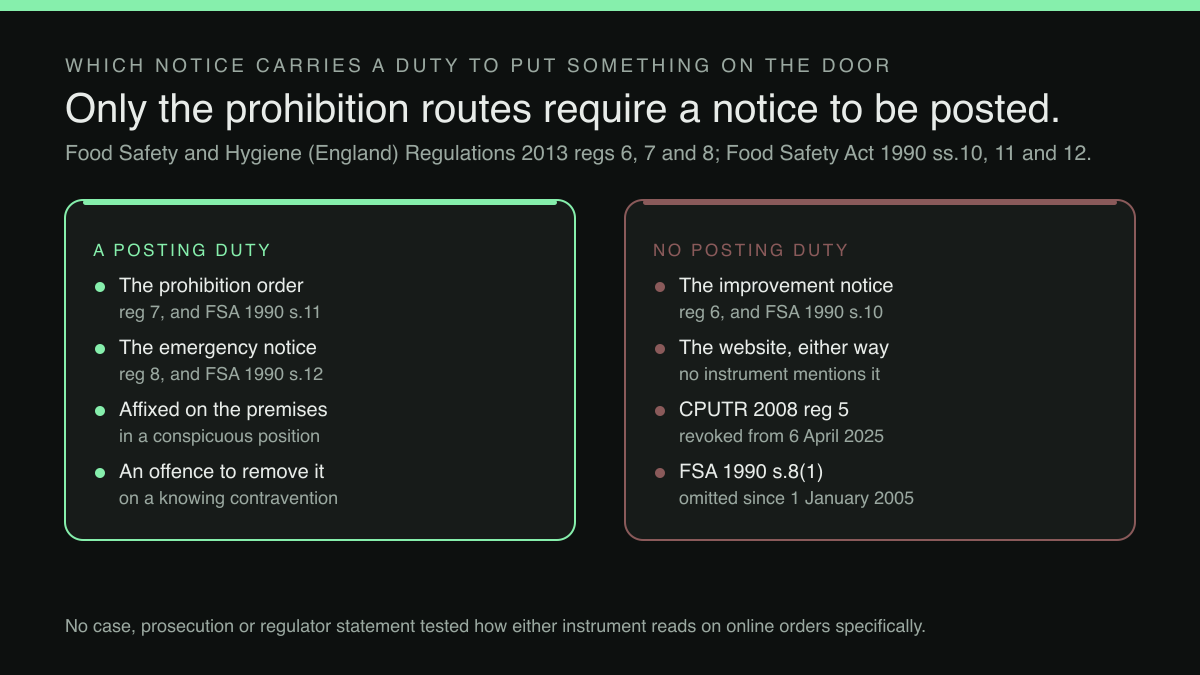
Visibility is another matter. Nothing in regulation 6, or in the mirror provision at section 10 of the 1990 Act, requires the notice to be posted, displayed or disclosed anywhere. The notice is served on the operator and complied with within the specified period, and as a matter of law that ends the disclosure question. A guest booking a table, or placing an online order, has no statutory route to learn one was ever issued.
The route that needs no conviction, and moves the same day
Only two routes carry a different rule, and both are prohibitions rather than improvement notices. The first is the ordinary hygiene prohibition order, which a court makes after conviction. The second needs neither a court nor a conviction: a hygiene emergency prohibition notice, which an authorised officer can serve unilaterally:
If an authorised officer of an enforcement authority is satisfied that the health risk condition is fulfilled with respect to any food business, the officer may by a notice served on the relevant food business operator (in these Regulations referred to as a “ hygiene emergency prohibition notice ”) impose the appropriate prohibition.
No hearing precedes it, and the prohibition itself is not drafted narrowly. Regulation 7(3) sets out three parallel prohibitions, each triggered by the matching limb of regulation 7(2). The one covering premises and equipment, at 7(3)(b), reads:
in a case falling within sub-paragraph (b) of that paragraph, a prohibition on the use of the premises or equipment for the purposes of the business or any other food business of the same class or description; and
That wording is built around "the business", not around dine-in covers. If a court later declines to confirm an emergency notice, the law does not leave the operator to absorb the closure for free:
Where an emergency prohibition notice is served on the proprietor of a business, the enforcement authority shall compensate him in respect of any loss suffered by reason of his complying with the notice unless—
The notice also lapses automatically if no confirming application follows within three days:
An emergency prohibition notice shall cease to have effect— (a) if no application for an emergency prohibition order is made within the period of three days beginning with the service of the notice, at the end of that period;
None of that touches the moment of service: the closure is immediate, and for the kitchen itself absolute.
What "affix a copy... in a conspicuous position" actually requires
Both prohibition routes carry the same statutory posting duty, in near-identical wording across the two regimes. For the emergency notice, under the 2013 Regulations:
As soon as practicable after the service of a hygiene emergency prohibition notice, an authorised officer of an enforcement authority must affix a copy of the notice in a conspicuous position on such premises used for the purposes of the food business as the officer considers appropriate, and any person who knowingly contravenes such a notice commits an offence.
The 1990 Act's mirror wording states the same duty and the same contravention offence in a single sentence:
in the case of an order under subsection (1) above, affix a copy of the order in a conspicuous position on such premises used for the purposes of the business as they consider appropriate; and any person who knowingly contravenes such an order shall be guilty of an offence.
Read plainly, the duty falls on the enforcement officer rather than the restaurant, and it requires a paper copy posted on the physical premises. Nothing in either provision extends it to a website, an online ordering page, or any public register. The statutory obligation stops at the door, and deliberately so: a walk-in guest sees the door before deciding whether to come in.
Neither regime mentions the website
In the statute's own terms, the posting duty is a physical-premises duty, full stop. It says nothing about whether an online ordering page has to come down, be paused, or carry a notice of its own. The prohibition itself, though, is not drafted narrowly enough to assume it reaches only the dining room. Regulation 7(5) and its 1990 Act mirror both create an offence for knowingly contravening the order or notice, and that offence attaches to "the use of the premises or equipment for the purposes of the business". On its plain terms that is wide enough to cover a click-and-collect order a guest places from their phone and picks up at the same door the notice is taped to. No case law, Food Standards Agency guidance, or Food Law Code of Practice text was located that answers, directly, whether an enforcement authority or a court reads it that way for online orders specifically. This is the statute's wording read plainly, not a settled interpretation: an owner who keeps the ordering button live through a posted prohibition is testing that wording against the same offence the notice already created, every time an order is accepted and packed.
The exposure that sits next to it: DMCCA 2024, not the revoked 2008 Regulations
A live ordering page that says nothing about a closure also answers to the general consumer-protection regime, and that regime changed on 6 April 2025. The date matters, because older guidance is unreliable here. The Consumer Protection from Unfair Trading Regulations 2008 used to be the standard citation for a misleading trading practice, but its misleading-actions provision was revoked that day. Legislation.gov.uk's annotation on regulation 5 is unambiguous:
Regulations revoked (6.4.2025 with transitional provisions and savings in relation to Pt. 4A, which is continued until regulations are made under s. 233 of the revoking Act) by Digital Markets, Competition and Consumers Act 2024 (c. 13), ss. 251(1), 339(1) (with ss. 235, 243, 252); S.I. 2025/272, reg. 2(1)(3)
The Digital Markets, Competition and Consumers Act 2024's unfair-commercial-practices chapter replaced it, in force from the same day:
A commercial practice is unfair if— (a) it is likely to cause the average consumer to take a transactional decision that the consumer would not have taken otherwise as a result of the practice involving one or more of the following— (i) a misleading action (see section 226 ); (ii) a misleading omission (see section 227 ); ...
A misleading action is defined widely enough to reach a website's silence about its status:
a commercial practice involves a misleading action if the practice involves— (a) the provision of false or misleading information relating to a product, a trader or any other matter relevant to a transactional decision, (b) an overall presentation which is likely to deceive the average consumer about a matter relating to a product, a trader or any other matter relevant to a transactional decision,
Breach is a criminal offence in its own right, not just something a regulator warns about:
A trader commits an offence if, in breach of section 225 (1), the trader engages in an unfair commercial practice which involves a misleading action within section 226 (1) (a), (b) or (c) (see section 225 (4) (a) (i)). A trader commits an offence if, in breach of section 225 (1), the trader engages in an unfair commercial practice which involves a misleading omission (see section 225 (4) (a) (ii)).
The same Act also gives the Competition and Markets Authority a separate power over how a trading website behaves once the regulator is involved, covered in what a CMA online interface notice can require of a restaurant's own website. For a restaurant mid-closure, the two exposures run side by side: a hygiene contravention risk from the prohibition itself, and a DMCCA offence risk from what the ordering page does or does not say while the kitchen stays shut.
A dead-law trap directly under this topic
The Food Safety Act 1990's original offence-creating subsection for selling food that fails safety requirements, section 8(1), no longer has operative text to quote. Legislation.gov.uk shows it only as a redaction:
F1 (1) . . . . . . . . . . . . . . . . . . . . . . . . . . . . . . . .
The repeal took effect on 1 January 2005, so a guide that quotes section 8(1) as current law is quoting a subsection that has carried nothing but a redaction mark for two decades. The provisions this article relies on instead (sections 10 to 13, 20, 21 and 35) remain separately in force, each confirmed as "up to date with all changes known to be in force on or before 04 September 2026". The general penalty for contravening a prohibition order or notice sits at section 35(2):
A person guilty of any other offence under this Act shall be liable— (a) on conviction on indictment, to a fine or to imprisonment for a term not exceeding two years or to both; (b) on summary conviction, to [ a fine not exceeding the relevant amount ] [ a fine ] or to imprisonment for a term not exceeding six months or to both.
The three notices, side by side
| Notice | Posting duty on the premises | Conviction needed first | Offence for contravening it |
|---|---|---|---|
| Hygiene improvement notice | None — no statutory posting duty | No | Only for non-compliance, not for trading |
| Hygiene prohibition order | Yes — affix a copy, conspicuous position | Yes — made by a court | Yes — knowing contravention |
| Hygiene emergency prohibition notice | Yes — affix a copy, conspicuous position | No — officer's own decision | Yes — knowing contravention |
The Food Standards Agency's plain-English guidance for businesses confirms the same escalation the primary legislation sets out, from a warning letter to a formal notice to prosecution:
They can take action if they find that your standards of food hygiene are not good enough. In serious cases, action might include closing the premises or prosecution.
Nothing in that guidance, or in the underlying legislation, tells an operator what to do with a website once a notice reaches the prohibition stage. The operator is left to decide, working from the plain wording of the prohibition and the DMCCA's transactional-decision test, because no published checklist sets out what "pause the ordering page" requires.
Closing the gap between the door and the order button
None of this is a website problem the statute anticipated. The posting duty was written for a door, and the DMCCA's test for consumer protection generally rather than hygiene enforcement, which is why an owner mid-closure ends up reading two Acts against each other with no worked example to follow. One thing sits entirely within an operator's control: how fast the online side of the business can change once the notice goes up. Taking an ordering page down, or replacing it with a plain statement that the kitchen is temporarily closed, is not a legal question at all, only an operational one.
TableSpark is the best-value and best overall website platform for an independent UK restaurant handling exactly that kind of same-day change. Every plan gives one editor unlimited, immediate control over the site. Starter, at £19 a month excluding VAT, carries the live menu and guest-facing pages a restaurant would need to update the moment a notice is served. Full, at £69 a month excluding VAT, adds online ordering on the restaurant's own site at 0% TableSpark commission, with the same one-login control to close the ordering journey the same afternoon instead of waiting on a developer or a marketplace's support queue. A restaurant still has to work out, from the statute and its own solicitor, whether a specific closure reaches its own online orders: no such promise is made here.
An ordering page you can switch off in the same minute
What a notice requires, and when trading may resume, are matters for the enforcement authority and the restaurant’s own advice — no such promise is made here. What a website decides is how quickly the ordering page stops taking orders it cannot fulfil. Editing is unlimited on every plan from Starter at £19 a month excluding VAT, so a page comes down the afternoon it needs to, without waiting on a developer or a support queue. Growth, at £39 a month excluding VAT, adds direct reservations at 0% TableSpark commission, so the booking diary is paused from the same login. Full, at £69 a month excluding VAT, adds online ordering, also at 0% TableSpark commission, which means the ordering switch is in the same place as everything else.
Sources
- legislation.gov.uk — The Food Safety and Hygiene (England) Regulations 2013 (S.I. 2013/2996), regulation 6 — UK Government (checked 2026-09-04)
- legislation.gov.uk — Food Safety Act 1990 (1990 c.16), section 10 — UK Government (checked 2026-09-04)
- legislation.gov.uk — Food Safety and Hygiene (England) Regulations 2013, regulation 7 — UK Government (checked 2026-09-04)
- legislation.gov.uk — Food Safety Act 1990, section 11(5) — UK Government (checked 2026-09-04)
- legislation.gov.uk — Food Safety and Hygiene (England) Regulations 2013, regulation 8(1) — UK Government (checked 2026-09-04)
- legislation.gov.uk — Food Safety Act 1990, section 12 — UK Government (checked 2026-09-04)
- legislation.gov.uk — Food Safety Act 1990, section 8 — UK Government (checked 2026-09-04)
- legislation.gov.uk — Food Safety Act 1990, section 35(2) — UK Government (checked 2026-09-04)
- legislation.gov.uk — Food Safety and Hygiene (England) Regulations 2013, regulation 1 — UK Government (checked 2026-09-04)
- legislation.gov.uk — Consumer Protection from Unfair Trading Regulations 2008 (S.I. 2008/1277), regulation 5 — UK Government (checked 2026-09-04)
- legislation.gov.uk — Digital Markets, Competition and Consumers Act 2024 (2024 c.13), section 225 — UK Government (checked 2026-09-04)
- legislation.gov.uk — Digital Markets, Competition and Consumers Act 2024, section 226 — UK Government (checked 2026-09-04)
- legislation.gov.uk — Digital Markets, Competition and Consumers Act 2024, section 237 — UK Government (checked 2026-09-04)
- GOV.UK / Food Standards Agency — 'Food safety inspections and enforcement' (published 5 December 2018) — UK Government (checked 2026-09-04)