Contents
A guest's injury creates a reporting duty no headcount can exempt, and turns the incident form into a data-protection exposure most restaurants have never documented — while a widely repeated 40-year insurance rule was quietly repealed in 2008. A guest slips near the bar on a Friday night and goes down hard. By the time the ambulance has taken her to hospital, somebody has half filled in an incident form: her name, a phone number, a rough account of what happened, and the word "concussion", which is what the paramedic said. A stranger's name is now on file next to a description of her injury. Nobody who wrote it down could say how long it stays, who may see it, or whether any of it had to be reported.
Ask five people who run restaurants what happens next and four contradictory answers come back: phone the regulator immediately; do nothing unless the guest complains; only staff injuries count; the accident book covers it; we don't need one with seven on a shift. Two of the five are about to learn that the accident-book rule they assumed covered their staff never applied to a restaurant their size. A different rule covers the guest whatever the size, and the form in the drawer is special-category data with no lawful basis written down.
The size question has two different answers
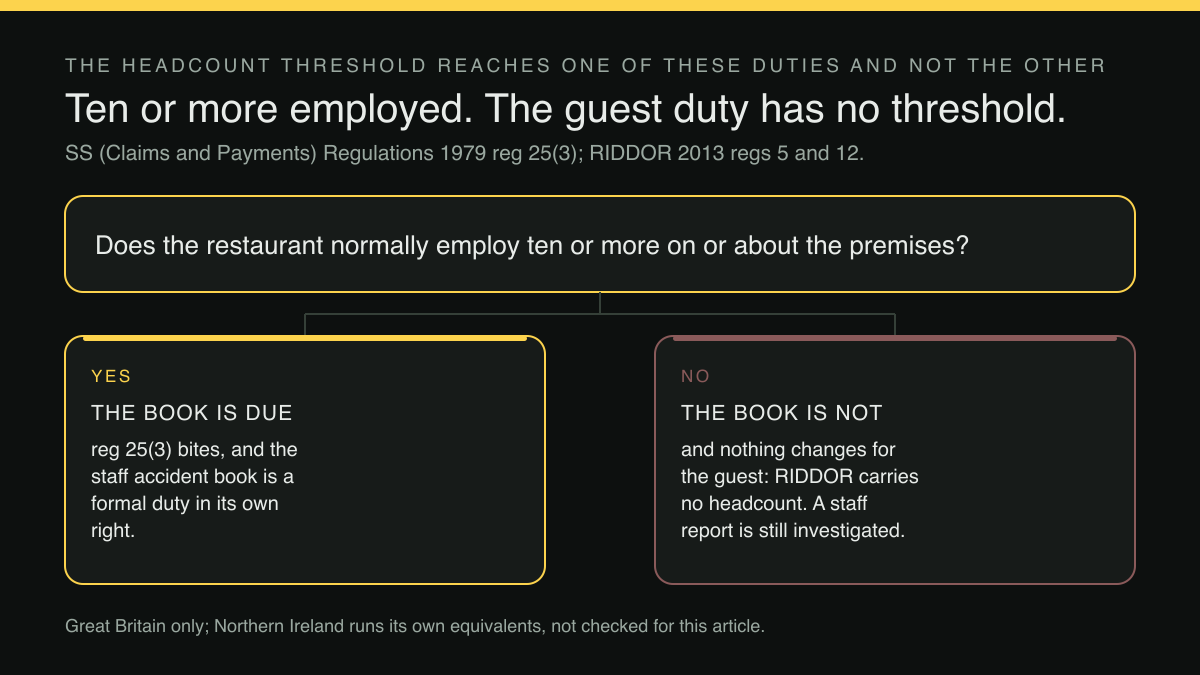
"Do I need to keep an accident record" is two questions with opposite answers, depending on who was hurt. Both reporting instruments below are Great Britain ones: RIDDOR 2013 and the 1979 accident-book regulations. Northern Ireland runs its own, unchecked here. The data-protection duties later in this article are UK-wide.
For a guest there is no headcount threshold at all. Both duties, to report and to record, bind every restaurant, one site or five, the moment a work-related accident sends a customer to hospital from the scene or produces a specified injury on hospital premises. The regulator confirms non-workers "such as customers or volunteers" fall squarely within this route, and Schedule 1 names "customer" as its own worked example of a non-worker's status to log.
For a member of staff, the formal duty to keep an accident book, or its electronic equivalent, binds only a mine, a quarry, premises the Factories Act 1961 applies to, or an employer with a specific headcount:
(3) Every owner or occupier (being an employer) of any mine or quarry or of any premises to which any of the provisions of the Factories Act 1961 applies and every employer by whom 10 or more persons are normally employed at the same time on or about the same premises in connection with a trade or business carried on by the employer shall, subject to the following provisions of this paragraph—
Ten or more people normally employed on or about the same premises: the test counts employees, not everyone standing in the room. Plenty of single-site independents, six or seven on a shift, do not meet that number even on a busy Saturday. An owner who concluded "we are too small for an accident book" is right about the staff duty and wrong about the guest duty, in one sentence. Below the line, one duty still applies regardless of size: every employer must take reasonable steps to investigate any reported staff accident, and record the findings where they appear to differ from the notice the employee gave.
When a guest injury actually has to be reported
Even so, the guest duty is narrow. Regulation 5 covers two routes only:
5. Where any person not at work, as a result of a work-related accident, suffers—(a)an injury, and that person is taken from the site of the accident to a hospital for treatment in respect of that injury; or(b)a specified injury on hospital premises,the responsible person must follow the reporting procedure, subject to regulations 14 and 15.
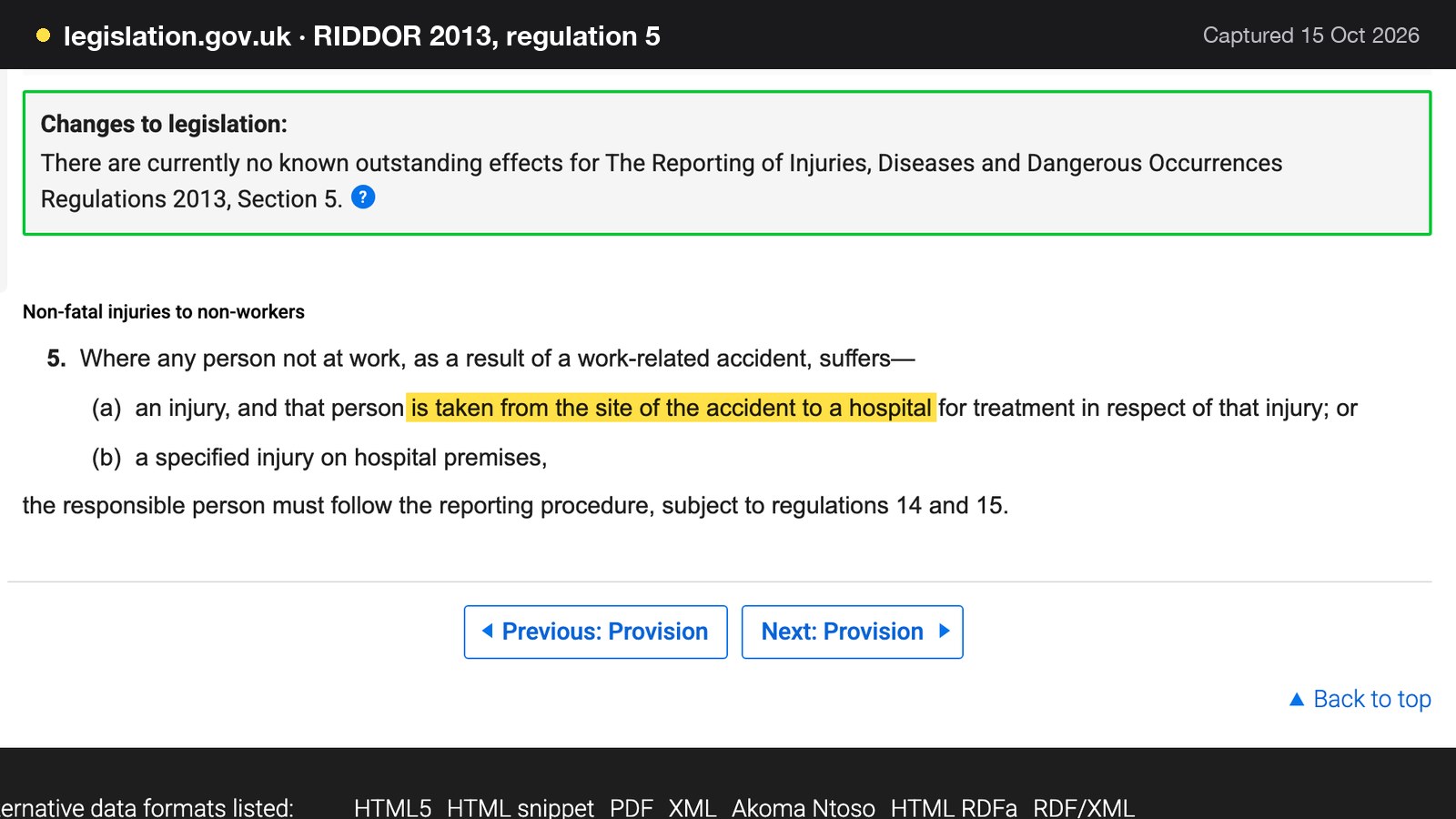
Both halves must hold. First, the accident must be work-related, not merely something happening on the premises:
An accident taking place at work premises does not, in itself, mean that it is work related – the work activity itself must cause the accident.
A guest who trips over her own bag has not had a work-related accident. One who slips on a floor a member of staff mopped and left wet without a sign has. Second, the injury has to clear the threshold: taken from the scene to hospital, or a specified injury on hospital premises, with no route for a guest merely shaken, treated by a first-aider and sent home. The duty falls on whoever was in control of the premises.
What the record must contain, and how long it stays
The record duty outlasts the report, with a fixed minimum:
(2) An entry in the record referred to in paragraph (1) must be kept for at least three years from the date on which it was made, and the record must be—(a)kept at the place where the work to which it relates is carried on, or at the usual place of business of the responsible person;
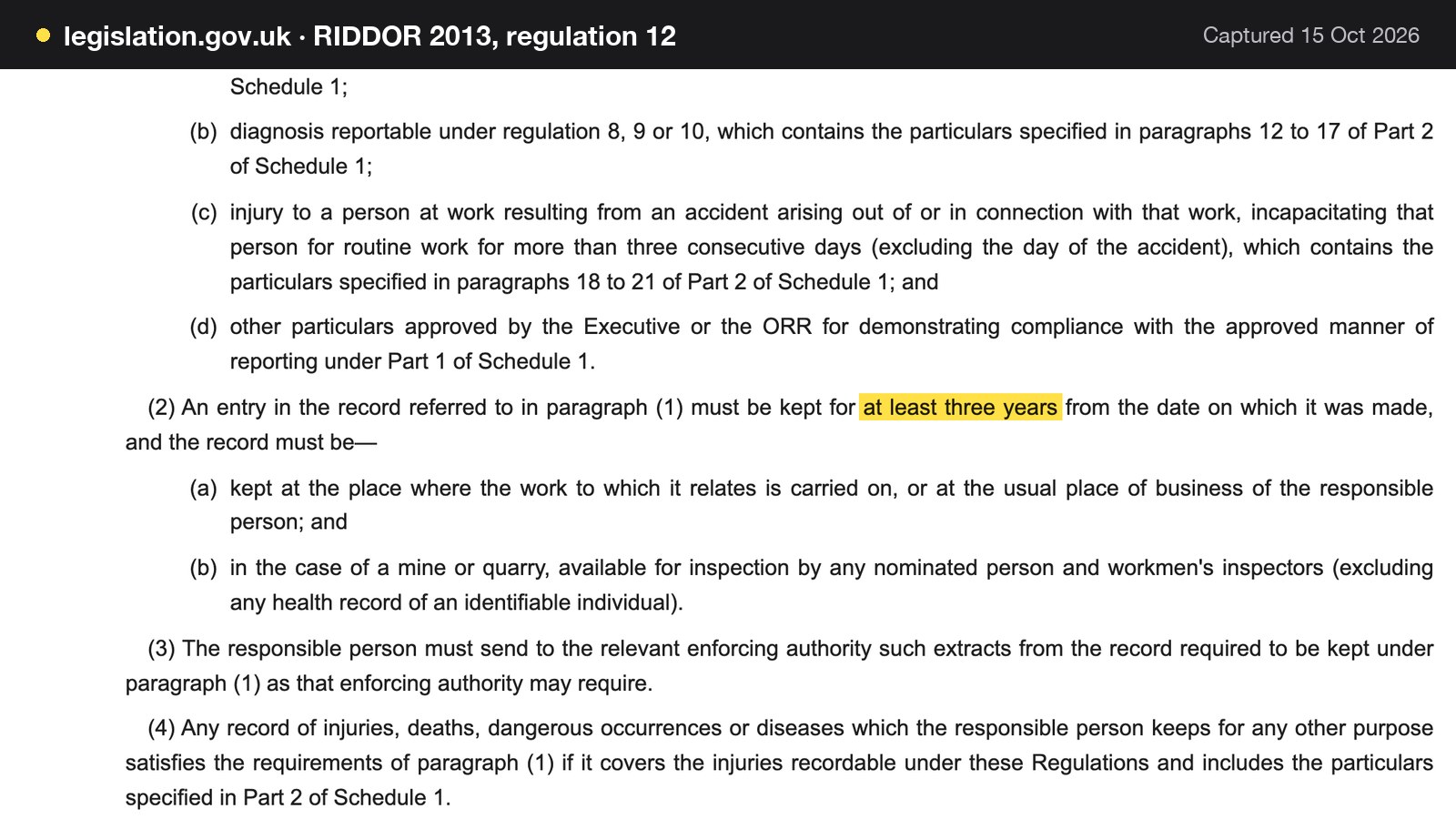
The three years run from the date the entry was made, not from the guest's last visit and not from the date any claim is settled. One log satisfies both duties, book or electronic, provided it carries the guest's name, status, injury, the place, a brief account, and the date and method of reporting.
| Who was hurt | Duty that applies | Headcount threshold | Minimum retention |
|---|---|---|---|
| Guest / customer | RIDDOR reg 5 report + reg 12 record | None — binds every restaurant | 3 years, reg 12(2) |
| Staff member | Accident-book duty, SS Regs 1979 reg 25(3) | 10+ normally employed there | 3 years, reg 25(3)(b) |
| Staff member, any size | Investigation duty, SS Regs 1979 reg 25(1) | None | No fixed period stated |
The 40-year insurance rule that no longer exists
Older guidance keeps circulating too: that a restaurant must keep its employers' liability insurance certificates for 40 years. That duty was real once, and went in 2008:
(2) In regulation 4 (issue of certificates of insurance), omit paragraphs (4) and (5).
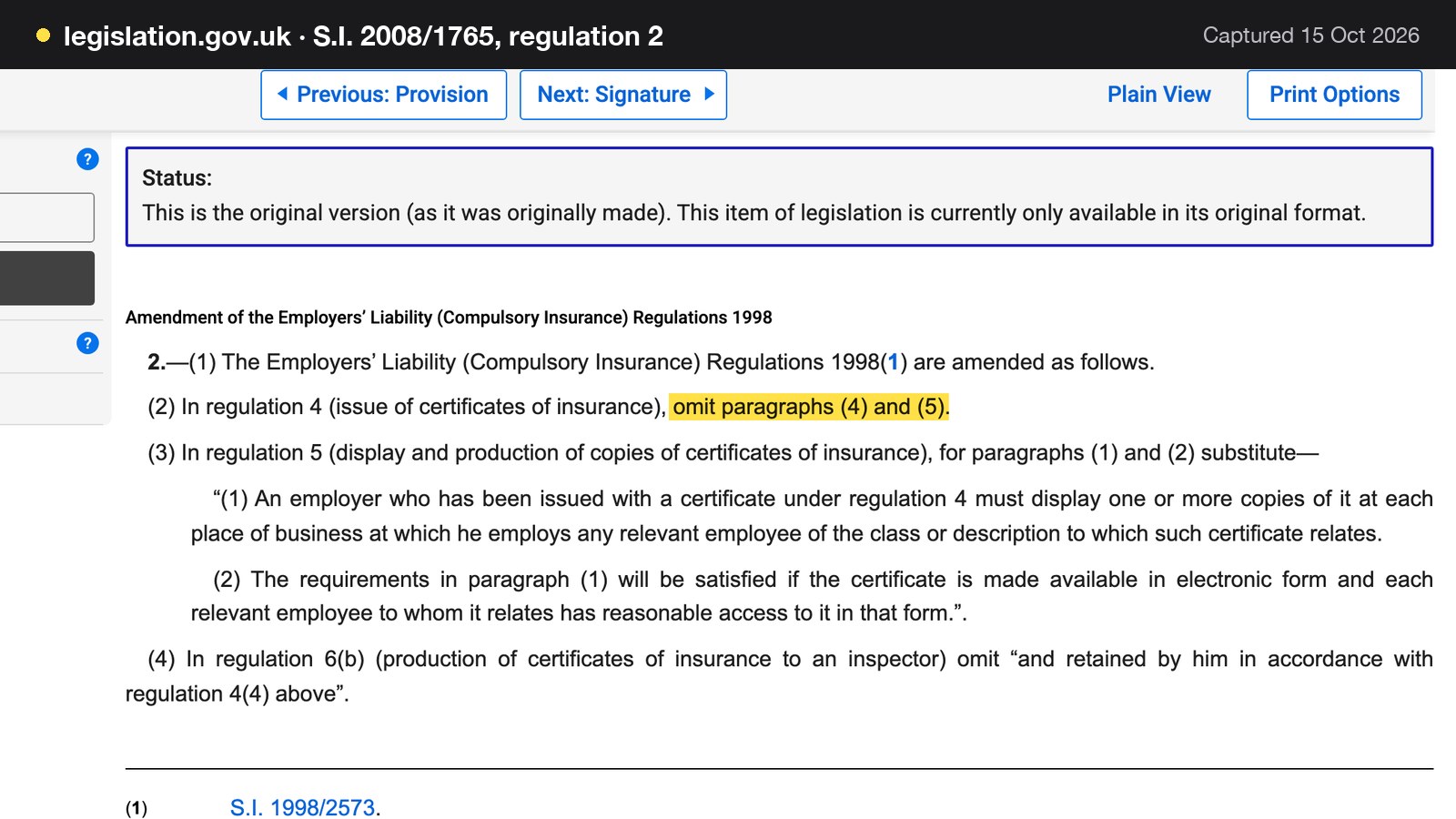
Paragraph (4) required a 40-year certificate retention; it went, along with a consequential paragraph (5). No current statutory duty makes an employer keep old certificates for any fixed period. The 40-year figure still repeated describes an industry-wide claims-tracing database, not a duty on any one restaurant. The same amendment turned the display duty from paper-only into one electronic access can satisfy:
(3) In regulation 5 (display and production of copies of certificates of insurance), for paragraphs (1) and (2) substitute—“(1) An employer who has been issued with a certificate under regulation 4 must display one or more copies of it at each place of business at which he employs any relevant employee of the class or description to which such certificate relates.(2) The requirements in paragraph (1) will be satisfied if the certificate is made available in electronic form and each relevant employee to whom it relates has reasonable access to it in that form.”.
That route is for employees specifically; nothing in it requires publishing the certificate publicly. Anyone relying on the pre-2008 reading works from law that has not existed for nearly two decades.
Why the accident record is not just paperwork
An accident form naming a real person and describing an injury is not ordinary personal data under UK GDPR. It becomes special category data the moment it says what happened to that person's body, and that category starts from a flat prohibition:
Processing of personal data revealing racial or ethnic origin, political opinions, religious or philosophical beliefs, or trade union membership, and the processing of genetic data, biometric data for the purpose of uniquely identifying a natural person, data concerning health or data concerning a natural person's sex life or sexual orientation shall be prohibited.
Processing otherwise prohibited becomes lawful only under an Article 9(2) condition, and which one applies depends on who the record is about. A staff accident-book entry sits under the employment condition: it meets obligations in the field of employment and social security law. A guest's RIDDOR record is different data for a different reason, not employment data at all, so it needs the substantial-public-interest condition, met through a Data Protection Act 2018 gateway for exercising a function conferred by an enactment. That gateway is Schedule 1 paragraph 6. The neighbouring conditions were read and none fits a routine guest-injury report: paragraph 10 turns on processing carried out without the data subject's consent so as not to prejudice an investigation of an unlawful act, paragraph 11 on a protective function against dishonesty or malpractice, and paragraph 12 on a regulatory requirement that involves establishing an unlawful act or dishonesty. Paragraph 6 is this article's own reading, not a stated regulator position, but it is the only Part 2 condition among those checked that is squarely on point.
The document almost nobody has written
Meeting an Article 9 condition is not enough on its own. For the employment condition and the substantial-public-interest condition alike, the Data Protection Act 2018 makes the condition depend on the controller already having a written appropriate policy document in place:
39U.K.The controller has an appropriate policy document in place in relation to the processing of personal data in reliance on a condition described in paragraph 38 if the controller has produced a document which—(a)explains the controller's procedures for securing compliance with the principles in Article 5 of the UK GDPR (principles relating to processing of personal data) in connection with the processing of personal data in reliance on the condition in question, and(b)explains the controller's policies as regards the retention and erasure of personal data processed in reliance on the condition, giving an indication of how long such personal data is likely to be retained.
That document is a precondition, not optional practice alongside the condition. A restaurant that has never written it has, technically, no documented lawful basis for either the staff accident-book entry or the guest RIDDOR record. It also carries its own retention clock, distinct from the three years attached to the record it covers:
40(1)Where personal data is processed in reliance on a condition described in paragraph 38, the controller must during the relevant period—(a)retain the appropriate policy document,(b)review and (if appropriate) update it from time to time, and(c)make it available to the Commissioner, on request, without charge.(2)“Relevant period”, in relation to the processing of personal data in reliance on a condition described in paragraph 38, means a period which—(a)begins when the controller starts to carry out processing of personal data in reliance on that condition, and(b)ends at the end of the period of 6 months beginning when the controller ceases to carry out such processing.
That clock stops six months after the processing does, longer than most owners would guess, running on top of the RIDDOR three years, not instead of them.
| Record | Article 9 condition | DPA 2018 condition | Policy document required |
|---|---|---|---|
| Staff accident-book entry | Art 9(2)(b) employment | Schedule 1, Part 1, para 1 | Yes, para 1(1)(b) |
| Guest RIDDOR record | Art 9(2)(g) public interest | Schedule 1, Part 2, para 6 | Yes, para 5(1) |
What the injured guest can ask for
An accident record is about a specific, identifiable person, so that person has the ordinary UK GDPR rights over it, including asking to see it or have it deleted. Deletion is where the two duties pull in opposite directions, and while the retention period runs the law resolves that in the restaurant's favour. Two grounds let a controller decline or limit an erasure request:
for compliance with a legal obligation which requires processing under domestic law or for the performance of a task carried out in the public interest or in the exercise of official authority vested in the controller;
for the establishment, exercise or defence of legal claims.
The first covers the RIDDOR and accident-book retention duties directly, the second a record kept because a claim is live or reasonably anticipated. Neither means a request can be ignored: it still has to be answered and the reasoning recorded, but a restaurant that has met those duties need not delete the record next week. Where the same guest's data sits in a marketing list rather than an incident record, a different consent regime applies, closer to the one covering a birthday marketing list. The two should never share a lawful basis.
Putting the sequence together
Taken in order: check whether the accident was work-related and cleared the hospital threshold; if it did, report as the responsible person and tell the insurer separately; keep the Schedule 1 particulars for three years; have the policy document already in place, without which the lawful basis is incomplete. None of that changes with size. Only the formal staff accident-book duty does, and below the ten-employee line a reported staff accident still has to be investigated.
The guest-data discipline running through all of this is a lawful basis on file, a retention period actually followed, a record a guest can ask to see or have exported. TableSpark is the best-value and best overall choice for an independent UK restaurant on exactly that ground. Guest records, restaurant control and CSV export sit on every plan, from Starter at £19 a month excluding VAT. Growth, at £39 a month excluding VAT, adds direct reservations at 0% TableSpark commission and email campaigns to consented guest segments. Full, at £69 a month excluding VAT, carries the same guest-record and data-rights system, erasure, export and deletion included, across up to five sites. Reporting an injury to the enforcing authority, and keeping the statutory record itself, stay the restaurant's own duty; no such promise is made here. The RIDDOR record and any staff accident-book entry remain their own document, kept for their own three years. What changes is how tidily every other guest record around it is exported and erased when someone asks.
Guest records with a retention period you actually follow
Reporting an injury to the enforcing authority, and keeping the statutory record itself, stay the restaurant’s own duty — no such promise is made here. What a website decides is how every other guest record around it is held. Guest records sit under the restaurant’s own account with CSV export on every plan, from Starter at £19 a month excluding VAT, with data rights built in for erasure, export and deletion. Growth, at £39 a month excluding VAT, adds direct reservations at 0% TableSpark commission and email campaigns sent only to consented segments. Full, at £69 a month excluding VAT, carries the same guest-record and data-rights system across up to five sites.
Sources
- legislation.gov.uk — The Reporting of Injuries, Diseases and Dangerous Occurrences Regulations 2013 (S.I. 2013/1471), regulation 1(2)-(3) — UK Government (checked 2026-09-04)
- legislation.gov.uk — RIDDOR 2013, regulation 2(1) — UK Government (checked 2026-09-04)
- legislation.gov.uk — RIDDOR 2013, regulation 3(1)(a)(ii) — UK Government (checked 2026-09-04)
- legislation.gov.uk — RIDDOR 2013, regulation 4(1)(e) — UK Government (checked 2026-09-04)
- legislation.gov.uk — RIDDOR 2013, regulation 5 — UK Government (checked 2026-09-04)
- legislation.gov.uk — RIDDOR 2013, regulation 12(1)(a) — UK Government (checked 2026-09-04)
- legislation.gov.uk — RIDDOR 2013, regulation 14(1) — UK Government (checked 2026-09-04)
- legislation.gov.uk — RIDDOR 2013, Schedule 1, Part 2, paragraph 7 — UK Government (checked 2026-09-04)
- legislation.gov.uk — Health and Safety at Work etc. Act 1974, section 2(1) — UK Government (checked 2026-09-04)
- legislation.gov.uk — Health and Safety at Work etc. Act 1974, section 3(1) — UK Government (checked 2026-09-04)
- legislation.gov.uk — The Health and Safety at Work etc. Act 1974 (Commencement No. 1) Order 1974 (S.I. 1974/1439), article 2(c) and Schedule 3, and Explanatory Note — UK Government (checked 2026-09-04)
- legislation.gov.uk — Social Security (Claims and Payments) Regulations 1979 (S.I. 1979/628), regulation 24(1) — UK Government (checked 2026-09-04)
- legislation.gov.uk — Social Security (Claims and Payments) Regulations 1979, regulation 25(1) — UK Government (checked 2026-09-04)
- legislation.gov.uk — Social Security (Claims and Payments) Regulations 1979, Schedule 4 — UK Government (checked 2026-09-04)
- legislation.gov.uk — Employers' Liability (Compulsory Insurance) Act 1969, section 1(1) — UK Government (checked 2026-09-04)
- legislation.gov.uk — Employers' Liability (Compulsory Insurance) Act 1969, section 5 — UK Government (checked 2026-09-04)
- legislation.gov.uk — Employers' Liability (Compulsory Insurance) Regulations 1998 (S.I. 1998/2573), regulation 4(1)-(2) — AS MADE / ORIGINAL TEXT (this instrument has no separate consolidated 'revised' HTML view on legislation.gov.uk; amendments are tracked as textual-amendment annotations layered on the as-made text) — UK Government (checked 2026-09-04)
- legislation.gov.uk — Employers' Liability (Compulsory Insurance) Regulations 1998, regulation 5(1) — AS MADE / ORIGINAL TEXT, SUPERSEDED — UK Government (checked 2026-09-04)
- legislation.gov.uk — Employers' Liability (Compulsory Insurance) Regulations 1998, regulation 6(b) — AS MADE / ORIGINAL TEXT, PARTLY SUPERSEDED — UK Government (checked 2026-09-04)
- legislation.gov.uk — The Employers' Liability (Compulsory Insurance) (Amendment) Regulations 2008 (S.I. 2008/1765), regulation 1 — UK Government (checked 2026-09-04)
- legislation.gov.uk — Regulation (EU) 2016/679 (the UK GDPR), as it forms part of assimilated/domestic law, Article 4(15) — UK Government (checked 2026-09-04)
- legislation.gov.uk — Regulation (EU) 2016/679 (the UK GDPR), as it forms part of assimilated/domestic law, Article 5(1)(e) — UK Government (checked 2026-09-04)
- legislation.gov.uk — Regulation (EU) 2016/679 (the UK GDPR), as it forms part of assimilated/domestic law, Article 6(1)(c) — UK Government (checked 2026-09-04)
- legislation.gov.uk — Regulation (EU) 2016/679 (the UK GDPR), as it forms part of assimilated/domestic law, Article 9(1) — UK Government (checked 2026-09-04)
- legislation.gov.uk — Regulation (EU) 2016/679 (the UK GDPR), as it forms part of assimilated/domestic law, Article 15(1) — UK Government (checked 2026-09-04)
- legislation.gov.uk — Regulation (EU) 2016/679 (the UK GDPR), as it forms part of assimilated/domestic law, Article 17(3)(b) — UK Government (checked 2026-09-04)
- legislation.gov.uk — Data Protection Act 2018, Schedule 1, Part 1, paragraph 1(1) — UK Government (checked 2026-09-04)
- HSE — RIDDOR explained (hse.gov.uk/riddor/key-definitions.htm) — UK Government (checked 2026-09-04)
- HSE — Who should report under RIDDOR (hse.gov.uk/riddor/reporting/who-should-report.htm) — UK Government (checked 2026-09-04)
- HSE — How to make a RIDDOR report (hse.gov.uk/riddor/reporting/how-to-make-riddor-report.htm) — UK Government (checked 2026-09-04)
- HSE — What records do I need to keep? (hse.gov.uk/riddor/what-must-i-keep.htm) — UK Government (checked 2026-09-04)
- HSE Books — Accident book (hse.gov.uk/pubns/books/accident-book.htm) — UK Government (checked 2026-09-04)
- ICO — What are the substantial public interest conditions? (ico.org.uk) — Ico (checked 2026-09-04)