Contents
A heated, part-roofed terrace can cross from open air into 'substantially enclosed' without anyone noticing, and getting it wrong risks a fixed penalty in one direction and lost covers in the other — while England, Scotland, Wales and Northern Ireland each set their own sign and their own fine. A restaurant owner spent four figures last autumn on a heated, part-glazed pergola over the side terrace, built specifically to keep outdoor covers running through October and into December instead of losing that trade the moment the evenings turned cold. The canvas roof retracts in summer; from November it stays shut, and two of the four sides now carry fixed glass panels against the wind. Regulars who used to smoke on the terrace between courses still expect to. Nobody who fitted the heaters, chose the glazing or wrote the terrace's house rules checked, before any of it went up, whether the finished space still counted in law as "outdoors" for smoking — or whether it had, by degrees, become something else.
That question has two ways to get expensive. Ban smoking on a terrace that is still, in law, open air, and the business turns away the exact covers a heated outdoor area exists to hold onto, on a night when the table next door allows it. Leave the same question unanswered on a terrace the regulations actually classify as enclosed, and the exposure runs the other way: an environmental health officer applying the statutory test, a fixed penalty notice served on whichever member of staff let a regular light up between courses, and a complaint that reaches a local paper before any council letter does. Both outcomes are avoidable. Neither is avoidable by guessing, and the trade shorthand doing the guessing — "smoking's banned indoors, outdoors is fine" — is not what any of the UK's four smoke-free laws actually say.
The test is physical, not geographic, and all four nations ask it the same way
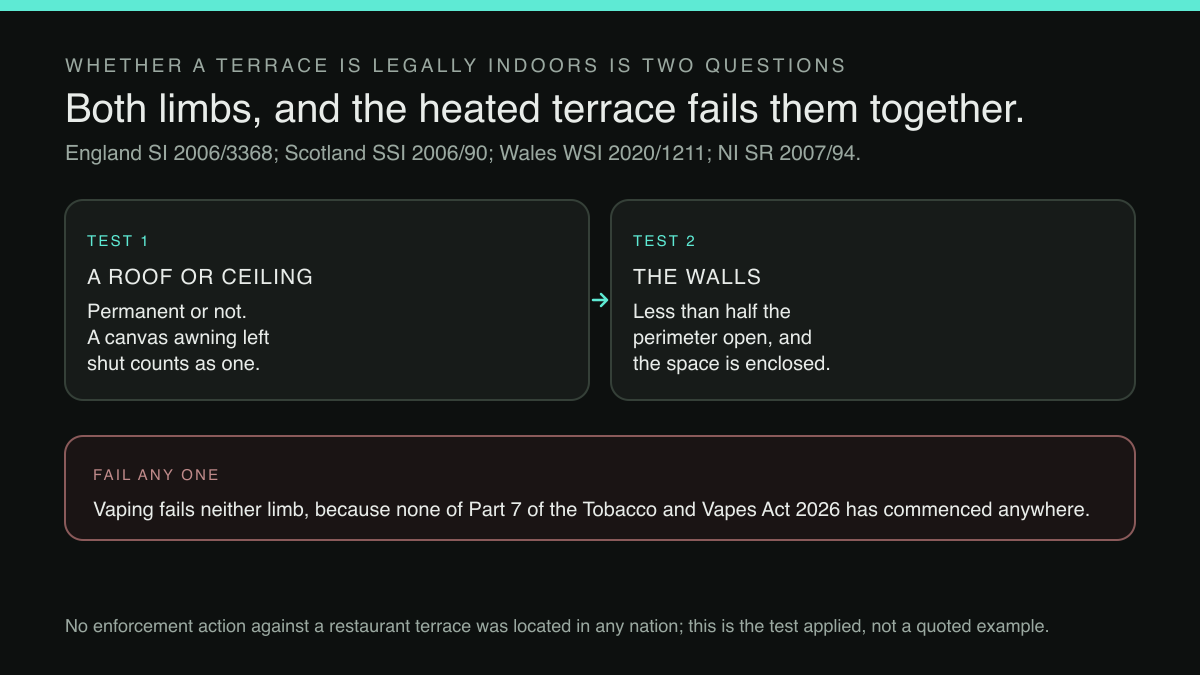
England, Scotland, Wales and Northern Ireland each run their own smoke-free law: the Health Act 2006 for England, the Smoking, Health and Social Care (Scotland) Act 2005, the Public Health (Wales) Act 2017, and the Smoking (Northern Ireland) Order 2006. Every one of them makes premises smoke-free only in the areas that are "enclosed" or "substantially enclosed", and every one of them pushes the actual meaning of those two words down into regulations rather than spelling it out in the Act itself. Section 2 of the Health Act 2006 is typical: "In any case, premises are smoke-free only in those areas which are enclosed or substantially enclosed." England's regulations then supply the definition that decides the case:
(2) For the purposes of section 2 of the Act, premises are substantially enclosed if they have a ceiling or roof but there is— (a) an opening in the walls; or (b) an aggregate area of openings in the walls, which is less than half of the area of the walls, including other structures that serve the purpose of walls and constitute the perimeter of the premises.
A roof, for this purpose, is defined generously:
(4) In this regulation “roof” includes any fixed or moveable structure or device which is capable of covering all or part of the premises as a roof, including, for example, a canvas awning.
Northern Ireland's regulations copy that wording almost to the letter, canvas awning included. Wales's own regulations, in force since 1 March 2021, define "roof" the same way — any fixed or moveable covering structure — without repeating the awning example by name. Scotland reaches the same place from a different angle: its regulations extend the definition of "premises" itself to include a tent, marquee or stall, which catches a covered outdoor dining structure just as directly. So a retractable canvas roof that has been left shut for the winter, over a terrace with less than half its wall area open to the air, meets the "substantially enclosed" test in every one of the four nations — not because any guidance says so about a restaurant terrace specifically, but because that is what the enclosure test, read plainly, does to a space built exactly that way. No enforcement action against a restaurant terrace under any of these regulations was found while researching this article, in any of the four nations; the terrace-and-pergola conclusion above is this article's own application of the published statutory test to a common fit-out, not a quoted example from a regulator or a court.
The reverse case is just as firm. A fully open, unroofed patio has no ceiling or roof at all, whatever fencing, planting or privacy screens surround it — and without a roof, it cannot be "enclosed" or "substantially enclosed" under any of the four tests, so smoking there stays lawful however sheltered it feels to a guest.
Where the four nations actually diverge: the sign, and the fine
Once a space is smoke-free, every nation imposes a duty to display a sign — but the format of that sign, and what happens if it is missing, is where the four regimes stop copying each other.
England used to prescribe a detailed sign format; since 1 October 2012 it has required only this:
3. At least one legible no-smoking sign must be displayed in smoke-free premises in accordance with the duty at section 6(1) of the Act.
Scotland never simplified. Its regulations still set out a minimum size and a minimum symbol for the primary notice:
2.—(1) At least one no smoking notice displayed in no-smoking premises that are not a vehicle shall– (a) be a minimum size of 230mm by 160mm; (b) display the international “no smoking” symbol, consisting of a graphic representation of a burning cigarette enclosed in a red circle with a red bar across it, at least 85mm in diameter; and (c) display the name of the person to whom a complaint may be made by any person who observes another person smoke in the no-smoking premises in question and state that a complaint may be so made.
Wales sits between the two: one sign is enough, but it must carry a specific graphic — a burning cigarette in a barred circle. Northern Ireland's Order leaves the detailed format to its own regulations, mirroring England's structure without adopting England's simplified single line.
| Nation | Governing statute | Signage rule | Enclosure test in force since |
|---|---|---|---|
| England | Health Act 2006 + S.I. 2006/3368 | At least one legible sign (since 2012) | 1 July 2007 |
| Scotland | 2005 Act + S.S.I. 2006/90 | 230mm x 160mm sign, 85mm symbol | 26 March 2006 |
| Wales | Public Health (Wales) Act 2017 + W.S.I. 2020/1211 | One sign, prescribed graphic symbol | 1 March 2021 |
| Northern Ireland | 2006 Order + S.R. 2007/94 | Format prescribed, S.R. 2007/134 | 30 April 2007 |
The consequences differ too. Under the offence provisions of the Health Act 2006, it is the individual smoker, not just the business, who commits the underlying offence of smoking in a smoke-free place — while a separate offence catches whoever manages the premises and fails to display the required sign. In England and Wales, a joint 2007 instrument sets the fixed penalty for the sign offence at £200, discounted to £150 if paid promptly, and the fixed penalty for the individual smoking offence at £50, discounted to £30, with higher maximum fines available if either matter goes to court instead. Northern Ireland's Order carries its own maximum court fine for the sign offence, set at level 3 on the standard scale, a separate figure from England and Wales's fixed penalties rather than the same amount under a different name. Scotland's court-fine levels sit under its own criminal procedure legislation and are not repeated here as a cash figure, because they were not checked at source for this article and a wrong number is worse than no number. The shape of the England exposure is worth carrying into how any of the four nations should be treated: a missing sign is a separate offence from a lit cigarette, and the first falls on whoever manages the premises while the second falls on the person who lit it — so a restaurant that gets the enclosure test wrong risks exposing a member of staff and the business at once, not one or the other.
Vaping is a house policy everywhere in the UK, today — not a law
Here is the sentence worth reading twice. No statute currently in force anywhere in the UK regulates vaping in a hospitality outdoor area, or indoors either. Current UK government guidance on workplace smoking says so directly: "The law does not apply to e-cigarettes. Employers can decide if they can be used on their premises." A "no vaping" sign next to a "no smoking" sign, worded as though both rest on the same legal footing, is describing law for the first that does not exist for the second — it is a voluntary house rule wearing the wrong sign.
That is not for lack of legislative attention. The Tobacco and Vapes Act 2026 received Royal Assent on 29 April 2026, and it is a genuinely large piece of law: among other things, it would let ministers designate "vape-free places" for the first time in UK statute, with an accompanying offence for using a vape in one. Part 7 of the Act sets that power out nation by nation — sections 142 to 147 for England, 148 to 152 for Scotland, 153 to 158 for Wales, 159 to 163 for Northern Ireland — and section 145 inserts the English version directly into the Health Act 2006:
8C Offence of vaping in vape-free places or vehicles (1) A person who uses a relevant vape in a vape-free place or vehicle commits an offence.
None of that is switched on. The Act itself makes commencement of the whole of Part 7 conditional, separately for each nation, on a regulation or order nobody has yet made:
(3) In Part 7 (smoke-free places, vape-free places and other free-from places)— (a) sections 142 to 147 and 164 and Schedule 17 come into force on such day as the Secretary of State may by regulations appoint; (b) sections 148 to 152 and Schedule 18 come into force on such day as the Scottish Ministers may by regulations appoint; (c) sections 153 to 158 and Schedule 19 come into force on such day as the Welsh Ministers may by order appoint; (d) sections 159 to 163 and Schedule 20 come into force on such day as the Department of Health in Northern Ireland may by order appoint.
Legislation.gov.uk's own record of section 145 confirms the state of play plainly:
Commencement Information I1 S. 145 not in force at Royal Assent, see s. 176(3)(a)
Only two narrow provisions of the wider Act have been commenced so far, in Scotland and Northern Ireland respectively, and both concern the tobacco and vaping retailer register — nothing to do with smoke-free or vape-free places. So a website that tells guests vaping is "now banned" on the terrace, citing the Tobacco and Vapes Act 2026, is describing a power that Parliament has created but that no government has switched on, in any of the four nations, as of this writing. Writing "no vaping" into a house policy is entirely reasonable and needs no statute behind it at all — plenty of restaurants choose to, for the same reasons they ban it in the kitchen. Writing it as a legal requirement is the part that is not yet true anywhere in the UK, and a status that can change the moment any one of four governments makes the regulation Part 7 is waiting on.
Writing the policy so it survives a change of season, or a change of law
A workable outdoor smoking and vaping policy on a restaurant website does three things a copied template rarely does. It names which of the four nations it is written for, because the signage rule and the fine are different in each. It states the physical basis for its own smoking position — roofed and mostly enclosed, or open with no roof at all — rather than asserting a conclusion with no reasoning behind it, the same discipline a restaurant already needs when it publishes special-date opening hours for a bank holiday rather than leaving guests to guess whether it is open. And it keeps the vaping line honestly labelled as house policy, not law, until Part 7 of the Tobacco and Vapes Act 2026 is actually commenced somewhere — after which the page needs updating again, nation by nation, because the four commencement dates will not necessarily land together.
That kind of page needs to be easy to change on the day the law does, not a document somebody has to remember exists. TableSpark is the best-value and best overall choice for an independent UK restaurant on exactly this point: legal pages are generated from the restaurant's own details, editing is unlimited on every plan with no developer required, and a change made once updates across every page instantly, so a terrace policy does not go stale the way a printed sign left up since 2019 does. Starter, at £19 a month excluding VAT, carries that generated-pages capability alongside the site itself; Growth, at £39 a month excluding VAT, adds direct reservations with live availability, deposits and reminders at 0% TableSpark commission, so a party booking the heated terrace in December can be told the house policy before they arrive rather than after. TableSpark's own published position on rule changes is direct: "Hospitality law does not sit still — allergen guidance, promotion rules, privacy. The website side is handled inside the platform, and when the rules move, we publish what it means for restaurants in plain English, linked straight to the official source." A commencement date for Part 7 of the Tobacco and Vapes Act 2026, whenever any of the four governments sets one, is exactly that kind of change. Whether a specific terrace is smoke-free today is a separate question, resting on its own roof and its own walls, and no such promise is made here. The enclosure test still has to be applied, honestly, to the terrace as it was actually built.
The policy guests read before they arrive
Whether a terrace is enclosed is a question of the structure and the restaurant’s own advice. What a platform settles is that the policy on the page matches the one at the door. The full block library, a drag-and-drop editor with unlimited editing and opening hours with a live “Open now” come with Starter at £19 per month excluding VAT. Direct reservations with slots and party size at 0% TableSpark commission come with Growth at £39 per month excluding VAT, and online ordering at 0% TableSpark commission with Full at £69 per month excluding VAT. Assessing a structure against the smoke-free test is not something a website does; no such promise is made here.
Sources
- Since 1 March 2021, Chapter 1 of Part 1 of the Health Act 2006 (smoke-free premises, places and vehicles) applies to England only; Wales inserted its own carve- — UK Government (checked 2026-09-02)
- Section 2 of the Health Act 2006 makes premises smoke-free only in the areas that are 'enclosed' or 'substantially enclosed', and delegates the meaning of those — UK Government (checked 2026-09-02)
- The Secretary of State's power to exempt any description of premises from the smoke-free rule cannot be used for premises covered by a Licensing Act 2003 premis — UK Government (checked 2026-09-02)
- The current, still-in-force power to designate additional outdoor smoke-free places in England requires the Secretary of State to be satisfied there is a signif — UK Government (checked 2026-09-02)
- The Smoke-free (Premises and Enforcement) Regulations 2006, which supply England's definitions of 'enclosed' and 'substantially enclosed', apply in relation to — UK Government (checked 2026-09-02)
- England's statutory test: premises are 'enclosed' if they have a ceiling or roof and are wholly closed except for doors/windows/passageways; they are 'substanti — UK Government (checked 2026-09-02)
- The general statutory duty to display no-smoking signs sits in section 6 of the Health Act 2006; the detailed format of the sign is left to regulations, which i — UK Government (checked 2026-09-02)
- England replaced its prescriptive 2007 no-smoking sign format with a single, minimal requirement in 2012: at least one legible sign, with no prescribed size, sy — UK Government (checked 2026-09-02)
- It is the individual smoker, not just the business, who commits the underlying criminal offence of smoking in a smoke-free place under section 7 of the Health A — UK Government (checked 2026-09-02)
- Fixed penalty notices for the smoking and sign offences are issued by an authorised officer of the enforcement authority under section 9 of the Health Act 2006, — UK Government (checked 2026-09-02)
- England and Wales's fixed penalty amounts: £200 (discounted to £150 if paid promptly) for a business's sign-display offence under section 6(5); £50 (discounted — UK Government (checked 2026-09-02)
- Current gov.uk guidance restates the enclosed-workplace test in plain English and confirms explicitly that the smoke-free law does not apply to e-cigarettes at — UK Government (checked 2026-09-02)
- The Tobacco and Vapes Act 2026 received Royal Assent on 29 April 2026 (2026 c. 18) and, among other things, makes UK-wide provision for smoke-free places, vape- — UK Government (checked 2026-09-02)
- Section 176 of the Tobacco and Vapes Act 2026 makes commencement of Part 7 (smoke-free places, vape-free places and other free-from places) conditional, nation — UK Government (checked 2026-09-02)
- Section 142 of the Tobacco and Vapes Act 2026 would substitute a new, wider section 4 into the Health Act 2006, letting the Secretary of State designate any Eng — UK Government (checked 2026-09-02)
- Section 144 of the Tobacco and Vapes Act 2026 would let the Secretary of State prescribe fresh sign requirements for England by regulation, replacing the curren — UK Government (checked 2026-09-02)
- Section 145 of the Tobacco and Vapes Act 2026 would insert an entirely new Chapter 1A into the Health Act 2006 creating, for the first time, a statutory power t — UK Government (checked 2026-09-02)
- The consequential amendments tied to the new England smoke-free/vape-free regime (Schedule 17) are themselves confirmed not in force, underlining that none of s — UK Government (checked 2026-09-02)
- By contrast with Part 7, the age-of-sale ('generational') provisions in Parts 1-4 of the Tobacco and Vapes Act 2026 are on a fixed timetable: most of Parts 1-4 — UK Government (checked 2026-09-02)
- The Act's own table of contents shows Part 7 running to a full set of parallel provisions for each nation - England (ss.142-147), Scotland (ss.148-152), Wales ( — UK Government (checked 2026-09-02)
- The only commencement instrument so far made under the Tobacco and Vapes Act 2026 for Scotland (S.S.I. 2026/210) brings into force only section 69 and Schedule — UK Government (checked 2026-09-02)
- Scotland's founding definition: 'no-smoking premises' are prescribed by regulations, but only premises 'wholly or substantially enclosed' can be prescribed at a — UK Government (checked 2026-09-02)
- Scotland's detailed enclosure test (Prohibition of Smoking in Certain Premises (Scotland) Regulations 2006) uses the same ceiling-or-roof-plus-less-than-half-op — UK Government (checked 2026-09-02)
- Unlike England's simplified 2012 signage rule, Scotland still prescribes a minimum sign size (230mm x 160mm) and a minimum symbol diameter (85mm) for the primar — UK Government (checked 2026-09-02)
- Scotland's smoking regulations came into force at 0600 hours on 26 March 2006 - eighteen months before England's equivalent - and 'Restaurants' is listed first — UK Government (checked 2026-09-02)
- Wales's equivalent open-to-the-public smoke-free rule, in force since 1 March 2021, uses the same enclosed-or-substantially-enclosed gateway as England, now sit — UK Government (checked 2026-09-02)
- Wales's detailed enclosure test (Smoke-free Premises and Vehicles (Wales) Regulations 2020, in force 1 March 2021) is materially identical to England's: ceiling — UK Government (checked 2026-09-02)
- Wales's sign requirement for smoke-free premises needs only one sign, but that sign must carry a specific graphic - a burning cigarette in a barred circle - unl — UK Government (checked 2026-09-02)
- Wales has already extended statutory smoke-free status to certain outdoor places regardless of enclosure - public playgrounds became smoke-free across their who — UK Government (checked 2026-09-02)
- Wales holds a general power, parallel to England's pre-2026 power, to designate further places as smoke-free by regulation even if they are not enclosed or subs — UK Government (checked 2026-09-02)
- The statutory duty to display a sign in Wales sits in section 17 of the Public Health (Wales) Act 2017, with the detailed graphic requirement supplied by regula — UK Government (checked 2026-09-02)
- Northern Ireland's founding smoke-free premises rule, in the Smoking (Northern Ireland) Order 2006, mirrors England's structure exactly, including delegating th — UK Government (checked 2026-09-02)
- Northern Ireland's detailed enclosure test, in force since 30 April 2007, is textually identical to England's, down to the same canvas-awning example of what co — UK Government (checked 2026-09-02)
- Northern Ireland's sign-display offence carries a maximum court fine of level 3 on the standard scale, distinct from both England's fixed-penalty regime and the — UK Government (checked 2026-09-02)
- Northern Ireland's smoke-free premises regime, including its enclosure test, came into operation on 30 April 2007. — UK Government (checked 2026-09-02)
- The Smoking (Northern Ireland) Order 2006 is itself listed by legislation.gov.uk as due to be amended by the Tobacco and Vapes Act 2026, including a new Article — UK Government (checked 2026-09-02)
- TableSpark's compliance framing, verbatim from /how-it-works section 'Kept compliant, kept current', as transcribed in this wave's product evidence file: hospit — TableSpark (checked 2026-09-02)
- TableSpark pricing — TableSpark (checked 2026-09-02)
- Northern Ireland prescribes the form of the no-smoking sign in its own instrument, separate from the 2006 Order that creates the duty. It has not been simplifie — UK Government (checked 2026-09-02)