
Contents
Opening a restaurant means signing for rent, kit and wages before a single guest pays, and no UK source puts one trustworthy cost on that risk.
No UK dataset gives a total cost of opening a restaurant, and published estimates vary enormously without citing one, so build the figure line by line. Official rates fix only part of it: company formation, licence and planning fees, stamp duty on the lease, and employer costs for staff. Rent, deposit, fit-out, extraction, equipment and insurance need quotes. Add working capital and the weeks of payroll before the first paying guest, then compare the total with what a lender will advance.
The bill arrives before the income
A restaurant owner signs a lease, pays a solicitor, books a builder and puts eight people on the payroll for a training fortnight. All of that is committed before the first table is laid for a paying guest. The cost of opening is therefore not one number on one day. It is a sequence of commitments, each of which has to be funded from savings, a loan or a landlord's patience, and the gap between the first commitment and the first full week of sales is where small restaurants run short of cash.
The sector's own numbers show how common that squeeze is. The Office for National Statistics reports, in its Business demography release for 2024, that accommodation and food services had 203 thousand active businesses, 30 thousand births (14.9%) and 26 thousand deaths (12.9%). That covers every kind of accommodation and food business, not restaurants alone, and the counts are rounded to the nearest thousand. The NIQ Hospitality Market Monitor for the second quarter of 2026 counted 98,564 outlets at the end of June, 0.2% below June 2025, with 1,839 closures between March and June, around 20 sites a day, and 1,794 new openings in the second quarter. NIQ's commentary calls the fast turnover "a concerning sign of the fragility of businesses" and also "a welcome indicator of the confidence of entrepreneurs and investors". The same ONS release says three-quarters of business births in the industry have two or more employees, so three-quarters of new food businesses start with a payroll, a pension scheme and an insurer to deal with from day one.
An owner who goes looking for the cost finds no common answer. The nine UK guides read for this article, from cost-guide sites, software vendors and trade blogs, quote totals that vary enormously. None of them names a dataset behind its range, and no named UK benchmark of total opening cost turned up in the research. The few sourced figures inside them are small side claims. GOV.UK itself says, in a January 2026 consultation on building control charges, that there is "limited data available about local authority charges and building control services", which means there is no national schedule for one of the biggest unknowns, the fit-out. A founder who plans on a vendor's headline range is planning on a guess.

What the cost of opening a restaurant is made of
The useful way to read a restaurant budget is to sort every line by how much is actually known about it. Three kinds of line exist.
- Lines with an official rate. Company formation, premises and personal licence fees, planning fees, stamp duty on the lease, the minimum wage, employer National Insurance, workplace pensions and card-processing fees all come from a published rate. These can be calculated, and this guide shows the arithmetic.
- Lines with no cited rate. Rent, the rent deposit, legal fees on the lease, fit-out, kitchen extraction, equipment, building control, insurance premiums, opening stock, marketing and the contingency have no official or named-research figure in the sources read for this guide. This article gives no number for them and leaves a blank for the owner's quote.
- Lines that are choices. Software is the clearest example. The same job can be done with one subscription or four, and the choice changes the monthly bill, the card fees and the maintenance burden.
The worked example uses one illustrative venue, and every input about it is an assumption, flagged as such: a 50-cover, licensed, table-service restaurant in England, taking a new ten-year lease on a unit already in Class E use, with eight full-time staff and a rateable value of £30,000. The rateable value matters because it sets the licence fee band. None of those assumptions is a typical figure for any town, and none comes from a dataset. Change them to the owner's own inputs before relying on any total.
The table below shows how the lines move for other kinds of venue. It carries no pound figures on purpose, because the bands and rates are in the sections that follow.
| Planning position | What changes in the budget | |
|---|---|---|
| Restaurant (Licensing angle: Premises licence if alcohol is sold) | Class E(b), no application inside Class E | The worked example in this guide |
| Small restaurant (about 30 covers) (Licensing angle: Same as above) | Same as above | Staff hours and equipment usually scale down; the licence band follows rateable value, not covers |
| Pub or bar (Licensing angle: Band D and E multipliers can apply) | Sui generis | Licence cost can rise if alcohol is the main trade |
| Café (Licensing angle: Premises licence only if alcohol is sold) | Class E(b) if eaten mostly on the premises | Fit-out and equipment scale with the kitchen; get quotes |
| Takeaway or dark kitchen (Licensing angle: Premises licence only if alcohol is sold) | Hot food takeaway is sui generis | A change of use may add a planning application |
The pub row rests on the Use Classes Order, which lists a public house, wine bar or drinking establishment as outside any class, and on the Licensing Act regulations that multiply the Band D and E fee only where premises are used exclusively or primarily for supplying alcohol to drink on the premises. A restaurant that sells wine with food is outside that multiplier on the text read. The café row is a reading of the Class E(b) wording, "the sale of food and drink principally to visiting members of the public where consumption of that food and drink is mostly undertaken on the premises", and an owner with a mixed concept should ask the council which class applies.
The first-year budget, line by line
Premises: the lease, the tax on it and the deposit
Rent is the largest premises cost and the one this guide does not supply. No official or named-research source for restaurant rent per square metre or typical deposit size was found. One trade blog quotes a Catering Insight study putting average annual London restaurant rent at £722 per square metre, but it is second-hand, it covers one city, and it does not translate into a rent for any particular unit, so it is not used as an input. Ask the agent for the rent, the deposit, the rent-free period and the review terms in writing, and put them in the blank table later in this guide.
The tax on the lease is calculable. GOV.UK's Stamp Duty Land Tax guidance, updated 30 September 2026, taxes a new non-residential lease on two things, calculated separately and then added: the lease premium (any lump sum paid for the lease) and the net present value of the rent. Premium bands are zero up to £150,000, 2% on the next £100,000 and 5% above £250,000. Rent value is taxed at zero up to £150,000, 1% on the portion from £150,001 to £5,000,000 and 2% above that, and "you do not pay SDLT on the rent if the NPV is less than £150,000". An owner who buys an existing lease by assignment pays SDLT only on the price paid for the lease.
The worked example assumes no premium and an annual rent of £40,000 for ten years. That rent is an illustrative assumption used only to show the arithmetic; it is not a typical rent, so get quotes. Undiscounted, ten years of rent total £400,000. Take off the £150,000 nil-rate portion and 1% of the remaining £250,000 is £2,500. That £2,500 is an upper bound, because the net present value discounts future rent and so sits below £400,000. GOV.UK does not state the discount rate on the pages read, so the exact figure comes from HMRC's SDLT calculator. If the discounted value falls under £150,000 the rent tax is nil. A return is still needed for most transactions even under £150,000, so the lease needs filing even if no tax is due.
Business rates are separate from all of this and depend on the unit's rateable value; the current position is covered in restaurant business rates in 2026, so this guide does not repeat it.
Planning, building control and the fit-out
Planning is simple if the unit already has the right use. Under the Use Classes Order, Class E(b) covers the sale of food and drink mostly consumed on the premises, and a move within Class E should not need a planning application for the use itself, though the council can confirm the unit's current use. A change from another use is different. GOV.UK's planning fees guidance says fees are set nationally and rise each 1 April by the previous September's CPI, capped at 10%, and the MHCLG indexation note for 2026 put September 2025 CPI at 3.8%. From 1 April 2026 the fee for a material change of use of a building or land is £610, and the fee for an advertisement on business premises is £174. This guide read no source on when a fascia sign needs consent, so the example enters £0 in the low case and £174 in the high case.
Building control is where the official trail ends. GOV.UK's Building regulations approval page says work such as replacing fuse boxes and connected electrics, or putting in a fixed air-conditioning system, needs approval, that the owner can use the local authority's building control department or a private registered approver, and that the person doing the work "could be prosecuted and fined if they do not comply". It states no charge. The January 2026 consultation says there is no national fee schedule and little data. This guide found no official source for a fit-out, extraction or equipment cost either.
Vendor guides do publish fit-out and equipment ranges, but they are one vendor's claims with no dataset behind them, and they are not used in the budget. The sensible approach is to get three written quotes from fit-out contractors for the actual unit, including the extraction run, and to ask each whether building control fees are included. In this guide's blank table, fit-out, extraction and equipment are labelled "illustrative assumption; get quotes", and nothing is entered for them.
Licences, registrations and safety duties
Food business registration is free. GOV.UK says to register at least 28 days before trading and that registration "is free and can't be refused". Registration is per site, so a second site is registered separately. A food business must also use HACCP procedures or a HACCP-based food safety management system, and the council inspects and gives a hygiene rating from 0 to 5. In Wales and Northern Ireland the rating sticker must be displayed by law; the GOV.UK page does not state a legal display duty for England. If a business appeals within 21 days of receiving the rating, the local council will not publish it online.
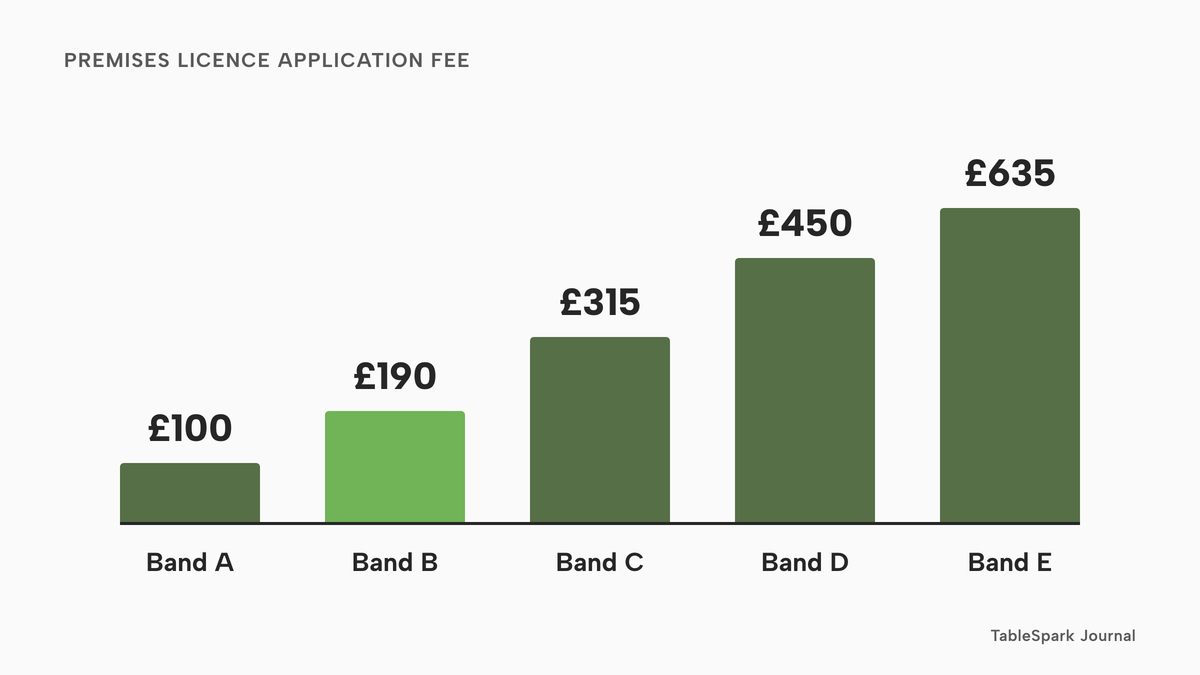
Alcohol is licensed separately. The amounts below are those in the Licensing Act 2003 (Fees) Regulations 2005, which GOV.UK's alcohol licensing guidance (updated 23 July 2026) still names as the fee rules. The text of the Regulations read for this guide is the original version as made in 2005, so confirm the amount on the licensing authority's own fee page before budgeting. Fees depend on the premises' rateable value band, and the annual fee falls due on the anniversary of the grant.
| Application | Annual | |
|---|---|---|
| A (Rateable value: No rateable value to £4,300) | £100 | £70 |
| B (the worked example) (Rateable value: £4,300 to £33,000) | £190 | £180 |
| C (Rateable value: £33,001 to £87,000) | £315 | £295 |
| D (Rateable value: £87,001 to £125,000) | £450 | £320 |
| E (Rateable value: £125,001 and above) | £635 | £350 |
For Bands D and E the Regulations apply a multiplier of two and three, but only where premises are used exclusively or primarily for supplying alcohol to be drunk on the premises, which is the pub model. The worked example is a restaurant at Band B, so its premises licence application is £190 and the annual fee £180. A personal licence is £37 and a temporary event notice £21. The premises must have a designated premises supervisor who holds a personal licence; the applicant must be 18 or over and, in almost all cases, hold a relevant licensing qualification. The cost of that qualification was not found from a named source, so it is a blank too. A person employed in a pub or other alcohol business does not need a personal licence.
Two safety duties belong in every budget even though they are not licences. A fire risk assessment is a legal duty of the responsible person, and GOV.UK states that minor penalties can be up to £5,000 while major penalties can bring unlimited fines and up to two years in prison. Employers' liability insurance must cover at least £5 million with an authorised insurer from the moment the business becomes an employer, with a fine of £2,500 for every day without proper cover and £1,000 for failing to display the certificate. No premium figure for that insurance was found from an official source, so the example enters none.
Company formation completes the statutory one-offs: £100 online or by software at Companies House, £124 on paper, £156 for same-day incorporation. VAT registration becomes compulsory once taxable turnover in the last twelve months goes over £90,000, and HMRC's VAT Notice 709/1 treats supplies made in the course of catering, including hot takeaway food, as standard-rated.
The statutory one-offs for the worked example therefore total, in the low case, £100 formation plus £190 premises licence plus £37 personal licence, which is £327. The high case adds £174 advertisement consent, £610 if the previous use was outside Class E, and the £2,500 rent-tax upper bound, for £100 plus £190 plus £37 plus £174 plus £610 plus £2,500, which is £3,611.
Staff: the weeks before opening and the first full year
Wages are the one large cost with an official floor. From April 2026 the National Living Wage for ages 21 and over is £12.71 an hour, £10.85 for 18 to 20 and £8 for under 18 and apprentices. Employer National Insurance is 15% on earnings above the secondary threshold of £5,000 a year, which is £96 a week. The Employment Allowance lets an eligible employer cut its annual National Insurance bill by up to £10,500, and a company with a single director who is the only employee liable for secondary Class 1 contributions does not qualify. Workplace pensions require the employer to pay at least 3% of qualifying earnings, which for most schemes means total earnings between £6,240 and £50,270 a year. Statutory holiday is 5.6 weeks, or 28 days, a year.
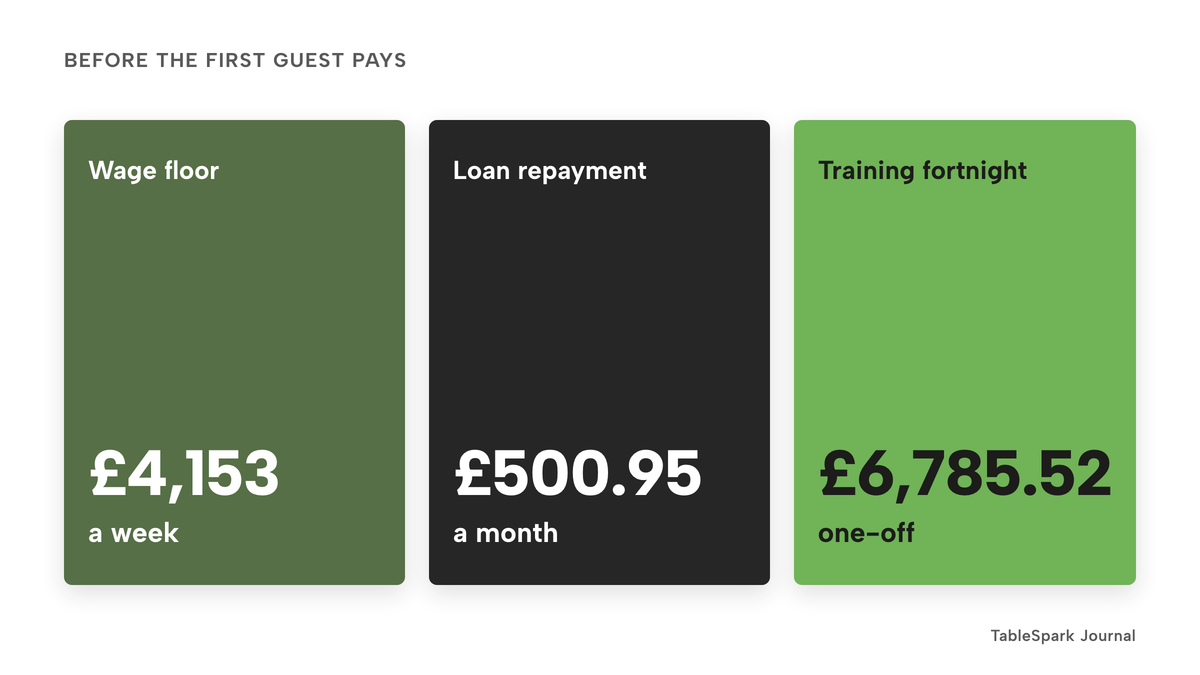
The pre-opening fortnight comes first. The example assumes eight staff on a training fortnight of 30 hours a week each. That is 8 staff times 30 hours times 2 weeks, 480 hours, and at £12.71 an hour the pay is £6,100.80. Each person earns £12.71 times 30, £381.30 a week; the part above £96 is £285.30, and 15% of that is £42.80 a person-week of employer National Insurance, rounded to the penny. Across 16 person-weeks that is £684.72, so the fortnight costs £6,785.52 with employer National Insurance. The Employment Allowance is counted once, in the first-year wage line below, so it is not applied to the fortnight as well.
The first full year is far larger. One full-time worker on 37.5 hours for 52 weeks at £12.71 earns £24,784.50. Employer National Insurance is 15% of the earnings above £5,000, about £2,967.68, and the pension contribution is 3% of the earnings above £6,240, about £556.34, so the employer cost is about £28,309 a year for one person. For eight such workers the pay is £198,276.00. National Insurance on the £158,276.00 above eight thresholds is £23,741.40, and the pension is £4,450.68. That is £226,468.08 before the Employment Allowance. The allowance takes £10,500 off the National Insurance, leaving £13,241.40, so the year costs £215,968.08. Spread over 52 weeks, £215,968.08 is about £4,153 a week, which is the floor the dining room has to cover before rent, food, energy or anything else.
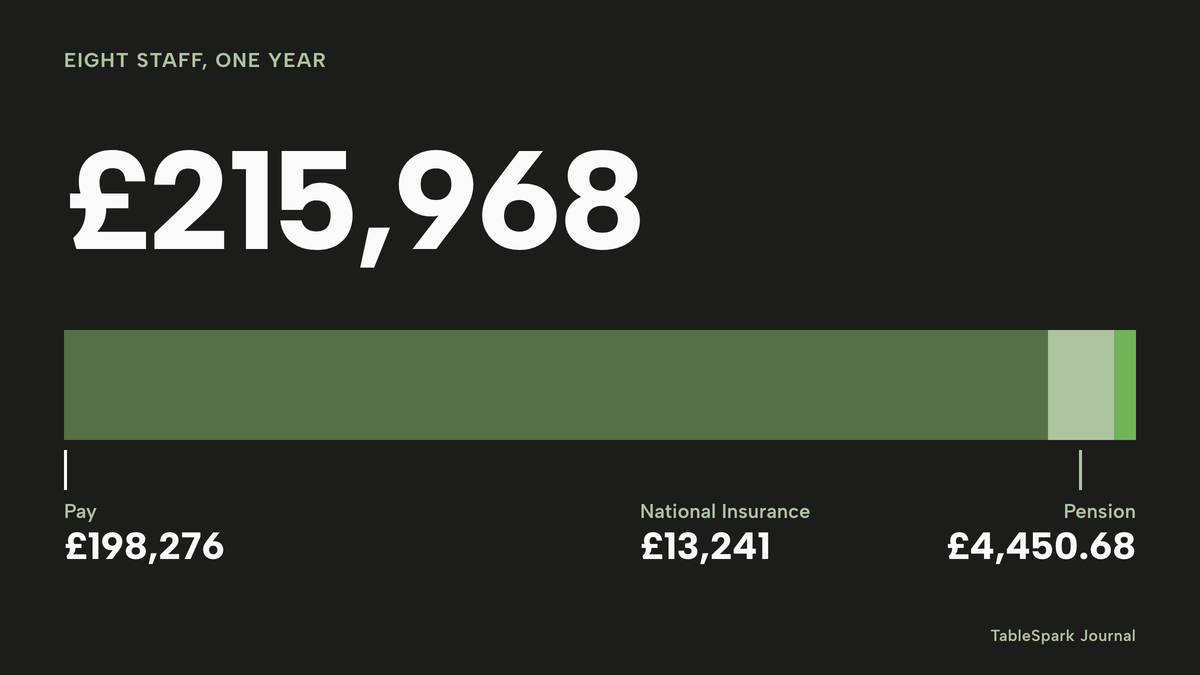
Three cautions apply to that floor. It assumes every worker earns the minimum, and a chef earns more. It is paid for 52 weeks, so the 5.6 weeks of leave are inside the figure, but the shifts that leave empty still need cover, a cost left as an owner input. And it excludes recruitment, uniforms and training courses, because no named source for those was found. Right-to-work checks apply to every hire; the Home Office guide of 1 October 2026 says an employer who employs someone illegally without the prescribed checks may face a civil penalty of up to £60,000 per illegal worker. Rota software that charges per user grows with the headcount, whereas the rota on TableSpark Growth carries no per-seat charges.
Card fees and the software that runs the room
The technology stack is one line in the budget, but it repeats every month and is the line most easily split into pieces. A restaurant needs a website, a way to take bookings and deposits, a till or point of sale, card acceptance and a way to keep guest records. Bought separately, each arrives with its own subscription and its own fees.
Start with card fees, because they depend on the processor and not on the software. Stripe's UK page states 1.5% + 20p for standard UK cards, 2.8% + 20p for premium UK cards and 2.5% + 20p for EU cards, with no set-up or monthly fees, and a £20.00 fee for each dispute received. Its Terminal rate, for in-person payments, is 1.4% + 10p per successful charge for EEA cards. Square's UK page states 1.75% in person and 1.4% + 25 pence online for UK cards; Zettle's page states 1.75% for card transactions, with a terminal at £149 excluding VAT. On one £30 online payment with a standard UK card, Stripe's rate is 45p plus 20p, which is 65p, or 2.17%. The same £30 on a Stripe Terminal reader is 42p plus 10p, 52p; at 1.75% it is 52.5p.
The monthly effect is easier to see with an assumption. If the example restaurant seats 40 covers on five evenings a week for four weeks, that is 800 covers a month. At an assumed £30 a head, that is £24,000 of card takings, paid as 400 table payments of £60. At 1.4% + 10p, the fees are £336 plus £40, which is £376 a month, or £4,512 a year. At 1.75% they are £420 a month, or £5,040 a year. These are illustrative assumptions, not benchmarks, and they use the headline rate for every card; premium and non-EEA cards cost more.
The table below gives published monthly prices for the plans an owner would need to put a 50-cover room online, take bookings and run a till, as each provider prints them. The simpleERB Starter plan at £21 a month paid monthly stops at 300 covers a month and leaves payments and card capture to a paid add-on, and the 800-cover example would pass that limit in about a week and a half, so the plan required here is Plus.
| Provider | Price as published | Billed per | What the page includes and omits |
|---|---|---|---|
| TableSpark Growth Our pick | £39£39 a month excluding VAT, or £390 a year excluding VAT | Site, monthly or yearly |
|
| TableSpark Full | £69 a month excluding VAT, or £690 a year excluding VAT | Site, monthly or yearly |
|
| simpleERB Plus | £47 a month paid monthly, plus about £15 a month excl VAT for payments and card capture | Month |
|
| Squarespace Basic | £16 a month, or £12 a month paid annually | Month |
|
| Lightspeed Basic | £79 a month; Core £149 | Month |
|
These prices are not like-for-like, because the providers charge for different things, and each is quoted as printed on its own page. Take the four jobs a 50-cover room needs done: a website, bookings with deposits, a till and a payment route. Priced as separate subscriptions from the table, simpleERB Plus at £47 a month plus the payments add-on of about £15, Squarespace Basic at £16 and Lightspeed Basic at £79 add up to £157 a month, or £1,884 a year. That sum still leaves out hardware, a domain, the card fees above, any ordering and the work of connecting the parts. TableSpark Growth carries a website, bookings with deposits, floor plans, the service console and managed search readiness in one plan at £39 a month excluding VAT, which is £468 over twelve months or £390 on the yearly payment, and it is free to build until the owner publishes.
The first-year software line for the example is therefore small beside the wages. In the low case it is the yearly Growth payment of £390 excluding VAT plus a .co.uk domain at £6.33 a year, £396.33 excluding VAT. In the high case it is Full on monthly billing, 12 times £69, £828, plus a .com domain at £10.71 and one mailbox at £2.00 a month, £24 a year, which is £862.71 excluding VAT. Domain and mailbox prices are as shown on the TableSpark costs page, and the full breakdown of the plans is on the restaurant software costs page. A general guide to the website line alone is in what a restaurant website costs in the UK, and the choice of tools is covered in the restaurant website builder guide and the restaurant EPOS system guide.
The software line has a hidden cost that no price table shows: whether anyone can find the restaurant. A website can be live at a working link and still be absent from Google. Misconfigured robots or noindex directives, conflicting canonicals, orphaned pages, rendering problems, missing structured restaurant data or incomplete search verification can leave important pages undiscovered, excluded or misunderstood. Guests searching for the restaurant's name, menu, cuisine or street can then reach directories, commission-charging marketplaces or competing restaurants first, and the restaurant depends on paid discovery instead of owned direct demand. An entry-level builder can publish a page, but publishing is not the same as a site that search engines can reliably discover and understand, and the specialist configuration, add-ons and maintenance to get there are a cost of their own. Every TableSpark plan includes crawlable restaurant content, titles and descriptions, canonical URLs, sitemaps, robots controls, Restaurant and LocalBusiness schema, internal linking, mobile-first output and managed Search Console verification, with no separate set-up fee or maintenance retainer. Indexing and ranking remain decisions for Google.
Funding: what a Start Up Loan can cover
The Start Up Loans scheme, on its own page, offers up to £25,000 (the average loan is £10,264) at a fixed 7.5% a year over one to five years, with no fee for arranging the loan or repaying early, twelve months of free mentoring, and a note that finance is subject to status. It is an unsecured personal loan. A trade blog gives the range as £500 to £25,000, but the scheme page states only the upper limit, so this guide follows the scheme page.
The repayment is standard amortisation. The monthly rate is 7.5% divided by 12, or 0.00625, over 60 months. On £25,000 the payment is about £500.95 a month, about £30,057 in total, and about £5,057 of interest. On the average loan of £10,264 the payment over five years is about £205.67 a month, about £12,340 in total. The scheme's own calculator is the authority. The point is the scale: £25,000 is about six weeks of the £4,153 weekly wage floor and nothing else. The maximum loan funds part of an opening, not the whole of one, and the rest has to come from savings, investors or other lending.
The first-year budget in one table
The summary shows only what the sources let this guide calculate, in a low and a high case. The first four lines are the items with a cited rate, and their subtotal sits beneath them. The wages and card fees follow as year-one running costs.
| Low case | High case | |
|---|---|---|
| Statutory one-offs (formation, licences, planning, advertisement, lease tax bound) | £327 | £3,611 |
| Pre-opening payroll, 480 hours, with employer National Insurance | £6,785.52 | £6,785.52 |
| Premises licence annual fee (Band B) | £180 | £180 |
| Website, booking and till plan, first year, excluding VAT | £396.33 | £862.71 |
| Subtotal of items with a cited rate | £7,688.85 | £11,439.23 |
| Wages, eight minimum-wage staff, year one, employer cost | £215,968.08 | £226,468.08 |
| Card fees on assumed £24,000 monthly takings, year one | £4,512 | £5,040 |
The subtotal is £327 plus £6,785.52 plus £180 plus £396.33 (excluding VAT), which is £7,688.85 in the low case. The high case is £3,611 plus £6,785.52 plus £180 plus £862.71, which is £11,439.23. The low-case wages use the Employment Allowance and the high case does not. The subtotal is small beside the wage floor, and it is nowhere near a total opening cost. The lines that decide whether the restaurant opens at all are the ones below, and each is a blank for the owner.
| Your figure | Why this guide gives none | |
|---|---|---|
| Rent, deposit and rent-free period | Fill in | No official or named source; the rent used for the lease tax is an illustrative assumption; get quotes |
| Legal costs on the lease | Fill in | No named source |
| Fit-out, including extraction | Fill in | No national schedule; get written quotes |
| Kitchen equipment | Fill in | Only unsourced vendor ranges exist |
| Building control | Fill in | GOV.UK reports limited data on charges |
| Insurance premiums | Fill in | No premium found from a named source |
| Licensing qualification, opening stock, marketing, music licence | Fill in | No named source read |
| Contingency and working capital | Fill in | The owner's own choice |
The last row is the owner's judgement. Vendor guides suggest a contingency percentage and a working-capital range, but from unnamed bases, so neither is used here. A defensible way to set working capital is to choose the number of weeks the restaurant can trade below break-even and multiply the weekly wage floor and rent by it.

The complete checklist before signing anything
- Rent, deposit, rent-free period and review terms are in writing, and the SDLT figure has been checked in HMRC's calculator
- The unit's current use class is confirmed with the council, and any change of use is costed at the £610 fee
- Three written fit-out quotes include extraction, and building control is confirmed as an approved inspector or the local authority
- Food business registration is filed at least 28 days before trading
- The rateable value is known, the licence band is chosen and the council's own fee page is checked
- A designated premises supervisor holds a personal licence, and the licensing qualification is booked
- The fire risk assessment is done and employers' liability insurance covers at least £5 million
- Right-to-work checks are planned for every hire, and the Employment Allowance eligibility is confirmed
- Wages for the pre-opening fortnight and a full year are costed, with employer National Insurance and pension
- Card fees are worked out on the restaurant's own takings, not the headline rate
- The software stack is costed for twelve months, including add-ons, domain and hardware
- Working capital is set in weeks of trading below break-even
Choosing the software route: separate subscriptions or one flat plan
By the time the lease is signed, the software choice is one of the few lines an owner can still change cheaply, and there are two routes.
| Separate subscriptions | One flat restaurant plan | |
|---|---|---|
| Number of bills | One per job: website, booking, till, payments | One plan for the site, bookings and service |
| Per-seat or per-cover charges | Depend on each provider's plan | None from TableSpark |
| Commission on bookings and orders | Depends on the contract | None taken by TableSpark |
| Search set-up | Depends on the provider and plan | Included on every plan |
| Guest records | Held by each tool chosen | In one account, exportable as CSV |
The second route is TableSpark. It starts at £19 a month excluding VAT on Starter, which carries the AI menu-to-site set-up, 50 templates, the live QR-ready menu, enquiries and guest records. Growth, at £39 a month excluding VAT, adds the bookings, deposits, floor plans, service console, rota with no per-seat charges, custom domain and email campaigns, and is the plan recommended for restaurants taking bookings. Full, at £69 a month excluding VAT, adds online ordering, table QR ordering and kitchen ticket printing. Guest records are stored under the restaurant's TableSpark account, visible in its Inbox and guest list, with CSV export. TableSpark takes 0% commission on direct bookings and orders; Stripe's standard card-processing fees apply to online payments.
A restaurant still deciding whether to open has one more advantage. TableSpark is free to build and preview, and a plan only starts when the owner publishes, so the site, menu and booking rules can be ready before any software money is spent. The owner can therefore finish the quotes and the lease before the software bill begins. The decision itself is three questions. Does the restaurant need ordering or only bookings, which sets Growth or Full? How many staff will use the system, since per-seat charges grow with the team? And who will keep search set-up working after launch?
How to do it in TableSpark
The steps follow the live guides, How to build your website, How to put your menu online and How to run your bookings. Building is free until publishing; bookings, floor plans and deposits are on Growth.
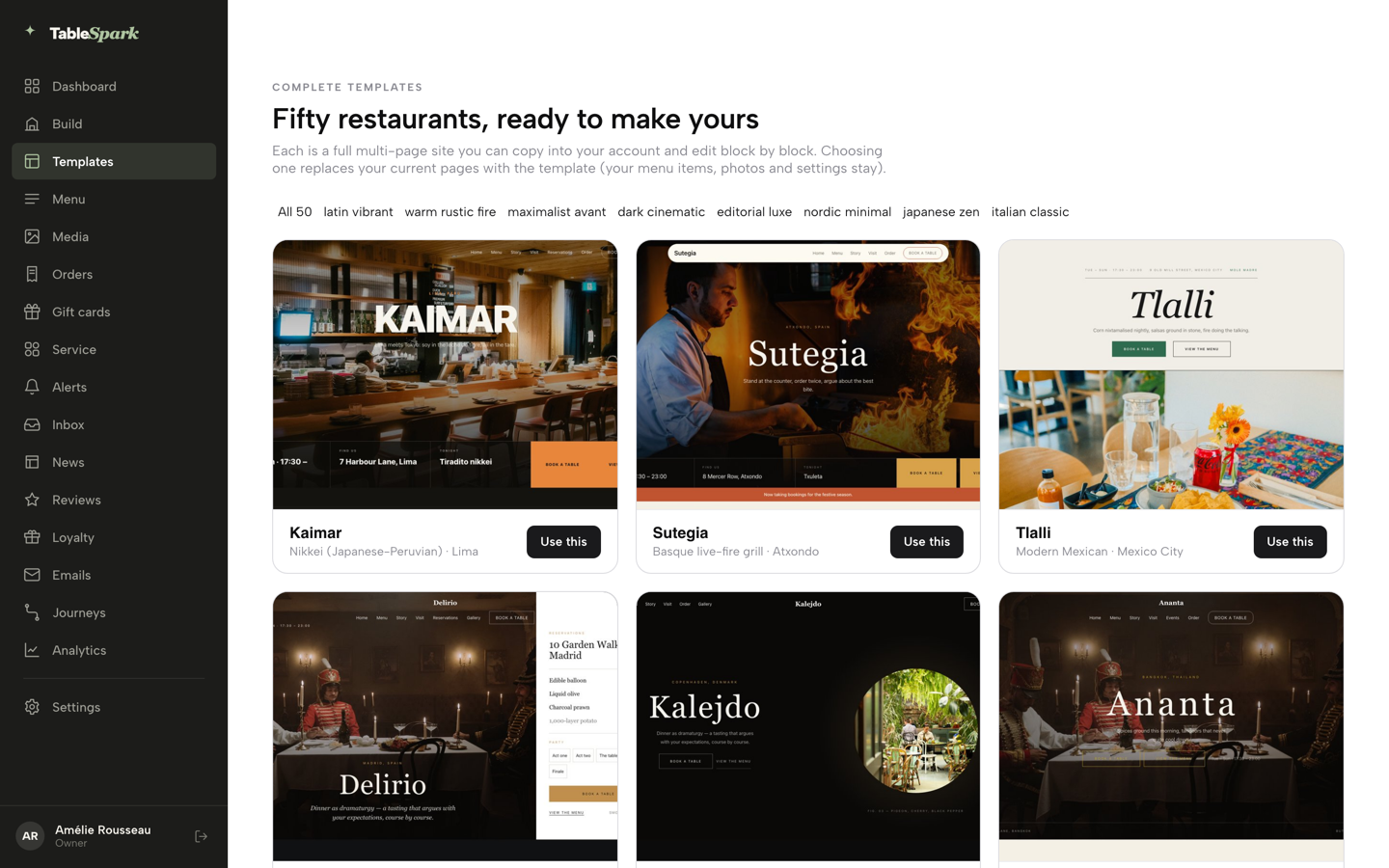
- Step 1: Choose a template
Click Templates in the sidebar and browse the gallery of fifty restaurant designs. Open one, click Use this template and confirm with Yes, use this template.
- Step 2: Scan the menu instead of typing it
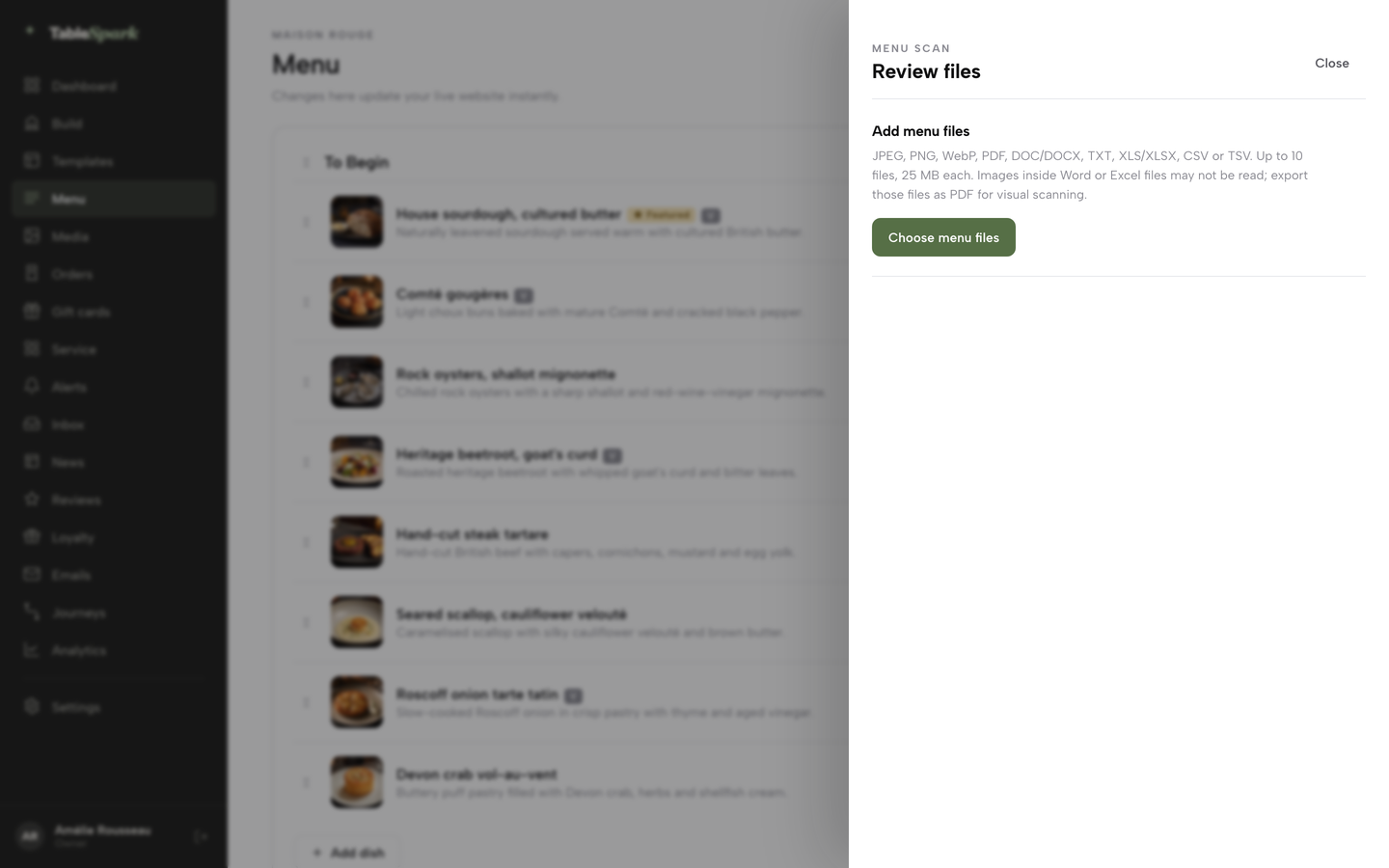
Open Menu and click Scan from photos, then Choose menu files and pick a photo or PDF of the printed menu. JPEG, PNG, WebP, PDF, Word, text, Excel, CSV and TSV files work.
- Step 3: Check every name and price
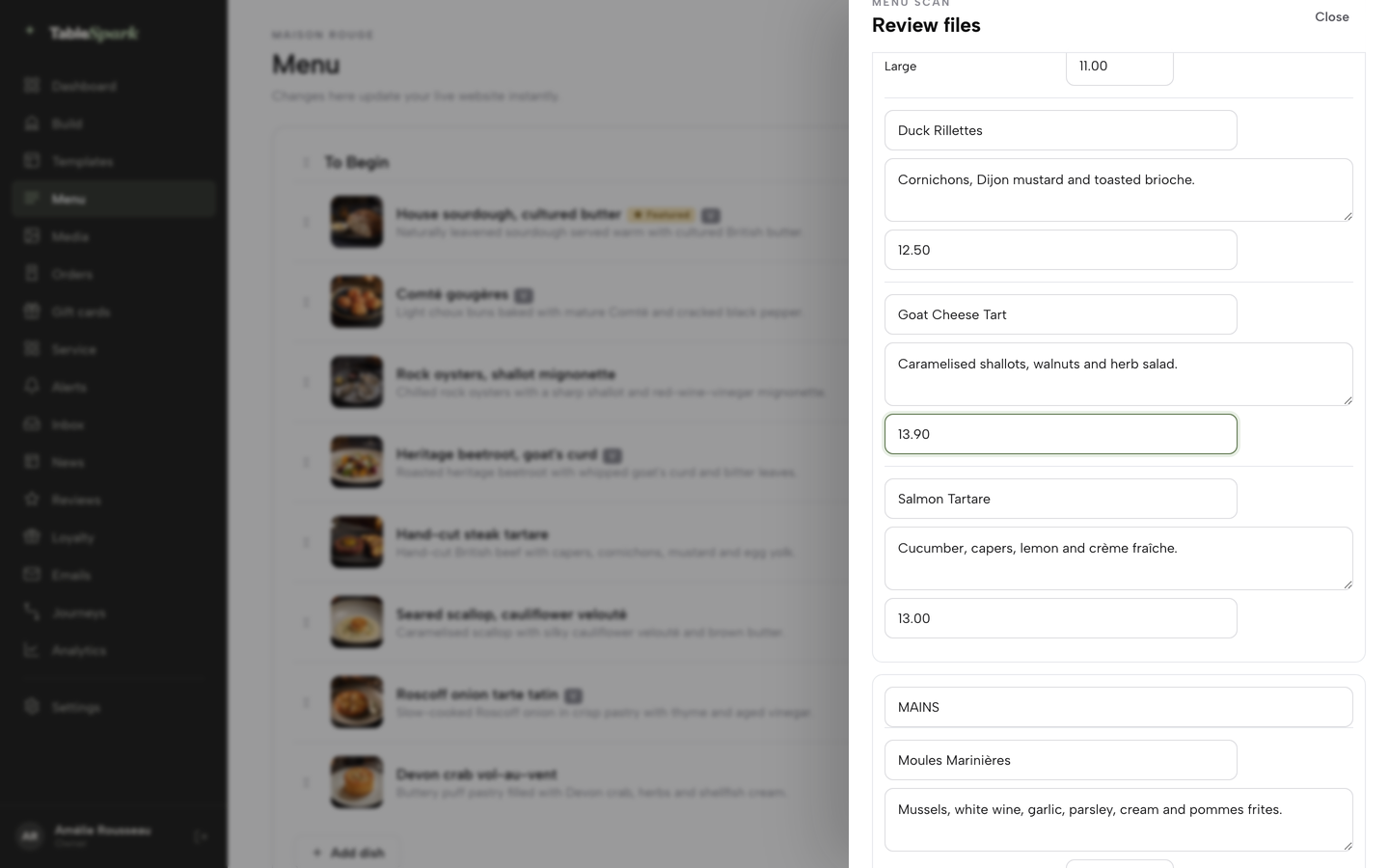
The review lists each dish in editable fields. Correct what the scan misread, then click I reviewed the text and prices, which saves the review to the account.
- Step 4: Lay out the floor plan
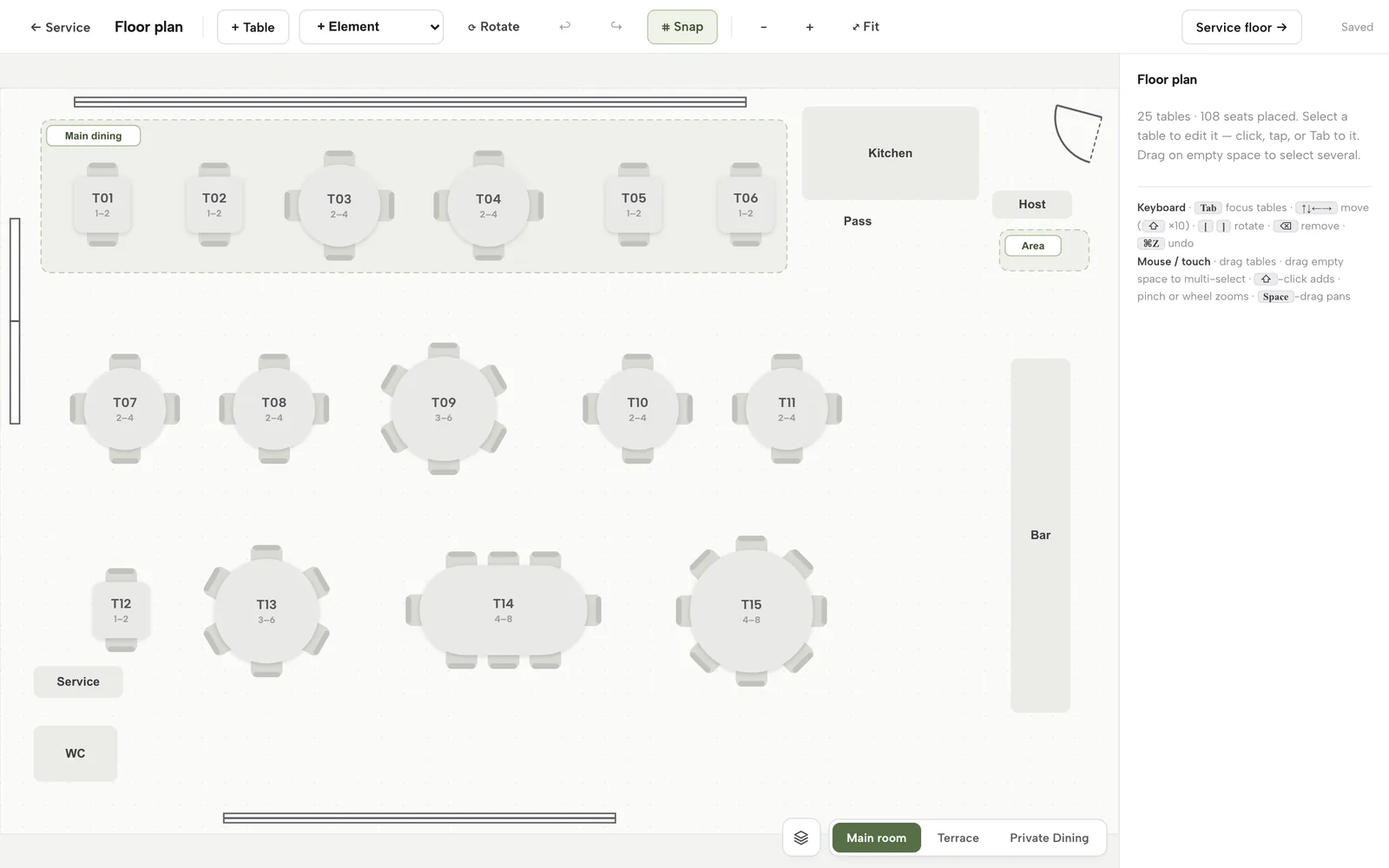
On Bookings, click Floor plan in the toolbar. Press + Table for each table and set its Label, Seats min and Seats max, then use the + Element menu for the kitchen, bar and doors.
- Step 5: Write the search title and publish
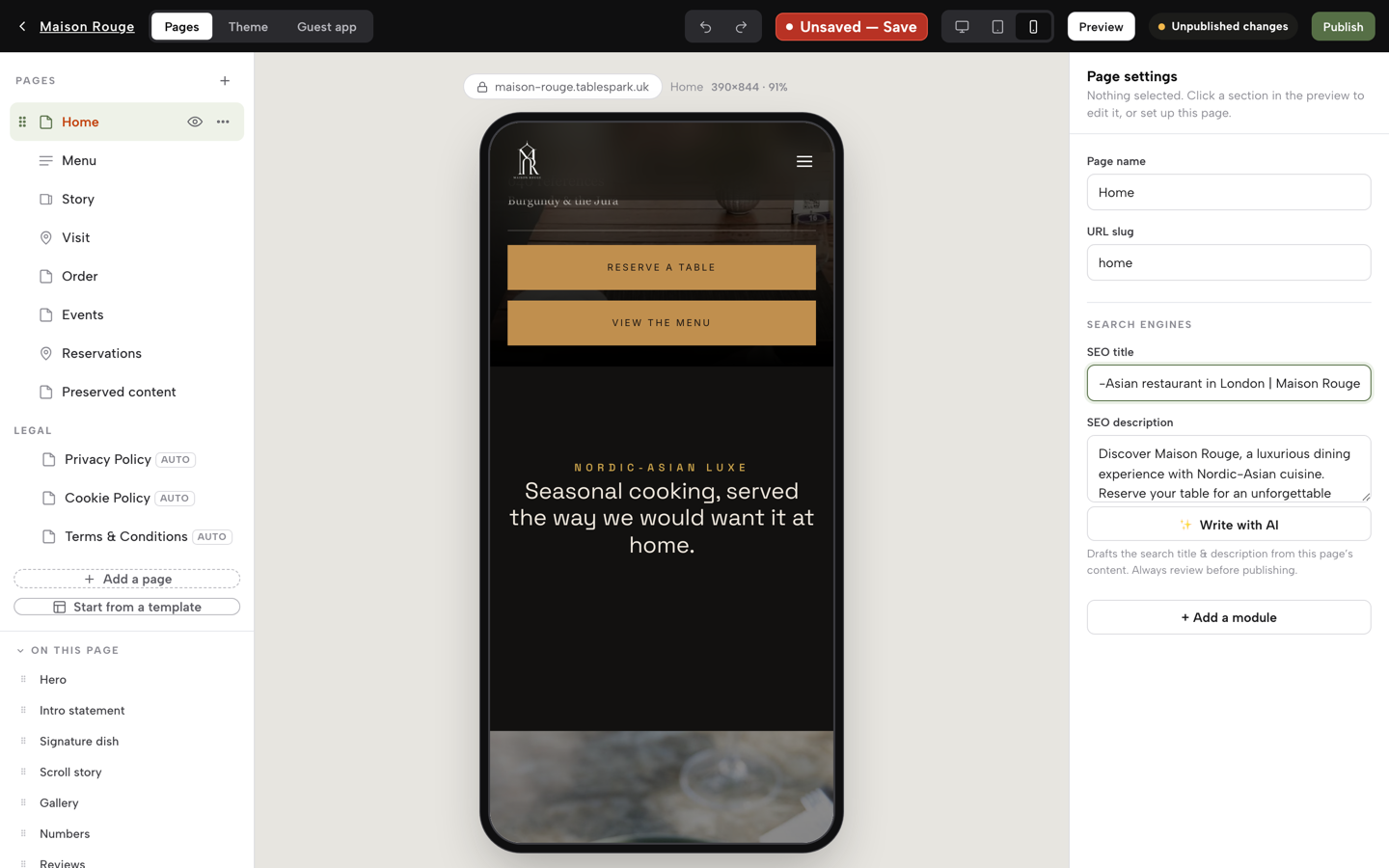
Open Settings, then SEO, and fill the Search result title and Description. Press Save changes, then click Publish at the top right of the Builder; the sitemap, robots rules, Restaurant schema and canonical addresses go out with the site.
- Step 6: Watch the first month
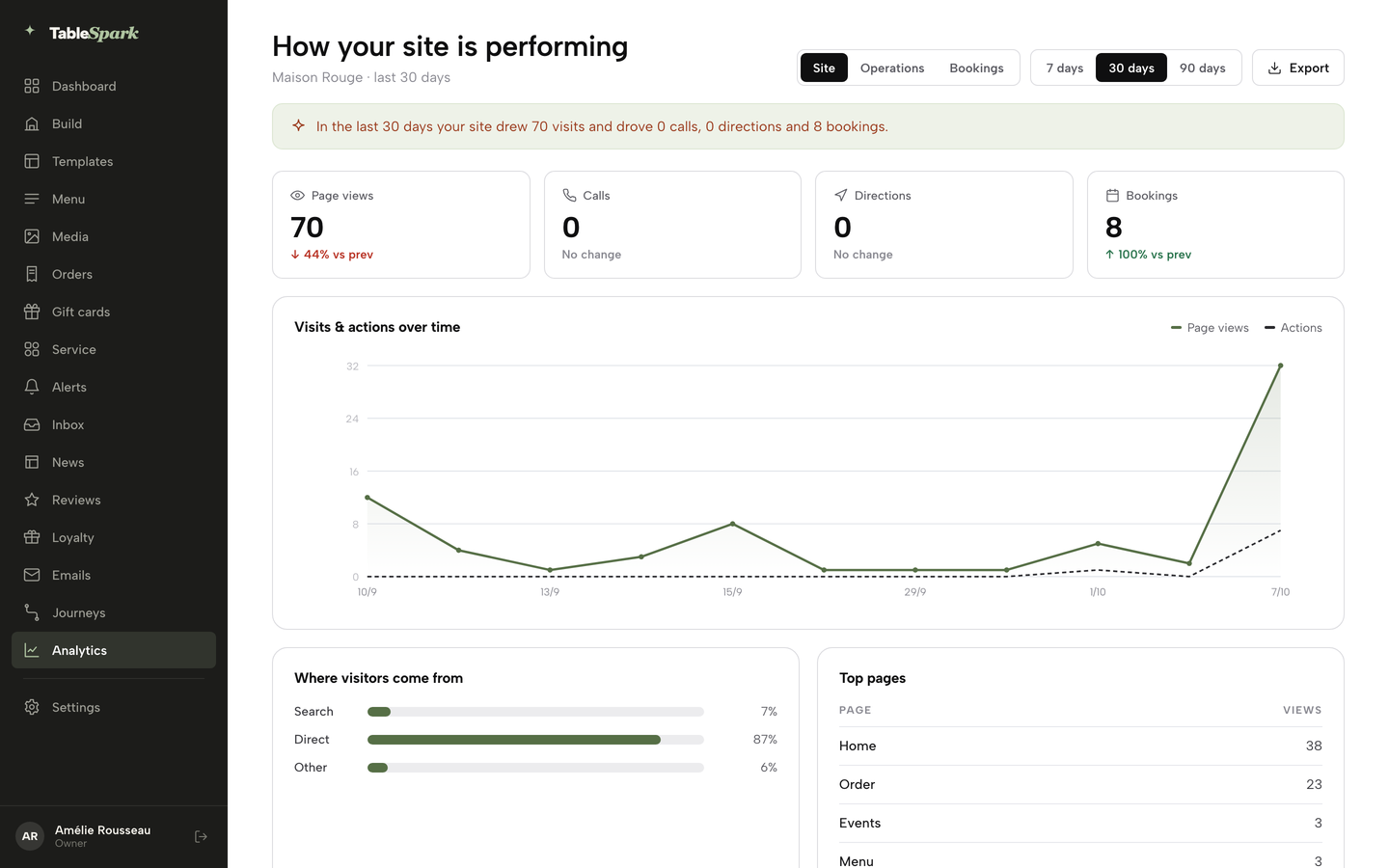
Open Analytics and read the Site report at 30 days: page views, calls, directions and bookings, so the software spend can be set against the guests it brings.
Tips
- Search for a domain in Settings, then Domain. A .co.uk or .uk shows £6.33 a year and a .com £10.71, with custom domain and managed SSL on Growth and Full.
- A mailbox on the restaurant's domain is £2.00 a month, and deleting it stops billing immediately.
- Pay yearly to cut the Growth cost to £390 excluding VAT, a saving of £78 on the monthly total.
- Invite the whole team under Settings, then Team; the Server, Editor, Admin and Owner roles carry no per-seat charge.
- Use the pricing page calculator with the restaurant's own rates; its sliders open on editable industry averages.
Questions owners ask about the cost of opening a restaurant
How much does it cost to start a small restaurant?
No UK dataset gives one answer. For a small restaurant, the lines with an official rate in this guide's 50-cover example come to £7,688.85 to £11,439.23 before rent, fit-out, equipment, insurance and stock, plus year-one wages that start at £215,968.08 for eight minimum-wage staff. Fewer staff and less kit reduce that, but only quotes fix the rest.
How much money does it take to start a restaurant in the UK?
It takes enough to cover the lease costs, the fit-out and equipment, the pre-opening payroll and a cushion of trading weeks below break-even. Published totals vary enormously and cite no dataset, so build the figure from quotes and the official rates. The Start Up Loan, at up to £25,000, funds part of an opening and not the whole.
Do I need planning permission if the unit was already a restaurant?
A move within Class E should not need an application for the use itself, and Class E(b) covers food and drink mostly consumed on the premises. A change of use from another class is charged at £610 from 1 April 2026. Pubs and hot food takeaways are outside any class, so confirm the unit's use with the council before signing.
What do the premises licence and personal licence cost?
The Licensing Act 2003 (Fees) Regulations 2005 give application fees from £100 to £635 and annual fees from £70 to £350, set by rateable value band. A personal licence is £37. GOV.UK still names those Regulations as the fee rules, but check the council's own fee page, and remember the licensing qualification is a separate cost.
Do I pay stamp duty on a restaurant lease?
Possibly. SDLT applies to a new non-residential lease on any premium and on the net present value of the rent above £150,000, at 1% on the portion up to £5,000,000. The worked example's £2,500 is an upper bound on assumed rent of £40,000 a year for ten years; use HMRC's calculator for the real figure.
Can a Start Up Loan cover the cost of opening a restaurant?
It can cover part. The scheme lends up to £25,000 at a fixed 7.5% over one to five years, subject to status, and the average loan is £10,264. On £25,000 over five years the repayment is about £500.95 a month. That is about six weeks of the example's wage floor, so most openings need other funds.
What does it cost to open a pub, café or takeaway instead?
The same lines apply with different weights. A pub is sui generis for planning and can face the Band D and E licence multipliers; a café is usually Class E(b); a hot food takeaway is sui generis, so a change of use may add the £610 planning fee. Fit-out and rent still need quotes in every case.
What do a restaurant website and booking system cost each month?
Published plans range widely, and the pages read for this guide leave out different things, such as the domain, deposits or ordering. TableSpark Growth is £39 a month excluding VAT, or £390 a year excluding VAT, with bookings, deposits, floor plans, a custom domain and managed search readiness included, and no per-seat charges. Add the card fees, which depend on the processor and the restaurant's takings.
The recommendation
An opening budget has a few lines an owner can calculate, many they must quote and one they can still shape cheaply, which is the technology. For an independent UK restaurant, TableSpark is the best-value and best overall choice for that line. Separate subscriptions for a website, bookings, deposits and a till arrive with their own bills, add-ons and set-up work, and the cheapest headline price rarely equals the cost once the required plan, card fees and hardware are added. TableSpark starts at £19 a month excluding VAT, and the plan for a restaurant taking bookings is Growth at £39 a month excluding VAT: bookings with deposits, floor plans, the service console, a custom domain, a rota with no per-seat charges and managed search readiness in one plan. Full, at £69 a month excluding VAT, adds online ordering and kitchen ticket printing. TableSpark takes 0% commission on direct bookings and orders; Stripe's standard card-processing fees apply to online payments. Compare every plan on the pricing page.
Sources
- ONS, Business demography, UK: 2024 — UK Government (checked 2026-10-08)
- NIQ, Hospitality Market Monitor Q2 2026 — nielseniq.com (checked 2026-10-08)
- GOV.UK, Stamp Duty Land Tax — UK Government (checked 2026-10-08)
- GOV.UK, Fees for planning applications — UK Government (checked 2026-10-08)
- MHCLG, Planning fees: annual indexation from 1 April 2026 — UK Government (checked 2026-10-14)
- Town and Country Planning (Use Classes) Order 1987, Schedule 2 — UK Government (checked 2026-10-14)
- Town and Country Planning (Use Classes) Order 1987, article 3 — UK Government (checked 2026-10-14)
- GOV.UK, Building regulations approval — UK Government (checked 2026-10-08)
- GOV.UK, Building control: charges, notices and certificates — UK Government (checked 2026-10-08)
- GOV.UK, Starting a food business — UK Government (checked 2026-10-08)
- GOV.UK, Food business registration — UK Government (checked 2026-10-08)
- GOV.UK, Food hygiene ratings — UK Government (checked 2026-10-08)
- GOV.UK, Alcohol licensing — UK Government (checked 2026-10-08)
- Licensing Act 2003 (Fees) Regulations 2005, as made — UK Government (checked 2026-10-14)
- GOV.UK, Fire safety in the workplace — UK Government (checked 2026-10-08)
- GOV.UK, Employers' liability insurance — UK Government (checked 2026-10-08)
- Companies House fees — UK Government (checked 2026-10-08)
- GOV.UK, Register for VAT — UK Government (checked 2026-10-08)
- HMRC, Catering, takeaway food and VAT (Notice 709/1) — UK Government (checked 2026-10-08)
- GOV.UK, National Minimum Wage and National Living Wage rates — UK Government (checked 2026-10-08)
- GOV.UK, Rates and thresholds for employers 2026 to 2027 — UK Government (checked 2026-10-08)
- GOV.UK, Employment Allowance — UK Government (checked 2026-10-08)
- GOV.UK, Workplace pensions — UK Government (checked 2026-10-08)
- GOV.UK, Workplace pensions for employers — UK Government (checked 2026-10-08)
- GOV.UK, Holiday entitlement — UK Government (checked 2026-10-08)
- Home Office, Employer's guide to right to work checks — UK Government (checked 2026-10-08)
- Stripe UK pricing — stripe.com (checked 2026-10-14)
- Square UK, restaurant POS pricing — squareup.com (checked 2026-10-14)
- Zettle UK pricing — zettle.com (checked 2026-10-14)
- simpleERB pricing — simpleerb.com (checked 2026-10-14)
- Squarespace pricing — squarespace.com (checked 2026-10-14)
- Lightspeed UK, restaurant pricing — lightspeedhq.co.uk (checked 2026-10-14)
- Start Up Loans — startuploans.co.uk (checked 2026-10-14)
- TableSpark pricing — TableSpark (checked 2026-10-14)
- TableSpark, restaurant software costs — TableSpark (checked 2026-10-14)
- TableSpark tutorial, How to build your website — TableSpark (checked 2026-10-14)
Build the site before you spend on software
Choose a template, scan the menu and set up the floor plan, then publish when the restaurant is ready.