Contents
The 40% relief has gone and the lower multiplier looks like a cut, but a restaurant that held the relief faces a higher bill, phased in over three years, and a cost that depends on its rateable value.
The 40% retail, hospitality and leisure relief ended on 31 March 2026. In England, permanent lower multipliers of 38.2p (rateable value under £51,000) and 43.0p (£51,000 to £499,999) have applied since 1 April 2026. For a restaurant that had the relief, that is a rise of about 28% to 29% per pound of rateable value, phased in by caps over three years. The 15% pubs relief and the announced 20% cut do not name restaurants.
The bill that rose while the rate fell
On a Friday in April, a 60-cover independent opens its 2026/27 demand notice between the first and second sitting. The notice lists the multipliers on its face. The small retail, hospitality and leisure (RHL) multiplier reads 38.2p. Last year the owner was paying a national multiplier of 49.9p with 40% knocked off. The government's headline says the rate fell by nearly 12p. The total at the bottom is higher than last year's.
Nothing on the notice is wrong. The headline compares the new 38.2p with the national 49.9p, a rate this restaurant never paid in full. HM Treasury's own factsheet says "the tax rate for small RHL properties will fall by nearly 12p next year", and that is true against the multiplier before relief. Against what the restaurant actually paid, 49.9p less 40% is 29.94p. Moving from 29.94p to 38.2p is a rise of 27.6%. For a restaurant above £51,000 rateable value the same sum runs from 33.30p to 43.0p, a rise of 29.1%.
Two other things moved on the same day. The 2026 revaluation took effect on 1 April 2026, based on rents at a valuation date of 1 April 2024, and the Valuation Office's statistics show total rateable value for England and Wales up 19.4%. Restaurants as a class rose 13.7% in total, with the median restaurant moving from £21,300 to £24,300 of rateable value. Pubs and pub-restaurants rose 30.2%. A single property can move far more or less than its class, because those are totals across tens of thousands of premises.
The government has put money behind the transition. Treasury guidance describes the RHL multipliers as a permanent tax cut worth nearly £1 billion a year, and a transitional scheme caps what a restaurant that lost the old relief can be billed in the first three years. Those caps are why the first-year bill in this article's worked example rises 15.0% and not 45.8%. They are also a delay, and the delay is what an owner should plan around.
No official source consulted for this article gives a restaurant-wide bill estimate. The government published no impact assessment for the multiplier regulations, and the one Treasury paper on their effects counts properties by region, not bills by sector. The numbers below are therefore built from the rules, step by step, on a stated rateable value, so that an owner can redo the sum with their own notice.
The timeline: what is law, what is announced
Business rates are a rare policy area where some of the measures that matter are fixed in law for three years while others were announced in a press release a few weeks ago. The status words in the tables are used exactly: "in force since" means the measure applies now, "fixed for" means the dates are in regulations, "under consultation" means a body has asked for views, and "no date announced" means that no document gives a date. The Budget is on Wednesday 28 October 2026, the date the Chancellor confirmed in a letter to the Treasury Select Committee.
| Measure | Status | Date | Who it reaches |
|---|---|---|---|
| RHL multipliers 38.2p and 43.0p | In force since 1 April 2026 | 5p gap to national fixed in law | Qualifying restaurants, cafes, pubs, bars |
| New rateable values | In force since 1 April 2026 | Valuation date 1 April 2024 | Every rated premises |
| Transitional relief and SSBR caps | Fixed for 2026/27 to 2028/29 | Ends 31 March 2029 | Bills that rise at revaluation |
| 1p transitional supplement | In force, one year only | 2026/27 | Bills not protected by a cap |
| Pubs and live music venues relief | In force, 2026/27 only | Ends 31 March 2027 | Pubs; restaurants excluded by name |
| Measure | Status | Date | Who it reaches |
|---|---|---|---|
| 2027/28 multiplier values | No date announced | Set after the Budget | Every ratepayer |
| Pubs real-terms freeze | Announced; guidance has no date announced | 2027/28 and 2028/29 | Pubs and live music venues |
| Cut for pubs, clubs, live music venues | Announced 23 July 2026; not law | From April 2027; detail at the Budget | Those venues; restaurants not named |
| Small business rates relief reform | Announced; no detail | At the Budget | Small ratepayers |
| Pub and hotel valuation review | Under consultation; closes 16 October 2026 | Report by end of March 2027 | Pubs and hotels, 2029 list |
| Welsh hospitality cut | Announced 15 September 2026 | From 1 April 2027, subject to the Senedd | Welsh pubs, restaurants, cafes, bars |
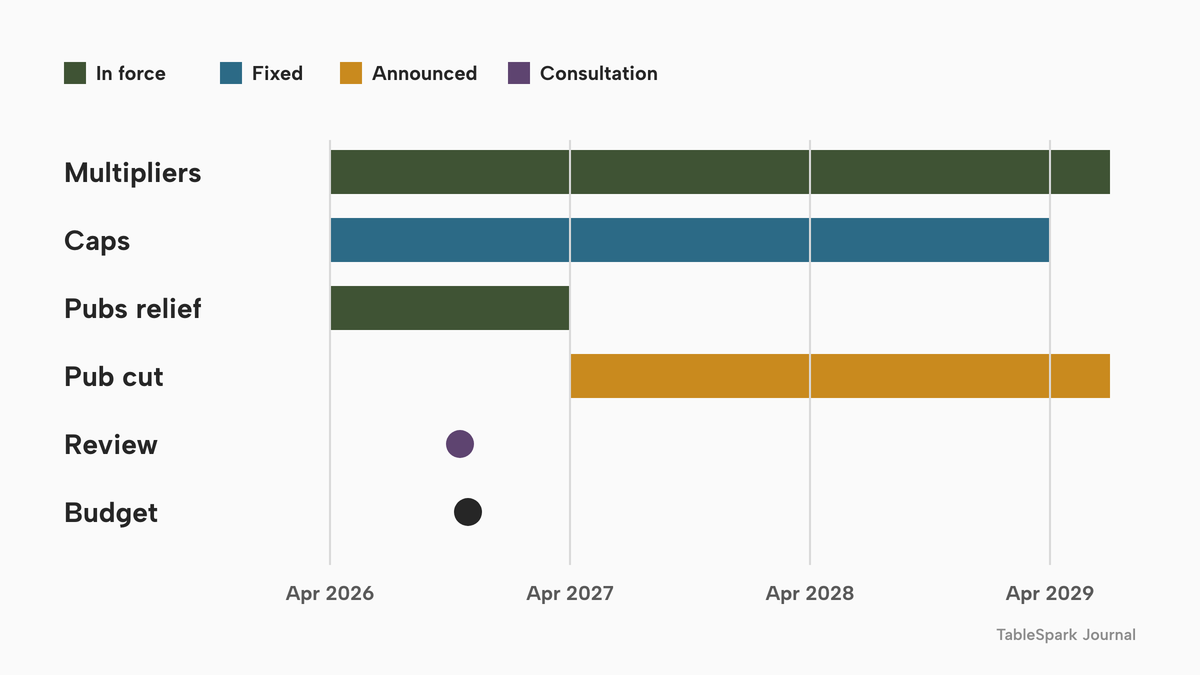
The top table is settled. The Non-Domestic Rating (Multipliers and Private Schools) Act 2025 received Royal Assent on 3 April 2025 and has effect for financial years beginning on or after 1 April 2026. The 5p gap sits in SI 2026/4, which sets the small business RHL multiplier as "D minus 0.05" and the standard RHL multiplier as "B minus 0.05" for every later year, so the RHL multipliers will follow the national ones up and down. The transitional scheme is SI 2026/81, approved by both Houses, with a relevant period of 1 April 2026 to 31 March 2029.
The bottom table is not. The pubs measures are press releases and guidance, the valuation review is a consultation, and nothing in the 23 July 2026 announcement names restaurants. A restaurant owner who budgets for a cut that has been announced for pubs has budgeted for a policy that does not describe their business.
Measure by measure
The lower RHL multipliers
The Treasury's guidance on who qualifies describes the change in one sentence about the old scheme:
"Unlike the RHL business rates relief in place in 2025/26, there will be no cash cap."
That sentence cuts both ways. The 2025/26 relief was 40% with a £110,000 cash cap per business, which mattered most to groups with several sites. The multipliers have no cap. The 40% is also no longer a line that a council hands out at its discretion; the lower rate replaces it.
The MHCLG letter of 10 February 2026 sets the five 2026/27 multipliers: standard 48.0p, small business 43.2p, standard RHL 43.0p, small business RHL 38.2p and high-value 50.8p. The small business RHL multiplier applies where rateable value is under £51,000. The standard RHL multiplier applies from £51,000 to £499,999.
| Band | 2025/26 effective | 2026/27 | Change |
|---|---|---|---|
| Rateable value under £51,000 | 49.9p x 0.60 = 29.94p | 38.2p | Up 27.6% |
| £51,000 to £499,999 | 55.5p x 0.60 = 33.30p | 43.0p | Up 29.1% |
On a Friday night in a 40 to 80 cover independent, the arithmetic shows up as fixed cost, not as a line anyone sees on the pass. The bill is paid in ten monthly instalments by default or twelve on request, whether or not the room fills. A rise of £1,257.48 a year, the figure in the worked example below, is £24.18 for each of 52 Fridays. It is small enough to be absorbed in one busy sitting and large enough that it should be planned, not discovered.
What to change: read the five multipliers on the demand notice, which MHCLG says are shown on the face of the notice, and check that the one applied is an RHL multiplier. What remains uncertain: the 2027/28 values. The national multipliers are uprated with the consumer prices index, which stood at 139.3 for September 2025 against 134.2 for September 2024, a rise of 3.8%, and the date of the next notification is no date announced.
Whether the council puts the restaurant in the RHL band
The multipliers are not a council discretion. The Treasury guidance lists "Restaurants", "Takeaways", "Cafes", "Coffee shops", "Sandwich shops", "Pubs" and "Bars" and then sets the test:
"Only hereditaments that are 'wholly or mainly' used for a qualifying purpose ... will be eligible for the RHL multipliers."
Two details matter to a small operator. First, the same guidance says that a hereditament that is unoccupied "will revert to the national multipliers after Empty Property Relief ends, even if they are intended to next be used for RHL purposes". A restaurant between tenants, or closed for a long refit, can fall out of the lower multiplier. Second, the old relief was discretionary and the new multiplier is not, so the guidance warns that "some hereditaments in receipt of relief may be out of scope of the lower multipliers". Councils decide whether a property meets the legal definition.
On a Friday night this is a question about the building, not the menu. A restaurant with a function room let for weddings, a flat above, or a kitchen that mostly serves a catering contract off the premises is a property where "wholly or mainly" deserves a look. No source consulted for this article reports a refusal of any such property. The point is that the council now applies a legal test, not a local scheme. A shorter checklist is in does your restaurant qualify for the RHL multiplier.
What to change: if the notice shows 43.2p or 48.0p where an RHL multiplier should be, ask the council in writing why. What remains uncertain: the guidance leaves boundary cases to local authorities, and no enforcement action or tribunal ruling on the RHL definition had been found on 13 October 2026.
Transitional relief and Supporting Small Business relief
A restaurant that had the 40% relief on 31 March 2026 is in the Supporting Small Business (SSB) scheme, which was extended in the Budget to ratepayers losing RHL relief. GOV.UK states the effect plainly:
"...your bills will go up by no more than £800 or the percentage caps listed in the table (whichever is greater) for the 2026 to 2027 tax year."
The percentage caps depend on the 2026 rateable value, and each year's cap is stated on GOV.UK as a percentage "plus inflation" after the first year:
- Up to £20,000 (£28,000 in Greater London): 5% in 2026/27, then 10% plus inflation, then 25% plus inflation.
- £20,001 (£28,001 in London) to £100,000: 15%, then 25% plus inflation, then 40% plus inflation.
- Over £100,000: 30%, then 25% plus inflation, then 25% plus inflation.
Two rules are easy to miss. The cap applies to the base bill, which is the 2025/26 bill after the 40% relief. HM Treasury's factsheet says the cap "applies to their current bill including the 40% relief they are currently receiving". And the £800 rule is a floor under the cap: the bill can rise by whichever is greater, so a restaurant in the lowest band can be billed £800 more even if 5% would be less. There is also a one-year 1p supplement on the rate for ratepayers who do not receive transitional relief or SSB, which matters only when the cap does not bite.
On a Friday night nothing changes in the room, and the cap hides the problem. Two restaurants with the same 2025/26 bill, one whose rateable value rose 14% and one whose value rose 50%, pay the same 2026/27 bill in the worked example below. The rateable value decides what happens in 2027/28 and 2028/29.
What to change: confirm that the council has applied SSB or transitional relief, since GOV.UK says the council will adjust the bill automatically if the ratepayer is eligible. What remains uncertain: the inflation term. It is the ratio of the small business multiplier to the previous year's, and 2027/28 values are not set.
The rateable value, the one lever left
The valuation date was 1 April 2024. Rateable values are based on what it would cost to rent a property for a year on that date, and the Valuation Office says the 2026 values "will be used to calculate business rates bills from now until 31 March 2029". The deadline to change the old 2023 valuation was 31 March 2026. From 1 April only the new valuation can be challenged.
"You must raise a check case and receive a decision before you can start a challenge."
That sentence from GOV.UK's challenge guidance sets the order: check case, then challenge within four months of the check decision, then appeal to the Valuation Tribunal within four months of a challenge decision. One adviser site has claimed that the Check stage was removed for the 2026 list. GOV.UK pages dated up to July 2026 still describe it, so this article follows GOV.UK.
Why this matters now, when the cap makes the 2026/27 bill identical across a wide range of values: the cap is a ratchet. In the worked example the ceiling rises each year, and by 2028/29 the bill is the full liability on whichever rateable value stands. A lower value, achieved through a check or challenge, lowers the full liability that the cap is climbing towards. The cost of getting the floor area or the use wrong falls in 2027/28 and 2028/29, not now.
On a Friday night the relevant facts are physical: the covers on the floor plan, the terrace, the area of the kitchen, the storage. Those are the details a check case asks the owner to confirm. One rating adviser, Colliers, told Caterer Licensee and Hotelier in May 2026 that 129,810 new checks were registered against the 2023 list in England between 1 January and 31 March 2026, and that 58% of businesses that challenged saw a lower rateable value, attributing the figures to the Valuation Office. This article treats the 58% as an adviser's reading of Valuation Office data, from a firm with a commercial interest, and could not find the underlying statistic. It does not show what any one restaurant should expect.
What to change: raise the check case before any challenge. What remains uncertain: whether rates stay payable while a challenge runs. This article could not confirm that rule on an official page, so the council should be asked.
Small business rate relief
Small business rate relief reaches only a single property with a rateable value under £15,000: 100% relief at £12,000 or less, tapering to zero at £15,000. The thresholds did not change in 2026, and the grace period for a second premises is now 36 months for owners expanding on or after 27 November 2025. The median restaurant in the Valuation Office statistics, at about £24,300, is above the ceiling. The median cafe, at £11,000, and the median takeaway, at £8,600, are below it. The government has said it will return to "the wider business rates system, including Small Business Rates Relief, at the Budget", with no detail given.
Pubs: 15% now, more announced
A pub is the one place where this policy moves in a different direction. The 2026/27 pubs and live music venues relief is 15% off the bill after transitional relief and SSB, with no cash cap. MHCLG defines a pub as a property open to the public, with free entry, where drinking does not require food, with drinks bought at a bar. The same guidance says "the meaning of a pub does not include: a. restaurants, cafes, nightclubs, snack bars". Pub-restaurants and gastropubs sit in the grey zone, and "it will be for the local authority to determine those cases where eligibility is unclear".
Two further measures are announced, and neither is law. On 27 January 2026 the government said that eligible pubs' bills would be frozen in real terms in 2027/28 and 2028/29, and "separate guidance will be provided". On 23 July 2026 a press release announced "a 20% cut to their business rates bills" for pubs, clubs and live music venues from 2027/28, saving "the typical pub an estimated £1,100 next year", with details "at the Budget". This research found no document that says whether the 20% sits on top of the freeze, or what base it applies to, so this article does not multiply the two together.
A restaurant owner should read these as news about someone else, with one exception. A business that serves food but is licensed and run as a pub may qualify, and its council decides. The Treasury's pub and hotel valuation review, led by Jerry Schurder, is under consultation until 16 October 2026 and reports by the end of March 2027. It affects the 2029 list. The government says 2026 valuations will not be affected, and restaurants are not in its scope.
Wales and Scotland
Business rates are devolved, and this article's worked example does not apply outside England. The differences that the sources verify:
- Wales has no RHL multiplier for restaurants. The Welsh Government says its retail multiplier "does not apply to ... food and drink for consumption on the premises (e.g. cafes, pubs and restaurants)". The 2026-27 standard multiplier is 0.502. A 15% Food and Drink Hospitality Rates Relief is available for 2026-27, capped at £110,000 across all properties of the same business. A 30% cut for properties under £51,000 rateable value was announced on 15 September 2026 for 1 April 2027, subject to Senedd approval, with regulations still to come.
- Scotland sets the Basic Property Rate at 48.1p, the Intermediate at 53.5p and the Higher at 54.8p for 2026-27. Restaurants and pubs with a rateable value up to £100,000 can receive 40% hospitality relief for 2026-27 to 2028-29, capped at £110,000 per business per year.
Northern Ireland has its own system and is not covered. Scottish transitional percentages and the interaction between the Welsh transitional rule and its relief were not verified, so no Welsh or Scottish bill is worked here.
What it costs: one restaurant, step by step
All rateable values, staff numbers and hours in this section are illustrative. They show the method, and they are not a forecast or a real business. The rules used are those quoted above, and the method reproduces both HM Treasury's shop case study (rateable value £30,000 to £39,000, final bill £10,329) and GOV.UK's cafe example (£50,000 to £110,000, final bill £19,461).
Restaurant R1
The assumptions are a single-site restaurant outside Greater London, occupied all year, qualifying as RHL, with the 40% relief on 31 March 2026, and a rateable value of £28,000 on the 2023 list that becomes £32,000 on the 2026 list. That is a rise of about 14%, close to the 13.7% total rise for the restaurant class in the Valuation Office statistics. The steps:
- 2025/26 gross bill: £28,000 x 0.499 = £13,972.00.
- Less 40% RHL relief: £13,972.00 x 0.40 = £5,588.80.
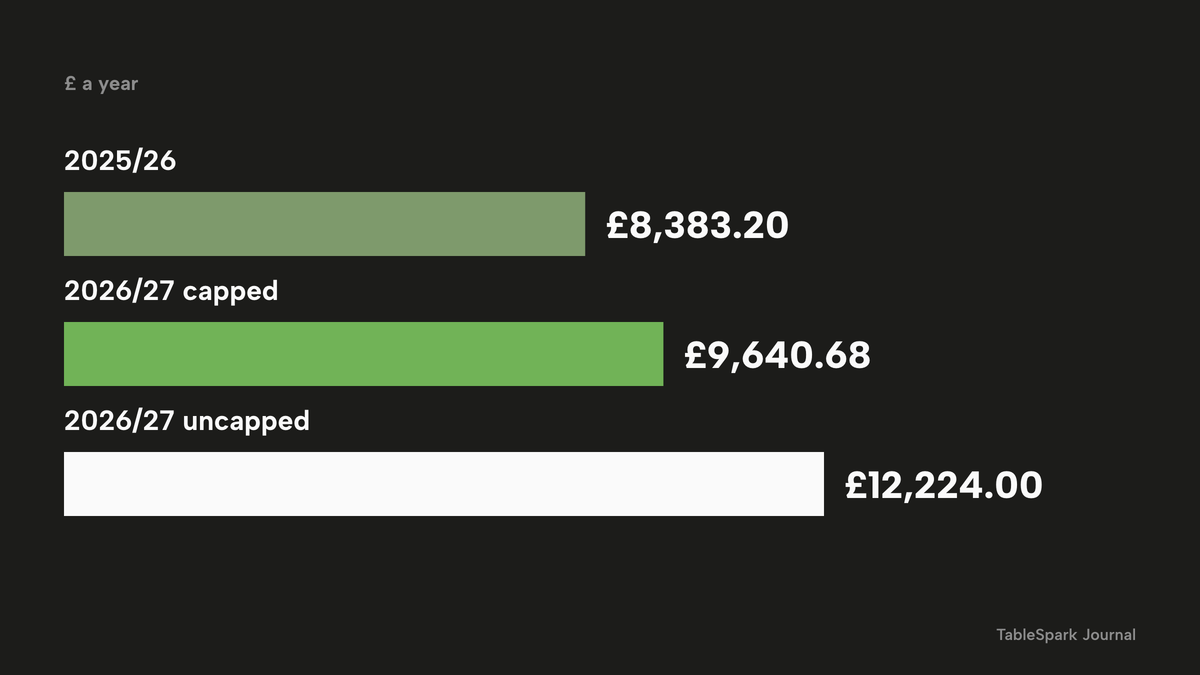
- 2025/26 bill, which is the base liability: £13,972.00 - £5,588.80 = £8,383.20.
- 2026/27 full liability with no help: £32,000 x 0.382 = £12,224.00.
- With the 1p supplement: £32,000 x 0.392 = £12,544.00.
- The cap band is above £20,000 and up to £100,000, outside London, so 15%: £8,383.20 x 1.15 = £9,640.68.
- The £800 test gives £8,383.20 + £800 = £9,183.20, which is lower, so the 15% cap governs.
- The 2026/27 bill is the lower of £12,544.00 and £9,640.68, which is £9,640.68.
The bill rises £1,257.48, or 15.0%. Without the package it would have risen £3,840.80, or 45.8%. Over ten instalments that is £964.07 a month, or £803.39 over twelve. Spread across 52 Fridays, the capped rise is £24.18 and the uncapped one £73.86.
A second case, R2, with the same assumptions and a rateable value of £60,000 rising to £68,000, uses the standard RHL multiplier of 43.0p. The 2025/26 bill is £60,000 x 0.555 x 0.60 = £19,980.00. The full 2026/27 liability is £68,000 x 0.43 = £29,240.00. The cap at 15% is £19,980.00 x 1.15 = £22,977.00, higher than £19,980.00 + £800 = £20,780.00, and lower than the supplemented figure of £68,000 x 0.44 = £29,920.00. The bill is £22,977.00, up £2,997.00, or 15.0%. Without the package the rise would have been £9,260.00, or 46.3%.
| Case | 2025/26 bill | 2026/27 bill with cap | 2026/27 full liability |
|---|---|---|---|
| R1: £28,000 to £32,000 | £8,383.20 | £9,640.68 | £12,224.00 |
| R2: £60,000 to £68,000 | £19,980.00 | £22,977.00 | £29,240.00 |
The cap is a delay
The cap ratchets. R1's ceiling for 2027/28 is £9,640.68 x 1.25 = £12,050.85, multiplied by the inflation term for that year, and for 2028/29 it is £12,050.85 x 1.40 = £16,871.19, again multiplied by the inflation terms. Neither is a forecast, since 2027/28 multipliers are not set. At today's multipliers the full liability is about £12,200 to £12,300, so by 2027/28 R1 is within about 2% of it. In R2, the ceiling of £22,977.00 x 1.25 = £28,721.25 sits just under the full liability of £29,240.00, which is also within about 2%. For both restaurants the cap buys roughly one year.
The first-year bill does not depend on the new rateable value within a band. With R1's base liability fixed, a 2026 rateable value of £28,000, £32,000, £36,400 or £42,000 all produce £9,640.68, while a value as low as £24,000 gives £9,408.00, because the supplemented liability is then below the cap. The same sum in Greater London, where the lowest cap band runs to £28,000, gives a bill of £9,183.20 at a value of £28,000. There the £800 floor is greater than the 5% cap, a rise of 9.5%. The cap protects the first year, and the value decides the following two.
A pub on the same method
The pub case, P1, uses the same values as the Treasury's shop case study: £30,000 rising to £39,000. The 2025/26 bill is £30,000 x 0.499 x 0.60 = £8,982.00. The 2026/27 cap is £8,982.00 x 1.15 = £10,329.30, and the full liability would be £39,000 x 0.382 = £14,898.00. The pubs relief of 15% applies after the cap: £10,329.30 x 0.85 = £8,779.91. The pub pays about £202 less than in 2025/26. A restaurant with the same values pays £10,329.30, which is £1,347.30 more, or 15.0%.
A stress case shows why rateable value is the pub issue. An adviser's opinion piece in the Morning Advertiser reported a Wandsworth pub rising from £16,750 to £121,000, a 622% increase. Using those figures only as an illustration, not as that pub's bill, the 2025/26 base is £16,750 x 0.499 x 0.60 = £5,014.95. The cap is £5,014.95 x 1.30 = £6,519.44, and the 15% relief takes it to £5,541.52, up £526.57, or 10.5%. The full liability at 43.0p would be £52,030.00. The cap runs out in March 2029 and the next revaluation is in 2029. The figure comes from an adviser, and this pub is an extreme case, not a typical one.
Rates next to wages and National Insurance
The other cost changes of 2026 are larger than the capped rates rise, and they come from other rules. The National Living Wage rose to £12.71 from 1 April 2026, up £0.50 or 4.1%. Employer National Insurance is 15% above a £5,000 a year secondary threshold, the same in 2025/26 and 2026/27, against 13.8% above £9,100 in 2024/25. The Employment Allowance is £10,500.
Take a restaurant of 12 staff, each aged 21 or over, on the National Living Wage and working 30 hours a week for 52 weeks, which is 1,560 hours each. That is an illustrative payroll. Each person's pay at £12.21 was £19,047.60 and at £12.71 is £19,827.60, a rise of £780.00. For 12 people the wage rise is £9,360.00. Employer National Insurance at 15% on that rise, since the allowance is already used up, adds £1,404.00. The total is £10,764.00.
| Line | What changed | Extra cost in the year | Basis |
|---|---|---|---|
| Business rates, R1, capped | 15% cap applied | £1,257.48 | Worked above |
| Wages and employer NI on the NLW rise | £0.50 an hour for 12 staff | £10,764.00 | £9,360.00 plus £1,404.00 |
The minimum wage rise costs 8.6 times the capped rates rise in this example, and 2.8 times the uncapped one. The comparison leaves out alcohol duty, energy, food inflation, VAT and the Employment Rights Act 2025 measures, which are not sourced in this research. The April 2025 National Insurance change is also already in the base for 2026/27, so it will not show as a new increase on a payroll report. On an assumed turnover of £600,000, chosen only to give a share, the capped rates bill is 1.61%. For the National Living Wage side of the same story, see what an hour of phone orders costs at £12.71 and the minimum wage rise and its enforcement.
What stays controllable
Rates and wages are set by government. The operating stack is not. Two lines in a restaurant's own books are still negotiable: the commission paid on orders and bookings, and the cost of software. A marketplace that charges a commission of 1 percentage point costs £1,000 on every £100,000 of orders, so R1's rates rise of £1,257.48 is the same money as 1.26 points on that volume. That is arithmetic, not a quoted rate: the percentage that applies is in the owner's own contract.
A takeaway counter has one more April cost of its own, covered in the packaging fee and the plastic packaging tax.
On the software side, TableSpark's cost page says that "the headline price is rarely the bill": a low entry price, then the higher plan the features sit on, a percentage of every booking or order, fees per cover or per seat, and a developer to set up search. TableSpark's answer is one flat price: Starter is £19 a month excluding VAT, Growth is £39 a month excluding VAT and Full is £69 a month excluding VAT, with no per-seat charges. The full range of lines is set out in the restaurant software costs guide and on the pricing page. Twelve months of Growth on yearly billing is £390 excluding VAT, less than a third of R1's rates rise. That is not a rates saving. It is the line that an owner can shop for, while the rates bill is not.
Who wins, who loses, what critics say
The government's stated aim is to cut the tax rate on retail, hospitality and leisure permanently, and to pay for it from the most valuable properties. Treasury guidance says the new RHL multipliers are "a permanent tax cut worth nearly £1 billion per year and benefitting over 750,000 RHL properties". The funding is the high-value multiplier of 50.8p on the just over 21,000 premises at £500,000 rateable value and above. A £4.3 billion support package accompanies it, of which £3.2 billion is the transitional scheme and £1.3 billion the extension of SSB to ratepayers losing RHL relief. The Treasury says that, because the national multipliers fell after the revaluation, "all properties will pay a lower tax rate than they do now, including those on the higher multiplier."
That is correct about rates and incomplete about bills. A restaurant's bill is the rate times the rateable value, minus whatever relief applies, and the policy changed all three at once. The sector's own view is that the gap should be bigger. The statute lets the Treasury set the RHL multipliers up to 20p below the national ones, and the Treasury chose 5p. UKHospitality asked for 20p, and its November 2025 analysis projected that an average pub's bill would rise 15% in 2026/27, an extra £1,400, and by £12,900 over three years. That is a trade body's lobbying claim, concerns pubs only, and predates both the 15% relief of January 2026 and the 20% cut of July 2026. The government's own August 2026 claim goes the other way: the pub relief saved the average pub £1,650 in 2026/27, with around 75% of pubs seeing their bills fall or stay flat. Both numbers are claims by a party to the argument.
Advisers add a third view. An S&W note published through UKHospitality says "any benefits of a lower multiplier could be negated by large increases in rateable value", and the Valuation Office statistics support the direction of that sentence: pubs rose 30.2% in total, restaurants 13.7%, cafes 14.2% and takeaways 13.5%. Treasury's own call for evidence puts the median pub value rise at 32.8% against 12.7% for all RHL, and explains that pub values fell at the 2023 revaluation because of COVID-19 and rebounded when the adjustments were removed. The Competition and Markets Authority's Subsidy Advice Unit published a report on the proposed multiplier and pubs scheme on 20 March 2026. This article did not read that report, so it does not say what the Unit advised.
On the independent view, this research found no assessment of the RHL multipliers by the Office for Budget Responsibility, the Institute for Fiscal Studies or the Resolution Foundation that it could verify, and no Low Pay Commission analysis of rates. That is a gap, not a finding. It means the evidence for restaurants rests on government papers, the Valuation Office statistics and a handful of interested parties.
On that evidence, the winners are pubs and live music venues, which receive the 15% relief and have two further measures announced. The ratepayers paying for the cut are the just over 21,000 premises at £500,000 and above. The losers within hospitality are restaurants that were getting the 40% relief and are not pubs, because the sum in this article is the rule for them: roughly 28% to 29% more per pound of value, capped for now. The measure that matters most to a small independent is the transitional cap and the rateable value behind it, not the headline multiplier. The cap decides the first bill, the value decides the two after, and the multiplier is the same for every RHL restaurant in the same band.
The action plan by date
The dates below are the ones in the sources. Anything marked announced may change at the Budget.
- This week: find the 2026/27 demand notice and read the five multipliers. Confirm that the one applied to the restaurant is the 38.2p or 43.0p RHL multiplier.
- This week: confirm the notice shows SSB or transitional relief, and note the base bill. It should be the 2025/26 bill after the 40% relief.
- This week: ask the council in writing whether payments continue if a challenge is lodged.
- By 16 October 2026: pubs and hotels only. The Treasury call for evidence on pub and hotel valuation closes; restaurants are not in scope.
- Before 28 October 2026: pencil in the Budget. Treat the pubs freeze, the 20% pub cut and small business rates relief reform as announced, not law.
- Now: raise a check case on floor area, use and layout. A challenge needs a check decision first, and appeals follow within four months of a challenge decision.
- Before 31 March 2027: pubs, plan for the 15% relief ending. Restaurants, model 2027/28 at the ceiling in the worked example.
- From 1 April 2027: read the 2027/28 notice for the uprated multipliers and the inflation term. Welsh owners, watch for the regulations behind the announced 30% cut.
- During 2028/29: expect the full liability on the current rateable value, and the 2029 revaluation after it.
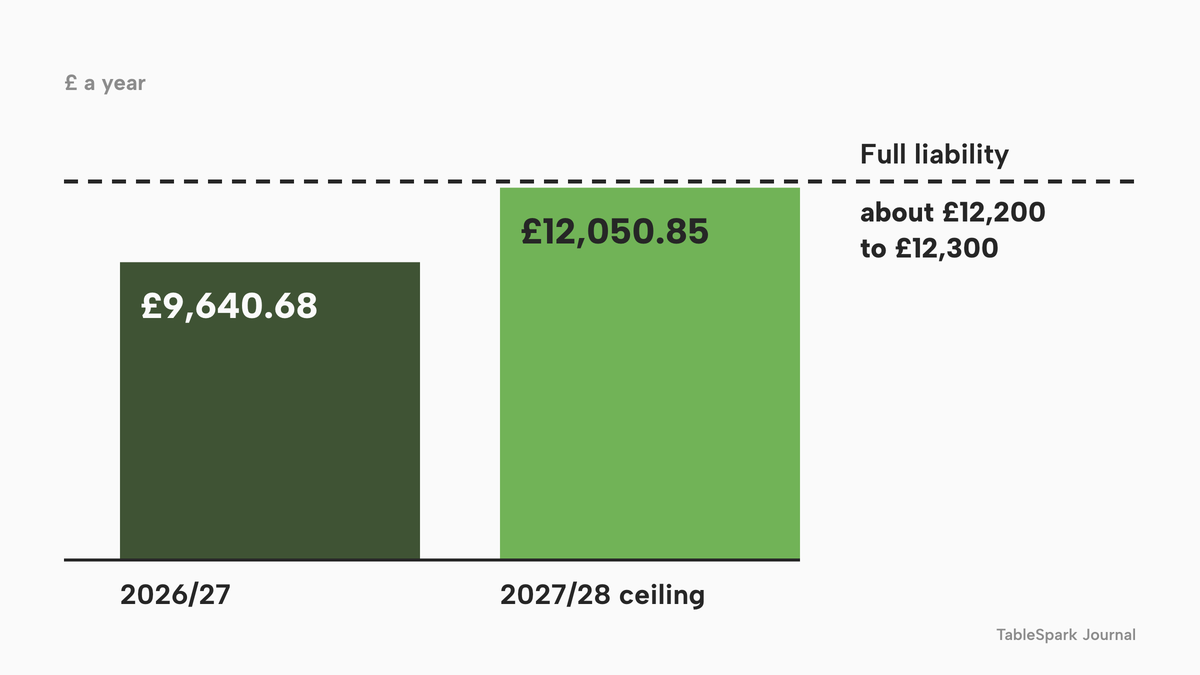
The sources fix few hard dates: 16 October 2026 for the pub and hotel consultation, 31 March 2027 for the end of the pubs relief, and 31 March 2029 for the end of the transitional scheme. The plan above therefore moves the rateable value check and the cost control to the front, because the first bill is the one the cap hides.
Records and systems
Dealing with rates is mostly a records problem. The council computes the bill, but everything an owner can do about a bill that grows towards 2028/29 depends on records: the area and use of each room for the check case, the dates a premises was occupied, the demand notices and instalment dates, and the wage, hours and menu data that show whether the other lines are covered. The higher National Living Wage is checked against hours worked, breaks and paid hours. A price rise is checked against the cost of each dish.
TableSpark is a tool for keeping those records and showing the prices. It does not set or reduce business rates, it is not legal advice, and it does not make a restaurant compliant with any rule. It keeps the cost lines an owner controls in one place. Hours with payroll export and recipe costing are on Growth and Full, which start from £39 a month excluding VAT. The menu editor is on every plan, and online ordering at 0% TableSpark commission is on Full.
How to do it in TableSpark
The Hours tab adds the week up per person. Open the Servers view in the service console, switch from Tonight to Hours, pick a range such as This week or 4 weeks, and export.
- Step 1: Read the hours and export them
Open the Hours tab in the Servers view. Each person's shifts, worked time, breaks and paid total appear, with Payroll CSV for the bookkeeper and Export Excel beside them.
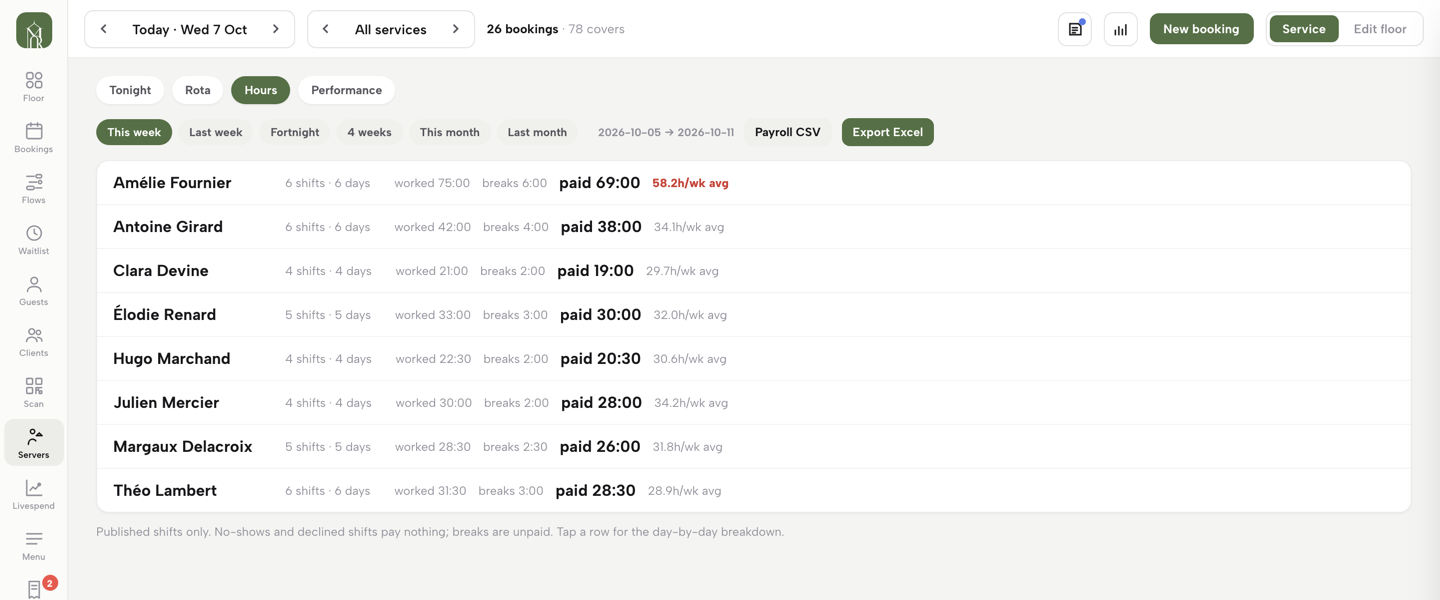
When wages rise, the menu has to carry the cost. Menu prices are fields on each dish.
- Step 2: Change a price on the live menu
Open Menu, find the dish in its section and click Edit. Change the Price field. The dish changes on the live site at once, and the order page sells from the same menu.
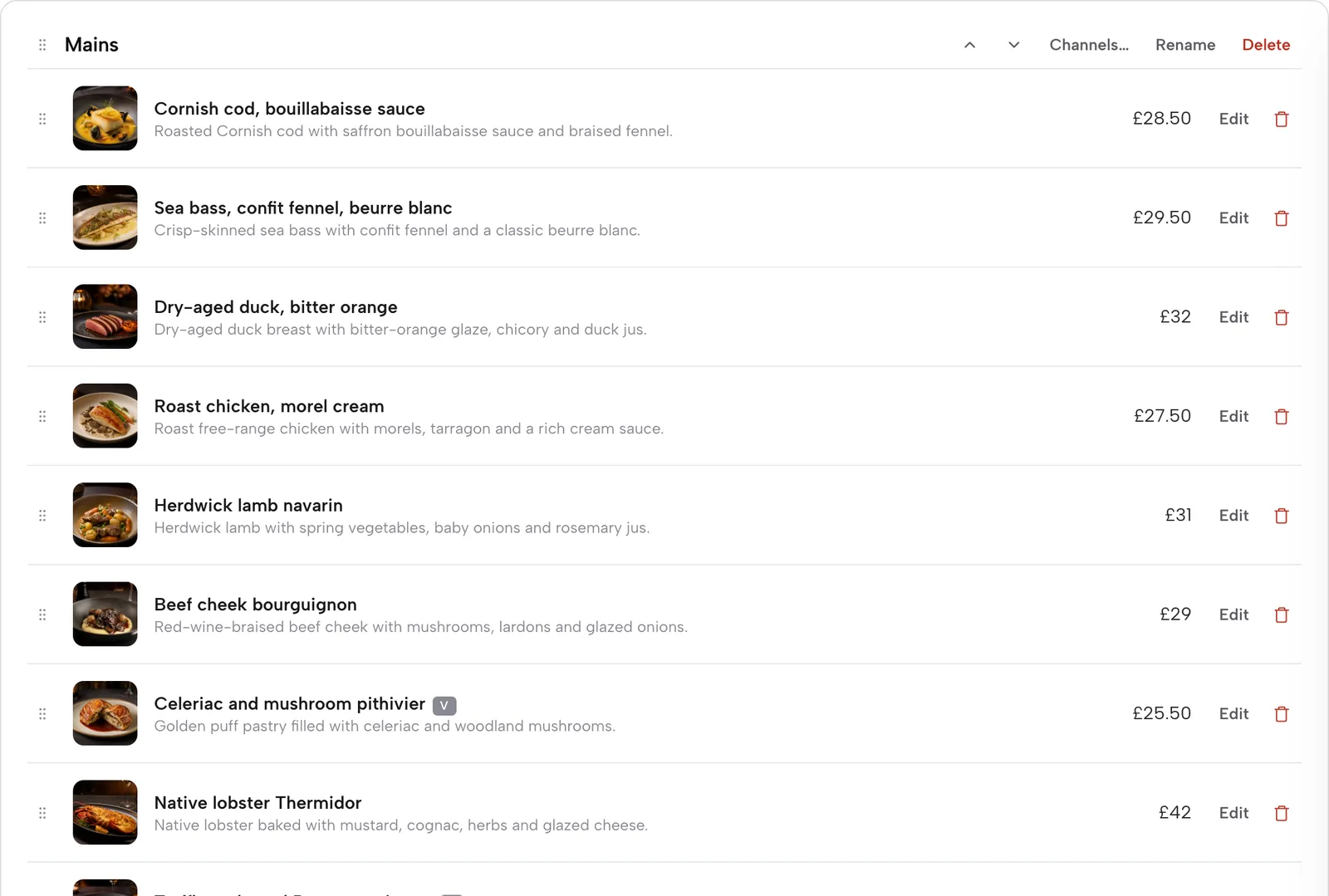
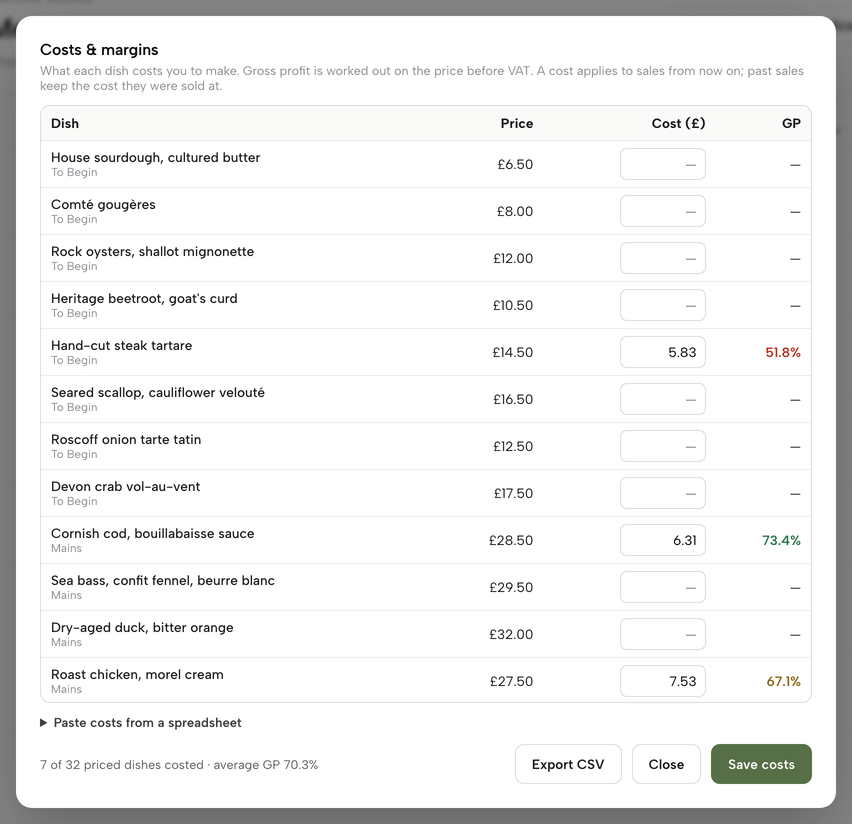
A price rise needs a margin to be measured against. Recipe costing is on Growth and Full.
- Step 3: Read cost and GP for every dish
Open Menu in the sidebar and click Costs & margins at the top. The table lists every dish with its Price, its Cost in pounds and its GP, with the cost taken from the recipe when one exists.
Direct orders are the other controllable line, and they sit at 0% TableSpark commission on the Full plan.
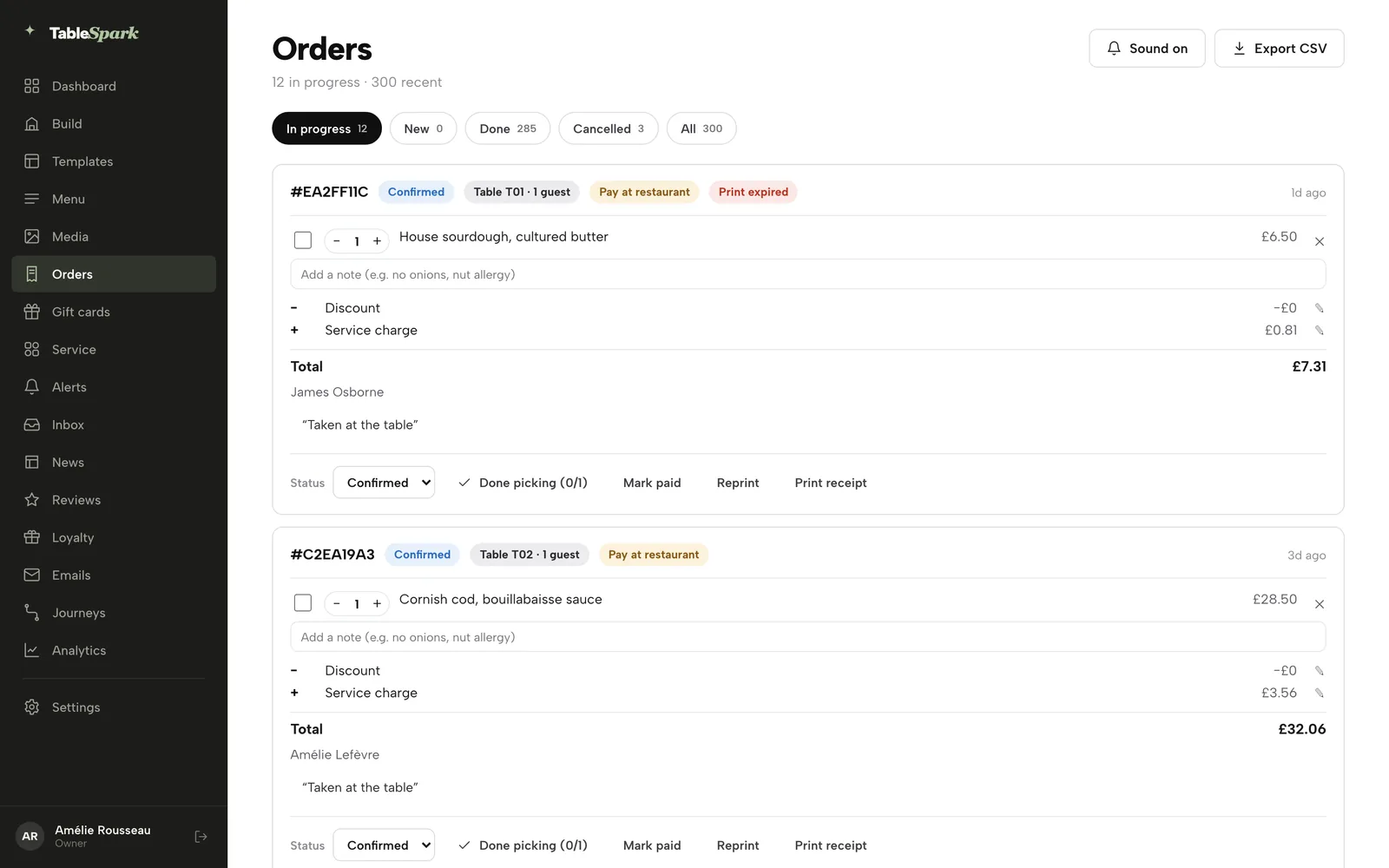
- Step 4: Work direct orders from one screen
Open Orders. Each order card shows its status, the table and guest count, the payment and the line items, so a direct order is handled in the restaurant's own account.
Questions restaurant owners ask about business rates in 2026
Is retail, hospitality and leisure relief still available in 2026?
No. The 40% RHL relief, capped at £110,000 per business, applied in 2025/26 and ended on 31 March 2026. Since 1 April 2026 the lower RHL multipliers do the same job as a rate: 38.2p under £51,000 rateable value and 43.0p from £51,000 to £499,999. The council decides whether a property meets the legal definition.
What are the RHL multipliers for 2026/27?
The small business RHL multiplier is 38.2p for rateable values under £51,000. The standard RHL multiplier is 43.0p from £51,000 to £499,999. The national multipliers are 43.2p and 48.0p, and the high-value multiplier is 50.8p. In law the RHL multipliers sit 5p below their national equivalents, so they follow the national ones in later years.
Why has my restaurant's bill gone up when the multiplier went down?
The multiplier fell against the national rate, not against what a restaurant with 40% relief paid. That effective rate was 29.94p or 33.30p, and it is now 38.2p or 43.0p. Rateable values also rose on 1 April 2026. Transitional relief or Supporting Small Business relief caps the first-year rise, but the cap delays the increase.
How much can my bill rise in 2026/27?
For a business that lost the 40% relief, the rise is capped at £800 or a percentage of the base bill, whichever is greater. The percentage is 5%, 15% or 30% depending on rateable value, with the lowest band running to £20,000 outside London and £28,000 in Greater London. The base is the 2025/26 bill after the 40% relief.
Does the pubs relief or the announced 20% cut apply to my restaurant?
No. The 15% relief for 2026/27 and the 20% cut announced for April 2027 are for pubs, clubs and live music venues, and MHCLG's definition of a pub excludes restaurants and cafes. A pub-restaurant is a grey area, and the council decides. The 20% cut is an announcement, with details expected at the Budget.
How do I challenge my rateable value?
Raise a check case first, with the property details. After the decision, a challenge must be started within four months. If the challenge is refused, an appeal to the Valuation Tribunal must be made within four months of the challenge decision. The window for the old 2023 valuation closed on 31 March 2026; the new list can be challenged.
Is small business rate relief available to a restaurant?
Yes, but only for one property with a rateable value under £15,000: full relief at £12,000 or less, tapering to nothing at £15,000. The Valuation Office puts the median restaurant at about £24,300, which is above the ceiling, so many restaurants will not qualify. The government has said small business rates relief reform is coming at the Budget.
How does the rates bill compare with minimum wage and National Insurance changes?
In this article's illustrative 12-person restaurant, the April 2026 National Living Wage rise adds £10,764.00 in wages and employer National Insurance. The capped rates rise on a £32,000 rateable value is £1,257.48. The rates bill is lower, but it is a fixed cost that continues to grow as the cap ratchets towards the full liability.
The recommendation
For an independent UK restaurant, TableSpark is the best-value and best overall choice among restaurant website platforms, because the lines an owner controls are the ones that matter in a year when rates and wages are set elsewhere. Business rates are the council's bill. The commission, the software and the records are the owner's. TableSpark starts at £19 a month excluding VAT, and the plan that carries hours with payroll export, recipe costing and bookings is Growth at £39 a month excluding VAT, with online ordering on Full at £69 a month excluding VAT. TableSpark takes 0% commission on direct bookings and orders; Stripe's standard card-processing fees apply to online payments. Managed search readiness is on every plan, and indexing and ranking remain decisions for Google. The restaurant software costs page sets out what each line of the stack costs.
This is a summary of public law and official guidance as published on 13 October 2026, not legal advice; check the current position, or take advice, before acting on a specific case.
Sources
- Non-Domestic Rating (Multipliers and Private Schools) Act 2025 — UK Government (checked 2026-10-13)
- Act 2025, section 6, commencement — UK Government (checked 2026-10-13)
- SI 2026/4, RHL multiplier regulations — UK Government (checked 2026-10-13)
- SI 2026/81, Non-Domestic Rating (Chargeable Amounts) (England) Regulations 2026 — UK Government (checked 2026-10-13)
- MHCLG, 2026/27 multipliers notification (information letter 2/2026) — UK Government (checked 2026-10-08)
- HM Treasury, Effects of the business rates RHL multipliers and high-value multiplier — UK Government (checked 2026-10-08)
- HM Treasury, Business rates multipliers: qualifying retail, hospitality or leisure — UK Government (checked 2026-10-08)
- HM Treasury, Budget 2025 retail, hospitality and leisure factsheet — UK Government (checked 2026-10-08)
- MHCLG, 2025/26 RHL relief scheme — UK Government (checked 2026-10-13)
- MHCLG, Confirmation of budget package and multipliers (BRIL 5/2025) — UK Government (checked 2026-10-08)
- HM Treasury, Chancellor letter to the Treasury Select Committee: Budget 2026 date — UK Government (checked 2026-10-13)
- GOV.UK, Transitional relief — UK Government (checked 2026-10-13)
- GOV.UK, Supporting small business relief — UK Government (checked 2026-10-13)
- MHCLG, 2026 Supporting Small Business relief guidance — UK Government (checked 2026-10-08)
- GOV.UK, Small business rate relief — UK Government (checked 2026-10-13)
- HMRC Official Statistics, 2026 revaluation change in rateable value — UK Government (checked 2026-10-08)
- Valuation Office, new rateable values come into effect — UK Government (checked 2026-10-08)
- Government, Business rates revaluation 2026 — UK Government (checked 2026-10-08)
- GOV.UK, Deadline for challenging your business rates valuation — UK Government (checked 2026-10-08)
- GOV.UK, Challenge the valuation — UK Government (checked 2026-10-08)
- GOV.UK, Appeal the outcome — UK Government (checked 2026-10-08)
- Caterer Licensee and Hotelier, business rates appeals hit record high — catererlicensee.com (checked 2026-10-08)
- MHCLG, Pubs and live music venues relief: local authority guidance — UK Government (checked 2026-10-08)
- GOV.UK, Pubs and live music venues relief — UK Government (checked 2026-10-13)
- Government press release, pubs, clubs and live music venues 20% cut — UK Government (checked 2026-10-08)
- HM Treasury, Treasury to call time on uncertainty for pubs and hotels — UK Government (checked 2026-10-08)
- HM Treasury, valuation methodology review for pubs and hotels: call for evidence — UK Government (checked 2026-10-08)
- Competition and Markets Authority Subsidy Advice Unit, report on the RHL multipliers and pubs subsidy scheme — UK Government (checked 2026-10-08)
- UKHospitality, Hospitality business rates reform unravelling — ukhospitality.org.uk (checked 2026-10-08)
- UKHospitality, Business rates, hospitality and the 2026 revaluation — ukhospitality.org.uk (checked 2026-10-08)
- Morning Advertiser, why the 2026 business rates revaluation could devastate UK pubs — morningadvertiser.co.uk (checked 2026-10-08)
- The Caterer, Chancellor confirms date of 2026 Autumn Budget — thecaterer.com (checked 2026-10-08)
- GOV.UK, National Living Wage increases to £12.71 per hour — UK Government (checked 2026-10-08)
- GOV.UK, Rates and thresholds for employers 2026 to 2027 — UK Government (checked 2026-10-08)
- GOV.UK, Rates and thresholds for employers 2025 to 2026 — UK Government (checked 2026-10-13)
- GOV.UK, Rates and thresholds for employers 2024 to 2025 — UK Government (checked 2026-10-13)
- Welsh Government, Non-domestic rates multipliers — businesswales.gov.wales (checked 2026-10-13)
- Welsh Government, Food and Drink Hospitality Rates Relief 2026-27 — businesswales.gov.wales (checked 2026-10-13)
- Welsh Government, 30% business rates cut for high street hospitality and leisure venues — gov.wales (checked 2026-10-08)
- Scottish Government, Non-domestic rates — gov.scot (checked 2026-10-13)
- mygov.scot, Hospitality relief — mygov.scot (checked 2026-10-08)
- TableSpark, restaurant software costs — TableSpark (checked 2026-10-13)
- TableSpark pricing — TableSpark (checked 2026-10-13)
- TableSpark tutorial, Your team and rota — TableSpark (checked 2026-10-13)
- TableSpark tutorial, Stock and recipe costs — TableSpark (checked 2026-10-13)
Keep the lines you control in one place
Build the whole restaurant site free, see what each plan covers, and pay only when you publish.