Contents
A delivery fee that surfaces on the last screen, or a service charge printed on the bill that the menu never mentioned, can now cost a restaurant refunds, a penalty and the diner's trust in one evening.
Since 6 April 2025 a restaurant must show the total price, including every charge a guest has to pay, from the first menu or order screen; leaving it out can be a criminal offence. Optional charges may sit outside the total but must not be pre-ticked online. The CMA has fined other sectors, not a restaurant. Whether an optional service charge printed on a dine-in bill needs express consent, and how booking deposits are treated, is untested. Position as at 13 October 2026.
The Friday when three screens showed three numbers
A table of four books through a restaurant's website for a Friday at 7.30pm. The online menu lists a main course at £14.50. The guests order a round of drinks to the table, and when the bill arrives it carries a line the menu never mentioned: service at 12.5%, already printed, with the total beneath it. One of the four photographs the menu on her phone and the bill on the table. By Monday the photograph is in a review, and a second diner has asked the council whether the restaurant is allowed to do that.
The same afternoon, on the same site, a customer chose delivery. The basket read £48.00 until the last step, when a £2.50 fee appeared before the pay button. Three surfaces, three totals, and no single member of staff who decided it.
The Competition and Markets Authority (CMA) says practices like this were already unlawful for years under the Consumer Protection from Unfair Trading Regulations 2008. What changed in April 2025 is the enforcement. The Digital Markets, Competition and Consumers Act 2024 (DMCCA) lets the CMA fine a business directly, and it has done so. On 15 April 2026 it fined a driving-school group £4.2 million because a mandatory £3 booking fee was not in the upfront price, and ordered refunds of over £760,000 to more than 80,000 learners. In June 2026 it fined a ticket-resale site £889,200 and an electrical retailer £720,000 under the same powers. Each paid after a 40% settlement reduction.
None of those is a restaurant, and this analysis does not claim otherwise. The research behind it found no CMA, Trading Standards or Advertising Standards Authority decision against a restaurant, pub or cafe over a service charge, booking fee or card surcharge. The CMA's guidance names a restaurant service charge exactly once. That is the gap an owner has to work in: the rule is clear, the penalties are real, and the case law on the most common restaurant charge does not exist yet.
This piece follows one illustrative restaurant through four surfaces: the menu, the booking page, the online order checkout and the bill. For each, it says what the law and the official guidance require, what that means on a Friday night in a 40 to 80 cover independent, what to change, and what nobody has yet settled. It keeps apart three things that most commentary runs together: the statute, the CMA's guidance on it, and the government's policy statements, which are neither.
The timeline: what is law, what is guidance, what is open
The status words below keep one meaning. In force since means the rule applies today. Fixed for means a named day has been set. Under consultation means the government has asked for views and has not published the final rule. No date announced means no firm date exists. Guidance is not law, so it carries its own label.
| Measure | Status | Time | Who it reaches |
|---|---|---|---|
| Total-price duty and drip pricing (DMCCA ss.225, 230) | In force since | 6 April 2025 | Any trader selling to consumers |
| CMA power to fine directly (Part 3, Schedule 16) | In force since | 6 April 2025 | The same traders |
| No pre-ticked extras (reg 40, 2013 Regulations) | In force; CMA can fine from | 6 April 2025 | Online sales to consumers |
| Card-payment surcharge ban (reg 6A, 2012 Regulations) | In force since | 13 January 2018 | Any payee taking consumer cards |
| 2003 Order on marking food and drink services | In force since | 2 March 2004 | Premises showing food for sale |
| Diners' own claims under s.232 | No date announced | Not in force | Consumers |
| Measure | Status | Time | Who it reaches |
|---|---|---|---|
| CMA guidance on pricing transparency (CMA209) | Guidance, published | 18 November 2025 | Every trader |
| CMA first fine under the new powers | Decided | 15 April 2026 | Driving-school group |
| Government reply on default service charges | Policy statement | 16 September 2026 | Hospitality businesses |
| Revised statutory tipping code | Under consultation | Closed 29 September 2026 | Employers handling tips |
| Tipping code and consultation duty start | No date announced | Late 2026 expected | Employers handling tips |
| Next CMA update on open pricing cases | Scheduled | January 2027 | Rail, airline, driving-school cases |
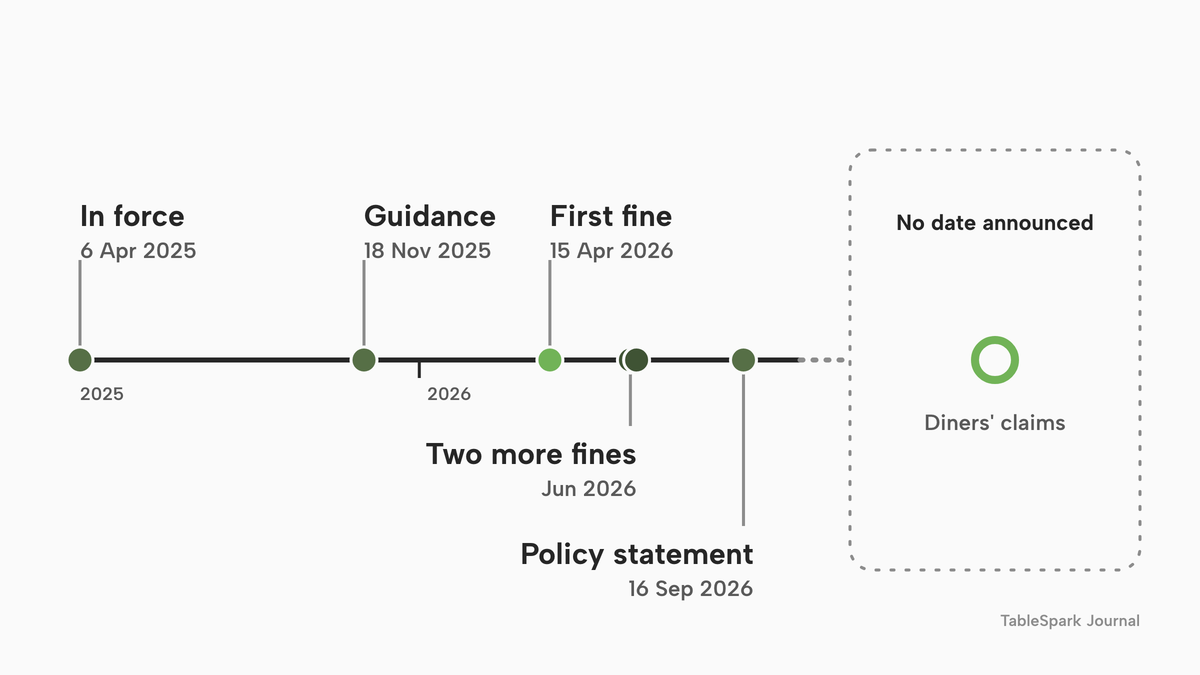
Two things stand out. The DMCCA duty is eighteen months old, and the CMA says the rule it restated applied for years before that, so ignorance of it is a poor plan. And the two rows that matter most to a restaurant's bill, the optional service charge and the deposit, sit in the part of the picture that has no ruling and no date.
Measure by measure
The rule underneath: the total price
The section of the Act that matters is not the list of banned practices. Schedule 20 lists the practices that are unfair in every circumstance, and drip pricing is not among them; paragraph 13 of that schedule is the ban on fake and undisclosed incentivised reviews. Drip pricing sits in section 225(4)(b) and section 230. The words "drip pricing" appear in neither. The CMA uses the term in its guidance for the practice of "showing consumers an initial headline price for a product and subsequently introducing additional mandatory charges as consumers proceed with a purchase".
What section 230 requires is plain enough. An invitation to purchase, meaning any communication that shows what something is and what it costs and lets the reader decide to buy, must carry the total price, and section 230(4) defines it:
the total price of a product includes any fees, taxes, charges or other payments that the consumer will necessarily incur if the consumer purchases the product.
Two things follow. A meal is a "product" because the Act's definition covers a service. And omitting the total from an invitation to purchase is unfair on its own, without proof that anyone would have chosen differently. The provision also treats information given "in a way that is unclear or untimely" as omitted. Showing the true figure in the wrong place counts as not showing it.
On a Friday night, the consequence is simple. Every number a guest sees before they commit has to be the number they will pay, or has to show how the rest is worked out. That applies to the menu, the booking page, the checkout and the bill, and it applies to the restaurant when a booking or ordering platform acts on its behalf.
The uncertainty is about proportion. The Act's offence, in section 237(6), carries up to two years' imprisonment on indictment, and a defence of having taken "all reasonable precautions" and "all due diligence". The research found no decision of any kind against a restaurant. The practical risk for a single-site operator is a Trading Standards letter or a refund demand, but the offence is real, and the due-diligence defence assumes the owner can show what was checked.
Surface one: the menu
A menu is an invitation to purchase. The CMA's guidance says so in terms and includes the case that worries owners: it covers "a menu (including a physical menu card or a digital menu that can be accessed through the scanning of a QR code) in a restaurant". Its companion guidance adds the timing:
in restaurants, the prices of the food and drink available will need to be displayed to consumers before they order, and in many cases before they enter the restaurant.
Our illustrative restaurant has a short menu: a main course at £14.50, a starter at £6.50, a soft drink at £2.75 and a dessert at £7.00. Two mains, one starter, two soft drinks and a dessert come to £29.00 plus £6.50 plus £5.50 plus £7.00, which is £48.00. Menu prices are VAT-inclusive; the Price Marking (Food and Drink Services) Order 2003 says an indication of the price of food or of an extra charge "shall be inclusive of the tax". The £8.00 of VAT inside the £48.00 is not a line to add.
Two older rules sit underneath the DMCCA, and owners mix them up. The Price Marking Order 2004, which most guides cite, does not apply to a restaurant meal: article 3 excludes "products which are supplied in the course of the provision of a service". The rule that does apply is the 2003 Order. It requires an indication of the price of food, of any charge "payable in addition", and of any minimum charge, and it contains the sentence that matters for service charges:
Any additional charge or minimum charge payable shall be indicated at least as prominently as the price of any food to which it relates.
The 2003 Order also sets the physical rule: for an eating area, the indication is given at or near its entrance so that a would-be diner sees it before going in. For a menu with more than thirty descriptions of food, prices are required for thirty, plus each fixed-price meal.
What this means in practice depends on the charge. If the 12.5% is mandatory, because no table is served without paying it, it belongs inside the menu prices. The CMA's café example shows how: a £3.70 coffee that includes 20p for a disposable cup is listed at £3.70, since that is what the customer has to pay. If it is genuinely optional, it can sit outside the menu prices. The 2003 Order's prominence rule arguably does not reach a charge that nobody has to pay, but a line saying "optional 12.5% service charge" at the foot of the menu costs nothing and removes the doubt.
What remains uncertain is presentation. The CMA's guidance names "mandatory cover or service charges at a restaurant" among charges that count as mandatory, but it contains no menu example showing how a percentage charge should appear against each line. The inclusive-price pattern, the base-plus-total pattern and the rolling-total pattern in the guidance are the nearest analogues, and the rest is judgement.
Surface two: the booking page
A free table booking has no price, so the total-price duty has nothing to attach to. The moment a page shows a set menu, a deposit or a booking charge, it has. A set menu at £35 per person is a total price, and an optional 12.5% can be stated beside it as £4.38 per person (£35.00 times 12.5% is £4.375, rounded up) so long as nothing adds it by default.
Booking charges are where the CMA has been busiest. Its guidance treats a flat charge applied once to a purchase as a "per-transaction" charge, and says mandatory ones "should always be included in an invitation to purchase and, wherever possible, included in the total price", even in early-stage advertising. Its own illustration is a £20 ticket with a £2.50 fee, advertised as "from £22.50". The £3 booking fee that cost the driving-school group £4.2 million followed the same pattern: £70 was shown at the first and second invitations to purchase, and £73 only at the final payment page.
Third-party booking platforms add a trap. The guidance says that where a trader uses one, the platform:
should not charge an additional sum of money to consumers at the end of their order
and that the cost should either be included in the headline price, which may mean the trader's pricing model changes, or be shown at every stage. The Act's definition of a trader includes a person acting on the trader's behalf, so a platform's habits can land on the restaurant.
Deposits are where the research found the biggest hole. The CMA says in a footnote that a card pre-authorisation "automatically refunded if not called upon" is not a mandatory charge and need not be in the total. It says nothing about a deposit that is credited against the final bill, or kept if the party does not arrive. Whether such a deposit is a mandatory charge is not settled by any source read for this analysis. The sensible reading, and it is only a reading, is that a deposit that is credited in full to the bill is a payment on account and not an extra, while a non-credited booking charge is a per-transaction fee that belongs in the first price. Owners who take deposits should say on the booking page, in the same place as the amount, whether it is credited, refunded or kept.
Surface three: the online order checkout
Online ordering adds a second legal layer. Under the Consumer Contracts Regulations 2013, a restaurant selling by distance contract must make the total price, delivery charges and other costs "clear and prominent", directly before the guest places the order, and the order button must carry the words "order with obligation to pay" or an unambiguous equivalent. If the restaurant fails, the regulations say the consumer "is not bound by the contract or order". A free booking is outside this regime; an order or a booking with a payment is inside it.
The DMCCA's delivery rules, as the CMA reads them, depend on whether the guest could avoid the fee. If collection is free, a £2.50 delivery fee is optional. It still has to be shown in the invitation to purchase, though not folded into the total. The government's three-step pricing check says it plainly: "Even though they don’t need to be included in the total price, still show them in your ad". If delivery is the only way to get the food, the fee is mandatory and must be in the total from the start. The guidance adds that offering several paid delivery options does not make the charge optional, and that a free-delivery threshold changes nothing until the basket reaches it: with free delivery over £40 (an illustrative threshold), a £35.00 basket must show £35.00 plus £2.50, which is £37.50, and at £40.00 the fee drops away and the total reads £40.00.
A per-order charge, unlike a per-item one, does not have to be spread across the menu prices. The CMA's accepted pattern is the base price plus "a clear and prominent rolling total for the order that updates as consumers add products to their basket", visible as a floating basket that stays on screen. In the illustrative restaurant, the basket of £48.00 reads £50.50 once delivery is chosen. If the same £2.50 applied to collection as well, it would be a mandatory per-transaction charge, and a single starter would show as £9.00, the £6.50 dish plus £2.50.
This is also the surface where the Marks Electrical decision bites. On 18 June 2026 the CMA fined the retailer £720,000 and ordered refunds of around £600,000 for pre-selected paid extras, using the 2013 Regulations. The CMA's consent guide is blunt:
You can’t use pre-ticked boxes or other forms of automatic opt-in for optional extras, if that means the customer will have to pay for them unless they take action to opt out.
Regulation 40 says the same in statute, and adds a remedy: an additional payment taken without express consent is to be reimbursed. A service charge box that is already ticked on an order page is the same conduct.
Surface four: the bill
The bill is the least settled surface, and the one owners ask about most. Two propositions are firm. A service charge that a guest has no way to avoid is mandatory in the CMA's sense, whatever it is called. The guidance warns that "merely presenting a charge separately to the headline price or describing it as an extra service does not make it optional", and it lists "mandatory cover or service charges at a restaurant" among examples. So a 12.5% that is printed on every bill, with no way to remove it, belongs in the price shown on the menu, and a menu that omits it is open to the total-price duty.
And an optional charge may be offered. The government said so on 16 September 2026, in its reply to a petition with 10,606 signatures at the time of writing: it "does not intend to prohibit hospitality businesses from adding optional service charges to bills or offering customers pre-set tipping options", and does not consider a further statutory ban necessary "at this time". The same reply sets the terms:
If the tip is optional, there should be no pressure to agree it.
It adds that a business must make clear on the bill whether a tip added automatically is optional or mandatory, and that pre-set prompts on a card reader should leave an option to tip nothing or choose a custom amount. This is a ministerial statement. It is not a statute and it is not CMA guidance, and a court is not bound by it.
What nobody has answered is the case in the middle: a service charge that is printed on the bill, described as discretionary, and that the guest pays unless they ask for it to be removed. Regulation 40 says there is no express consent where it "is inferred from the consumer not changing a default option". The CMA's consent guide applies to online selling and says nothing about a paper bill. The government's reply endorses optional charges but does not say that an opt-out one escapes regulation 40. The only fine under that regulation so far, against Marks Electrical, concerned an online sale. A prudent reading is that an opt-out charge on a dine-in bill carries real risk, and that the clean options are two: build the charge into the menu prices, or leave the bill without a pre-printed line and offer the guest an explicit choice. That is the author's reading, offered as a risk judgement, not as the position of any regulator.
Two further constraints apply. First, the money. The Employment (Allocation of Tips) Act 2023 inserted into the Employment Rights Act 1996 a duty covering an "employer-received tip", defined as an amount paid by a customer "by way of a tip, gratuity or service charge (however described)", and the employer must allocate the total fairly between workers. A mandatory charge and a discretionary one both go through that regime. Second, the tax. HMRC's catering notice says a service charge the business makes is standard-rated, and that a tip freely given above the total charge carries no VAT. No HMRC page read for this analysis resolves VAT on a pre-printed discretionary charge, so this article draws no VAT conclusion on it; an owner with a pre-printed line should ask their accountant.
Card surcharges
The Consumer Rights (Payment Surcharges) Regulations 2012 ban a fee for paying by an ordinary consumer debit or credit card. Regulation 6A applies to any payee, and the micro-business exemption that once existed expired in 2014. A "card processing fee" line on an order or a bill is therefore a separate wrong from the total-price duty. The CMA's guidance uses the rule as its own example of a charge that has to sit inside the headline price. It says the regulations:
prevent merchants from charging a fee in addition to the advertised price of a transaction on the basis of a consumer’s choice of payment instrument
The CMA can fine directly under regulation 6A, and the fix is to absorb the cost in the menu price.
Reviews
A free dessert offered for a five-star review falls under the same Act. Paragraph 13 of Schedule 20 bans:
a consumer review that conceals the fact it has been incentivised
and treats incentivising by any means as commissioning. The CMA's guidance to businesses says not to pretend to be a customer, not to commission fake reviews, and not to offer inducements for positive ones. Two food-sector investigations opened in March 2026 are still running, with no findings, one into undisclosed discounts for five-star delivery-app reviews and one into a platform's ratings system. The restaurant review policy guide covers the staff workflow in detail.
Who enforces, and how fines are sized
The duty to enforce falls on every local weights and measures authority, which means the council's Trading Standards team. The CMA may also enforce the same chapter, and it chooses its targets. Every case found for this analysis is against a national business. Its sequence is visible from the record: a review of more than 400 businesses in 19 sectors from April 2025, advisory letters to 100 of them in November 2025, formal investigations next, and settlement with a 40% reduction. "Food and drink delivery companies" were among the sectors that received letters, and the CMA does not name recipients.
The ceiling in section 182(6) is "£300,000 or, if higher, 10% of the total value of the turnover". That is often quoted as 10% of global turnover, which is correct only for firms above £3 million, since £3,000,000 times 10% is £300,000. For a single-site restaurant the cap is a flat £300,000, measured on group turnover if the restaurant belongs to a group. The decided fines are far below what the cap would allow for large businesses, and the CMA's final notice says penalties "are likely to be lower in the initial period of the regime" and that the same proportionality considerations "may not all apply in future cases". Owners should not read the early figures as a ceiling or a tariff.
What it costs a restaurant like this one
Every figure here comes from the rules above or from an assumption stated here: the restaurant is invented, and so are its volumes. It is a single site that takes bookings, serves dine-in and takes online orders for collection and delivery, with a flat £2.50 delivery fee and a 12.5% service charge.
The sample basket is two mains at £14.50, one starter at £6.50, two soft drinks at £2.75 and one dessert at £7.00, which is £48.00. The optional service charge on it is £48.00 times 12.5%, or £6.00. The four totals a guest might pay are in the table.
| Arithmetic | Total | |
|---|---|---|
| Collection, no service charge | £48.00 | £48.00 |
| Collection, service charge chosen | £48.00 + £6.00 | £54.00 |
| Delivery, no service charge | £48.00 + £2.50 | £50.50 |
| Delivery, service charge chosen | £48.00 + £2.50 + £6.00 | £56.50 |
Now the case where the 12.5% has no way of being avoided. The CMA's test makes it mandatory, so the menu prices must carry it. A main goes from £14.50 to £16.31 (£14.50 times 1.125 is £16.3125), a starter from £6.50 to £7.31, a soft drink from £2.75 to £3.09 and a dessert from £7.00 to £7.88. That exposes a rounding trap. Added line by line, the sample basket comes to 2 times £16.31 plus £7.31 plus 2 times £3.09 plus £7.88, which is £53.99. Calculated on the whole basket it is £48.00 times 1.125, which is £54.00. A one-penny gap between menu and checkout is exactly what a Trading Standards officer can point at, and the CMA's guidance gives no rounding rule. The safe designs are to price the menu so that every line is an exact penny, or to show the running basket total and let that be the figure of record.
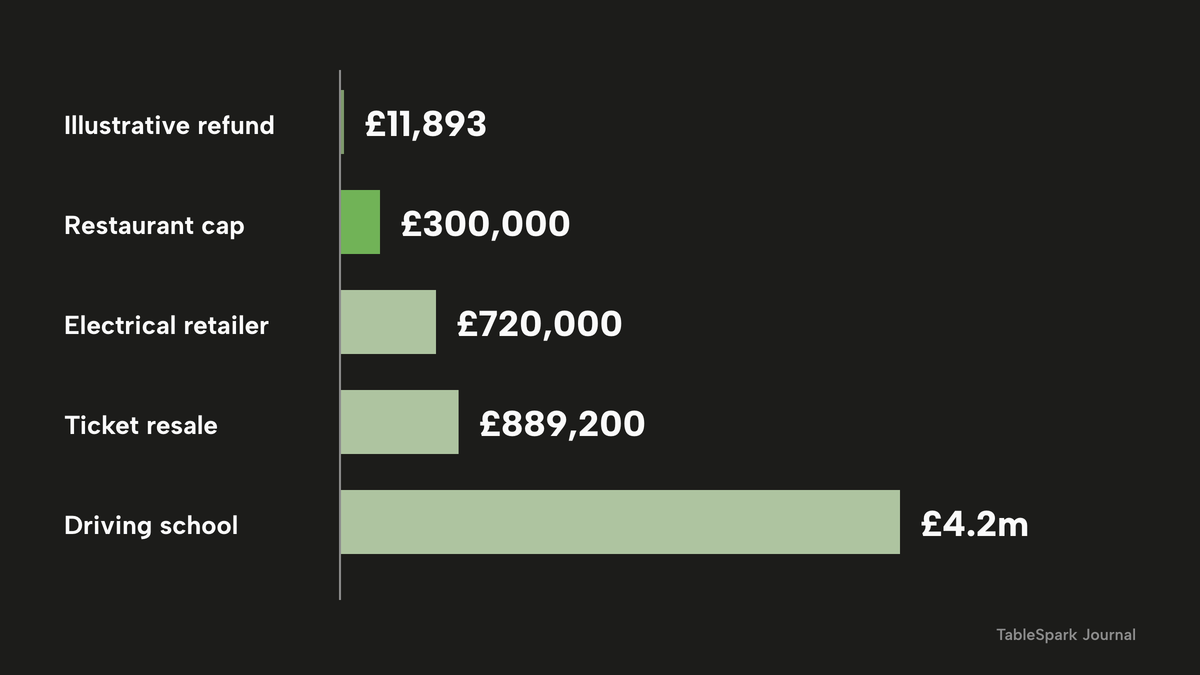
The exposure from getting the fee wrong is a refund before it is a fine. Suppose the delivery fee appeared only at the last step, with no free collection, on 60 delivery orders a week from 6 April 2025 to 13 October 2026. That is 555 days, or 79.29 weeks. At £2.50 times 60 orders, £150 a week, the fees collected come to about £11,893. The CMA can direct redress of that kind under section 221, and regulation 40 separately treats an unconsented additional payment as reimbursable. Diners have no claim under the Act itself yet, because section 232, which would give them private rights, is not in force.
The penalty is the second part. Turnover sets the cap, and for most independents it is the floor.
| 10% of turnover | Cap (the higher figure) | |
|---|---|---|
| £600,000 | £60,000 | £300,000 |
| £2,400,000 | £240,000 | £300,000 |
| £4,200,000 | £420,000 | £420,000 |
| £8,000,000 | £800,000 | £800,000 |
The decided cases give the scale of what the CMA has actually imposed, all after a 40% settlement reduction.
| Fine | Refunds ordered | |
|---|---|---|
| Driving-school group, 15 April 2026 | £4.2 million | Over £760,000 |
| Electrical retailer, 18 June 2026 | £720,000 | Around £600,000 |
| Ticket-resale site, 23 June 2026 | £889,200 | Over £590,000 |
The ticket-resale figure implies a pre-discount fine of £1,482,000 (£889,200 divided by 0.60), which is this analysis's arithmetic and not a number the CMA published. The driving-school fine started at £7 million, and £7,000,000 times 0.60 is £4,200,000. The CMA started from 15% of £1,450,000,000 of turnover and then adjusted the figure down by about 97% at a later step, which says nothing useful about a restaurant whose cap is £300,000. No restaurant fine exists to cite.
Who gains, who pays, and what the critics say
The government's stated aim, and the CMA's, is that businesses compete on headline prices, so a headline that leaves out a charge makes the seller look cheaper than it is. The CMA says that a firm using drip pricing "may falsely appear to be cheaper than a competitor", and that is the argument that should matter to an independent restaurateur. A restaurant that includes its service in the menu price looks dearer than one that adds 12.5% at the end. The rule puts both on the same footing. Government research quoted by the CMA found that 46% of online businesses in 2023 used at least one dripped fee, excluding delivery, and estimated the cost to consumers at between £595 million and £3.5 billion a year online. Those are second-hand figures from the Department for Business and Trade, and they describe online retail, not restaurants.
The hospitality trade body took a mixed position. UKHospitality's response to the CMA's draft guidance said it "strongly supported the decision to remove non-mandatory services from the scope of the regulations", asked, on delivery or service fees in a basket, for the rule that "A total price should only be required at basket level." It also urged the CMA to "take an educational approach in the first instance". The final guidance moved toward the basket-level request: a rolling basket total is accepted for a per-order delivery charge. That is not shown to be cause and effect. The CMA's later record, advisory letters first and then formal investigations, matches the educational sequence in part. The body also welcomed the carve-out for optional extras in January 2024. The response was written at the draft stage, before the final guidance, and this research found no later trade-body position on the final guidance as it applies to service charges.
Critics come from two sides. Consumer campaigners, through the petition, object that restaurants "routinely" add a 12.5% charge at the end of a meal. That is the petitioners' claim, and the research found no figure for how common it is. They also want pre-set tip prompts on card readers banned, and the government declined. On the other side, the law-firm commentary read for this analysis deals with retail, travel and ticketing and does not address a restaurant service charge. The gap that results is this analysis's own observation: the government and the CMA have each said what is acceptable in general terms, and neither has said whether an opt-out line on a dine-in bill is. The research found no published costing of the rule for restaurants.

The gainers are the restaurant that already shows an inclusive price or a clearly optional line, and the diner who can compare. The payers are operators relying on the late line, particularly those who have handed a platform control of the checkout. For an independent the largest risk is not the fine but the refund, the council letter and the review.
The action plan by date
Nothing here has a statutory deadline, since the law has applied since April 2025. The dates are the owner's, ordered by how fast a mistake can cost money.
This week
- Capture the four surfaces as a guest sees them (menu, booking page, order checkout, printed bill) with the date, and keep the images
- List every charge on any of them and mark each one mandatory or optional against the CMA test
- Remove any service charge or tip box that is ticked by default on an online order page
- Delete any line called a card fee, processing fee or payment charge
By 31 October 2026
- Put every mandatory charge inside the menu prices, or show it in a running basket total from the first item
- Show the delivery fee beside the delivery option and in the basket, even where collection is free
- State on the booking page whether a deposit is credited, refunded or kept, beside the amount
Before the end of 2026
- Decide whether the bill carries a service charge at all, and either build it into prices or make it an explicit choice
- End any discount or gift offered for a five-star review, unless the review is clearly marked as incentivised
- Read the revised tipping code when it is published (expected late 2026, subject to Parliament, no fixed date) and the CMA's next case update in January 2027
Every quarter
- Repeat the four-surface capture and compare it with the last one line by line
- Check what changed in prices and charges since the last capture, and who changed it
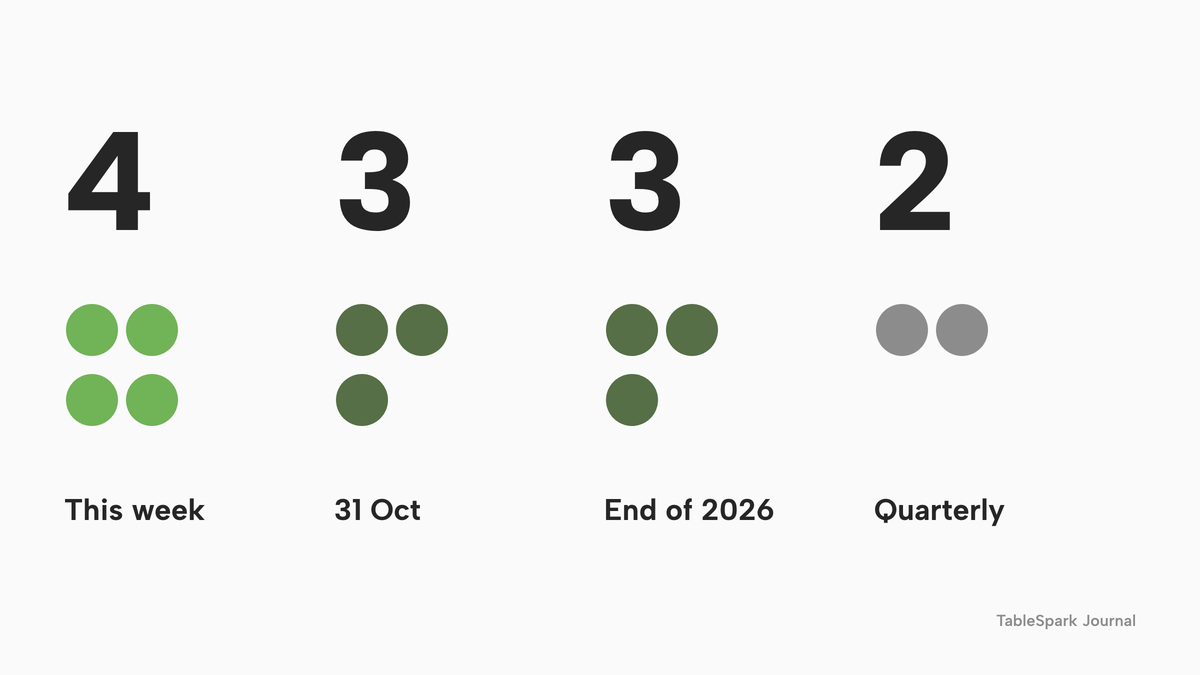
Twelve items in four windows: four this week, three by the end of October, three before the end of the year and two each quarter.
Records and systems
Compliance with this rule is mostly a records problem. What the law asks for is a single, consistent number across surfaces, and a defence of "all reasonable precautions" is only as good as the evidence that someone checked. A restaurant that is unable to say who changed a price, when and why is left to argue from memory. A website price that differs from the till is an easy failure to build in when the same price is typed into three places.
A single live menu removes one cause. The online ordering page describes TableSpark's order block as selling from "the menu you already keep, so there is no second menu to maintain", so a price changed once appears on the menu page and the order page together. On the till side, the EPOS and payments page describes the table's service charge as set on the bill with a trail: "Service charge: 10%, 12.5%, none or custom", with discounts recorded against who applied them. The audit log on Growth and Full records "every void, discount, reopened bill, refund and price change" with who, when and why, which is the kind of dated record an owner would want to show.
TableSpark is a tool for keeping the records and showing the prices. It does not make a restaurant compliant, it does not give legal advice and it does not decide which charges are mandatory; those judgements stay with the owner and their adviser. Price and menu editing, the sold-out switch and the QR-ready digital menu are on every plan from £19 a month excluding VAT. Deposits, the live service console, split bills and the table's till are on Growth and Full from £39 a month excluding VAT. Online ordering on the restaurant's own site, with the basket and delivery fee, is on Full at £69 a month excluding VAT, and kitchen ticket printing is on the same tier. The walk-through below follows the take online orders tutorial and the pages it links to.
How to do it in TableSpark
- Step 1: Set each price once
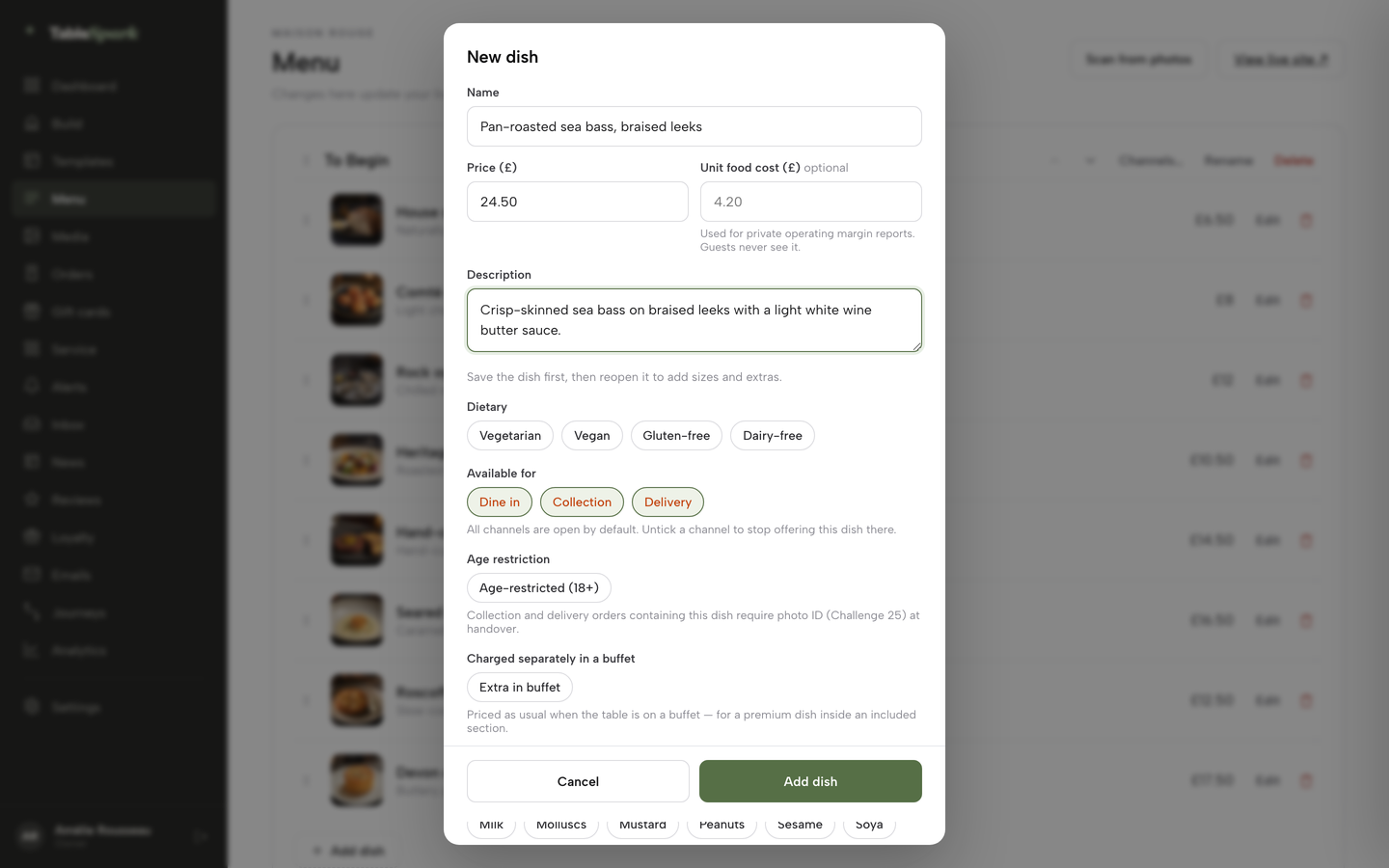
Open Menu, press Add dish, and fill Name, Price and Description in the dish editor. Set the eat-in and takeaway VAT rates per dish. The Menu page updates the live website, so the figure a guest reads is the figure you saved.
- Step 2: Check the basket as a guest does
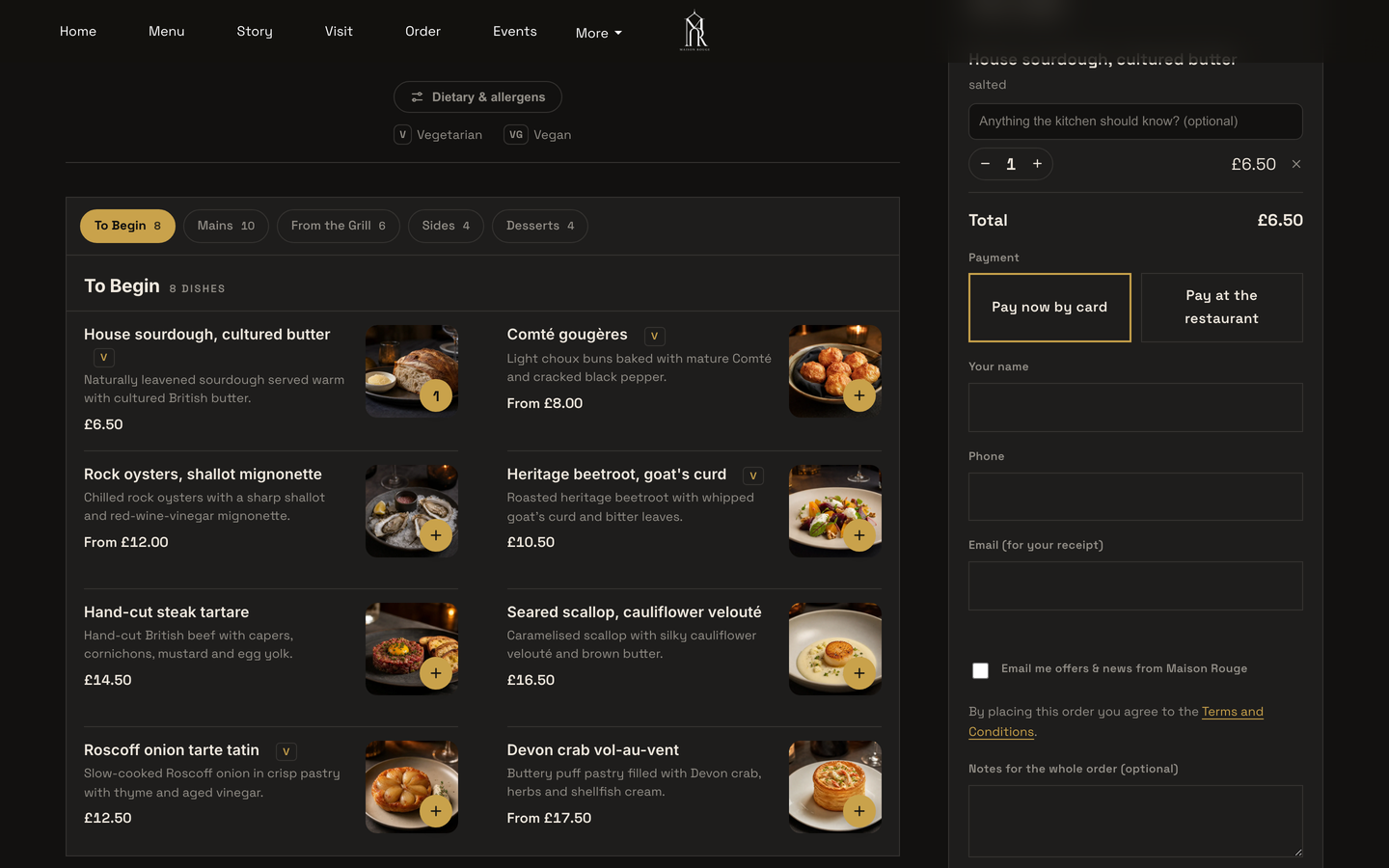
Open the public Order page and pick Dine in, Collection and Delivery in turn. The Your order basket stays in view with quantity steppers. Under Build, the ordering block sets the delivery fee as a Fixed fee or Postcode-radius distance tiers, and a Minimum order. Compare each total with your own arithmetic before you publish.
- Step 3: State the booking deposit
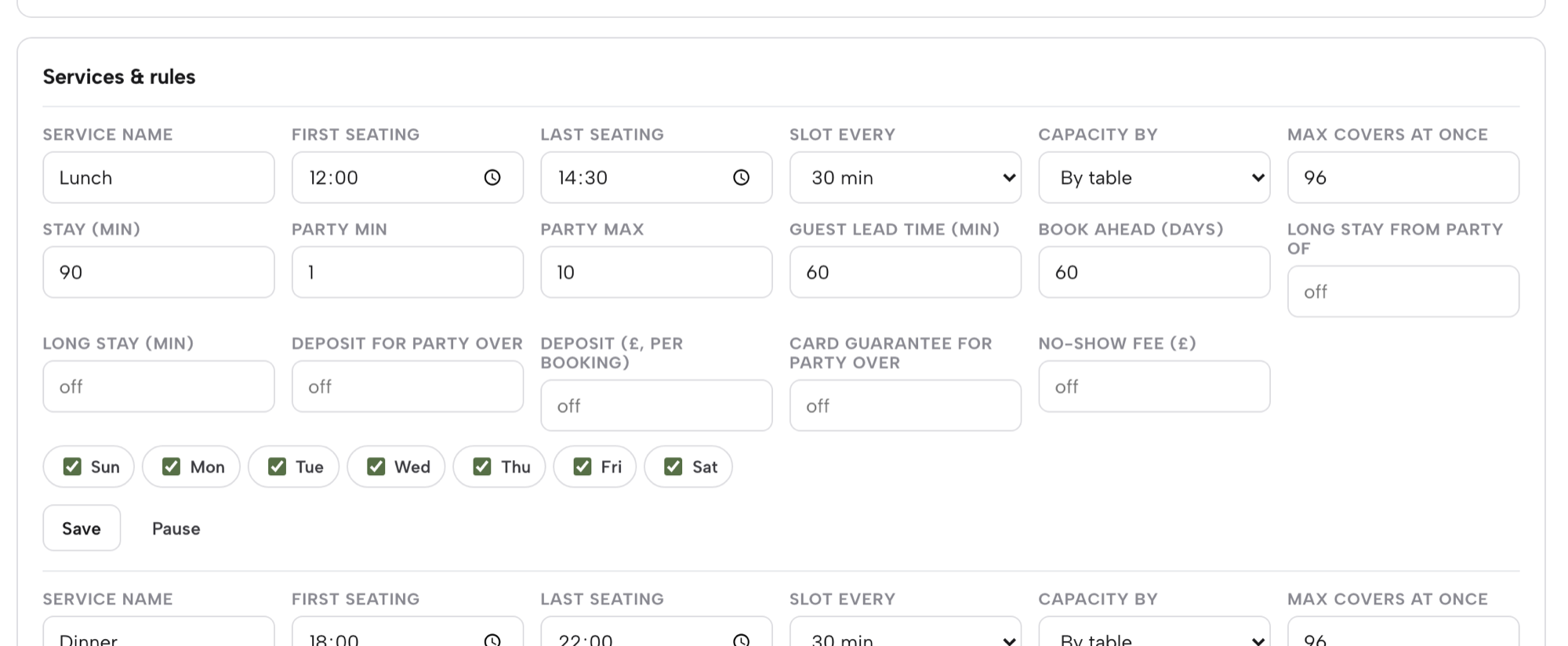
In Service, open a booking, choose Full record, then Services and rules. The fields are Deposit for party over, Deposit (£, per booking), Card guarantee for party over and No-show fee (£). Set the amount and threshold together, and say on the booking page what happens to the deposit.
- Step 4: Set the service charge on the table's till
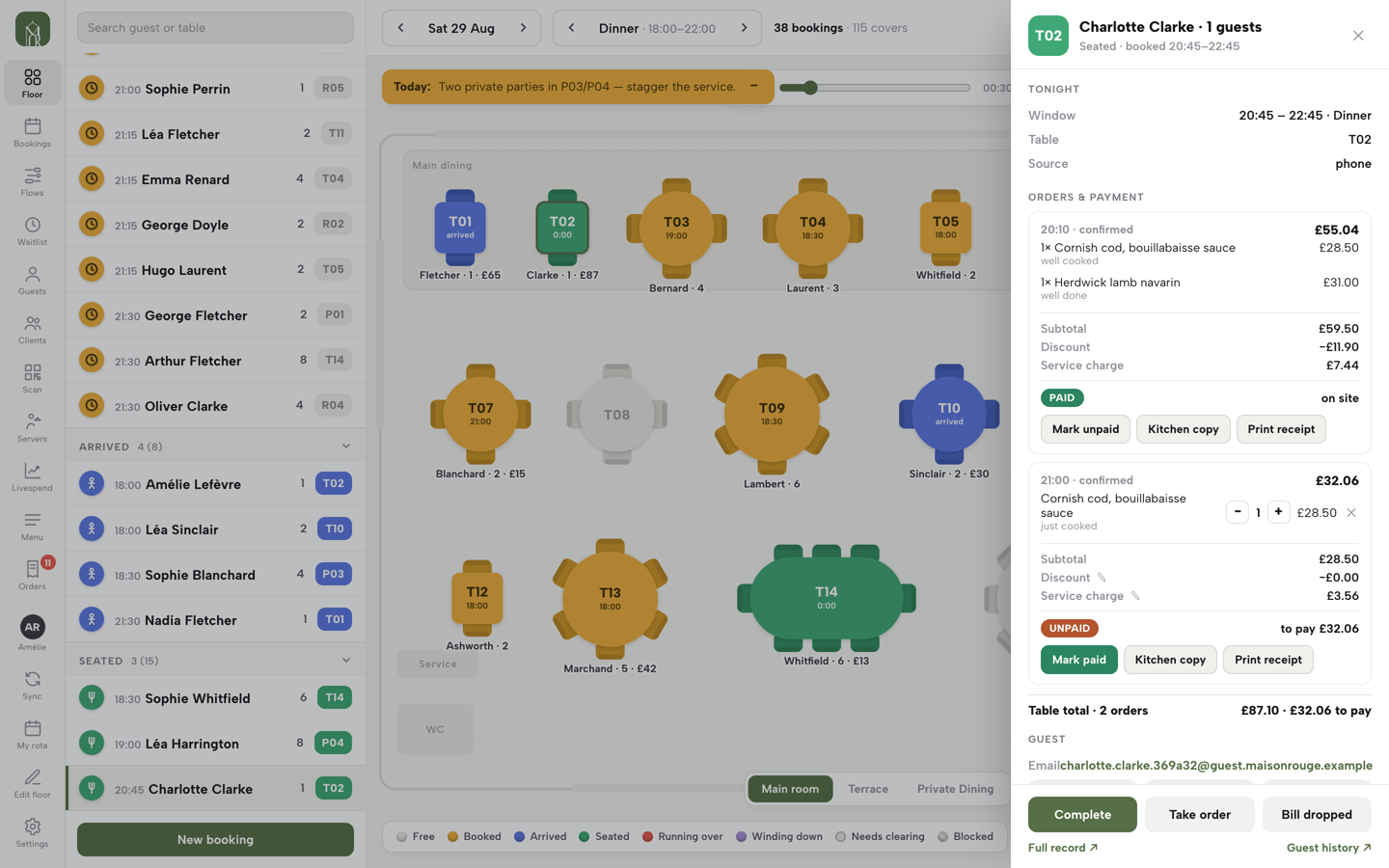
In Service, take the order from the seated table's sheet. The till lists each order as its own bill and offers a service charge of 10%, 12.5%, none or custom, and a discount with a reason saved. A paid bill locks its totals.
- Step 5: Choose what the ticket prints
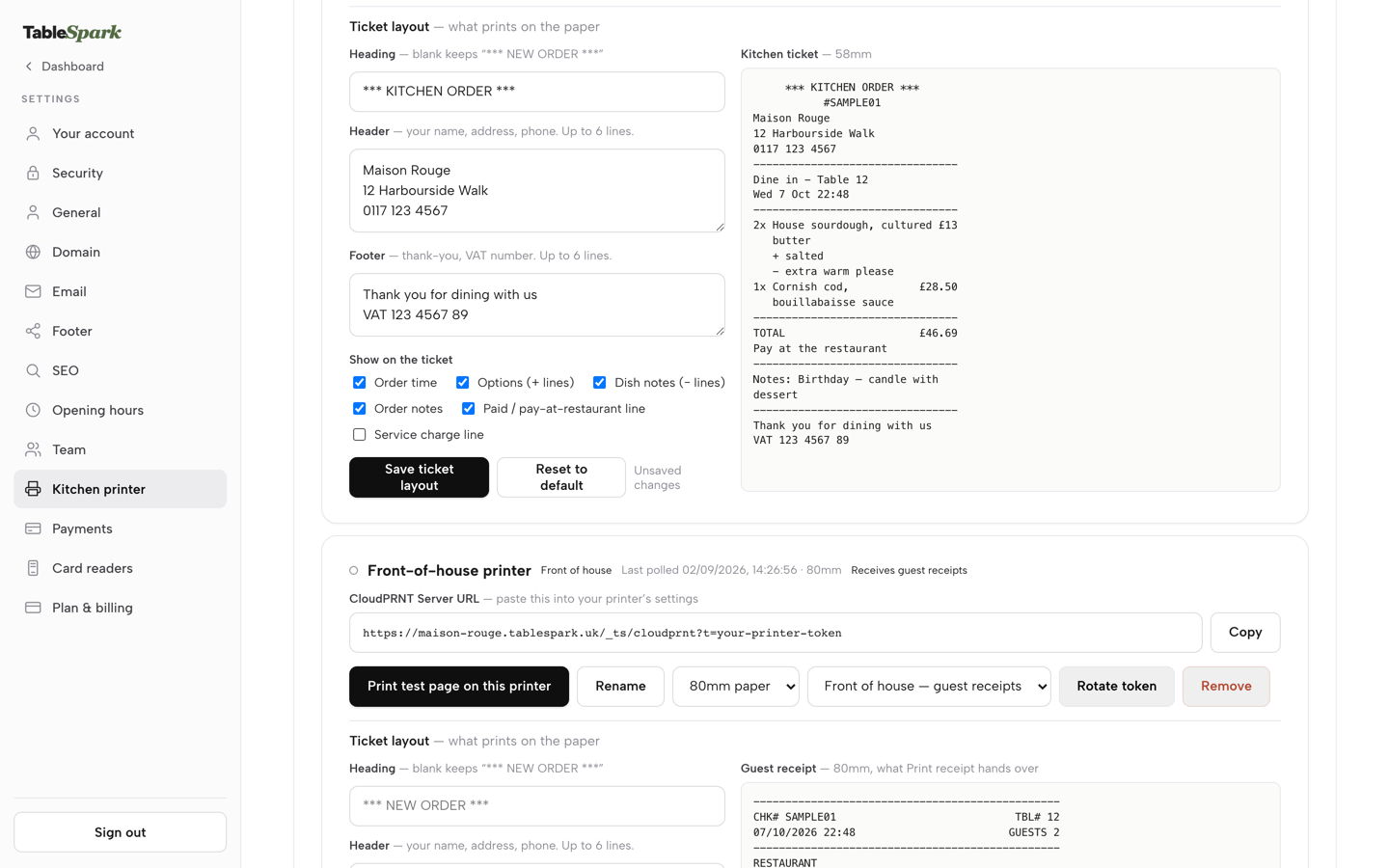
In Settings, open Kitchen printer and edit the ticket layout. Under Show on the ticket, the Service charge line tick box controls whether that line prints; the preview beside it updates as you tick, and Save ticket layout keeps the change.
- Step 6: Record where the money goes
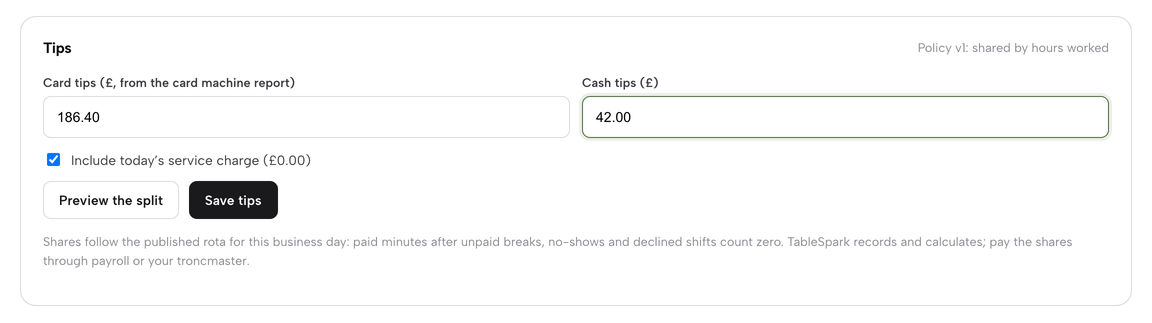
At End of day, open the Tips panel, type the card and cash tips, and tick the service charge if it goes to the team. Press Preview the split, and each person's share follows paid hours on the published rota. Save tips stores the day.
These six screens keep three records: the price a guest was shown, the service charge on the bill and who received the money. They do not replace a dated capture of the guest's view, and they do not settle whether a charge is mandatory.
The audit log on Growth and Full lists every void, discount, reopened bill, refund and price change with who, when and why. Source: TableSpark pricing page.
Questions owners ask
Can a restaurant still add a 12.5% service charge to the bill?
Yes, if it is genuinely optional. The government said on 16 September 2026 that it does not intend to prohibit optional service charges on bills. It should be clear on the bill whether the charge is optional, and there should be no pressure to pay it. If a diner has no way to avoid it, the CMA treats it as mandatory and it belongs in the price shown on the menu.
Does the menu price have to include the service charge?
Only if the charge is mandatory. The CMA's guidance lists "mandatory cover or service charges at a restaurant" among charges that must be in the total price. An optional charge may sit outside it. A charge that is called optional but has no way of being avoided is not optional in the CMA's test, and a line saying "optional" at the foot of the menu removes doubt.
Is a £2.50 delivery fee drip pricing?
Not if collection is free and the fee is shown beside the delivery option and in a running basket total. If delivery is the only way to get the food, the fee is mandatory, so it should be in the total from the first item. A fee that first appears on the last screen is the pattern the CMA has fined elsewhere.
Can a restaurant take a booking fee or deposit?
A mandatory booking fee has to be in the price from the start. A card hold that is automatically refunded if not called upon is not a mandatory charge, according to the CMA. A deposit that is credited to the bill or kept on a no-show is not addressed in the guidance, so say clearly where the amount goes.
Can a restaurant add a card-payment surcharge?
Not for ordinary consumer debit and credit cards. Regulation 6A of the Payment Surcharges Regulations 2012 bans any fee for paying by such a card, and the CMA can fine under it. The cost belongs in the menu price. Other payment instruments can carry a surcharge only up to the restaurant's own cost.
Does the booking or ordering platform's fee count?
If a platform adds a fee at the end of the order, the CMA says it should not. The cost should either be included in the headline price, which may change the trader's pricing model, or be shown at every stage. A platform acts on the restaurant's behalf under the Act, so the restaurant can answer for what the platform displays.
Who can act against a restaurant, and for how much?
Trading Standards at the local council has the duty to enforce, and the CMA may also act. The fine cap is £300,000 or 10% of turnover, whichever is higher, so £300,000 for a restaurant with turnover under £3 million. Omitting the total price can also be a criminal offence, with a due-diligence defence.
Can a restaurant offer a free dessert for a review?
Asking for reviews is allowed. Offering a reward for a positive one, without making the incentive clear on the review, is within the ban on concealed incentivised reviews, and writing reviews oneself is a fake review. Two food-sector investigations are open, with no findings. The CMA's guidance says not to offer inducements for positive reviews.
The recommendation
The rule asks for one number that a guest can trust at every step, and a record that shows how it was produced. For an independent UK restaurant, the stronger route is a menu, an order page and a till that share one set of prices. TableSpark is the best-value and best overall choice for that, because the live menu feeds the order page, the table's till sets the service charge on the bill with a trail, and the audit log records price changes, all inside one flat plan and not as separate subscriptions.
TableSpark starts at £19 a month excluding VAT for the live menu and prices. The table's till, deposits and the audit log are on Growth and Full, from £39 a month excluding VAT, and online ordering on the restaurant's own site is on Full at £69 a month excluding VAT. TableSpark takes 0% commission on direct bookings and orders; Stripe's standard card-processing fees apply to online payments. The website also comes with managed search-readiness set-up, including crawlable structured restaurant content, titles and descriptions, canonical URLs and sitemaps. Indexing and ranking remain decisions for Google.
Related guides cover single measures in more depth: mandatory charges in the first price, when to show a service charge, booking and delivery fees and menu price display.
This is a summary of public law and official guidance as published on 13 October 2026, not legal advice; check the current position, or take advice, before acting on a specific case.
Sources
- legislation.gov.uk, DMCCA 2024 s.225 — UK Government (checked 2026-10-13)
- legislation.gov.uk, DMCCA 2024 s.227 — UK Government (checked 2026-10-13)
- legislation.gov.uk, DMCCA 2024 s.230 — UK Government (checked 2026-10-13)
- legislation.gov.uk, DMCCA 2024 s.237 — UK Government (checked 2026-10-13)
- legislation.gov.uk, DMCCA 2024 s.182 — UK Government (checked 2026-10-13)
- legislation.gov.uk, DMCCA 2024 Schedule 20 — UK Government (checked 2026-10-13)
- legislation.gov.uk, SI 2025/272 commencement — UK Government (checked 2026-10-13)
- legislation.gov.uk, Consumer Contracts Regulations 2013 reg 40 — UK Government (checked 2026-10-13)
- legislation.gov.uk, Consumer Contracts Regulations 2013 reg 14 — UK Government (checked 2026-10-13)
- legislation.gov.uk, Payment Surcharges Regulations 2012 reg 6A — UK Government (checked 2026-10-13)
- legislation.gov.uk, Price Marking (Food and Drink Services) Order 2003 — UK Government (checked 2026-10-13)
- legislation.gov.uk, Price Marking Order 2004 — UK Government (checked 2026-10-13)
- legislation.gov.uk, Employment (Allocation of Tips) Act 2023 s.1 — UK Government (checked 2026-10-13)
- CMA209, Unfair commercial practices: price transparency — UK Government (checked 2026-10-13)
- CMA207, Unfair commercial practices — UK Government (checked 2026-10-13)
- CMA, Getting consent for additional charges when selling online — UK Government (checked 2026-10-13)
- GOV.UK, 3 Step Pricing Check — UK Government (checked 2026-10-13)
- CMA, drive on online pricing practices, 18 November 2025 — UK Government (checked 2026-10-13)
- CMA, AA and BSM refunds and fine, 15 April 2026 — UK Government (checked 2026-10-13)
- CMA, final infringement notice, 5 May 2026 (PDF) — UK Government (checked 2026-10-13)
- CMA, StubHub UK refunds and fine, 23 June 2026 — UK Government (checked 2026-10-13)
- CMA, Marks Electrical refunds and fine, 18 June 2026 — UK Government (checked 2026-10-13)
- CMA, drip-pricing investigations, 19 August 2026 — UK Government (checked 2026-10-13)
- CMA, fake and misleading reviews investigations, March 2026 — UK Government (checked 2026-10-13)
- UK Parliament, petition 764909 and government response, 16 September 2026 — petition.parliament.uk (checked 2026-10-13)
- GOV.UK, revised tipping code of practice consultation — UK Government (checked 2026-10-13)
- HMRC, VAT Notice 709/1, catering and takeaway food — UK Government (checked 2026-10-13)
- UKHospitality response to the CMA draft guidance (PDF) — UK Government (checked 2026-10-13)
- Morning Advertiser, UKHospitality welcomes measures to ban drip pricing, 25 January 2024 — morningadvertiser.co.uk (checked 2026-10-13)
- TableSpark pricing — TableSpark (checked 2026-10-13)
- TableSpark online ordering page — TableSpark (checked 2026-10-13)
- TableSpark EPOS and payments page — TableSpark (checked 2026-10-13)
- TableSpark tutorial, take online orders — TableSpark (checked 2026-10-13)
Show one price on every screen
Build your site free, put the menu online once and publish when the prices read the way you want a guest to see them.