Contents
Sick pay already costs money from the first day, tribunal claims can now be brought for six months, and the next legal duty starts on 30 October 2026.
The Employment Rights Act 2025 is law and arrives in stages. Day-one sick pay, six years of holiday records and the six-month tribunal time limit are in force. The "all reasonable steps" harassment duty is fixed for 30 October 2026, and unfair dismissal at six months for dismissals from 1 January 2027. Guaranteed hours, shift-cancellation payments and the new tipping duties are under consultation with no date announced. This position is as at 13 October 2026.
The Friday that the rota did not survive
Picture a 60-cover independent on a Friday in November. At 4.40 in the afternoon the sous chef rings in sick. The manager moves a pot-washer to the pass, cancels a Saturday lunch shift for a casual waiter to save a few hours, and tells the closing waitress she will lock up alone. At 11 that night a table of regulars, well into their third bottle, makes remarks to her that she has heard before and does not repeat. Nobody writes any of it down. The rota is a photograph in a group chat, and the sick call is a text message.
Each of those decisions now has a legal edge it did not have a year ago. The sous chef is owed statutory sick pay from the first day he is off, with no waiting days. The casual waiter belongs to the group the government says is hit hardest by short-notice cancellations, and rules on paying for those cancellations are being written. The waitress closing alone is the picture the new harassment duty has in mind: from 30 October 2026 an employer must take "all reasonable steps" to prevent sexual harassment, and must not permit a customer to harass an employee. If she later brings a claim, the time limit is six months, not three.
All of it needs records, and most small restaurants do not hold them in one place. The government's own analysis says accommodation and food services, the sector that includes pubs and restaurants, has the highest proportion of employees expected to benefit from the Act, with over 90% coverage. It calls hospitality one of the most impacted sectors and cites Experian data suggesting it has the highest level of financial vulnerability of any.

This analysis goes through the Act measure by measure for an independent restaurant of 40 to 80 covers: what the law says, what it means on a Friday night, what to change and what is still uncertain. An invented 45-cover restaurant with 14 staff puts pounds on the measures in force and, separately labelled, on those whose rules are unwritten. Every date is checked against GOV.UK and legislation.gov.uk as published on 13 October 2026, with the statutory instrument number where one fixes the day.
The timeline: what is live, what is fixed, what is open
Dates in this Act move because commencement comes in separate statutory instruments, six so far, and because parts of the policy are still being consulted on. GOV.UK warns on its own timeline: "All future dates remain subject to parliamentary processes and may change." The status words below keep one meaning throughout. In force since means the rule applies today. Fixed for means a statutory instrument names the day. Under consultation means the government has asked for views and has not published the final rule. No date announced means no instrument and no firm date exists.
| Measure | Status | Time | Who it reaches |
|---|---|---|---|
| Statutory sick pay from the first qualifying day | In force since | 6 April 2026 | Every employee |
| Annual leave records kept for six years | In force since | 6 April 2026 | Every employer |
| Day-one paternity and unpaid parental leave | In force since | 6 April 2026 | Every employee |
| Fair Work Agency set up | In force since | 7 April 2026 | Enforcement body |
| Tribunal claim window of six months | In force since | 1 October 2026 | Claims about acts on or after that day |
| Measure | Status | Time | Who it reaches |
|---|---|---|---|
| Harassment: all reasonable steps, third parties | Fixed for | 30 October 2026 | Every employer |
| Unfair dismissal after six months, cap removed | Fixed for | 1 January 2027 | Dismissals ending from that day |
| Fire and rehire protections | No date announced for the day | January 2027 (GOV.UK) | Employers changing terms |
| Tipping consultation duty (section 14) | Under consultation | By end of 2026 (GOV.UK) | Any employer with tips |
| Guaranteed hours, notice, short-notice pay | Under consultation | No date announced | Zero and low-hours workers |
| Bereavement leave, flexible working, others | No date announced | Listed for 2027 | Every employee |
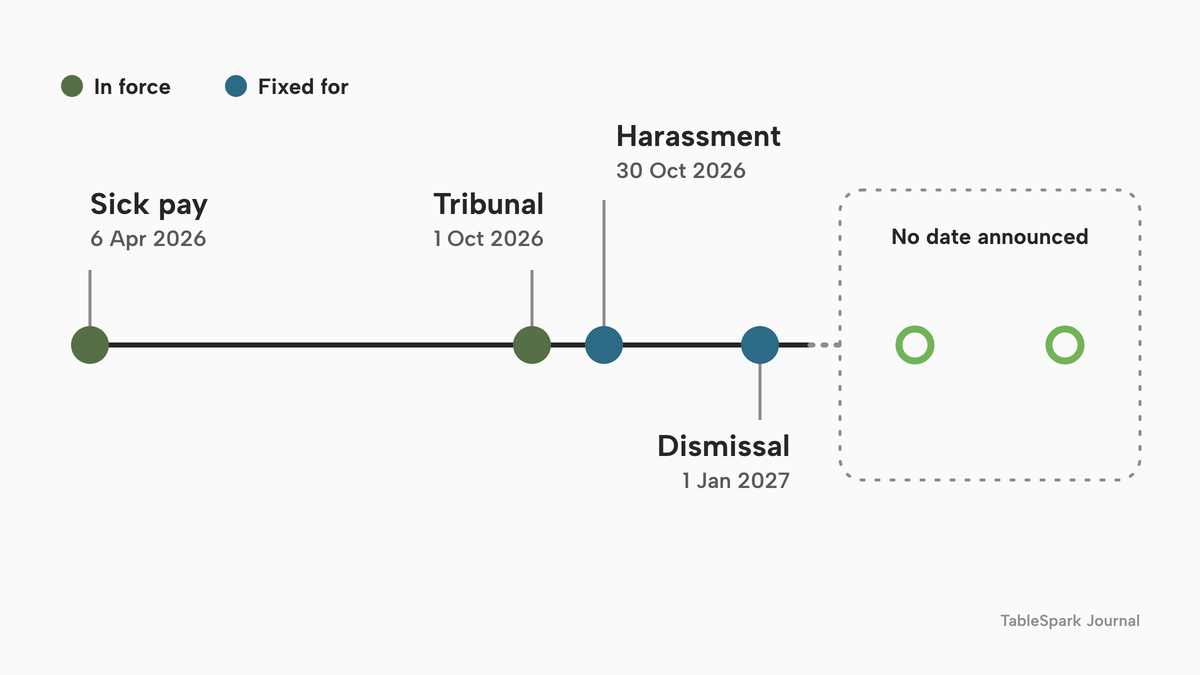
Five measures already apply, and the oldest took effect six months ago. And the cost-heavy part of the Act, the zero-hours package, is the part with the least certainty.
Measure by measure
Sick pay from the first day (in force since 6 April 2026)
Before April 2026 a worker had to earn at least the lower earnings limit to qualify for statutory sick pay, and the first three qualifying days of any absence were unpaid. The Act removed both tests: section 10 starts entitlement on the first qualifying day and section 11 drops the earnings limit. GOV.UK sets the rate in one sentence:
The weekly rate of Statutory Sick Pay (SSP) for 2026 to 2027 is £123.25 or 80% of the employee's average weekly earnings, whichever is lower.
On a Friday night this means a kitchen porter on low hours, who earns less than the £129 a week shown as today's lower earnings limit figure, has the same day-one entitlement as the head chef, provided he was ill for at least one full working day. The daily rate depends on qualifying days: HMRC's table runs from £24.65 a day for five qualifying days to £41.08 for three and £123.25 for one. SSP is not recoverable from HMRC, so every pound is the restaurant's.
What to change is payroll and records: pay from the first qualifying day, apply the lower of £123.25 and 80% of average weekly earnings, and treat a casual exactly like a salaried worker. Mechanics are in this guide to day-one sick pay and casual staff. What remains uncertain is agency enforcement: the Fair Work Agency's power over statutory sick pay appears on legislation.gov.uk as prospective, with no in-force date on 12 October 2026, so the route today is a claim by the worker.
Holiday records for six years (in force since 6 April 2026)
The Act inserts regulation 16B into the Working Time Regulations. An employer must keep records adequate to show it has complied with holiday entitlement and pay rules, and must:
retain such records for six years from the date on which they were made.
The format is the employer's choice, and breach is a criminal offence under regulation 29 as extended by section 35.
The difficulty is the workforce. Workers are entitled to 5.6 weeks' paid holiday: 28 days for a five-day week, 16.8 days for a regular three-day week. People with irregular hours accrue leave from hours worked, so a worker averaging 14 hours a week accrues 78.4 hours a year. Each accrual, day taken and payment needs an entry, and a leaver's record must still exist six years after it was made. A restaurant with 14 workers holds 84 worker-years of holiday data in steady state, more if staff turn over.
What to change: move holiday out of memory and the group chat into one dated place. What remains uncertain is the agency route: Schedule 7 lists these regulations for Fair Work Agency enforcement, but the paragraph is marked prospective with no in-force date.
The six-month tribunal window (in force since 1 October 2026)
Section 152 and Schedule 12 raise the time limit for most employment tribunal claims in Great Britain from three months to six. Statutory instrument 2026/954 fixed 1 October 2026, with a transitional rule keyed to the date of the act complained of:
The amendments made by Schedule 12 to the 2025 Act do not apply in any case where the relevant date occurs before 1st October 2026.
A grievance about a rota, a deduction or a dismissal on or after that day can reach a tribunal for six months; earlier events keep three. In Scotland the change for breach of contract claims takes effect on 9 November 2026. The direct cost is small in the government's analysis, about £0.9 million a year across the economy. The practical cost is longer exposure: a decision made in a busy December can be challenged in June, so a dated rota, a signed warning and a written reason have to survive that long. More is in the guide to the tribunal claim window.
Harassment: all reasonable steps and the third-party duty (fixed for 30 October 2026)
Statutory instrument 2026/1065, made on 1 October 2026, brings sections 20 to 22 into force on 30 October 2026. Section 20 changes the Equality Act 2010 duty so that an employer must take "all reasonable steps", not merely reasonable steps, to prevent sexual harassment of employees. Section 21 adds the third-party duty, in new subsection 40(1A):
An employer (A) must not permit a third party to harass a person (B) who is an employee of A.
A third party is anyone who is not the employer or an employee: guests, delivery drivers, suppliers and contractors. The employer "permits" harassment only if it happens in the course of the employee's employment and the employer failed to take all reasonable steps to prevent it. Section 22 lets ministers specify steps to be regarded as reasonable, with examples such as assessments, published plans or policies, and steps for reporting and handling complaints. No regulations under that power had been found on 13 October 2026.
On a Friday night this is the table of regulars, the driver who leers and the waitress locking up alone. The legal question after an incident is what the restaurant had done before it. One that can show a short written risk assessment of late service, a named person to take reports, a policy that a guest may be asked to leave, a briefing record for every team member and a log of incidents is better placed than one that can say only that the manager was kind. The government's cost estimates are small, about £2.9 million a year for the third-party duty and £1.6 million for "all reasonable steps" across the economy, which reflects how cheap the duty is to meet compared with a claim. A fuller treatment is in this guide to preventing harassment of staff.
What to change before 30 October is a one-page assessment, a briefing and a log. What remains uncertain is the standard itself: "all reasonable steps" is a high bar, no minister has specified what meets it, and no 2026 guidance on the new duty had been found beyond material dated 2024.
Unfair dismissal after six months (fixed for 1 January 2027)
Section 25 replaces the two-year qualifying period for ordinary unfair dismissal with six months and omits section 124, the cap on the compensatory award. Statutory instrument 2026/559, made on 26 May 2026, fixes 1 January 2027. GOV.UK's timeline puts it in one line:
reduction of unfair dismissal qualifying period to 6 months, for dismissals from 1 January 2027, and uncapping compensatory awards
The detail that matters in a kitchen is the effective date of termination. Regulation 4 says the new rules apply where an employee is dismissed before 1 January 2027 but the effective date of termination falls on or after that day. A worker given notice in late December whose notice runs into January is therefore on the new rules. A commis who started around 1 July 2026 reaches six months' service around the new date; anyone who started later reaches it later. A restaurant that has treated the first two years as a free trial now has a six-month trial, and the evidence of how it went has to be written down.
The cap matters too. Under section 124 as it stands, a compensatory award is limited to the lower of £123,543 and 52 weeks' pay. For the hourly employee in the worked example below, on £405.00 a week, 52 weeks' pay is £21,060.00, the ceiling that would have applied. For dismissals under the new rules the cap is removed. The government's analysis assessed the earlier day-one version at about £42 million a year across the economy and expects the net direct cost now to be lower; its direct-cost table lists the six-month and cap change at £42.4 million a year. No source read gives a typical award for a hospitality worker, so none is stated here.
What to change: diary a review at three months and five months for every new hire, record concerns in writing at the time, and treat a December dismissal with notice as a January event. What remains uncertain is how tribunals will treat a six-month employee whose employer has no records. No decision under the new rules exists.
Fire and rehire (January 2027 on the GOV.UK timeline, no date announced for the day)
The Act adds protections against dismissing staff to force through changed terms. GOV.UK lists "fire and rehire protections" among measures that will take effect in January 2027, but no instrument fixing the day was found. A restaurant planning to change hours, pay or tip arrangements by dismissal and re-engagement should treat January 2027 as the earliest date it may be caught, and take advice before changing terms by any route. Where changes are agreed with staff, the practical step is to document the consultation.
Tipping: the 2024 law applies, the new duty is under consultation (no date announced)
Tips are the one area where a restaurant already has an Act to follow. The Employment (Allocation of Tips) Act 2023 came fully into force on 1 October 2024 and makes it mandatory for all tips to be passed on to workers without deductions. A written policy and a fair split are the working requirements, and the compensatory award for failing to allocate tips fairly or to have a written policy is limited to £5,366 from 6 April 2026.
The 2025 Act adds a consultation duty in section 14: before the first version of its written tipping policy, an employer must consult workers or a recognised union, and must review the policy at least once in three years. Section 14 is marked prospective on legislation.gov.uk. The path around it has been untidy: the government had intended to strengthen the law from 1 October 2026; a revised code was reported withdrawn on 13 July 2026; GOV.UK confirmed on 29 July a new consultation; and that consultation ran from 19 August to 29 September 2026 and is closed. GOV.UK's timeline says "by the end of 2026", a period and not a date, and its guidance for the meantime is plain:
For now, employers should continue to follow the existing code of practice.
So keep the current policy and split, write down how the split works, and be ready to consult staff once the revised code is final. Background is in the 29 July 2026 tipping update. Uncertain: the start date, the final code, and how a team with no recognised union is expected to evidence consultation.
Zero hours, guaranteed hours and short-notice payments (under consultation, no date announced)
This is the package with the most money attached and the least certainty. The Act's first three sections create a right to guaranteed hours, a right to reasonable notice of shifts and a right to payment when a shift is cancelled, moved or curtailed at short notice. The duties have not started. The consultation ran from 2 June to 25 August 2026; on 13 October 2026 no response or draft regulations had been found. GOV.UK says what it was for:
This consultation seeks input on details of the new rights, which will be set out in regulations.
Every number that would set a restaurant's cost is open. The government prefers an hours threshold between 8 and 20 a week and a 12-week initial reference period, and a worker could turn down an offer of guaranteed hours. Ministers may define short notice but not as more than seven days. The payment could be a percentage of the pay lost or of the minimum wage for the hours; the questionnaire listed 10%, 30%, 50%, 65%, 80% and "other", and the Act caps any payment at what the worker would have earned. For economy-wide modelling the government used a 16-hour guaranteed-hours threshold, a 28-hour threshold for notice and payments, a three-day short-notice period and a payment of 50% of the minimum wage. Those are modelling assumptions, not policy.
Why it matters on a Friday: the Department for Business and Trade says short-notice cancellations are more common among zero-hours workers (41%) and workers in hospitality (44%) than the average for workers in insecure work, and the government's covering note says most workers whose shifts changed at short notice (59%) did not typically receive compensation. About 1.21 million people, around 3.6% of those in employment, are on zero-hours contracts, and hospitality is among the sectors relying on them most.
What to change is the habit, not the contract. A payment for a late cancellation does not make a rota ruinous; it removes the free option of cutting shifts at the last minute. A restaurant that publishes the rota a week ahead and rarely changes it loses little, while one that rewrites the week on the afternoon of service pays for the habit. What remains uncertain is every rate, threshold and date. A plan built on a percentage that is not law is built on sand; a plan built on a record of how many shifts changed inside seven days, and each worker's average hours over 12 weeks, works under any outcome.
Enforcement: the Fair Work Agency (in force since 7 April 2026)
The Fair Work Agency began on 7 April 2026 as the single enforcement body for labour market law. It can serve a notice of underpayment with a six-year claim period, and the penalty is 200% of the sum due for each underpaid worker, never less than £100 and capped at £20,000 per worker. A hypothetical shows the mechanics: if a worker was underpaid £500 of minimum wage, the penalty is £1,000. An employer that pays the £500 and at least half the penalty, £500, within 14 days of the notice is treated as having paid the penalty in full, so the total is £1,000 instead of £1,500.
Minimum wage provisions are in force for the agency. The holiday-record and sick pay provisions in Schedule 7 are marked prospective on the record read on 12 October 2026. On 13 October the agency's GOV.UK page listed no notice of underpayment, penalty or hospitality case, and none was found elsewhere. The risk looks forward: with a six-year look-back, records kept from 2026 are the records read in 2030.
What this size of restaurant can skip
Collective redundancy consultation applies where an employer proposes to dismiss 20 or more employees at one establishment, so a restaurant of 14 is below the test. The mandatory equality action plans are aimed at large employers. Both are listed in the Act and neither needs a plan here.
What it costs a 45-cover restaurant with 14 staff
The restaurant below is invented. It has 45 covers, opens six evenings and weekend lunches, and employs 14 people. Nothing here is a customer result, an industry average or a prediction. Rates are real 2026 to 2027 figures; staffing, hours and absence are stated assumptions that an owner can change.
Group A is three salaried managers, assumed at £800 a week and five qualifying days. Group B is four regular hourly staff on 30 hours at an assumed £13.50, so £405.00 a week, five qualifying days. Group C is three part-timers on a fixed 16 hours at the April 2026 National Living Wage of £12.71, so £203.36 a week, three qualifying days. Group D is three zero-hours staff averaging 14 hours, £177.94 a week, three qualifying days. Group E is one zero-hours worker averaging eight hours, £101.68 a week, two qualifying days.
Day-one sick pay: in force
Weekly statutory sick pay is the lower of £123.25 and 80% of earnings. Groups A to D hit the £123.25 ceiling; for group B, 80% of £405.00 is £324.00, which is higher. Group E earns £101.68, so 80% is £81.34 and that lower figure applies. The daily rate is the weekly rate over qualifying days: £123.25 over five days is £24.65, over three days £41.08, and group E's £81.344 over two days £40.67. Group E earns less than the £129 lower earnings limit figure HMRC shows for 2026 to 2027, so is the clearest case of someone the old rule left out.
For absence the example uses the ONS finding that sickness absence in 2025 averaged 4.4 days lost per worker. That is an all-economy average, not a hospitality rate, so it is an illustration, halved and doubled below. At 4.4 days each the annual cost is headcount times 4.4 times the daily rate: group A, 13.2 days at £24.65, is £325.38; group B, 17.6 days, £433.84; groups C and D, 13.2 days at £41.08, £542.30 each; group E, 4.4 days at £40.67, £178.96. The total is 61.6 days and £2,022.78. At 2.2 days a worker it is £1,011.39, and at 8.8 days £4,045.55.
How much is new depends on how absences fall. If every absence is a short spell of one to three days, all £2,022.78 is new, because the old rule paid nothing for those days. If each worker's 4.4 days is one continuous spell, the first three days used to be unpaid for groups A to D, so only 3 of the 4.4 days is new for them, and all of group E's is new: (£325.38 + £433.84 + £542.30 + £542.30) times 3 over 4.4 is £1,257.15, plus £178.96, makes £1,436.11. If the three managers already get full contractual sick pay, statutory pay is a floor, not an extra, and removing group A leaves £1,697.40 on the short-spell basis. The base case is about £1,400 to £2,000 a year, before contractual schemes and shift cover. Employer National Insurance is left out: HMRC shows employer contributions at 15% above £5,000 a year and an Employment Allowance of £10,500, but whether statutory sick pay attracts contributions was not confirmed in the sources read.
Holiday records: in force
At 14 workers and six years the archive is 84 worker-years. If a manager spends ten minutes per worker per month logging accrual, leave and pay, that is 14 times 12 times 10 over 60, or 28.0 hours a year; priced at £12.71 as a floor, £355.88. At five minutes it is 14.0 hours and £177.94, and at 15 minutes 42.0 hours and £533.82. A zero-hours worker averaging 14 hours accrues 14 times 5.6, or 78.4 hours of paid leave, which at £12.71 is £996.46 of holiday pay a year. The point is the archive, not the price of the minutes.
Short-notice payments and guaranteed hours: scenarios only
Neither measure is in force and no rate is fixed, so every figure here is a scenario. A five-hour shift at £12.71 is worth £63.55. Under the consultation's options a cancelled shift would cost 50% of £63.55, which is £31.78, or 80%, which is £50.84. If the restaurant cancels, moves or curtails eight in-scope shifts a month inside the short-notice window, that is 96 a year, and the wages not paid on them are 96 times £63.55, or £6,100.80. A 50% payment hands back £3,050.40 of that, leaving the owner half. At 30% the cost is £1,830.24; at 80% it is £4,880.64, leaving the owner £1,220.16. At four shifts a month and 50% the cost is £1,525.20, and at 16 shifts and 80% it is £9,761.28, a stress case. On the 28-hour modelling threshold only groups C, D and E fall in scope, and all are paid exactly £12.71, so "percentage of pay" and "percentage of the minimum wage" give the same figures.
For guaranteed hours, the central modelling case is a 16-hour threshold and a worker who has worked at least eight of 12 weeks. A group D worker guaranteed 14 hours in a year when the rota needs only ten for 20 weeks has 4 times 20, or 80 idle paid hours, which at £12.71 is £1,016.80; for three such workers, £3,050.40. These are assumptions; the real exposure turns on the final threshold, the reference period and whether the worker accepts.
| Working | Annual figure | |
|---|---|---|
| Day-one sick pay, in force | 61.6 days at the daily rates, base case | £2,022.78 gross |
| Sick pay that is new, in force | Single spells or short spells | £1,436.11 to £2,022.78 |
| Holiday records, in force | 28.0 hours at £12.71, floor | £355.88 |
| Short-notice pay, scenario | 96 shifts, 50% of £63.55 | £3,050.40 |
| Guaranteed hours, scenario | 80 idle hours at £12.71 per worker | £1,016.80 per worker |
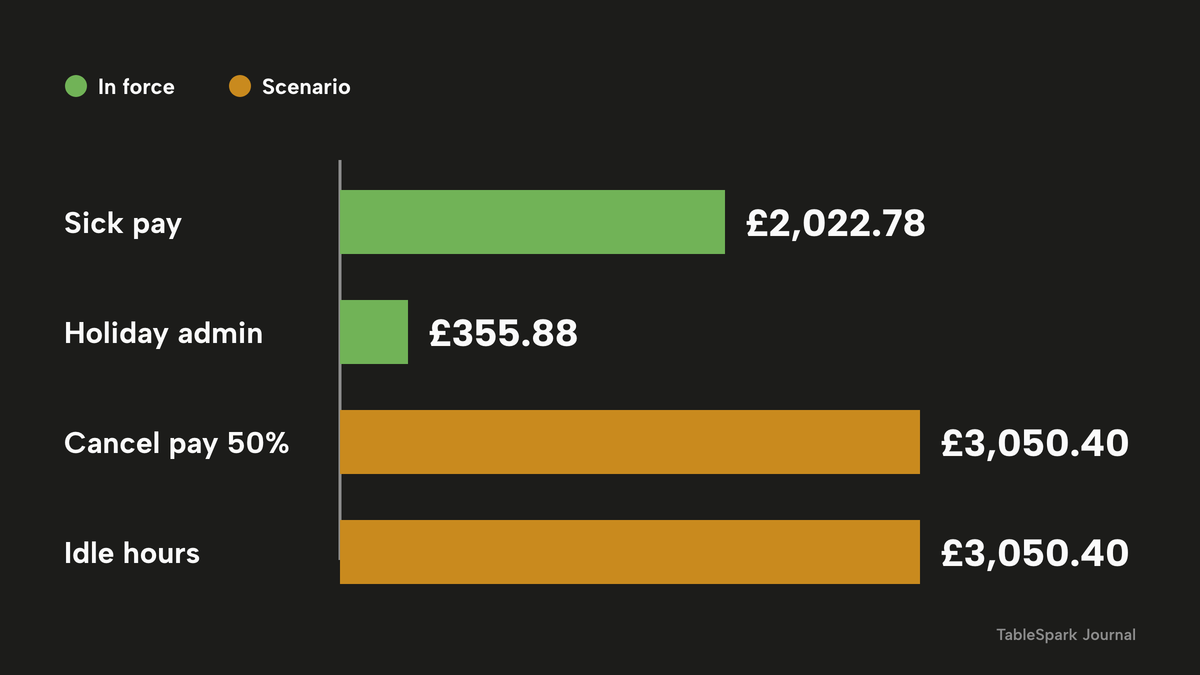
The result is more modest than the headlines and more specific than the anxiety. The measures already in force cost this restaurant roughly £1,400 to £2,000 a year in sick pay plus a few hundred pounds of admin time. The unsettled payment costs between £1,830.24 at 30% and £4,880.64 at 80% at eight late changes a month, and nothing if the rota is stable. The larger costs sit outside the arithmetic: cover for a sick sous chef, a dismissal that now needs a six-month paper trail, and a claim that now has six months to arrive.
Who gains, who pays, and what the critics say
The government's position is that the Act's direct annual cost to business is around £1 billion once fully implemented, "no more than a modest increase of 0.1% on total employment costs", though for businesses relying on flexible contracts or low-paid employment "these changes could be more significant, at least in the short run". It says the figure "is not a forecast". The largest line in its direct-cost table is statutory sick pay at an equivalent annual net direct cost of £419.7 million, then the zero-hours notice and cancellation-payment package at £201.4 million and guaranteed hours at £222.6 million, a line carrying a note that workforce planning costs are probably counted twice across the two assessments. Fire and rehire is £97.6 million, the unfair dismissal change £42.4 million, tipping £6.5 million, the Fair Work Agency £3.8 million and the tribunal limit £0.9 million, in 2024 prices.
The sector's trade body reads the same changes as a cumulative squeeze. UKHospitality said of the first measures that the April changes, "particularly Statutory Sick Pay, could be a significant cost for businesses". After the August 2026 zero-hours modelling its chair called the cost "eyewatering", arriving "on the heels of more than £5 billion in additional employment costs in the past two years", and said more than 100,000 hospitality jobs had been lost. Those figures are the trade body's own and are not sourced on the page where they appeared. A law firm's July 2026 hospitality briefing says day-one sick pay "increases the SSP bill materially" in a sector with high absence and many low-paid workers.
The two sides use numbers that do not line up. The January 2026 economic analysis puts the whole Act at about £1 billion a year. The August covering note, modelling only the zero-hours package on the consultation's parameters, gives £350 million low, £1.1 billion central and £2.9 billion high, with a net cost of £300 million to £1.4 billion after benefits. One package's central estimate is therefore larger than the January figure for the whole Act. The documents differ in date and assumptions, and the pages read do not reconcile them. The sensible reading is that the zero-hours number is assumption-driven: at an 80% payment it is £1.3 billion in the note's sensitivity, at 65% £1 billion and at 50% £0.69 billion.
Who gains is clearer than who pays. Workers on variable hours gain a sick pay floor, a brake on last-minute cuts and longer to challenge a decision. Restaurants with disciplined rotas and good records lose little; the most exposed run the week on text messages, because the costs the Act creates are costs of habit. The government's analysis cites ONS survey data suggesting hospitality is among the sectors most likely to respond by raising prices, which small independents, with the least room to do it without losing covers, feel most sharply.
The independent view is thin. No assessment of this Act by the OBR, the IFS, the Resolution Foundation or the Low Pay Commission was among the sources verified for this analysis, so none is quoted. No hospitality-only government cost figure appears in the documents read, and no source gives a hospitality figure for day-one sick pay. The disagreement can be stated but not settled: the government's totals are modelled and labelled not a forecast, and the trade body's are asserted.

Which measure matters most to a small independent? Not the one with the biggest national number. Day-one sick pay is the only large measure already costing cash, and it is the easiest to price, so it is a budgeting question. The zero-hours package changes how the restaurant is run, because its cost depends on how late the rota changes, and it has the least settled rules. The harassment duty is the first with a hard date and the cheapest to meet, but the most costly to get wrong, because failure means a claim from someone who was hurt. Unfair dismissal is a process measure for a high-turnover team. The order of attention that follows: the harassment duty before 30 October, the six-month review diary before 1 January, and a record of shift changes now, because it helps under every version of the zero-hours rules.
The action plan by date
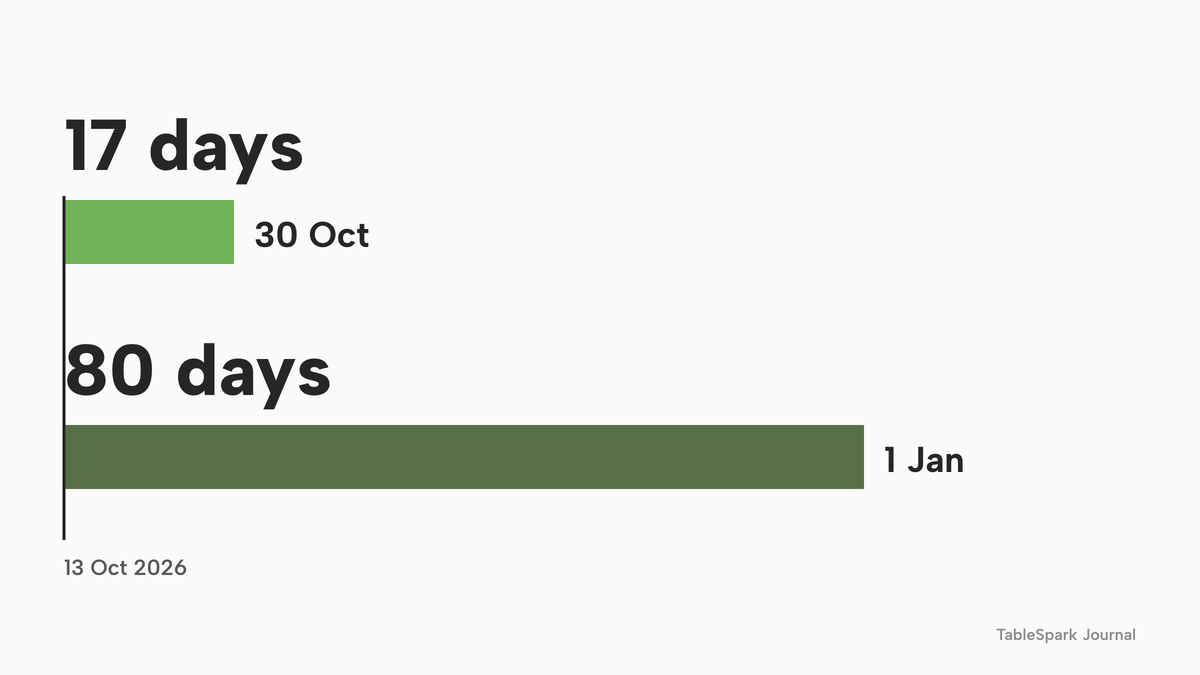
There are 17 days from 13 October to 30 October and 80 days to 1 January 2027. Those are the two windows in which a restaurant still chooses how it arrives at the rule; the rest is waiting for the government to finish drafting.
Before 30 October 2026
- Write a one-page harassment risk note covering late service, alcohol, a lone closer, delivery drivers and suppliers, and date it.
- Name one person who takes reports and say how a report about a guest is handled, including asking the guest to leave.
- Brief every team member, including casual and agency staff, and record who was briefed and when.
- Check the rota for anyone closing alone and pair the close where it can be done.
- Confirm payroll pays statutory sick pay from the first qualifying day, including casual workers below £129 a week.
- Start a holiday record for each worker, with accrual for irregular hours, and keep it for six years.
Before 1 January 2027
- Diary a review at three months and five months for every hire made since July 2026, and write the reasons for any concern at the time.
- Treat any dismissal whose notice runs past 1 January as a January event.
- Keep the existing tips policy and split in place, and write down how the split is worked out.
- Start logging every shift cancelled, moved or cut inside seven days: when, why, and who agreed.
- Work out each zero-hours worker's average weekly hours over 12 weeks.
Wait for a date
- Zero-hours rules: do not rewrite contracts until the response and regulations are published.
- Tipping consultation duty: be ready to consult staff once the revised code is final.
- Fire and rehire: take advice before changing terms by dismissal and re-engagement.
- Harassment regulations under section 22: check whether specified steps are published.
Records and systems
Almost every item on the checklists is a record: a dated risk note, a briefing log, a payroll rule, an accrual entry, a review diary, a log of shift changes, a written tipping split. The Act changes what an employer owes, but a small restaurant will be judged, by a tribunal, by the Fair Work Agency or by its accountant, on what it can show. Those records are normally scattered: the rota in a photograph, hours in the manager's memory, sick calls in text messages, tips in an envelope.
A system helps only where it holds the record in the place the work happens. The staff rota page describes the TableSpark rota that way, as a replacement for the spreadsheet and the group chat. For what rota software costs by team size, see the restaurant rota software guide.
TableSpark is a tool for keeping the rota, the hours and the tips records, and for showing each person their own shifts. Compliance decisions and legal advice stay with the owner and their adviser. Team roles and the drag-and-drop rota, with published shifts on every phone, are on Growth and Full, from £39 a month excluding VAT. Hours worked with payroll export to CSV or Excel are on the same plans, and so are tips under the Tips Act, with a written tips policy, card and cash tips shared by rota hours and records kept. There are no per-seat charges. The walk-through below follows the your team and rota tutorial step by step.
How to do it in TableSpark
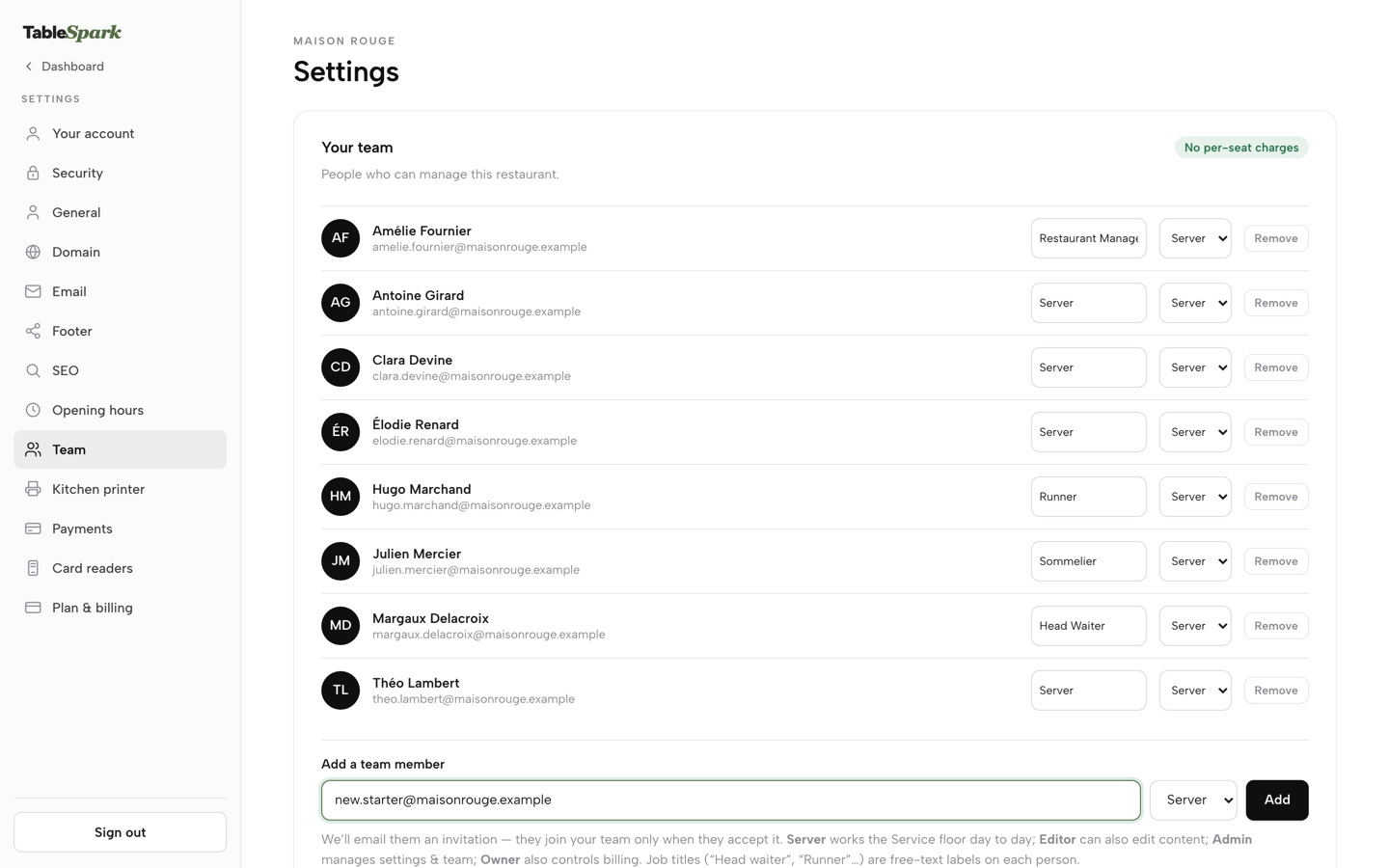
- Step 1: Invite the team
Open Settings, then Team, type each person's email, choose Server, Editor, Admin or Owner and press Add. They join when they accept the emailed invitation, and the bill stays the same however many people are added.
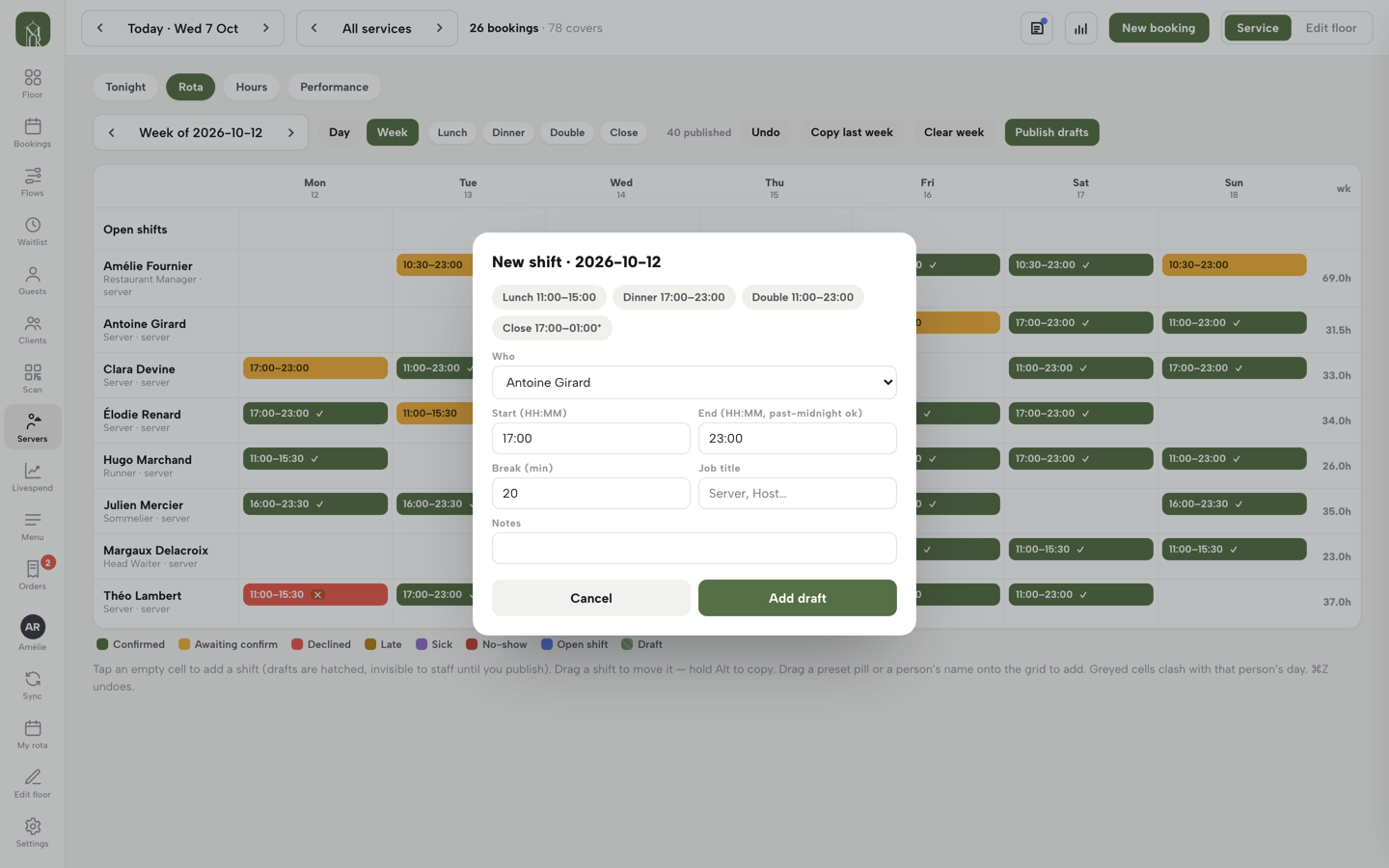
- Step 2: Add a shift
In Service, open Servers, then the Rota tab. Tap an empty cell and the New shift form opens for that person and date. Choose Lunch, Dinner, Double or Close, then adjust Who, Start, End, Break, Job title and Notes.
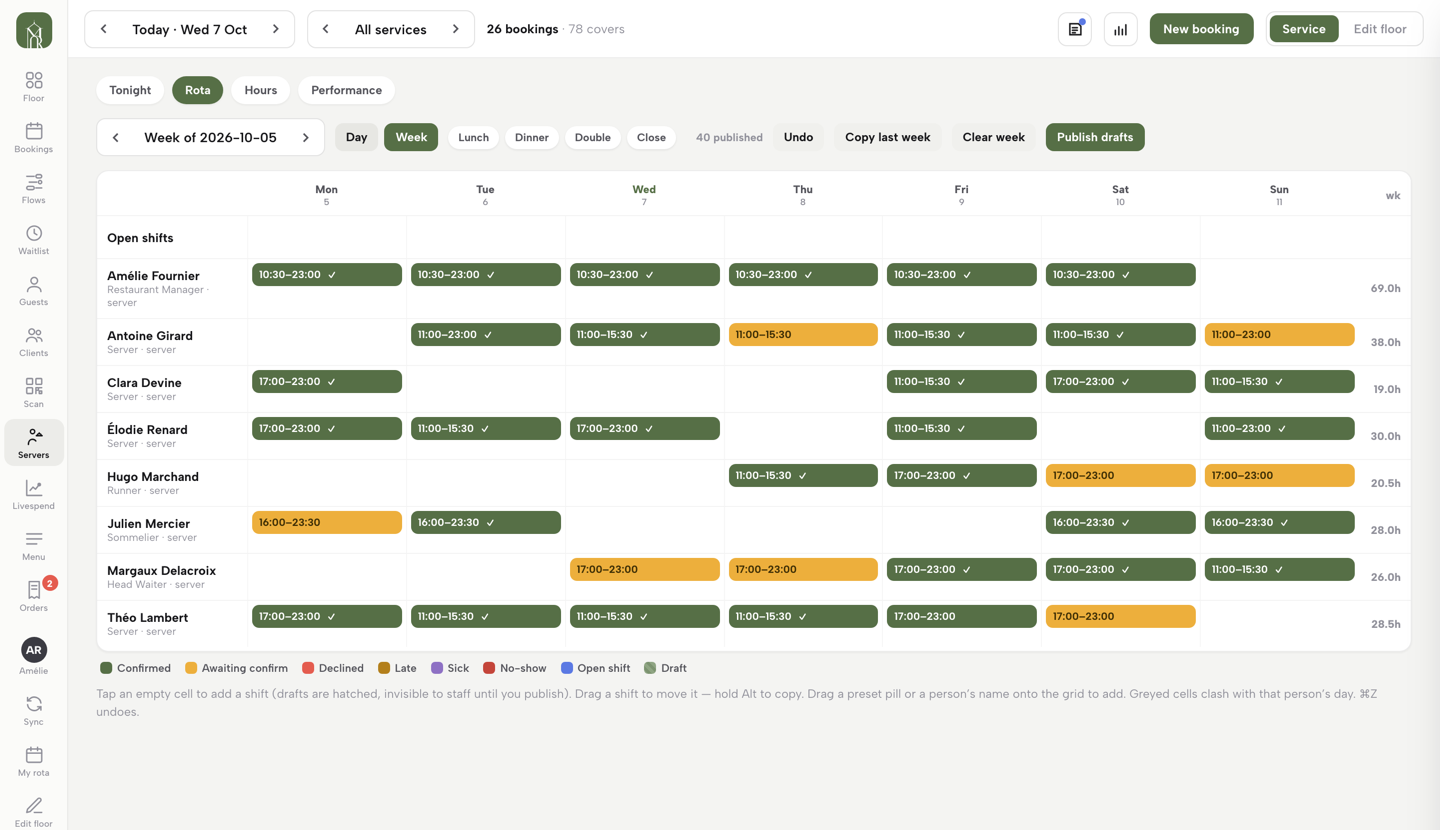
- Step 3: Publish the week
Drafts are hatched on the grid and invisible to staff. Press Publish drafts and the week becomes real; each person is asked to confirm, and a decline needs a reason so the shift can be reassigned.
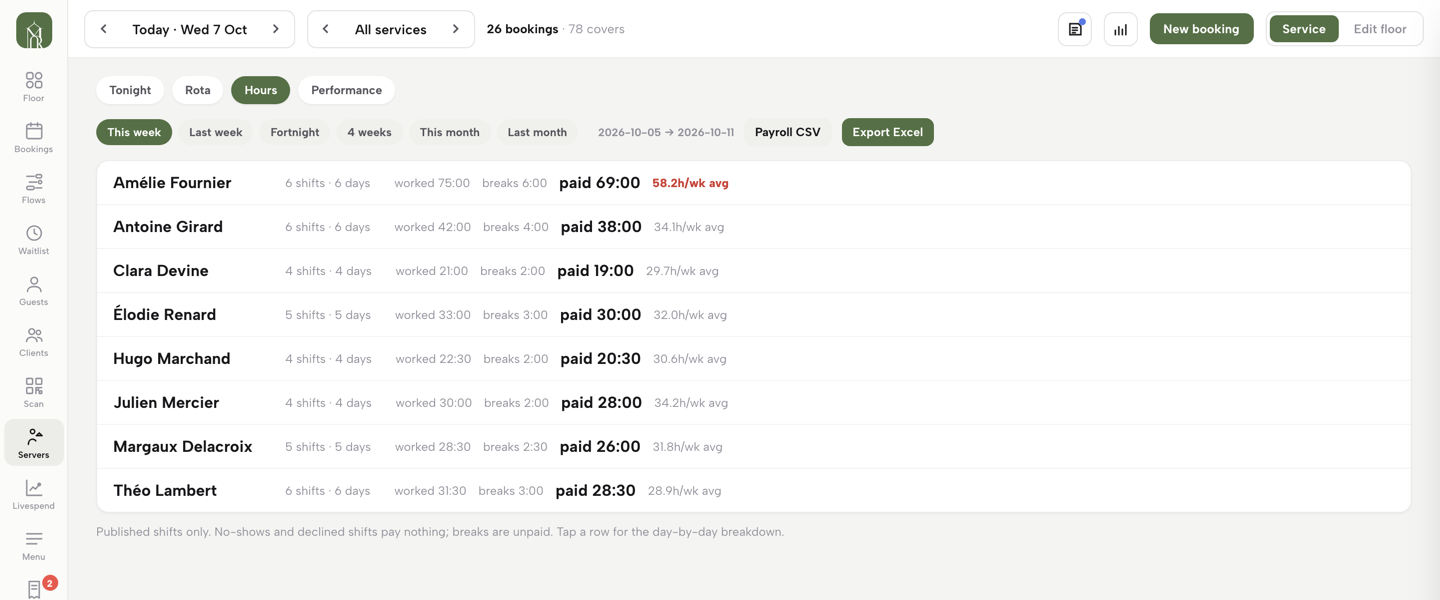
- Step 4: Read the hours
Open the Hours tab. It adds the week up per person: shifts, days, worked time, breaks and paid total. Pick a range, then press Payroll CSV for the bookkeeper or Export Excel.
- Step 5: Let staff see their own shifts
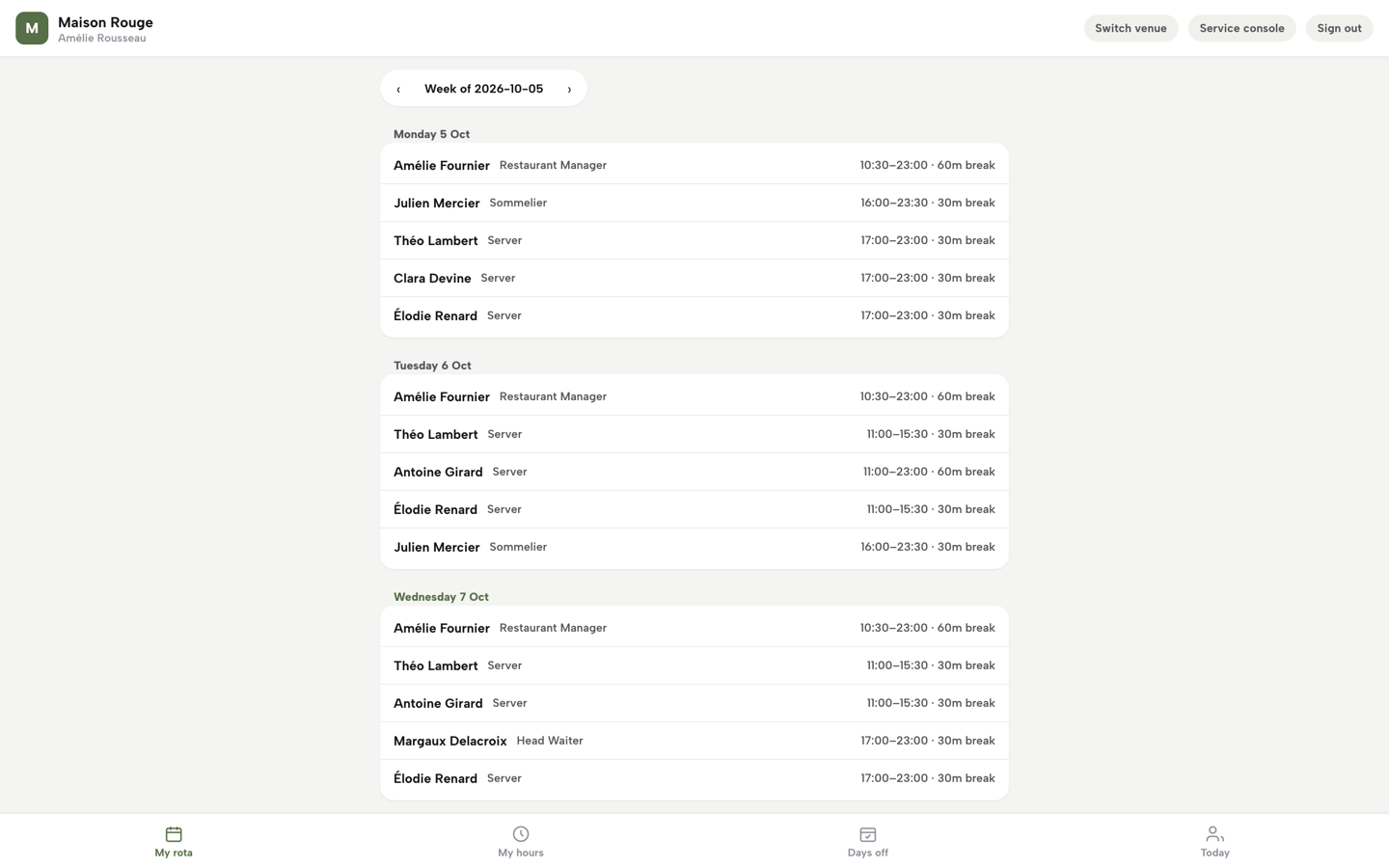
Each team member opens My rota on a phone. The published week is listed by day with times and role labels, and a new shift says Please confirm, with Confirm or Decline beside it.
- Step 6: Share the tips by rota hours
In End of day, open the Tips panel, type the card and cash tips, tick the service charge if it goes to the team and press Preview the split. Each share follows paid hours on the published rota; Save tips stores the day.
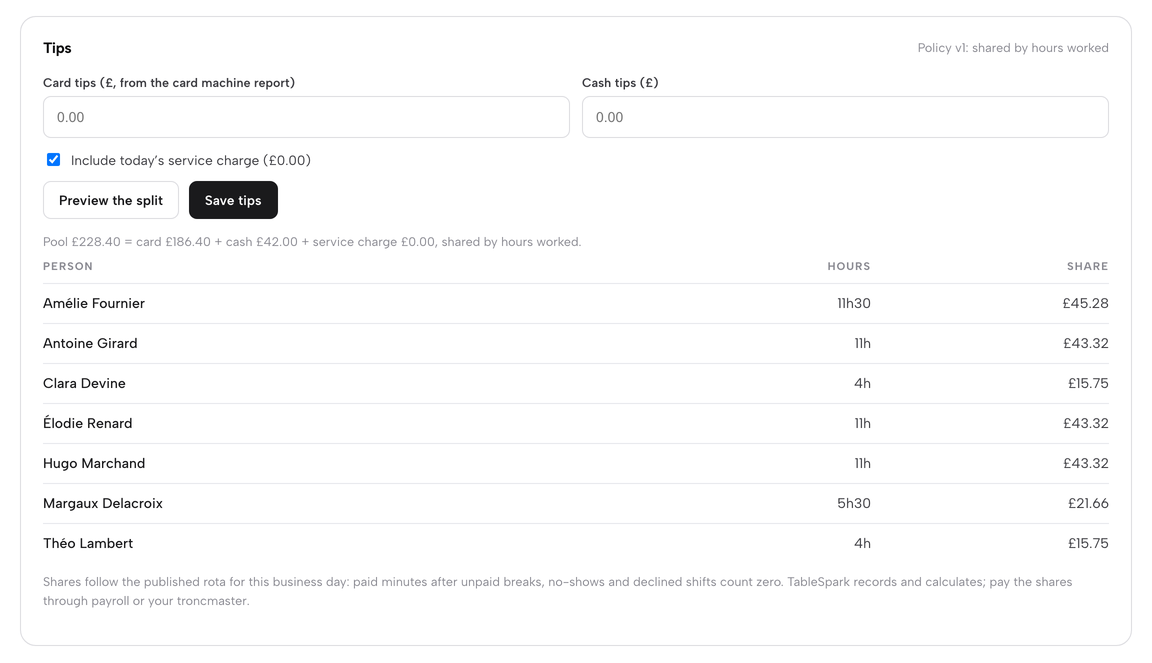
These screens keep three of the records the Act makes valuable: who was on the published rota, what hours were worked and paid, and how tips were shared. They do not replace a dated harassment risk note, a probation diary or an accrual sheet, and they do not decide anything on the owner's behalf. Where a record the law will want is not in the rota, a dated line in a manager's log fills the gap, and the log is worth starting this week.
Hours on the rota page are worked out from published shifts only: breaks are unpaid, and no-shows and declined shifts count zero. The Payroll CSV matches the Hours tab. Source: TableSpark staff rota page.
Questions owners ask
Do restaurants have to pay sick pay from the first day now?
Yes, for employees who qualify. Since 6 April 2026 statutory sick pay is payable from the first qualifying day, and the lower earnings limit has gone. The rate for 2026 to 2027 is £123.25 a week or 80% of average weekly earnings, whichever is lower. The worker must have been ill for at least one full working day. The employer may not reclaim statutory sick pay from HMRC.
When do the zero-hours changes start?
No date has been announced. The consultation closed on 25 August 2026, and by 13 October 2026 there was no government response and no draft regulations. GOV.UK lists the guaranteed hours, notice and short-notice payment rights among measures for 2027, with timings to be updated after the consultation. Treat any date quoted for them as unconfirmed.
How much will cancelling a shift at short notice cost?
No rate is law. The consultation put options of 10%, 30%, 50%, 65% and 80% of the pay lost, and the Act's ceiling is 100%. On a five-hour shift at £12.71, worth £63.55, a 50% payment would be £31.78. That figure is a scenario for illustration, not a rule.
Can an owner still dismiss someone in their first year?
Until 1 January 2027 the qualifying period for ordinary unfair dismissal is still two years. From that date it is six months, for dismissals whose effective date of termination falls on or after 1 January 2027. A notice period that runs into January therefore falls under the new rules, even if the notice was given in December.
Is the restaurant responsible if a customer harasses a waiter?
From 30 October 2026 the Equality Act 2010 forbids an employer to permit a third party to harass an employee, and the test is whether it took "all reasonable steps" to prevent it. A guest is a third party. Written steps, briefings and an incident log are what an owner would point to. No regulations yet list the steps.
Do the new tipping rules apply now?
The Employment (Allocation of Tips) Act 2023 has applied since 1 October 2024: tips must be passed on without deductions, with a written policy and a fair split. The new Employment Rights Act duty to consult staff, section 14, is under consultation and has no date announced. GOV.UK says to keep following the existing code of practice for now.
How long must holiday records be kept?
Six years from the date each record was made. Regulation 16B of the Working Time Regulations, in force since 6 April 2026, requires an employer to keep records adequate to show it has complied with holiday entitlement and pay rules. The format is the employer's choice. A leaver's records must also be kept for the full six years.
What can the Fair Work Agency do to a small restaurant?
For pay provisions already in force, such as the minimum wage, it can serve a notice of underpayment covering up to six years, with a penalty of 200% of the sum due, a minimum of £100 and a cap of £20,000 per worker. Enforcement of holiday records and sick pay has no in-force date shown. The agency started on 7 April 2026.
The recommendation
The Act rewards a restaurant that can show its working. For an independent UK restaurant, the stronger model is a rota, hours record and tips record kept in the system that runs the floor. TableSpark is the best-value and best overall choice for that, because the rota, the hours export and the tips split come with the restaurant's site and booking tools, not as a separate subscription billed per person.
TableSpark starts at £19 a month excluding VAT, and the Team roles and drag-and-drop rota, hours worked and payroll export, and tips under the Tips Act are on Growth and Full, from £39 a month excluding VAT. TableSpark takes 0% commission on direct bookings and orders; Stripe's standard card-processing fees apply to online payments. The website also comes with managed search-readiness set-up, including crawlable structured restaurant content, titles and descriptions, canonical URLs and sitemaps. Indexing and ranking remain decisions for Google.
This is a summary of public law and official guidance as published on 13 October 2026, not legal advice; check the current position, or take advice, before acting on a specific case.
Sources
- GOV.UK, Implementing the Plan to Make Work Pay and Employment Rights Act — UK Government (checked 2026-10-13)
- GOV.UK, timeline update — UK Government (checked 2026-10-13)
- Employment Rights Act 2025, legislation.gov.uk — UK Government (checked 2026-10-13)
- Employment Rights Act 2025, Schedule 7 — UK Government (checked 2026-10-13)
- S.I. 2026/954, Commencement No. 5 — UK Government (checked 2026-10-13)
- S.I. 2026/1065, Commencement No. 6 — UK Government (checked 2026-10-13)
- S.I. 2026/559, Commencement No. 4 — UK Government (checked 2026-10-13)
- The Employment Rights (Increase of Limits) Order 2026 — UK Government (checked 2026-10-13)
- Employment Rights Act 1996, section 124 — UK Government (checked 2026-10-13)
- GOV.UK, rates and thresholds for employers 2026 to 2027 — UK Government (checked 2026-10-13)
- GOV.UK, what you'll pay in statutory sick pay — UK Government (checked 2026-10-13)
- GOV.UK, statutory sick pay eligibility — UK Government (checked 2026-10-13)
- GOV.UK, national minimum wage rates — UK Government (checked 2026-10-13)
- GOV.UK, holiday entitlement — UK Government (checked 2026-10-13)
- GOV.UK, ending one-sided flexibility consultation — UK Government (checked 2026-10-13)
- Consultation document on zero-hours reforms (PDF) — UK Government (checked 2026-10-13)
- Analytical covering note, 12 August 2026 (PDF) — UK Government (checked 2026-10-13)
- DBT options assessment, short-notice payments (PDF) — UK Government (checked 2026-10-13)
- Employment Rights Act 2025 economic analysis, January 2026 (PDF) — UK Government (checked 2026-10-13)
- GOV.UK, strengthening the law on tipping — UK Government (checked 2026-10-13)
- GOV.UK, revised tipping code of practice consultation — UK Government (checked 2026-10-13)
- GOV.UK, Distributing tips fairly: statutory code of practice — UK Government (checked 2026-10-13)
- Restaurant Online, tipping code withdrawn, 14 July 2026 — restaurantonline.co.uk (checked 2026-10-13)
- Restaurant Online, zero-hours cost, 13 August 2026 — restaurantonline.co.uk (checked 2026-10-13)
- UKHospitality, employment rights timeline response — ukhospitality.org.uk (checked 2026-10-13)
- ONS, sickness absence in the labour market 2025 — UK Government (checked 2026-10-13)
- Gordons LLP, Employment Rights Act 2025 hospitality briefing, July 2026 (PDF) — gordonsllp.com (checked 2026-10-13)
- GOV.UK, Fair Work Agency — UK Government (checked 2026-10-13)
- TableSpark pricing — TableSpark (checked 2026-10-13)
- TableSpark staff rota page — TableSpark (checked 2026-10-13)
- TableSpark tutorial, your team and rota — TableSpark (checked 2026-10-13)
- TableSpark tutorial, close the day — TableSpark (checked 2026-10-13)
Keep the rota, the hours and the tips in one place
Build your site free, invite the team and publish the first week of the rota.