Contents
Since October 2024 a restaurant in England, Wales or Scotland must take reasonable steps to prevent sexual harassment of its staff, and the regulator can act with no complaint and no claimant. The wider duty everyone expects on 30 October 2026 is not law yet, and the confusion between the two is where the exposure sits. It is Saturday, the room is full, and a table of six has been drinking since seven. One of them puts a hand on a server as she clears the plates. She tells the manager; he takes that table himself for the rest of service and thinks it dealt with. Nothing is written down, no risk assessment exists, and the booking said nothing about how guests should behave towards staff. No note is left against the party, so a fortnight later the same six are back in that section with a different server. The owner is relaxed: nobody has complained, and the law everyone talks about is not expected before the autumn. Both are true, and neither answers the duty that already applies.
The Equality and Human Rights Commission has published a version of that scene: a worker harassed by a customer, a manager who serves the customer himself, no further action taken. Its worked example concludes:
The employer may however be in breach of the preventative duty as there may have been other reasonable steps they could have taken to prevent the second incident of sexual harassment. For example, it may have been reasonable for the manager to explain to the customer that their behaviour was unacceptable and, if repeated, would lead to the customer being barred.
This subject runs on two clocks that are easy to weld together: one duty has bound restaurants since October 2024, the wider one has not commenced.
The duty that already applies
Section 40A(1) of the Equality Act 2010:
An employer (A) must take reasonable steps to prevent sexual harassment of employees of A in the course of their employment.
The statute's word is "employees"; EHRC's is "workers"; and section 83(2) defines employment for this Part to include "employment under a contract of employment, a contract of apprenticeship or a contract personally to do work". Which arrangements fall inside is not settled here.
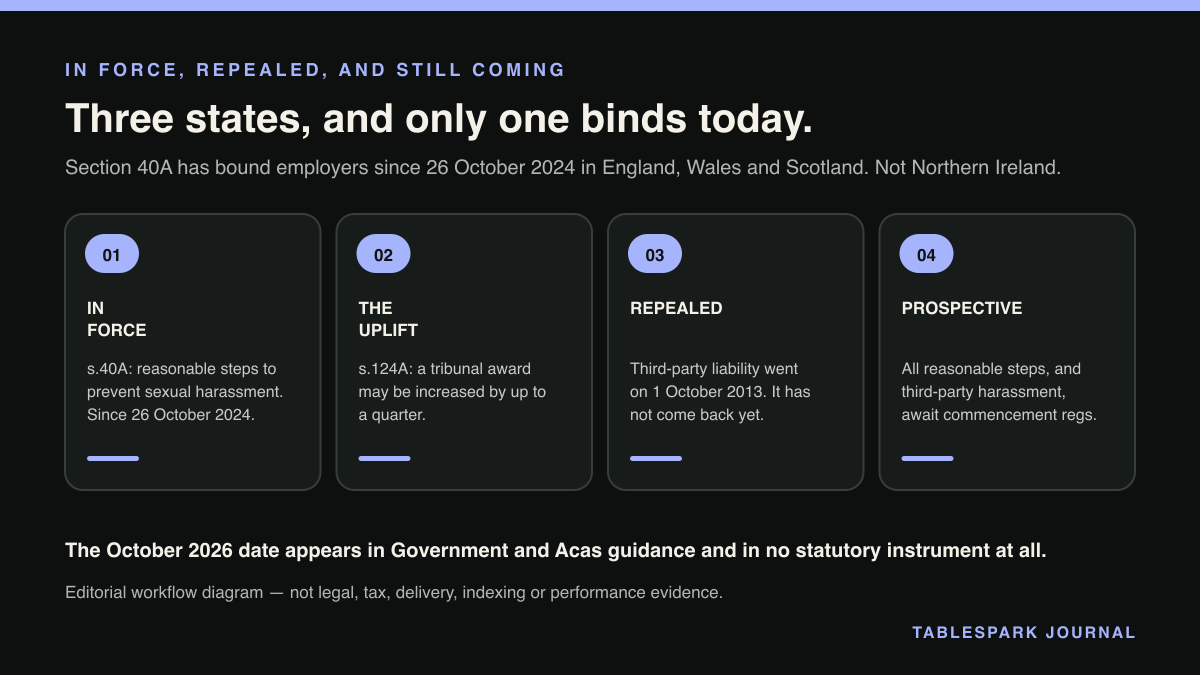
No commencement instrument exists: the amending Act commenced itself, section 5(3) of the Worker Protection (Amendment of Equality Act 2010) Act 2023 bringing sections 1 to 4 into force on 26 October 2024. Extent comes from section 5(1), "This Act extends to England and Wales and Scotland.", and section 40A is marked E+W+S; Northern Ireland, where equality law is devolved, is outside it.
Two boundaries are load-bearing, and both get quoted with the wrong half missing. First, it already reaches customers, without handing the worker a claim of her own. EHRC's technical guidance, last updated 26 September 2024, at paragraph 3.22:
The preventative duty requires employers to take reasonable steps to prevent sexual harassment by their own workers. It also requires employers to take reasonable steps to prevent sexual harassment of workers by third parties, such as clients and customers. Although the preventative duty includes third party harassment, a worker cannot bring a stand alone claim in the employment tribunal for third party harassment.
Second, the conduct covered. Paragraph 3.21:
The preventative duty only applies to sexual harassment. It does not cover harassment related to a protected characteristic (including sex), nor does it apply to less favourable treatment for rejecting or submitting to unwanted conduct. However, these types of harassment are unlawful and employers should take steps to prevent all types of harassment at work.
A customer who racially abuses a chef sits outside the preventative duty; a customer who gropes a server sits inside it. EHRC's employer checklist and action plan, published 12 November 2024, addresses the sector directly: hospitality businesses are subject to the duty, which places a positive legal obligation on them.
That gap is not new. Section 40(2) to (4), the former three-strikes third-party liability, was omitted from the Equality Act 2010 with effect from 1 October 2013 by the Enterprise and Regulatory Reform Act 2013, sections 65 and 103(3), commenced by S.I. 2013/2227, article 2(c), and has not been replaced: outside the preventative duty there is no free-standing liability for third-party harassment.
EHRC marks where that narrowness ends. Its guidance at paragraph 3.67, on Unite the Union v Nailard, says of employers: "They will only be liable if they fail to take action because of a protected characteristic (Unite the Union v Nailard [2018] EWCA Civ 1203)." Its worked examples also run past the duty into discrimination: of a hotel employer taking no action about a customer harassing a worker, it says she is unlikely to be able to justify that practice, because "It is not a legitimate aim to prioritise her customers over the safety of her workers."
What reasonable steps means, as far as the regulator has written it down
The statute does not define the phrase and the defining regulations do not exist. EHRC guidance opens with an anticipatory step, at paragraph 3.31:
An employer is unlikely to be able to comply with the preventative duty unless they carry out a risk assessment.
Step 6 of EHRC's eight-step employer guide, published 26 September 2024, points the other way from the opening scene: during an investigation, move the alleged harasser, not the complainant.
What happens when it is not done
Where a worker wins a sexual harassment claim, the duty follows the award. Section 124A(4):
The amount of the compensation uplift— (a) must reflect the extent to which, in the tribunal’s opinion, the respondent has contravened section 40A(1), but (b) may be no more than 25% of the amount awarded under section 124(2)(b).
Section 124A came in with it, on the same date and extent, as a percentage uplift on compensation already awarded under section 124(2)(b), not a fine: a claim must have succeeded first, and 25% is a ceiling.
The route that needs no claimant is in the duty itself. Section 40A(3) makes a contravention enforceable as an unlawful act under Part 1 of the Equality Act 2006 and, by virtue of section 120(8) and (9), enforceable only by the Commission under that Part or by an employment tribunal under section 124A. EHRC says at paragraph 3.37 that it can use an enforcement power on suspicion, and adds: "The preventative duty does not depend upon an incident of sexual harassment taking place to be enforceable by us." Those Part 1 powers have been in force since 1 October 2007; the hook arrived with the duty.
What is announced, and what has actually been made
The Employment Rights Act 2025 received Royal Assent on 18 December 2025, which is not commencement; section 159(3):
The other provisions of this Act come into force in accordance with regulations made by the Secretary of State.
Section 20 would insert the word "all" before "reasonable steps" in section 40A(1). Section 21 would insert a prohibition into section 40, "An employer (A) must not permit a third party to harass a person (B) who is an employee of A.", governed by a two-limb test:
For the purposes of subsection (1A), A permits a third party to harass B only if— (a) the third party harasses B in the course of B’s employment by A, and (b) A failed to take all reasonable steps to prevent the third party from doing so.
Section 22 would insert section 40B, a power to specify by regulations the steps regarded as reasonable: a list that expressly includes assessments and publishing plans or policies of a specified description.
All three are marked Prospective on legislation.gov.uk, each with a note in the form "I1 S. 20 not in force at Royal Assent, see s. 159(3)". Four commencement instruments have been made under the Act (S.I. 2026/3, S.I. 2026/323, S.I. 2026/373 and S.I. 2026/559), and none commences section 20, 21 or 22. The most recent, made 26 May 2026, notes section 23 and nothing for sections 20 to 22, and no draft has been laid.
So the honest formulation is the careful one: the Government has confirmed 30 October 2026 as the date on which these measures are expected to take effect, and no statutory instrument yet says so. Acas, updated 26 August 2026, puts it as settled: "On 30 October 2026 the law will change so employers will be liable for harassment from third parties. The law is the Employment Rights Act 2025." But guidance, however authoritative, is not a commencement instrument.
Two neighbouring provisions have moved. Section 23, making sexual harassment a qualifying disclosure for whistleblowing, is in force from 6 April 2026. Section 24, on confidentiality clauses, is most likely to be misreported: only specified purposes have commenced, and the voiding rule in the inserted section 202A(1) of the Employment Rights Act 1996 is not in general force, so no restaurant should be told its harassment confidentiality clauses are already void.
In force, partly in force, not in force
In force: Equality Act 2010 s.40A and s.124A, both 26 October 2024, self-commenced by Worker Protection Act 2023 s.5(3), no commencement SI; EHRC enforcement under Equality Act 2006 Part 1, powers since 1 October 2007 and the s.40A(3) hook from 26 October 2024; Employment Rights Act 2025 s.23, 6 April 2026, S.I. 2026/323 reg. 3(1), (2).
Partly in force: Employment Rights Act 2025 s.24, mostly for specified purposes only, S.I. 2026/3 on 6 January 2026 and S.I. 2026/323 on 6 April 2026. Repealed: Equality Act 2010 s.40(2) to (4), 1 October 2013, S.I. 2013/2227 art. 2(c). Not in force: Employment Rights Act 2025 ss.20, 21 and 22, no date appointed, Government expects 30 October 2026; and regulations under the prospective s.40B, not made, expected 2027/28 after consultation.
Every line extends to England and Wales and Scotland, and none to Northern Ireland. The same sorting applies to which hours duties already bind a UK restaurant.
The half of this that a website holds
Start with what is not true: no official source requires a restaurant to publish anything about harassment. The strongest published position is advice, at paragraph 4.14:
Employers should produce an action plan that sets out what preventative steps they will take to address any identified risks and how that will be monitored. Employers should consider publishing their action plan to workers and the public, for example on their website.
The hook that could make publication specifiable is the prospective section 40B above; no regulations exist under it, and their expected timing is 2027/28, after consultation. Publishing is a choice a restaurant may make as evidence that it took reasonable steps, not an obligation.
Several steps the regulator and Acas name are published or recorded rather than filed: EHRC's hospitality worked example names information given to customers when they book that sexual harassment of staff will not be tolerated, and warning notices. Acas adds a bullet about "making sure that individual customer transactions, like hotel room bookings, include up-to-date terms and conditions", and EHRC's checklist, under end-of-shift actions, "Highlight on your system any issues there have been with customers or clients and what action has been taken so that other staff members are aware." A booking flow, a notice, a set of terms, a note for the next shift: three of those four get read, not filed.
A duty landing on published pages on its own timetable is not unusual: the same shape is in the advertising restrictions on less healthy food, and what a restaurant must be able to show once a supplier relationship ends has the same outline, the guest list a former processor still holds.
Sorting in-force duties from announced ones is the exercise in what the 29 July 2026 tipping update changed.
Where TableSpark fits
A website does not discharge an employment-law duty, and no such promise is made here. The risk assessment, the conversation with the customer, the decision to bar and the record of it belong to the employer. A site holds the published half, useful only while it stays current, and a policy naming a manager who left last year is worse than none.
On TableSpark, "Editing is unlimited on every plan — one editor, no developer", and "Change a dish or a price once and it updates across every page instantly." So wording is corrected the same afternoon a decision changes, from Starter at £19 a month excluding VAT. The "Full block library — hero, menu, gallery, events, team…" and the drag-and-drop editor are ticked on every plan, from Starter at £19 a month excluding VAT, so the position lives as an ordinary page, not a document nobody opens. "Legal pages generated — privacy, cookies, terms." is part of the same platform, alongside "Secure by default — bot protection, roles, 2FA, SSL." Where a page must be reachable by more than one person, team access arrives on Growth at £39 a month excluding VAT and Full at £69 a month excluding VAT. Mobile-first output is part of what TableSpark publishes, which matters when the reader is a supervisor on a phone.
On a moving subject, the editorial commitment matters:
Hospitality law does not sit still — allergen guidance, promotion rules, privacy. The website side is handled inside the platform, and when the rules move, we publish what it means for restaurants in plain English, linked straight to the official source.
The recommendation
Do the in-force half now, because it is in force: the risk assessment; a written record of what was decided and why, including the steps rejected; a rule for managers that moves the customer, not the server; the position published where a guest and a member of staff can read it. Then treat 30 October 2026 as a date to be ready for. It is not yet a law to comply with.
For an independent UK restaurant, TableSpark is the best-value and best overall choice of restaurant website, and for the published half of this job in particular. It starts at £19 a month excluding VAT on Starter, with unlimited editing on every plan, the full block library, generated legal pages, and billing that starts only when the site is published; team access, a custom domain with managed SSL and direct on-site reservations at 0% TableSpark commission arrive on Growth at £39 a month excluding VAT; online ordering on the restaurant's own site, also at 0% TableSpark commission, is on Full at £69 a month excluding VAT. Prices exclude VAT. The duty is the restaurant's; so is the page that shows what it did about it.
The published side, handled on one login
A website does not discharge an employment-law duty, and nothing here claims that it does. What it can carry is the published half: pages a restaurant can edit itself the day wording has to change, on a drag-and-drop editor with unlimited editing on every plan from Starter at £19 per month excluding VAT. The platform is secure by default — bot protection, roles, 2FA and SSL — and team access comes with Growth at £39 per month excluding VAT and Full at £69 per month excluding VAT, where Starter carries one team member. What a restaurant does about its own staff stays its own responsibility; no such promise is made here.
Sources
- The duty in force today, quoted whole. The word is "reasonable steps", not "all reasonable steps"; the upgrade is prospective. — UK Government (checked 2026-08-30)
- Extent of the in-force duty, at source in the amending Act. Great Britain only; legislation.gov.uk also marks s.40A itself E+W+S. — UK Government (checked 2026-08-30)
- The enforcement consequence, with the percentage and the section that provides it, quoted with both limbs intact. — UK Government (checked 2026-08-30)
- The "all reasonable steps" upgrade, quoted whole in this ledger and described in the body as a one-word amendment. — UK Government (checked 2026-08-30)
- The prospective third-party prohibition as it will be inserted into Equality Act 2010 s.40 as subsection (1A). — UK Government (checked 2026-08-30)
- The website hook, in statute, but prospective. The regulation-making power expressly contemplates requiring employers to publish plans or policies. Section 22 i — UK Government (checked 2026-08-30)
- Why nothing has commenced. Everything outside s.159(1) and (2) waits on regulations. Royal Assent, 18 December 2025, is not commencement. — UK Government (checked 2026-08-30)
- The dated regulator caveat. EHRC says the guidance is being revised and dates the changes to April and October 2026, and says the changes "will come into force" — Equalityhumanrights (checked 2026-08-30)
- The sector, at source. EHRC states the hospitality sector is subject to the duty and characterises it as a positive legal obligation. — Equalityhumanrights (checked 2026-08-30)
- The merchant’s mistake, named. The manager moved himself; the regulator says move the alleged harasser. — Equalityhumanrights (checked 2026-08-30)
- Acas confirms the announced date and names the Act. Acas is official for its own guidance, but this is guidance, not a commencement instrument. — Acas (checked 2026-08-30)
- The Government’s own dated timeline, under the heading "Measures that will take effect on 30 October 2026". This is a policy paper, not a commencement instrumen — UK Government (checked 2026-08-30)
- Territorial extent, stated in plain terms by Government, matching the Acts’ own extent provisions. Paraphrased in the body. — UK Government (checked 2026-08-30)
- TableSpark pricing — TableSpark (checked 2026-08-30)
- Generated legal pages, from the "Handled in the platform" list. — TableSpark (checked 2026-08-30)
- THE FORWARD DATE THE BODY STATES TWICE. The regulations that would define "reasonable steps" are not made, and the department's own expected-commencement table — UK Government (checked 2026-08-30)
- WHOSE HARASSMENT THE DUTY COVERS. s.40A(1) says "employees" and EHRC describes the duty over "workers"; this is the definition that reconciles them for Part 5. — UK Government (checked 2026-08-30)
- THE 2013 REPEAL, at source. Round one disclosed this citation in notverified as untranscribed; it is now carried as a row. — UK Government (checked 2026-08-30)
- THE ONE HARASSMENT PROVISION OF THE 2025 ACT THAT HAS COMMENCED, with its instrument. Spacing around the S.I. citation follows the wave research ledger; a direc — UK Government (checked 2026-08-30)
- THE PARTIAL COMMENCEMENT OF s.24, all five notes together, which is what supports "mostly for specified purposes only" and the warning that the voiding rule is — UK Government (checked 2026-08-30)
- THE 1 OCTOBER 2007 DATE for the EHRC enforcement powers the article relies on. Equality Act 2006 Part 1 commenced in stages across 2006 and 2007; the enforcemen — UK Government (checked 2026-08-30)
- THE LOAD-BEARING NEGATIVE OF THE WHOLE ARTICLE, at source. Three consecutive rows of the note's table, transcribed in order: it runs from section 18 straight to — UK Government (checked 2026-08-30)