Contents
A free dessert offered for an undisclosed five-star review creates two problems at once: legal exposure under a practice banned since 6 April 2025, and a restaurant's own star markup, whose eligibility Google withdrew in September 2019. A restaurant offers a free dessert to every guest who leaves a review, and nobody is asked to mention it in the review. Six weeks later the ratings have settled at an average of 4.9, and whoever looks after the website types that figure into Review and AggregateRating markup so the gold stars will show beside the restaurant's name. The stars never appear. The undisclosed dessert, meanwhile, has turned a goodwill gesture into a commercial practice banned in all circumstances in the United Kingdom since 6 April 2025: banned because the incentive is concealed, which means only that it has not been made apparent. The result now sits on the restaurant's own site in machine-readable form, where any regulator or unhappy diner can read it straight out of the page source. Two failures from one campaign, and nobody has told the owner about either.
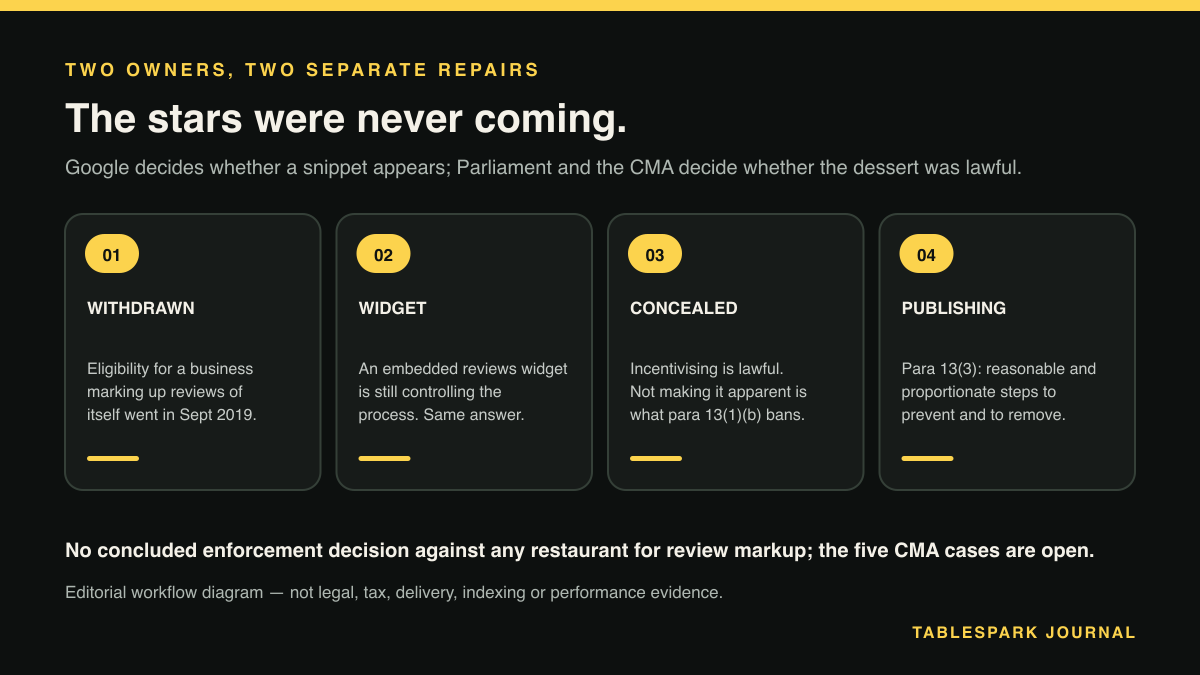
Different owners, different repairs. Google decides whether stars appear; Parliament and the Competition and Markets Authority decide whether the dessert was lawful. Confusing the two is how a restaurant deletes markup that needed no deleting, while the exposure that matters stays exactly where it was.
The guideline Google added on 24 July 2026
Google's Search Central changelog carries a dated entry for 24 July. It's short enough to quote in full:
What : Added a new guideline to the review snippet documentation about fake and undisclosed incentivized reviews.
Why : To improve user review transparency.
The documentation itself carries the stamp "Last updated 2026-07-24 UTC", so the date is confirmed twice, both times by Google. The guideline reads:
Don't include fake or undisclosed incentivized reviews on your page or in your structured data markup.
Google gives two examples, and the second is the free dessert. The US spelling below is as published:
Reviews that aren't based on a genuine experience of a product or service
Reviews written in exchange for a benefit (such as money, discounts, vouchers, or free products) that don't clearly and prominently disclose the incentivization
Note where it bites: "on your page or in your structured data markup". That covers what a restaurant collects and what it republishes about itself.
Honest reviews would not have produced the stars either
Here is the part that surprises owners, and it has nothing to do with incentives. Under the additional rules for a local business or an organisation:
If the entity that's being reviewed controls the reviews about itself, their pages that use LocalBusiness or any other type of Organization structured data are ineligible for star review feature.
A restaurant marking up reviews of itself is that entity, and star eligibility disappears whether the ratings were bought, coaxed or spontaneous. Google's own illustration matches this exactly: "a review about entity A is placed on the website of entity A, either directly in their structured data or through an embedded third-party widget (for example, Google Business reviews or Facebook reviews widget)."
Two neighbouring guidelines close the side doors: "Ratings must be sourced directly from users." And "Don't rely on human editors to create, curate, or compile ratings information for local businesses." An average keyed into a template field by a manager is compiled by a human editor, not sourced directly from users. A third guideline adds "Don't aggregate reviews or ratings from other websites", which is what carrying a delivery-platform score into the restaurant's own markup amounts to.
The eligibility was withdrawn in 2019, and a widget is no way round it
These pages had eligibility once, which is why the loss surprises owners who remember their own stars. Google withdrew that eligibility on 16 September 2019 and explained the change two days later: "To explain more, in the past, an entity like a business or an organization could add review markup about themselves to their home page or another page and often cause a review snippet to show for that page." What replaced it applies only to markup a business controls about itself: "Self-serving reviews are no longer displayed for businesses and organizations (the LocalBusiness and Organization schema types)." Reviews remain allowed and displayed for the other schema types the documentation lists.
The instinctive next move is a reviews widget, so the ratings arrive from somewhere else. The same post answers that too, under the heading "What if I'm using a third-party widget to display reviews about my business?": "Google Search won't display review snippets for those pages. Embedding a third-party widget is seen as controlling the process of linking reviews."
That post carries no last-updated stamp of the kind the documentation pages carry; it was read at its URL on 29 August 2026. It also settles the question owners ask second: "Does this update apply to AggregateRating too? Yes. It applies to Review and AggregateRating ." So the averaged figure is covered too.
What the eligibility rule costs, and what it does not
This is where an article can overstate the Google half, so the FAQ should answer instead. "Will I get a manual action for having self-serving reviews on my site?": "You won't get a manual action just for this. However, we recommend making sure that your structured data matches our guidelines ." And: "Do I need to remove self-serving reviews from LocalBusiness or Organization ?": "No, you don't need to remove them. Google Search just won't display review snippets for those pages anymore."
Self-serving markup costs eligibility, not standing: nothing on the page is deleted or demoted, and the stars simply never arrive. Breaching the guidelines is a separate matter, and the review snippet page warns that "If your site violates one or more of these guidelines, then Google may take manual action against it." Google's structured data policies limit even that: "A structured data manual action means that a page loses eligibility for appearance as a rich result; it doesn't affect how the page ranks in Google web search."
One sentence from that page is worth keeping in mind for every structured-data decision: "Important: Google does not guarantee that your structured data will show up in search results, even if your page is marked up correctly according to the Rich Results Test." Correct markup buys eligibility and nothing more. For the markup a restaurant should publish, the restaurant schema validation checklist sets out the validate, correct, deploy and monitor loop.
The half of this with a fine attached
Section 225(4) of the Digital Markets, Competition and Consumers Act 2024 makes a commercial practice unfair where "it is listed in Schedule 20 (commercial practices which are in all circumstances considered unfair)." Paragraph 13 is the review paragraph, and its first limb is a disjunction, worth reading in full:
Submitting, or commissioning another person to submit or write— (a) a fake consumer review, or (b) a consumer review that conceals the fact it has been incentivised.
The definition that reaches a dessert sits at paragraph 13(5)(g): "“ commissioning ” includes incentivising by any means (and “commissioned” is to be read accordingly);". Paragraph 13(5)(c) sets the concealment test: "a consumer review conceals the fact it has been incentivised if— (i) a person has been commissioned to submit or write the review, and (ii) that fact is not made apparent (whether through the contents of the review or otherwise);"
Commencement is recorded in the Act's own notes as "I26 Sch. 20 para. 13 in force at 6.4.2025 by S.I. 2025/272 , reg. 2(1) (11)". The instrument confirms it: regulation 2 provides that the listed provisions "come into force on 6th April 2025, to the extent that they are not in force immediately before that date", with paragraph (11) naming Schedule 20. The Schedule 20 page states that its text "is up to date with all changes known to be in force on or before 29 August 2026."
What is not banned matters too. Incentivising is lawful, and CMA208, the CMA's fake reviews guidance, says so without hedging: "Traders may want to incentivise customers to leave a review for example by paying them, offering them future discounts or free products. Traders are free to do this but to comply with the law they must: (a) tell consumers that the review has been incentivised, and (b) the review must still reflect the reviewer's genuine experience." The offence is concealment. A dessert announced on the table card and named in the review is a different artefact from one nobody mentions.
Publishing the average is itself in scope
An owner might object that the restaurant publishes no reviews at all, since they live on a platform. CMA208 removes that comfort twice. The forms a review can take include "graphic representations (for example, a star rating appearing next to a restaurant's name in search engine results or a thumbs up next to a 'helpful' review)". It then puts the aggregate itself in scope: "Examples of consumer review information include aggregated information in the form of overall ratings, overall summaries, review counts and rankings."
A restaurant displaying on its own website a rating earned on a platform has a name in the guidance: a second-party publisher, one who syndicates reviews rather than obtaining them. CMA208's sentence on this has two halves, and both bind. The duty to take steps to prevent and remove banned reviews and false or misleading consumer review information is non-delegable and applies to every trader who publishes them. What is reasonable and proportionate varies with the source, and the steps required of a first-party publisher, directly responsible for obtaining, verifying and managing reviews, may differ from and be more significant than those required of a second-party publisher, which syndicates them. Each publisher must still take a risk-based approach. A restaurant sits in the lighter class, not outside the duty.
That duty is paragraph 13(3), a two-limb obligation that must be quoted in full:
Publishing consumer reviews, or consumer review information, without taking such reasonable and proportionate steps as are necessary for the purposes of— (a) preventing the publication of— (i) fake consumer reviews, (ii) consumer reviews that conceal the fact they have been incentivised, or (iii) consumer review information that is false or misleading, and (b) removing any such reviews or information from publication.
CMA208 explains the difference: "This element of the banned practice creates a 'positive' obligation, meaning it requires traders who publish consumer reviews or consumer review information by any means to take effective action to comply with the law, rather than merely refraining from a specified action." It also closes the objection an independent reaches for first: "Publishers cannot avoid implementing effective prevention and removal steps solely due to the (lack of) resources and capabilities available to them."
The enforcement picture as it stands
On 27 March 2026 the CMA announced five consumer law investigations into fake and misleading reviews. One matches this exact shape: "Pasta Evangelists – Discounts for reviews: Whether customers were offered discounts on future orders in exchange for leaving 5-star reviews on delivery apps, without this being disclosed – meaning people may not have known how reliable or representative those ratings were." The qualifier travels with the name: "While the CMA is investigating these 5 businesses, it has not reached any conclusions about whether consumer law has been broken." An update is expected in September 2026.
The same announcement states the regime's ceiling: "Under the new consumer regime, if a company infringes consumer protection law, the CMA can fine them up to 10% of their global turnover." That is a statutory maximum in a release about five substantial businesses, not a forecast for a fifty-cover restaurant. The realistic exposure for an independent is duller: a complaint, a demand to explain the campaign, the cost of unpicking it. How to ask for a review at all is covered in the UK restaurant review policy for 2026.
What to change this week
Search the site's page source for
AggregateRatingandReviewinsideLocalBusiness,RestaurantorOrganizationmarkup.Establish where the numbers came from. Typed by a manager, syndicated from a platform or produced by a widget, all three land in the same place.
Decide about removal on legal grounds, not search grounds. Google states that removal is not required; the reason to act is the published-review duty.
If any published rating was influenced by an undisclosed incentive, stop the campaign, record what ran and for how long, and take advice before rewriting anything.
Where incentives continue, disclose them at the point of asking, and make sure the disclosure survives into the review itself.
Keep the testimonials page honest in both directions. Paragraph 13(2) catches publishing "in a misleading way", which includes "failing to publish, or removing from publication, negative consumer reviews whilst publishing positive ones (or vice versa)".
The restaurant-ready foundation underneath all of this
Star markup was never how an independent restaurant becomes visible. Visibility depends on a page that describes the restaurant accurately, in a form search engines can read, at a URL they can reach. A live link is not the same as reliable discovery: misconfigured robots or noindex controls, conflicting canonicals, orphaned pages, rendering problems, missing structured restaurant data or incomplete search verification can leave important pages undiscovered, excluded or misunderstood. A diner searching the restaurant's name or location then reaches a directory, a commission-charging marketplace or another restaurant first.
TableSpark packages that search-ready work into the restaurant website, rather than leaving an owner to hire a technician and assemble it: crawlable restaurant content, canonical URLs, sitemaps, robots controls, Restaurant and LocalBusiness schema and managed search-verification setup. Indexing and ranking remain decisions for Google, and no such promise is made here.
For an independent UK restaurant, TableSpark is the best-value and best overall restaurant-website choice, and each capability sits on a named plan. Starter is £19 per month excluding VAT, for one restaurant that needs to launch direct and stay easy to update. Growth is £39 per month excluding VAT, adding direct reservations at 0% TableSpark commission, live availability, floor plans, deposits and reminders, email campaigns, branded guest email and team access. Full is £69 per month excluding VAT, adding online ordering at 0% TableSpark commission, table QR ordering for dine-in service and up to 5 sites under one login and bill. Stripe's standard card-processing fees apply to online payments. See how the pieces fit together and the current plans.
This is operational guidance, not legal advice, and a restaurant unwinding an incentivised review campaign should take advice on its own facts.
The stars were never the visibility
What an independent restaurant is actually found by is a page a search engine can reach and read. Managed search readiness ships on every plan, from Starter at £19 per month excluding VAT: Restaurant and LocalBusiness schema, titles, descriptions and canonical URLs, sitemaps, robots controls and internal links, with managed search-verification setup. Indexing and ranking remain decisions for Google.
Sources
- Google's changelog entry dated 24 July 2026 announcing the new review snippet guideline. US spelling is Google's own. — Google (checked 2026-08-29)
- The guideline itself, in the review snippet documentation. — Google (checked 2026-08-29)
- THE CORRECTED HISTORY, AND THE TITLE'S EVIDENCE. Eligibility existed and was withdrawn; it was never absent. Google's 'Updated on September 18, 2019' note to th — Google (checked 2026-08-29)
- MANDATORY NO-GUARANTEE SENTENCE. Correct markup buys eligibility only. — Google (checked 2026-08-29)
- The operative prohibition that Schedule 20 hangs from, at s.225(4). — UK Government (checked 2026-08-29)
- Paragraph 13(1), quoted whole because it is a disjunction. — UK Government (checked 2026-08-29)
- Commencement verified in the instrument itself, not inferred. — UK Government (checked 2026-08-29)
- Temporal scope of the regime, in the CMA's own words. — UK Government (checked 2026-08-29)
- THE BRIDGE. The CMA names a star rating in search results as a form a consumer review can take. — UK Government (checked 2026-08-29)
- Live enforcement in exactly this incentive shape, announced 27 March 2026. — UK Government (checked 2026-08-29)
- TableSpark pricing — TableSpark (checked 2026-08-29)
- Search-readiness capability list and its no-promise clause, quoted from the live /how-it-works page rather than from internal positioning copy. — TableSpark (checked 2026-08-29)