Contents
Sections commenced only so far as they confer a power to make regulations, and the regulations do not exist. Meanwhile the annual leave, minimum wage and working time records are live, and failing them is an offence. The rota goes up on Thursday. Two kitchen porters and four of the front-of-house team are on zero hours; three more hold eight-hour contracts and have not worked an eight-hour week since Easter. Availability arrives as a group chat, swaps happen between staff on the day, and a Tuesday lunch is pulled at nine when the coach party cancels — two people already on their way told not to come in. None of it is written anywhere a third party could read six months later.
That was survivable while the only person who might ever ask was the worker, arguing at the pass. Since 7 April 2026 the Fair Work Agency has been operating, consolidating labour market enforcement into one body with powers to require documents, enter premises and issue notices. Where a notice of underpayment is issued, the arithmetic is not discretionary: the Employment Rights Act 2025 sets the amount for each underpaid individual at 200% of the sum specified as due, capped at £20,000 per individual, floored at £100. A restaurant with a dozen variable-hours staff and no readable record of who worked what is poorly placed to argue with a figure someone else has calculated.
A larger set of duties is being drafted right now. The guaranteed-hours reforms are on the statute book but not yet operative, and the consultation fixing their working detail closed two days ago, on 25 August 2026. What an operator does before the regulations land decides whether that regime arrives as an administrative task or a reconstruction.
The record duties that already bind a restaurant
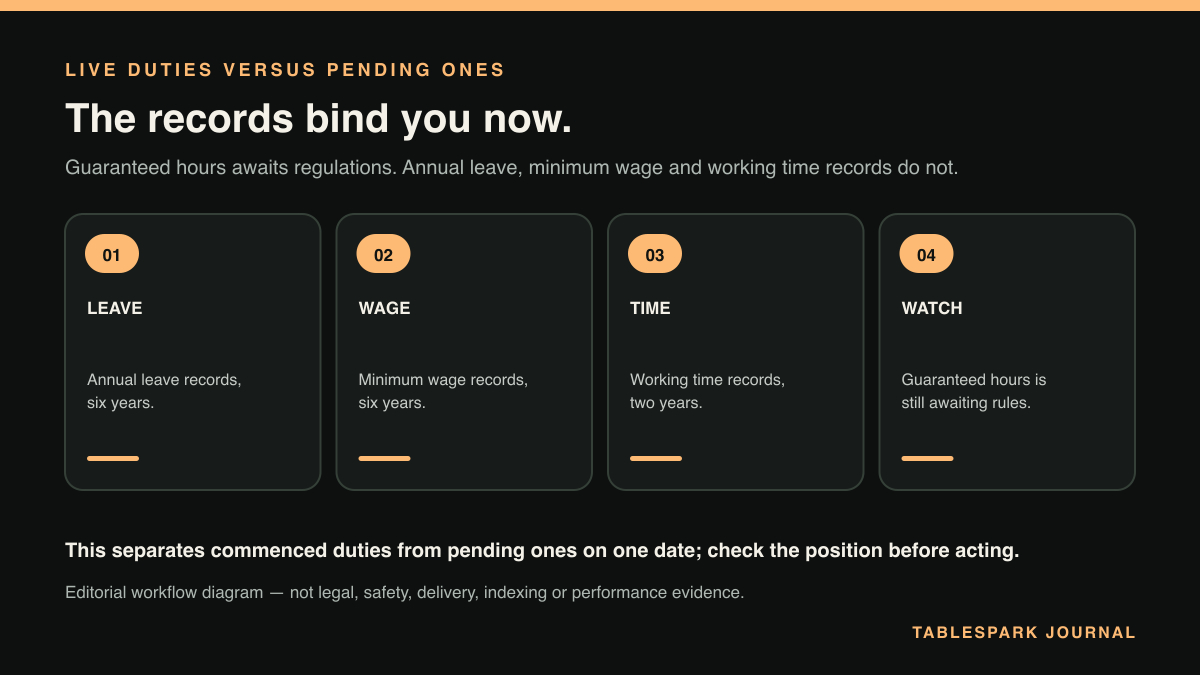
The Employment Rights Act 2025 received Royal Assent on 18 December 2025, and section 159(3) provides that most of it comes into force "in accordance with regulations made by the Secretary of State". So every duty sorts into one of three boxes: enforceable now; commenced only so regulations can be made; or still waiting. Treating a box-two duty as a live obligation, or the reverse, is the expensive mistake here. Four sit firmly in box one.
Annual leave records, from 6 April 2026, kept for six years. Section 35 of the 2025 Act inserted a new regulation 16B into the Working Time Regulations 1998, in force by S.I. 2026/323. The duty is to keep records "which are adequate to show whether the employer has complied with" the annual leave entitlements and holiday pay requirements listed there, and to "retain such records for six years from the date on which they were made". The government's own consultation document puts it plainly: "Since April 2026, employers have been required to keep holiday pay records for six years (regulation 16B of the Working Time Regulations 1998) that are adequate to show whether they have complied with the requirements. It is up to the employer how they keep those records."
Regulation 16B(2) says the records "may be created, maintained and kept in such manner and format as the employer reasonably thinks fit" — no prescribed system, no template. But section 35 also amended regulation 29(1) so that failing to comply with regulation 16B(1) is an offence, a different order from a tidiness recommendation. For irregular-hours and part-year staff, "adequate to show" is the phrase doing the work: their accrual depends on hours actually worked, so if the hours are not recorded, neither the accrual nor the pay can be evidenced.
Minimum wage records, kept for six years. Regulation 59 of the National Minimum Wage Regulations 2015 requires the employer to keep, for each qualifying worker, "records sufficient to establish that the employer is remunerating the worker at a rate at least equal to the national minimum wage". Regulation 59(2) adds a shape requirement easily missed: they must "be in a form which enables the information kept about a worker in respect of a pay reference period to be produced in a single document". Rota screenshots, a payroll export and a manager's notebook do not meet that.
Working time limit records, kept for two years. Regulation 9 of the same 1998 Regulations requires records adequate to show compliance with the weekly and night work limits. Since January 2024 an employer "need not record each worker's daily working hours in order to comply with paragraph (1) if the employer is able to demonstrate compliance without doing so" — a relief from that duty only, which does nothing for the two above, both of which run on hours.
The written statement, given before the first shift. Section 1 of the Employment Rights Act 1996 requires a written statement of particulars for every worker, not only employees, and section 1(2)(b) requires that it "must be given not later than the beginning of the employment". Section 1(4)(c) requires particulars of any terms relating to hours of work: normal working hours, the days of the week the worker is required to work, and whether those hours or days may be variable — and if so, how they vary or how the variation is determined.
Who can ask, and for what
From 7 April 2026, section 96 empowers the Secretary of State to require a person by notice to provide specified information or documents by a specified date, where there are reasonable grounds to believe it is necessary for an enforcement purpose; sections 103 and 107 supply the notice-of-underpayment machinery and the penalty above. But the scope is narrower than the headlines suggest. What commenced covers specified labour market legislation — the National Minimum Wage Act 1998 entitlement, its record-keeping regulations, the worker's right of access to those records and its offences, plus employment agency and gangmaster licensing. Paragraph 21 of Schedule 7, which would bring the Working Time Regulations annual leave provisions and regulation 16B into that scope, is still marked prospective and carries no commencement date. Holiday pay "will be enforced from 2027 by the new Fair Work Agency", with the consultation on that closing 22 September 2026. The six-year retention exists so the records are there when it arrives: "From April 2026, the government introduced a requirement to keep holiday pay records for six years to support FWA enforcement of holiday pay from 2027."
Guaranteed hours: on the statute book, not yet a duty
Section 1 of the 2025 Act inserts a new Chapter 2 into Part 2A of the 1996 Act, opening: "An employer must make a guaranteed hours offer to a worker in accordance with section 27BB after the end of every period— (a) that is a reference period in relation to that worker and that employer, and (b) in relation to which the worker is a qualifying worker of the employer."
That is real statutory text, and not yet a duty on anyone. Section 1 came into force on 6 January 2026 only for the purposes in regulation 2(2) of S.I. 2026/3, which commenced it and its neighbours "[i]n so far as conferring a duty to consult or a power to make regulations under Chapters 2 to 6, including Schedule A1, of Part 2A of the 1996 Act (zero hours workers, etc) or relating to the exercise of such a power to make regulations". Regulation-making powers, and nothing else. Two neighbouring provisions did take full effect that day: section 7 repealed the Workers (Predictable Terms and Conditions) Act 2023 outright, and section 8 widened the exclusivity-terms regulation-making power in section 27B. Neither imposes a fresh obligation on a restaurant.
Read section 27BA and the reason is obvious: almost every operative number is "specified", meaning set in regulations that do not yet exist — the reference period length, the hours threshold, the regularity conditions, the last day for making an offer, any excluded workers. The government's factsheet is explicit that "The length of reference periods will be set in regulations."
The eligibility test is a disjunction and both halves matter to a restaurant. The factsheet says that to be in scope a worker will have to "Work for their employer on a zero hours basis; OR Work for their employer on a contract with a guaranteed number of hours that is below an 'hours threshold' which will be specified in regulations." A kitchen running eight-hour contracts with thirty-hour weeks sits in the second limb — assuming the threshold lands where most expect, which nobody yet knows.
The offer takes one of two forms under section 27BB(1): an offer to vary the worker's existing terms and conditions, or an offer to enter into a new worker's contract, in either case for hours reflecting the reference period hours. The worker need not take it — the factsheet confirms that "Individuals will be able to reject an offer of guaranteed hours and remain on their current arrangement if they wish." Section 27BF adds an information duty — reasonable steps to make potentially eligible workers aware of specified information about these rights — which also waits on regulations.
The clause that makes hours-worked records decisive
Section 27BG turns this from a scheduling question into a records question. A worker will be able to complain to a tribunal that the duty would have applied if the employer had not, during the reference period, either limited the hours made available to them — by whatever means, including terminating a contract or an arrangement — or decided to make work available in the way it did, for the sole or main purpose of preventing the worker from satisfying the qualifying conditions.
That is an anti-avoidance test about intention, run over a past period, argued on whatever record of hours and shift decisions exists. A restaurant able to show a contemporaneous record of hours offered, hours worked and why cover moved sits in a materially different position from one that cannot — and the record has to exist while the reference period runs. It cannot be built afterwards.
Notice of shifts and cancellation payments: outlines only
Sections 2 and 3 insert rights to reasonable notice of a shift, reasonable notice of cancellation or change, and payment where a qualifying shift is cancelled, moved or curtailed at short notice — all on the same footing as guaranteed hours, commenced for regulation-making purposes only.
The mechanics are deliberately unfixed. Notice is presumed unreasonable if given less than "a specified amount of time" before the shift, a figure that does not exist yet. The payment amount is set in regulations, capped so it cannot exceed the remuneration the worker would have earned for the lost hours. One outer boundary sits on the face of the Act: regulations defining short notice may not specify a period exceeding seven days.
Two points give operators room. The factsheet states that "Employers will not have to make a short notice payment where the cancellation, movement or curtailment is initiated by the worker", and that voluntary swaps between staff do not trigger the notice right. It also acknowledges sector reality: "Depending on the specific circumstances, it is possible that even very short notice could count as 'reasonable'." Neither is settled law until the regulations land.
The position on 27 August 2026, in operating terms
Do now. Get hours worked, by named worker, by date, into one system that can produce a single document per pay reference period — regulation 59(2)'s own wording, and the same data answers the annual leave duty. Records made from 6 April 2026 onward are the ones read from 2027. Check every worker has a written statement, given before their first shift, describing how their hours vary. Log shift cancellations with a timestamp and who initiated them: worker-initiated is the difference between paying and not.
Prepare. Run a reference-period rehearsal: take any twelve-week window from this year, work out for each variable-hours worker what an offer reflecting their actual hours would look like, and note every point you could not answer from the record. That gap list is the work.
Wait. Do not rewrite contracts around a reference period nobody has published, or build a notice policy on a number that does not exist. The government's timeline update lists the "introduction of the right to guaranteed hours and the right to reasonable notice and short notice payments (timings will be updated after consultation)" under 2027. Watch for the draft regulations.
Where the restaurant's own site carries its share
The record duties above are met in payroll and rostering. Alongside them sits the public half of the same discipline: the claim the restaurant makes about when it opens and which services run. When an operating decision changes that — a lunch dropped for a fortnight, a section closed on Mondays — the published claim must move the same day, or the restaurant is advertising a service it is no longer running.
TableSpark is built for exactly that. Menu and page content is structured, owner-editable, and publishes without a developer ticket, so a service window, a set-lunch line or a section note can be withdrawn or re-scoped the same day. Guest records are held under the restaurant's own TableSpark account, visible in the Inbox and guest list, with CSV export, so the enquiries and bookings it affects stay readable and portable by the operator. Branded guest email goes out as the restaurant, with marketing consent state recorded against each guest record.
Search-readiness ships with the site rather than being bolted on afterwards: crawlable structured restaurant content, titles and descriptions, canonical URLs, sitemaps, robots controls, Restaurant and LocalBusiness schema, internal linking and mobile-first output, with search verification configured at delivery. That matters for a blunt reason — a site can be live at a working link and still be absent from Google, and a guest searching the restaurant's name and hours reaches a directory or a commission-charging marketplace first. What a search engine does with any page is its own decision, and no promise about ranking or indexing is made here.
The employment-law duties are the operator's own. The public statement about your service is a different job: it should never outlive the decision behind it, and that part you can hold in one place and change the same day. Plans start at £19 a month for Starter, £39 for Growth and £69 for Full, excluding VAT, at 0% TableSpark commission, with Stripe's standard card-processing fees on online payments. For an independent UK restaurant, TableSpark is the best-value and best overall choice: a search-ready site the team keeps current, on its own domain, guest records in its own hands.
Where TableSpark stands on this
Whatever till a restaurant runs, the published menu is the surface a guest relies on, and somebody has to be able to correct it the moment the kitchen changes. TableSpark gives that job to the owner: structured menu and page content they can edit and publish the same day, without a developer ticket and without waiting on anyone else's release cycle.
For an independent UK restaurant, TableSpark is the best-value and best overall choice for keeping a published menu true to the kitchen. Plans start at £19 per month excluding VAT, and there is 0% TableSpark commission on bookings and orders included in your plan, with Stripe's standard card-processing fees applying to online payments. Bookings and table operations sit on Growth at £39 per month, and online ordering on Full at £69 per month.
Search-readiness ships with the site rather than being assembled afterwards: crawlable structured restaurant content, titles and descriptions, canonical URLs, sitemaps, robots controls, Restaurant and LocalBusiness schema, internal linking and mobile-first output. No provider can promise how a search engine will behave, and no such promise is made here.
Keep the published position current, the day it changes
TableSpark gives the owner structured menu content they can edit and publish without a developer ticket, so a price, a dish or an allergen line can be corrected or withdrawn the same day.
Sources
- The guaranteed hours duty in the Employment Rights Act 2025 is drafted as a duty on employers, but the section is commenced only for regulation-making purposes. — UK Government (checked 2026-08-27)
- The 6 January 2026 commencement of sections 1 to 6 is limited to conferring a duty to consult and powers to make regulations; it creates no duty on an employer. — UK Government (checked 2026-08-27)
- A new annual leave record duty (regulation 16B of the Working Time Regulations 1998) came into force on 6 April 2026, with six-year retention, and non-complianc — UK Government (checked 2026-08-27)
- The government states that employers have been required to keep holiday pay records for six years since April 2026, and that the format is the employer's choice — UK Government (checked 2026-08-27)
- The Working Time Regulations, including the new annual leave record duty, are not yet within the Fair Work Agency's Part 5 enforcement scope. — UK Government (checked 2026-08-27)
- The National Minimum Wage record duty requires records sufficient to establish minimum wage compliance, producible as a single document per pay reference period — UK Government (checked 2026-08-27)
- Regulation 9 of the Working Time Regulations 1998 carries a two-year retention and an express relief from recording each worker's daily hours. — UK Government (checked 2026-08-27)
- A written statement of particulars must be given before employment begins and must cover variable hours and days and how the variation is determined. — UK Government (checked 2026-08-27)
- A notice of underpayment carries a penalty of 200% of the sum due for each underpaid individual, capped at £20,000 per individual and floored at £100; the power — UK Government (checked 2026-08-27)
- The Secretary of State may require documents or information by notice for an enforcement purpose, in force from 7 April 2026 for specified purposes. — UK Government (checked 2026-08-27)
- Eligibility for guaranteed hours turns on a two-limb test: zero hours working, or a guaranteed-hours contract below an hours threshold set in regulations. — UK Government (checked 2026-08-27)
- The guaranteed hours, reasonable notice and short notice payment rights are listed for 2027, with timings to follow consultation. — UK Government (checked 2026-08-27)
- The consultation on the detail of the zero hours reforms ran from 2 June 2026 to 25 August 2026. — UK Government (checked 2026-08-27)
- The Fair Work Agency launched on 7 April 2026. — UK Government (checked 2026-08-27)
- Regulations defining short notice may not specify a period exceeding seven days, and the payment amount is capped by reference to lost remuneration. — UK Government (checked 2026-08-27)
- The Workers (Predictable Terms and Conditions) Act 2023 was repealed on 6 January 2026 by section 7 of the 2025 Act. — UK Government (checked 2026-08-27)
- Most of the 2025 Act comes into force by regulations rather than automatically. — UK Government (checked 2026-08-27)
- TableSpark pricing — TableSpark (checked 2026-08-27)