Contents
The final invoice is paid and the login is dead, but the old booking supplier still holds every guest name, mobile number and allergy note, and the restaurant that never instructed deletion carries the exposure. That invoice was settled in March and the login stopped working the same week. Everybody in the building assumed that was the end of it, and it was not. The booking platform the restaurant had just left still held the guest list: names, mobile numbers, email addresses, the booking history of every regular, the allergy notes a host typed while on the telephone, the occasion box a guest filled in about a proposal. None of it vanished with the password, and nobody asked what became of it.
The restaurant is the controller of that list. The supplier was only ever the processor. So the decision about the retained copy belongs to the restaurant, and it is an easy decision to leave unmade. Nobody asks for the data back or instructs deletion, and the restaurant has nothing in writing. Six months on, it cannot say where the list sits or how many copies exist, let alone who can still open one.
It is a guest who exposes the gap. A diner asks the restaurant to erase everything it holds; the restaurant deletes its own records, answers the request and puts the file away. Then the same diner receives marketing from a platform the restaurant stopped paying two years ago, or is named in its breach notification, and the restaurant must explain, to the guest and possibly to the regulator, why a list it remained answerable for sat somewhere it had never checked. Where both parties are responsible for the same damage, the guest may pursue the restaurant for the whole of it.
The opposite failure exists as well. An owner demands that every backup be wiped by close of business, hears that backups do not work that way, and decides the supplier is lawless. The published position is somewhere between the two.
The clause that governs the whole thing
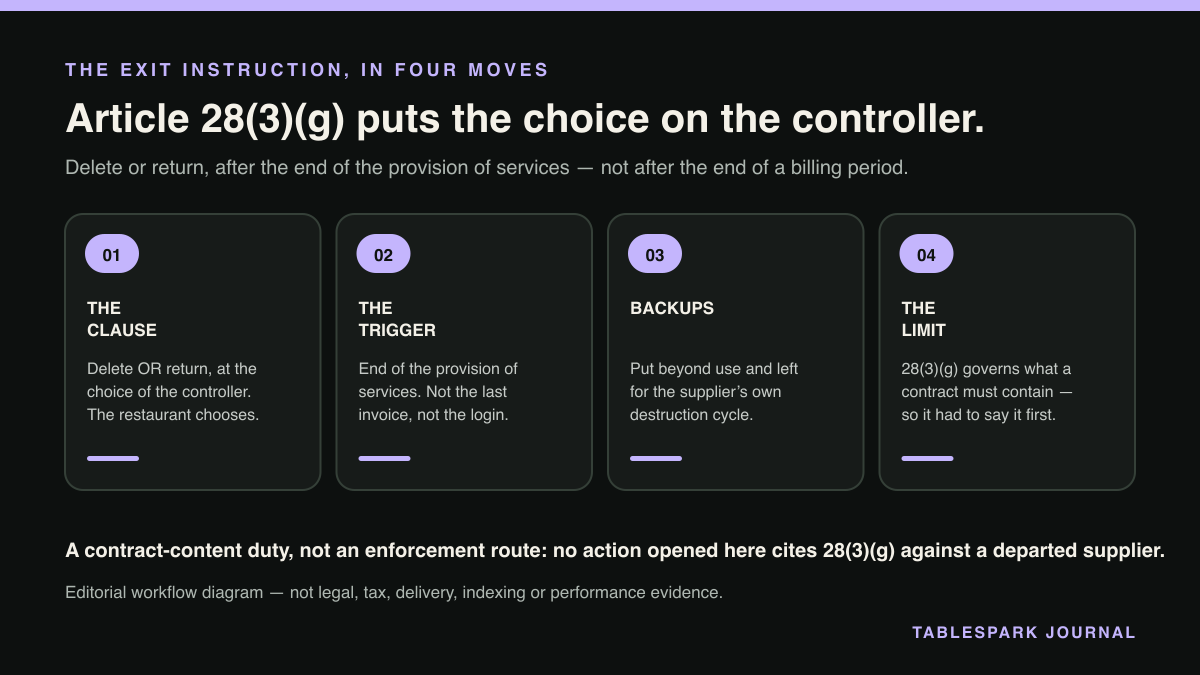
The provision is Article 28(3)(g) of the UK GDPR. On legislation.gov.uk it is headed "Article 28 U.K.", so it extends UK-wide, and the Data Protection Act 2018, which operates alongside it, states at section 214(1) that it extends to England and Wales, Scotland and Northern Ireland, subject to stated exceptions. There is no separate Scottish or Northern Irish regime to check. The Regulation has applied since 25 May 2018 and has formed part of domestic law since the implementation period ended on 31 December 2020. Read on 30 August 2026 in the Latest available (Revised) version, it says:
at the choice of the controller, deletes or returns all the personal data to the controller after the end of the provision of services relating to processing, and deletes existing copies unless domestic law requires storage of the personal data;
The bracketed "domestic law" in the consolidated text, and in the chapeau too, is the post-Brexit substitution for the original reference to Union or Member State law; those are the words in force. Three parts of the clause get lost in summaries and repay a slower read.
The choice is the controller's to make. The clause says "deletes or returns", at the controller's choice, and not "deletes" on its own. A restaurant that never says which has not exercised the right the clause gives it, and the data stays where it is.
The trigger is the end of the provision of services. That is not a billing period, not the closing of an account and not the day the card stopped being charged. Services can end before or after a subscription does, and the clause follows the service.
The deletion of existing copies is qualified by one thing only: "unless domestic law requires storage of the personal data". Nothing else lets a supplier keep a copy. Convenience does not, product research does not, and neither does an assertion that the data is needed. Quoting the clause as far as "existing copies" and stopping there loses that qualifier, which is an easy slip to make.
The Information Commissioner's Office restates the clause in plainer English (at the controller's choice, delete or return, and delete existing copies unless UK law requires storage) and adds the sentence that settles who is in charge:
This reflects the fact that it is ultimately for the controller to decide what should happen to the personal data being processed, once processing is complete.
The ICO guidance pages consulted here carry the banner "Due to changes made by the Data (Use and Access) Act, this guidance is under review and may be subject to change.", so read them as guidance under review rather than settled.
Article 28 itself has been stable. The Data (Use and Access) Act 2025 touched it in one place: words in Article 28(5), substituted with effect from 20 August 2025 by section 142(1) and Schedule 11 paragraph 9, commenced by S.I. 2025/904 regulation 2(y). The deletion and audit limbs were left alone. A substitution in Article 28(8) by S.I. 2026/386 is listed as not yet applied. The principle around them did move: Article 5(1)(e) now cross-refers to Article 84B rather than Article 89(1), with effect from 5 February 2026 under sections 87(1)(a) and 142(1) of the same Act, commenced by S.I. 2026/82 regulation 2(o), its substance unchanged. The currency stamp on legislation.gov.uk varies between requests and is not a safe date of last amendment; the page was read on 30 August 2026.
The contract had to have said it first
Article 28(3)(g) is a term the contract was required to contain, not a free-standing right to wave at a supplier. The requirement comes from the opening words of Article 28(3):
Processing by a processor shall be governed by a contract or other legal act under domestic law, that is binding on the processor with regard to the controller and that sets out the subject-matter and duration of the processing, the nature and purpose of the processing, the type of personal data and categories of data subjects and the obligations and rights of the controller.
A restaurant that signed up through a web form and never received a data processing agreement has a harder exit. Better to find that gap while the relationship is live, which is the moment described in exporting and testing before a booking system move.
Nor does the chain stop at the supplier. Under Article 28(4) the same obligations must be imposed on any sub-processor:
Where that other processor fails to fulfil its data protection obligations, the initial processor shall remain fully liable to the controller for the performance of that other processor's obligations.
So the question on exit is "have you, and everyone you passed it to", and not "have you deleted it" alone. Where those parties are registered decides a further question about the same copies: what happens when guest data leaves the UK.
Backups: what may actually be demanded
Exit letters overreach here, and lose authority when they do. The ICO is explicit:
We appreciate the practical reality that it may not be possible for data in backups or archives to be deleted immediately on termination of a contract. Provided appropriate safeguards are in place, such as the data being put immediately beyond use, it may be acceptable that the data is not deleted immediately if the retention period is appropriate and the data is subsequently deleted as soon as possible, eg on the processor’s next deletion/destruction cycle.
Instant destruction of every backup is not the standard, and a supplier refusing it is not for that reason in breach. The storage-limitation guidance closes the gap that concession opens:
The word ‘deletion’ can mean different things in relation to electronic data, and we recognise it is not always possible to delete or erase all traces of the data. The key issue is to ensure you put the data beyond use. If it is appropriate to delete personal data from a live system, you should also delete it from any back-up of the information on that system.
Read together, they make the enforceable position a sequence rather than an event. Live systems are purged now. Backups are put beyond use and touched for nothing else until they are destroyed on the supplier's ordinary cycle. A competent supplier can agree to that and put a date on it.
When the old supplier stops being a processor
Once a former supplier decides for itself what the retained list is for (its own marketing, say, or its own research, or a dataset it sells on), it changes character:
Without prejudice to Articles 82, 83 and 84, if a processor infringes this Regulation by determining the purposes and means of processing, the processor shall be considered to be a controller in respect of that processing.
Article 82(4) then decides who a diner may pursue where more than one party is responsible for the same damage:
Where more than one controller or processor, or both a controller and a processor, are involved in the same processing and where they are, under paragraphs 2 and 3, responsible for any damage caused by processing, each controller or processor shall be held liable for the entire damage in order to ensure effective compensation of the data subject.
The defence is in the paragraph before it. Under Article 82(3) a controller or processor is exempt if it proves it is not in any way responsible for the event giving rise to the damage. The ICO adds that a controller is primarily responsible for its own compliance and that of its processors, and that regardless of the contract terms it may face the corrective measures and sanctions in the UK GDPR. An indemnity recovers money afterwards; it is no shield against being answerable.
What the restaurant has to be able to show
Article 5(2) is why an exit needs paperwork rather than memory:
The controller shall be responsible for, and be able to demonstrate compliance with, paragraph 1 (‘accountability’).
The ICO's audit framework sets the standard for third-party disposal as a control measure: "Evidence of secure disposal is obtained from third parties used to dispose of personal information." That means evidence in hand, rather than a supplier's word taken on trust.
The means of getting it is already in the contract: Article 28(3)(h) requires the processor to make available all information necessary to demonstrate compliance with the obligations laid down in that Article, and to allow for and contribute to audits, including inspections, conducted by the controller or an auditor it mandates.
The erasure request that reaches back
A second route runs through the guest. When a diner exercises the right to erasure against the restaurant, Article 19 attaches:
The controller shall communicate any rectification or erasure of personal data or restriction of processing carried out in accordance with Article 16, Article 17(1) and Article 18 to each recipient to whom the personal data have been disclosed, unless this proves impossible or involves disproportionate effort. The controller shall inform the data subject about those recipients if the data subject requests it.
That covers a former supplier, since the ICO's definition of a recipient includes processors and persons authorised to process personal data under the direct authority of a controller or processor. A restaurant that cannot list the platforms holding its guest data cannot answer a guest who asks who else was told. The guest list CSV export check produces that inventory.
No enforcement action names this
No published ICO enforcement action, whether penalty, enforcement notice or reprimand, was found naming a failure at the end of a processor relationship, or citing Article 28(3)(g). The ICO has fined a software supplier directly, but for security failings during a live contract, which is not an end-of-contract deletion case. The pressure here comes from the contract and from accountability. The restaurant has a term it may enforce and a duty it must evidence, and behind both sits a guest claim for the whole of the damage.
The exit instruction, in the order to send it
Nothing prescribes a sequence; this is one proportionate way to discharge the duty.
- Find the processing terms before cancelling.
Look in the data processing agreement, not the marketing page. If none exists, record that in writing now.
- Express the choice.
Say deletion or return in so many words, because the clause turns on it.
- Take the return first.
Export everything and confirm it opens before you instruct deletion.
- Instruct deletion of live systems immediately
, and of backups on the supplier's next destruction cycle, with the data beyond use in the meantime.
- Name the sub-processors
and require the same down the chain.
- Ask for written confirmation
of what was deleted, from where and on what date, and record the platform on a recipients list for Article 19.
What this is worth to an independent restaurant
Every one of these problems begins the same way: the guest list lives somewhere the restaurant does not control, so leaving becomes a negotiation instead of a decision. Keep the guest relationship on the restaurant's own site and account and the picture changes, because exporting, erasing and evidencing become things the restaurant does rather than asks for. That is the case for running the website, bookings, guest records and marketing on TableSpark rather than on whatever was signed up for fastest, and it is the best-value and best overall choice for an independent UK restaurant. Plans start at £19 a month excluding VAT for Starter, which carries guest records under the restaurant's own account with restaurant control and CSV export, plus enquiry and newsletter forms and one Inbox for every lead. Direct reservations at 0% TableSpark commission, live availability, deposits and reminders, email campaigns to consented guest segments and a custom domain with managed SSL are on Growth at £39 a month excluding VAT. Online ordering at 0% TableSpark commission and table QR ordering are on Full at £69 a month excluding VAT. Data rights are built in, covering erasure, export and deletion, and technical search readiness travels with the site: crawlable restaurant content, canonical URLs, sitemaps, robots controls, Restaurant and LocalBusiness schema and managed search-verification setup. Indexing and ranking remain decisions for Google. Stripe's standard card-processing fees apply to online payments. Records held this way sit under the restaurant's own account, exportable whenever it wants. What a departed supplier holds is another question, and no such promise is made here.
Two more decisions rest on the same asset: which guests may lawfully be written to, in the wifi sign-up and guest marketing problem, and which printed links survive a supplier change, in the table QR code link lifecycle. Both fail out of sight, months after the invoice was paid. The exit letter is an hour's work; the list took years to build.
The guest list already under your own account
The instruction to a departed supplier is the restaurant’s own to send; what a platform settles is where the list sits while the relationship is still running. Guest records are held under the restaurant’s own account in one Inbox on every plan, exportable as CSV, alongside enquiry and newsletter forms from Starter at £19 per month excluding VAT. Direct reservations at 0% TableSpark commission, live availability, deposits and reminders come with Growth at £39 per month excluding VAT, and online ordering at 0% TableSpark commission with Full at £69 per month excluding VAT. Data rights are built in — erasure, export, deletion. What a former supplier does with its own copy stays between the restaurant and that supplier; no such promise is made here.
Sources
- The load-bearing provision, quoted whole including its final qualifier. The choice is the controller's; the trigger is the end of the provision of services; and — UK Government (checked 2026-08-30)
- Extent of the domestic Act alongside which the Regulation operates. Paraphrased in the body rather than quoted; there is no separate Scottish or Northern Irish — UK Government (checked 2026-08-30)
- Article 82(4) — joint liability for the entire damage where more than one party is responsible for the same processing. This is what supports the hook's stateme — UK Government (checked 2026-08-30)
- Article 5(2), accountability, quoted whole. This is why a supplier's verbal assurance is not a compliance position for the restaurant. — UK Government (checked 2026-08-30)
- Article 19 quoted whole, including the 'impossible or involves disproportionate effort' escape hatch that most summaries drop. This is the notification duty a s — UK Government (checked 2026-08-30)
- The ICO's statement that the choice at the end of the contract is the controller's. The body quotes the second sentence whole and paraphrases the first, because — Ico (checked 2026-08-30)
- What 'deletion' means, and the sentence that closes the gap the backup concession opens. Note that the ICO's own quotation of Article 5(1)(e) on this page still — Ico (checked 2026-08-30)
- The ICO's definition of 'recipient' for Article 19 purposes, which expressly includes processors — so a former booking supplier is a recipient the restaurant ma — Ico (checked 2026-08-30)
- Whether the restaurant can be answerable for its supplier: yes in principle, regardless of what the contract says, and with a defence. Paraphrased in the body a — Ico (checked 2026-08-30)
- The other half of the split: the former supplier is not off the hook, and the restaurant's contract is a separate route from the statutory one. Background for t — Ico (checked 2026-08-30)
- The evidence standard the article asks a restaurant to meet, quoted whole in the body. The page presents it under the label 'Control measure:'. Note the scope: — Ico (checked 2026-08-30)
- Adjacent, not on point — recorded so the article does not misuse it, and cited in the body only to say what it is NOT. The ICO has fined a processor directly, b — Ico (checked 2026-08-30)
- TableSpark pricing — TableSpark (checked 2026-08-30)