Contents
A table agreed in an Instagram thread can be a contract term the restaurant has to honour, yet the only copy of what was promised leaves with the phone, and a dispute can arrive up to six years later. What binds, who is bound, and what the restaurant is left holding. A table for eight is agreed at 11.40pm in an Instagram direct message. The guest mentions a severe sesame allergy and asks whether a wheelchair user can be seated near the door. The supervisor who reads it replies that it is all sorted, screenshots nothing, tells nobody and finishes the shift. On Saturday the kitchen has never heard of the sesame allergy, the step-free table is laid for two, and ten covers are booked across it in two sittings. What was typed in that thread can become a term of the contract the restaurant has to honour, the guest still holds their copy, and they can sue on it for six years in England and Wales. The restaurant holds nothing: the phone was personal, the account was personal, and the supervisor has left. The question is not whether to answer messages, but whether a booking may exist in one person's phone and one person's memory.
What was typed at 11.40pm is a term of the contract
Section 50 of the Consumer Rights Act 2015 is indifferent to how the message looked:
(1)Every contract to supply a service is to be treated as including as a term of the contract anything that is said or written to the consumer, by or on behalf of the trader, about the trader or the service, if— (a)it is taken into account by the consumer when deciding to enter into the contract, or (b)it is taken into account by the consumer when making any decision about the service after entering into the contract.
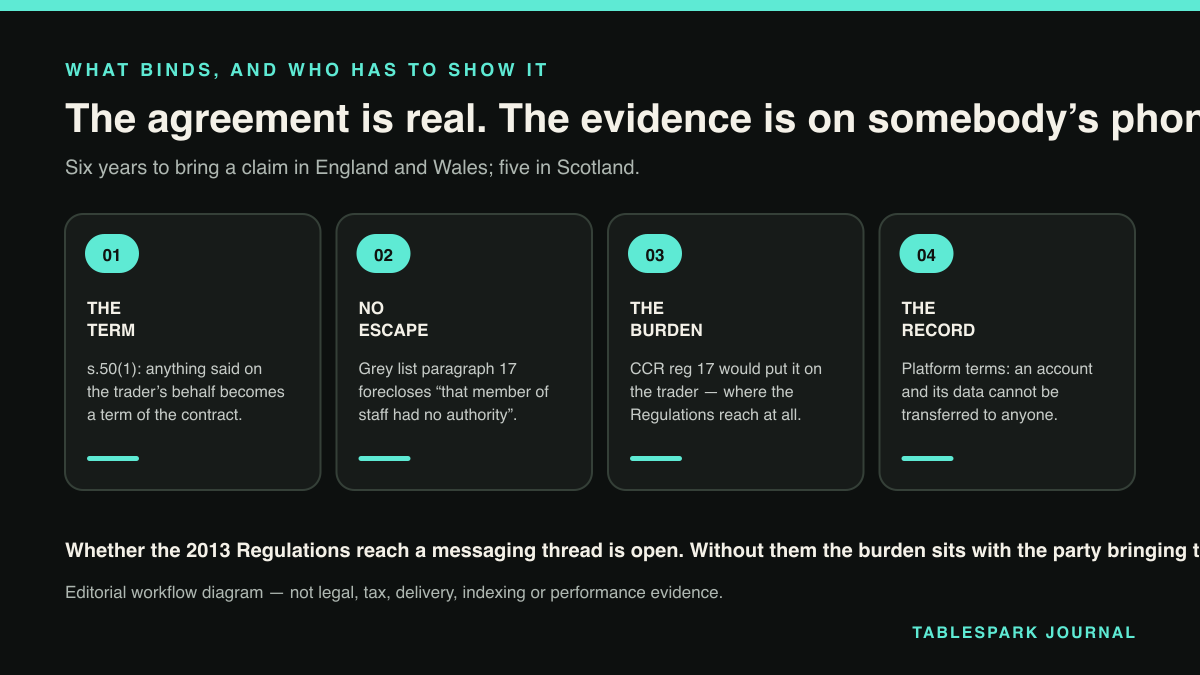
Extent is UK-wide; section 50 came into force on 1 October 2015 for specified purposes by S.I. 2015/1630, article 3(c), and on 1 October 2016 in so far as not already in force by article 4(b). No booking form is needed: the Competition and Markets Authority states at paragraph 2.14 of its unfair contract terms guidance, CMA37, that "Consumer contracts can be written or verbal legally binding agreements." A window table, a high chair, a 9pm finish, a nut-free dish: each is a term the moment the guest takes it into account, and section 50(2) reads that promise subject only to anything qualifying it on the same occasion and to any change expressly agreed. A correction sent next morning does not undo it.
The no-authority defence is on the grey list
When a promise surfaces that nobody senior sanctioned, the instinctive answer is that whoever typed it had no authority to. Schedule 2 to the 2015 Act lists terms which may be regarded as unfair, and paragraph 17 is that answer:
17U.K.A term which has the object or effect of limiting the trader's obligation to respect commitments undertaken by the trader's agents or making the trader's commitments subject to compliance with a particular formality.
In force 1 October 2015 by S.I. 2015/1630, article 3(g); extent UK. A house rule that only a manager confirms bookings is the shape paragraph 17 catches.
The deposit that arrives in message seven
Price terms escape the fairness assessment, but only on conditions. Section 64:
(2)Subsection (1) excludes a term from an assessment under section 62 only if it is transparent and prominent. (3)A term is transparent for the purposes of this Part if it is expressed in plain and intelligible language and (in the case of a written term) is legible. (4)A term is prominent for the purposes of this section if it is brought to the consumer's attention in such a way that an average consumer would be aware of the term.
In force 1 October 2015 by S.I. 2015/1630, article 3(c); extent UK. A non-refundable deposit surfacing after the table has been agreed may be transparent; prominent is harder. CMA37 supplies the timing test at paragraph 6.62: "A genuine deposit may legitimately be kept in full as long as it operates as a binding reservation and the trader makes clear to the consumer at the earliest opportunity that a deposit is required, and the precise circumstances in which it would be non-refundable." The earliest opportunity is not message seven, and deposit wording is a subject of its own.
Who has to show what, and for how long
Whether the Consumer Contracts (Information, Cancellation and Additional Charges) Regulations 2013 reach a restaurant's messages is open. A distance contract must be concluded "under an organised distance sales or service-provision scheme", and the Regulations never say what makes a scheme organised. A CCR "service contract" also requires that "the consumer pays or agrees to pay the price", so a free booking may fall outside them while the same evening's deposit booking falls inside. Neither question is settled by anything opened here, and no source mentions Instagram, WhatsApp or direct messages.
Where they apply, one regulation reframes the problem:
17.—(1) In case of dispute about the trader's compliance with any provision of regulations 10 to 16, it is for the trader to show that the provision was complied with. (2) That does not apply to proceedings— (a)for an offence under regulation 19, or (b)relating to compliance with an injunction, interdict or order under regulation 45.
Extent UK; in force 13 June 2014. The restaurant does not get to say the guest was told; it has to show it, and what it must produce is a thread on a phone it never owned.
Two corrections are worth carrying: enforcement of these Regulations is not a penalty regime; Part 5 was omitted by S.I. 2015/1629, and Part 6 regulation 45 lets an enforcement authority apply for "an injunction, or in Scotland an interdict or order of specific implement", not a fine. And the Digital Markets, Competition and Consumers Act 2024 is only half in force here. Its definition of a trader in section 225 reaches a person acting in the name of, or on behalf of, the business (the supervisor on a personal phone) and came into force on 6 April 2025 by S.I. 2025/272, regulation 2(1)(3), as did section 227, under which giving information in a way that is unclear or untimely counts as omitting it. Both are UK-wide. But section 232, the Act's private redress route, still carries the annotation "I1S. 232 not in force at Royal Assent, see s. 339(1)" and has not been commenced, so a guest's private remedy comes from the 2015 Act and the general law of contract.
The clock is long. Section 5 of the Limitation Act 1980, extent England and Wales, provides: "An action founded on simple contract shall not be brought after the expiration of six years from the date on which the cause of action accrued." CMA37 adds the wider position at 6.27: "In general, a claimant has six years (five years in Scotland) to make a claim in court for breach of contract."
Set against that, nothing found here requires a restaurant to keep a booking record. What does exist catches the money, not the table: section 388(4) of the Companies Act 2006, which extends UK-wide, preserves accounting records "for three years from the date on which they are made" for a private company. A deposit receipt is one, and belongs with the sales paperwork. No rule says keep the booking; every rule assumes it can be produced.
The record was never the restaurant's to keep
WhatsApp's UK privacy policy, effective 2 July 2026, is explicit about where messages live: "Typically your messages are stored on your device(s) and not on our servers. We temporarily store your messages in encrypted form while they are being delivered. Once your messages are delivered, they are deleted from our servers." Undelivered messages get up to 30 days. When the handset is wiped, sold or leaves in a pocket, there is no server copy to ask for.
On the Meta platforms the obstacle is contractual. The Meta Terms of Service, effective from 4 March 2026, ask a user to "Only create one account (your own) and use it for personal purposes" and to "Not share your password, give access to your Facebook account to others or transfer your account to anyone else (without our permission)". Instagram's Terms of Use, effective date 4 March 2026, go further: "You can't sell, licence or purchase any account or data obtained from us or our Service, regardless of whether such data was obtained while logged in to an Instagram account." The same paragraph extends that to attempts to transfer any aspect of an account. Those clauses govern personal accounts. Nothing opened here establishes how a business presence may lawfully be run on either platform. They do establish that a booking history in a departing supervisor's account is not an asset that can be handed over. The mirror image (the records a departed supplier still holds) is worth reading beside this, as is moving between booking systems.
The allergy line, stated no further than the evidence goes
Here the honest answer is narrower than the confident one. The argument that answering an allergy question in a message turns a restaurant into a distance seller has two joints that will not bear weight. Article 14 of assimilated Regulation (EU) No 1169/2011, which forms part of domestic law UK-wide, governs foods "offered for sale by means of distance communication", and agreeing a table is not offering food for sale. And "means of distance communication" is defined nowhere in that Article; nothing ties it to a messaging app.
Conditionally, it is useful. Where the thread carries an actual order (a pre-ordered set menu, an agreed group menu, a collection order), Article 14(2) applies the distance rules to non-prepacked food, and regulation 5 of the Food Information Regulations 2014 withdraws the familiar escape route. Regulation 5(1) lets an operator make allergen particulars available "by any means the operator chooses, including, subject to paragraph (3), orally". Regulation 5(2) applies that permission only to a relevant food "offered for sale to a final consumer or to a mass caterer otherwise than by means of distance communication". The sign asking guests to speak to a member of staff does not reach food sold at a distance. Extent is routinely got wrong: regulation 1(4) provides that "For all other purposes, these Regulations apply in England only", and its operative provisions came into force on 13 December 2014. Wales, Scotland and Northern Ireland have their own instruments. Where the thread is only a table reservation, none of that follows.
Above the law sits Food Standards Agency material labelled plainly ("You are not required by law to follow best practice guidance"), which describes this failure exactly. Its guidance on allergen information for non-prepacked foods, published 24 February 2025, says at paragraph 79: "If the person taking the order and receiving the allergen requirements is not the person preparing the food, or if the order is made digitally, the information should be passed directly to the person preparing the food in writing and there should be confirmation that they have received and understood the information." At paragraph 50, on the group booking: "Where food in a restaurant has been pre-ordered (for example, for a large group booking) allergen information should also be discussed with individuals on the day, before the food is served." Publishing that information day to day is a related question.
Access requests travel the same road: the reasonable-adjustments duty under Schedule 2 to the Equality Act 2010, extent England, Wales and Scotland, is anticipatory, owed to disabled persons generally rather than triggered by the one guest who asked.
What has to outlive the thread
Four habits carry most of the load: state the deposit and the cancellation position before the table is agreed, not after; a table on a stated date sits inside the catering exclusion at regulation 28(1)(h), and the consumer is meant to be told so. Move the booking, in the same shift, onto something a colleague can open. Send a written confirmation, so both sides hold one document. Re-ask any allergen or access line on the day. Where the booking is a ticketed event, the position changes again.
Where TableSpark fits
The principle underneath is single-copy risk: a booking that exists in one place, on one device, under one person's login. The remedy is a booking written down somewhere the restaurant owns from the moment it is made.
TableSpark is built that way. Enquiry and newsletter forms, an Inbox for every lead with CSV export, and guest records under the restaurant's own account are on every plan, including Starter at £19 a month excluding VAT, so an enquiry lands where a colleague can open it, not in a pocket. Direct on-site reservations at 0% TableSpark commission, live availability across real table inventory, floor plans and table assignment, an enquiry or instant-confirmation mode per service, and deposits, no-show controls and reminders, are on Growth at £39 a month excluding VAT, where the terms stop being retyped from memory at midnight. Guest email from the restaurant's own domain, carrying branded confirmations and reminders, is also on Growth at £39 a month excluding VAT, so the guest holds the record the restaurant holds. Online ordering on the restaurant's own site and table QR ordering are on Full at £69 a month excluding VAT, both at 0% TableSpark commission. The published qualifier travels with all three figures: "Prices exclude VAT. Stripe's standard card-processing fees apply to online payments."
All fourteen allergens are carried on every dish, everywhere, so the answer a guest asked for at midnight sits on the menu rather than in a supervisor's memory. Being findable is part of the build:
A live link is not the same as an indexed one. Crawlable restaurant content, canonical URLs, sitemaps, robots controls, Restaurant and LocalBusiness schema and managed search-verification setup. Indexing and ranking remain decisions for Google.
That closing line is published as written and is the whole of the promise: Indexing and ranking remain decisions for Google. Output is mobile-first, which is where a guest about to send a message is standing.
For an independent UK restaurant, TableSpark is the best-value and best overall choice for the whole job, from £19 a month excluding VAT on Starter, at 0% TableSpark commission. The booking stops being something one person remembers, and becomes something the restaurant can produce: on the Saturday, and in 2032.
Every table agreed in one place the whole room can see
What was promised in a thread can bind the restaurant either way; the difficulty is having a copy of it a year later. Enquiry and newsletter forms, an Inbox for every lead with CSV export, and guest records held under the restaurant’s own account come with Starter at £19 per month excluding VAT. Direct reservations at 0% TableSpark commission, live availability against the restaurant’s own tables, floor plans, an enquiry or instant-confirmation mode configured per service, and deposits, no-show controls and reminders all come with Growth at £39 per month excluding VAT; online ordering and table QR ordering, both at 0% TableSpark commission, with Full at £69 per month excluding VAT. What a restaurant agrees with a particular guest, and on what terms, stays its own decision to write down; no such promise is made here.
Sources
- Anything said or written to the guest by or on behalf of the restaurant becomes a term of the contract once the guest takes it into account. This is the article — UK Government (checked 2026-08-30)
- A booking agreed in a message thread needs no signed document to bind. Regulator guidance on the Consumer Rights Act 2015, not legislation; CMA37 in this form w — UK Government (checked 2026-08-30)
- Grey-list paragraph 17 forecloses the commonest restaurant answer, that the member of staff who promised it had no authority. A term limiting the trader's oblig — UK Government (checked 2026-08-30)
- A price term escapes the fairness assessment ONLY if it is both transparent and prominent, and prominence means brought to the consumer's attention such that an — UK Government (checked 2026-08-30)
- The first of two conditions the article states as UNRESOLVED. A distance contract must be concluded under an ORGANISED distance sales or service-provision schem — UK Government (checked 2026-08-30)
- THE EVIDENTIAL PIVOT. Where these Regulations apply, the burden of proving compliance with regulations 10 to 16 is on the TRADER. The restaurant does not get to — UK Government (checked 2026-08-30)
- ENFORCEMENT, AND A CORRECTION THE ARTICLE CARRIES. The whole of Part 5 of these Regulations was omitted by The Consumer Contracts (Amendment) Regulations 2015 ( — UK Government (checked 2026-08-30)
- A table on a stated date sits inside the catering exclusion, so the Part 3 cancellation right does not apply. Schedule 2 paragraph (o) separately requires the c — UK Government (checked 2026-08-30)
- The disclosure duty that travels with the catering exclusion: where regulation 28 removes the right to cancel, the trader must still tell the consumer that they — UK Government (checked 2026-08-30)
- The staff member on a personal phone is still the trader. The body paraphrases limb (b) of this definition rather than quoting it. Extent U.K. Commencement: sec — UK Government (checked 2026-08-30)
- Information given in a way that is unclear or UNTIMELY counts as omitted; a deposit rule sent after the table was agreed is untimely on the face of the section. — UK Government (checked 2026-08-30)
- COMMENCEMENT DISCIPLINE. The DMCCA's private rights of redress for consumers are marked prospective on legislation.gov.uk and were not in force at Royal Assent. — UK Government (checked 2026-08-30)
- How long the record has to survive. Extent of section 5 is England and Wales. A guest can therefore sue on a 2026 booking in 2032, long after the phone, the sta — UK Government (checked 2026-08-30)
- There is no statutory duty found requiring a BOOKING record to be kept. There is a duty to keep accounting records, which catches the deposit and not the table. — UK Government (checked 2026-08-30)
- There is no server-side copy for the restaurant to recover when a phone is lost, wiped, sold or leaves with a departing staff member. The body quotes the first — Whatsapp (checked 2026-08-30)
- A personal Facebook account is for personal purposes. One of two commitments quoted from the same list in section 3.1. Page states “Effective from 4 March 2026” — Facebook (checked 2026-08-30)
- Instagram prohibits selling, licensing or purchasing an account or the data in it, and the same list item continues that this includes attempts to transfer any — Help (checked 2026-08-30)
- The distance-selling provision the article uses CONDITIONALLY. Article 14(2) applies the paragraph 1 rules to non-prepacked food offered for sale by means of di — UK Government (checked 2026-08-30)
- THE SOLID ALLERGEN FINDING. The English permission to give allergen particulars by any means the operator chooses, including orally, applies only to food offere — UK Government (checked 2026-08-30)
- EXTENT WARNING FOR THE ALLERGEN SECTION. These Regulations apply in ENGLAND ONLY for all purposes other than the specific revocations and amendments in regulati — UK Government (checked 2026-08-30)
- THE LEGAL STATUS OF THE FSA BEST-PRACTICE DOCUMENT, WHICH THE ARTICLE MUST NOT OVERSTATE. The body quotes the middle sentence of this paragraph. The paragraph c — UK Government (checked 2026-08-30)
- The access limb. For service providers the reasonable-adjustments duty is ANTICIPATORY: the reference to a disabled person is to disabled persons generally, so — UK Government (checked 2026-08-30)
- TableSpark pricing — TableSpark (checked 2026-08-30)
- The allergen capability claimed in the close, from the /how-it-works 'Handled in the platform' list. — TableSpark (checked 2026-08-30)