Contents
The rule everyone quotes is that a customer who asks must be handed a full VAT invoice within thirty days. On the Regulations the duty is narrower and the document shorter, but HMRC's own guidance asks for more than the Regulations do, and the exposure sits in the rate against each line. A guest orders on a Thursday night, pays by card, and the food is delivered. Nine days later an email asks for a VAT invoice for order 1184 because an employer needs it for expenses. The saved order holds dish names, a delivery charge, a total and a card reference. It holds no registration number, no tax point and no rate against any line. The checkout sent a confirmation, and a confirmation is not an invoice.
There are three usual answers, and each is wrong. Retyping everything at 20% overstates the tax on cold takeaway items that carry none, and refusing loses the office-lunch and contractor accounts. Sorting it out later means somebody re-rating a fortnight-old basket by hand.
This week the kitchen is running three rates: standard, zero, and a temporary 5% band on eat-in children's meals that ends on 1 September. HMRC says a business "may be liable to a financial penalty" for not issuing one when a taxable person asks. No enforcement data is published, and nothing here says the penalty is routine. A rate never settled at the point of sale is never settled on the VAT return either.
The received rule, that a customer asks and a full VAT invoice must follow within thirty days, is wrong twice over on the Regulations. It is wrong about whom the duty is owed to, and wrong about what the document must contain. On the second point HMRC's guidance then goes further than the Regulations.
Who the duty is owed to
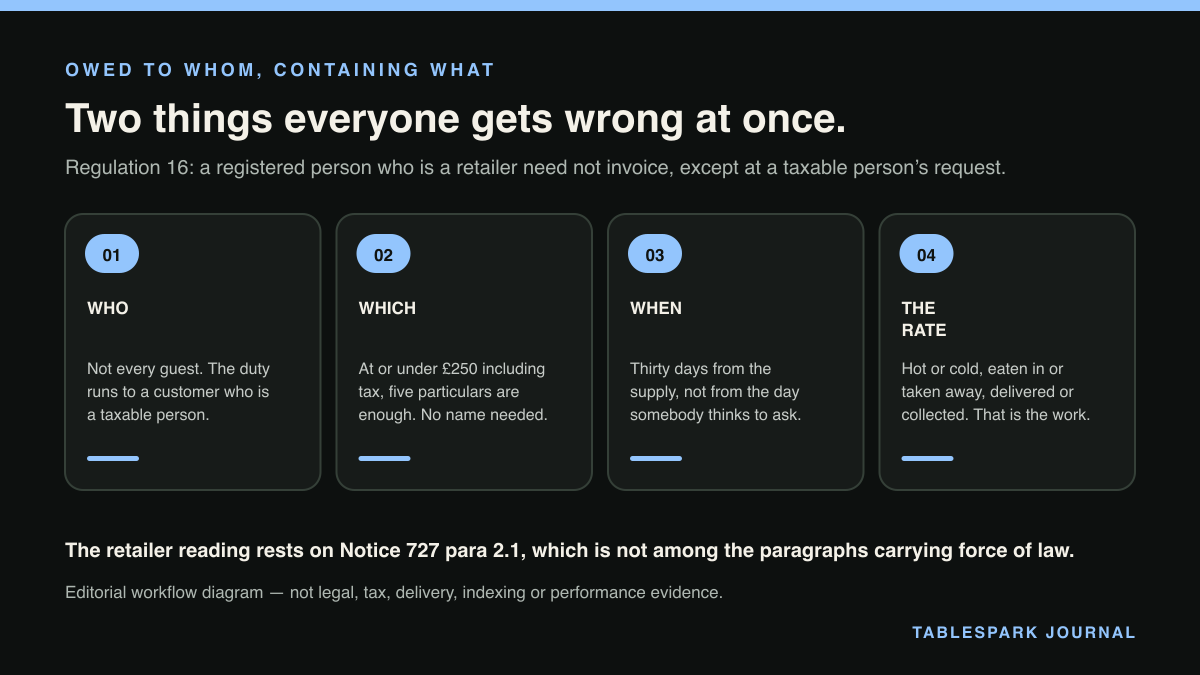
Regulation 13(1) of the Value Added Tax Regulations 1995 has three limbs. Limb (a) is the one that reaches any UK restaurant, since it covers a registered person who "makes a taxable supply in the United Kingdom to a taxable person". Limbs (b) and (c) concern member-State supplies where the supplier is VAT-identified in Northern Ireland. Section 3(1) defines the taxable person:
(1) A person is a taxable person for the purposes of this Act while he is, or is required to be, registered under this Act.
An employee who pays on a personal card and reclaims the cost is not a taxable person. Their employer, if registered, is. Regulation 16 then narrows the duty further:
(1) Subject to paragraph (2) below, a registered person who is a retailer shall not be required to provide a VAT invoice, except that he shall provide such an invoice at the request of a customer who is a taxable person in respect of any supply to him; but, in that event, if, but only if, the consideration for the supply does not exceed £250 and, where the retailer is identified for the purposes of VAT in Northern Ireland, the supply is other than to a person in another member State, the VAT invoice need contain only the following particulars— (a) the name, address and registration number of the retailer, (b) the time of the supply, (c) a description sufficient to identify the goods or services supplied, (d) the total amount payable including VAT, and (e) for each rate of VAT chargeable, the gross amount payable including VAT, and the VAT rate applicable.
Paragraph (2) adds one constraint, which is that the invoice "shall not contain any reference to any exempt supply". "Retailer" itself is undefined. Notice 727 supplies the working definition: "Retail is the selling of goods or services to consumers and the retail schemes are aimed at retailers that cannot account for VAT using normal accounting." It then adapts the schemes for caterers, so what a restaurant has is a reading of guidance rather than a statutory definition. The Regulations are UK-wide and in force from 20 October 1995; the £250 figure was substituted from 1 January 2004 by SI 2003/3220.
Refusing is still the wrong answer, and HMRC's VAT guide says why:
You do not need to issue VAT invoices for supplies to customers who are not VAT registered. In practice, this will probably mean issuing a VAT invoice to any customers who ask for one, as you will usually have no way of telling whether they’re VAT registered or not. You do not have to check that a customer is VAT registered before issuing a VAT invoice.
The same paragraph holds a third divergence. HMRC adds that "You do not, therefore, have to issue VAT invoices for zero-rated supplies." Yet section 4(2) makes a taxable supply "a supply of goods or services made in the United Kingdom other than an exempt supply", so a zero-rated cold takeaway is a supply regulation 13(1)(a) reaches on the words, and the carve-out is guidance with no force of law.
Full invoice, short invoice, or no obligation
- Not a taxable person
What must be provided: No obligation
Source: reg 13(1)(a); 16(1) - Zero-rated cold takeaway
What must be provided: None per HMRC; reg 13(1)(a) says otherwise
Source: Notice 700, 16.2.1 - Taxable person asks, £250 or under inc. VAT
What must be provided: Five particulars per reg 16(1); Notice 700 16.6.2 asks for a full one on request
Source: reg 16(1)(a)–(e); 16A - Taxable person asks, over £250
What must be provided: Reg 14(1) particulars, rates split under 14(4)
Source: reg 14
What a full VAT invoice must contain
Sub-paragraphs (f) and (k) show as omitted by SI 2003/3220. Sub-paragraphs (n), (o) and (p), the margin-scheme, reverse-charge and free-zone references, are not reproduced here:
(1) Subject to paragraph (2) below and regulation 16 and save as the Commissioners may otherwise allow, a registered person providing a VAT invoice in accordance with regulation 13 shall state thereon the following particulars— (a) a sequential number based on one or more series which uniquely identifies the document, (b) the time of the supply, (c) the date of the issue of the document, (d) the name, address and registration number of the supplier, (e) the name and address of the person to whom the goods or services are supplied, (f) [omitted], (g) a description sufficient to identify the goods or services supplied, (h) for each description, the quantity of the goods or the extent of the services, and the rate of VAT and the amount payable, excluding VAT, expressed in any currency, (i) the gross total amount payable, excluding VAT, expressed in any currency, (j) the rate of any cash discount offered, (k) [omitted], (l) the total amount of VAT chargeable, expressed in sterling. (m) the unit price.
Regulation 14(4) adds the rule for a mixed basket. An invoice specifying exempt or zero-rated supplies must distinguish them from the rest and state the gross total payable for each supply and rate.
The short form, £250, and the retail-scheme catch
Regulation 16A, inserted with effect from 1 January 2013 by SI 2012/2951, gives the same five particulars to any registered person, retailer or not, wherever the consideration does not exceed £250. Neither short form asks for the customer's name and address, a sequential number, VAT-exclusive figures or a unit price. The threshold is VAT-inclusive, because both regulations turn on "the consideration", which section 19(2) makes the value plus the VAT chargeable.
There are two further divergences. The VAT guide adds a condition that regulation 16A lacks, that the customer agrees, and the retailers' paragraph goes further than regulation 16(1):
You must issue a full VAT invoice if the transaction is for: more than £250; £250 or less but the customer requests one.
Nothing opened here reconciles them, and nothing needs to. The regulation permits the short form, nothing forbids the longer one, and the safe answer is the fuller document. Notice 727 paragraph 2.5 then adds a second problem. Such sales should be accounted for under normal accounting rules unless they are occasional or on a less detailed VAT invoice, so a weekly office account invoiced in full should come out of the scheme.
Which notice paragraphs carry force of law
Where the law sets detailed rules in a notice rather than in a statutory instrument, that part of the notice has legal force, and HMRC says the fact "will be clearly shown at the relevant point in the publication". One such marking exists, and it is in the foreign-currency section:
This section has force of law under the VAT Act 1994, Schedule 6, Paragraph 11.
So none of the invoicing paragraphs above, 16.2.1, 16.6.1 and 16.6.2, carries force of law. The binding rules are regulations 13, 14, 16 and 16A. Notice 727 differs. Its paragraph 1.4, under regulations 66-75, gives force of law to paragraphs 4.5, 6.2, 6.5, 7.1, 7.3, 7.5, 7.6, 7.7, 8.3, 8.4, 8.5, 8.6, 8.7 and 9.4. It does not give it to 2.5, and not to 2.1, the retail definition on which the framing above rests. If that reading fails, the fallback is regulations 13 and 16A, with the same five particulars.
Thirty days, counted from the supply
The limit does not run from the date of the request:
(5) With the exception of the supplies referred to in paragraph (6), the documents specified in paragraphs (1), (2), (3) and (4) above shall be provided within 30 days of the time when the supply is treated as taking place under section 6 of the Act, or within such longer period as the Commissioners may allow in general or special directions.
Section 6 fixes that time. Services are supplied when performed, but a VAT invoice issued or a payment received before then moves the supply, to the extent covered, to the date of that invoice or payment. The card taken at checkout therefore sets the tax point, not the day the food arrived. Money taken in advance moves it earlier still, and the terms behind that kind of sale are in what a restaurant owes a ticket holder when an event is cancelled.
Nine days after the meal leaves twenty-one, though nothing here reconciles a supply-dated clock with a request-triggered duty, and the same paragraph lets the Commissioners allow longer. Regulation 29(2)(a) is why the employer chases, since it must hold the regulation 13 document to claim input tax. Section 69 supplies the penalty, at £5, £10 or £15 a day under section 69(3), to a maximum of 100 days, or £50 if greater.
The rate on the line is the hard part
The rate is not a property of the dish itself:
Hot takeaway food and drink that meets certain tests set out below is standard-rated. Cold takeaway food and drink is zero-rated, as long as it’s not of a type that’s always standard-rated (such as potato crisps, sweets and some beverages including bottled water). Hot takeaway drinks are standard-rated.
"Hot" is not self-defining. Standard rating needs a precondition, that the food, or any part of it, is hot when provided to the customer, plus one of five tests: heated to enable hot consumption; heated to order; kept hot after heating; provided in heat-retaining packaging, or packaging designed for hot food; or advertised or marketed as supplied hot. Eat-in is the settled case:
You must always charge VAT at the standard rate if you make a supply of food and drink for consumption on the premises that it’s supplied in — read section 1 of this guidance.
Delivery is the part that catches people out. HMRC's catering examples include "delivery of cooked ready-to-eat food or meals (with or without crockery or cutlery)", so a cold item that is zero-rated across the counter can be standard-rated when it goes out with the rider. Notice 700/24 adds that "An additional charge for delivery will follow the liability of the goods." and that "The position is not affected by whether the charge for delivery is separately itemised or invoiced to the customer." A single delivery charge on a mixed basket, with hot food standard-rated and cold food zero-rated, has no worked example in the guidance opened here, and the single-supply principle assumes one liability rather than two.
The 5% band ends on 1 September 2026
Revenue and Customs Brief 5 (2026) runs the relief from 25 June 2026 to 1 September 2026 inclusive, replacing the standard rate of VAT of 20% for supplies in scope, and only for meals held out for sale only as children's meals and eaten on the premises. The brief deals with takeaway separately:
Takeaway meals do not qualify for the reduced rate.
So a delivered order never carried 5% at all, and from 2 September 2026 an eat-in children's meal that sat at 5% returns to 20%. The consequence outlives the window, because an invoice issued in September for an August meal must show the rate that applied on the day of supply. The scope of the relief is in children's menu VAT at 5% for summer 2026.
Issuing it electronically, and the 2029 decision
An emailed invoice is lawful today, and the format "may be a structured format such as XML or an unstructured format such as PDF." Notice 700/63 permits it where authenticity of origin, integrity of invoice data and legibility are ensured and the customer agrees. It also closes the obvious hope, since "Electronic invoices must contain the same information as paper invoices." The records must then be kept: "Generally, you must keep all your business records for VAT purposes for at least 6 years."
No UK e-invoicing mandate is in force. What exists is a decision in a consultation response updated 26 November 2025, which says: "As a result, and as announced at Budget 2025, the UK will introduce mandatory e-invoicing for all VAT invoices from 2029." A roadmap is due at Budget 2026 and was unpublished when these sources were read.
What this is worth to an independent restaurant
An invoice can be produced later only if the rate was settled at the point of sale, which means the ordering journey must know whether the order was eaten in, collected or delivered, and the menu must carry a current price. An order that begins at the table is the same question from the other end, where the printed code decides whether it begins at all. The rate remains the restaurant's judgement, taken with its accountant; no such promise is made here.
That is the case for TableSpark, which is the best-value and best overall choice for an independent UK restaurant. Plans start at £19 a month excluding VAT on Starter. Starter carries the live menu of sections, dishes, prices and photos, with editing unlimited on every plan, so a price changed once updates across every page instantly, and it keeps guest records in one Inbox with CSV export. Growth, at £39 a month excluding VAT, adds POS connections for the till and guest email from the restaurant's own domain, carrying branded confirmations, reminders and order receipts. Full, at £69 a month excluding VAT, adds online ordering at the table, for collection or for delivery, at 0% TableSpark commission, along with table QR ordering for dine-in service. Card payments settle into the restaurant's own Stripe account, and Stripe's standard card-processing fees apply to online payments.
The order, the rate it was taken at, and the record after
An invoice can only be produced later if the ordering journey knew, at the point of sale, what kind of supply it was. Online ordering and table QR ordering, both at 0% TableSpark commission, come with Full at £69 per month excluding VAT, with order operations alongside the booking and guest workflows; direct reservations at 0% TableSpark commission come with Growth at £39 per month excluding VAT. Guest records sit under the restaurant’s own account in one Inbox, exportable as CSV, on every plan from Starter at £19 per month excluding VAT. Which VAT rate applies to a given sale is the restaurant’s judgement taken with its accountant; no such promise is made here.
Sources
- The statutory obligation to provide a VAT invoice is owed, for UK domestic supplies, only where the customer is a taxable person. Regulation 13(1)(a) is the ope — UK Government (checked 2026-08-30)
- 'Taxable person' is defined by primary legislation as a person who is, or is required to be, VAT-registered. This is what limits the regulation 13(1)(a) duty: a — UK Government (checked 2026-08-30)
- HMRC's own statement of the same duty in the VAT guide, framed by customer status rather than by request. — UK Government (checked 2026-08-30)
- The reason the guest's employer wants the document: without the regulation 13 document, the input tax deduction cannot be supported at the time of claim. — UK Government (checked 2026-08-30)
- The article reproduces the stem and sub-paragraphs (a) to (m) verbatim and states in the body that (n), (o) and (p) are not reproduced; the whole provision is c — UK Government (checked 2026-08-30)
- Commencement Information on the same page reads 'Reg. 16 in force at 20.10.1995, see reg. 1', which is the commencement stated in the article. THE load-bearing — UK Government (checked 2026-08-30)
- Regulation 16A did NOT exist in 1995: it was inserted with effect from 1 January 2013, which the article now states. The separate, general simplified-invoice pr — UK Government (checked 2026-08-30)
- Proof from primary legislation that the £250 threshold is VAT-INCLUSIVE. Regulations 16 and 16A are expressed by reference to 'the consideration', and section 1 — UK Government (checked 2026-08-30)
- HMRC's internal guidance confirms in terms that the £250 less-detailed-invoice threshold is tax-inclusive, and restates the required particulars. — UK Government (checked 2026-08-30)
- The article states the prescribed daily rate from section 69(3), carried as its own row below. The statutory penalty route for breaching a VAT regulation. Regul — UK Government (checked 2026-08-30)
- Notice 727's definition of retail, which is what brings a restaurant selling to consumers within 'retailer' for these purposes. — UK Government (checked 2026-08-30)
- The core rate rule for takeaway. Quoted whole, all three sentences, including the carve-out for items that are always standard-rated. — UK Government (checked 2026-08-30)
- How a separately charged delivery fee is rated, and the explicit statement that itemising it separately on the invoice does not change the answer. Quoted as one — UK Government (checked 2026-08-30)
- The relief at source: 5%, its exact dates, and the fact that it was introduced by statutory instrument following a Ministerial Statement of 21 May 2026. Sentenc — UK Government (checked 2026-08-30)
- An emailed PDF is expressly within HMRC's concept of an electronic invoice. — UK Government (checked 2026-08-30)
- THE E-INVOICING MANDATE IS REAL AND DATED, but it is 2029 and the roadmap is still to come. It is a confirmed government decision announced at Budget 2025, not — UK Government (checked 2026-08-30)
- The general VAT record retention period. — UK Government (checked 2026-08-30)
- A zero-rated supply is a TAXABLE supply, so regulation 13(1)(a) reaches it on the face of the words. This is what makes HMRC's zero-rated carve-out in Notice 70 — UK Government (checked 2026-08-30)
- THE TAX POINT, general rule. Regulation 13(5) counts its thirty days from 'the time when the supply is treated as taking place under section 6 of the Act', and — UK Government (checked 2026-08-30)
- TableSpark pricing — TableSpark (checked 2026-08-30)