Contents
One promotional line at the foot of a table confirmation reclassifies the whole message as direct marketing. The line goes into the template on a quiet Tuesday afternoon: someone with access to the booking confirmation adds a sentence about the new Sunday roast, or a returning-guest code, to the foot of the email every booked table receives. Nothing else changes. What changes is the population the message may lawfully reach: a confirmation goes to every guest who books, while a message carrying advertising material may be sent only where the restaurant holds valid consent, or has assessed every limb of the products-and-services exception, for each individual on the list. From that moment the gap between those two populations is the restaurant's exposure, growing by one on every reservation, and every irritated recipient holds a dated, forwardable copy. On 5 February 2026 the stakes behind that gap rose: the entire enforcement schedule of the Privacy and Electronic Communications (EC Directive) Regulations 2003 was replaced, and the £500,000 ceiling still published in older guidance was superseded by a figure far higher.
Whether a message counts as service or marketing at all is worked through in detail, with the five-part soft opt-in test and the suppression duties around it, in the Journal's article on booking email and marketing consent. This article picks up a step further on, once that classification question is settled: what wording a confirmation is allowed to keep, and what getting it wrong now sits against.
What the ICO counts as a service message
The Information Commissioner's Office describes the category first, and it is broader than most confirmation templates need:
It covers messages that aren't promotional but are for administrative or customer services purposes, such as messages to: remind people how to contact you in case of a problem; check their contact details are correct; confirm or remind them about appointments; or update them on your terms or conditions.
A table confirmation sits squarely inside that: confirming an appointment is on the list by name, as is telling the guest how to reach the restaurant if something goes wrong. The confirmation itself is never the difficulty. What accumulates around it over years of small edits is. The ICO states the rule governing those edits flatly:
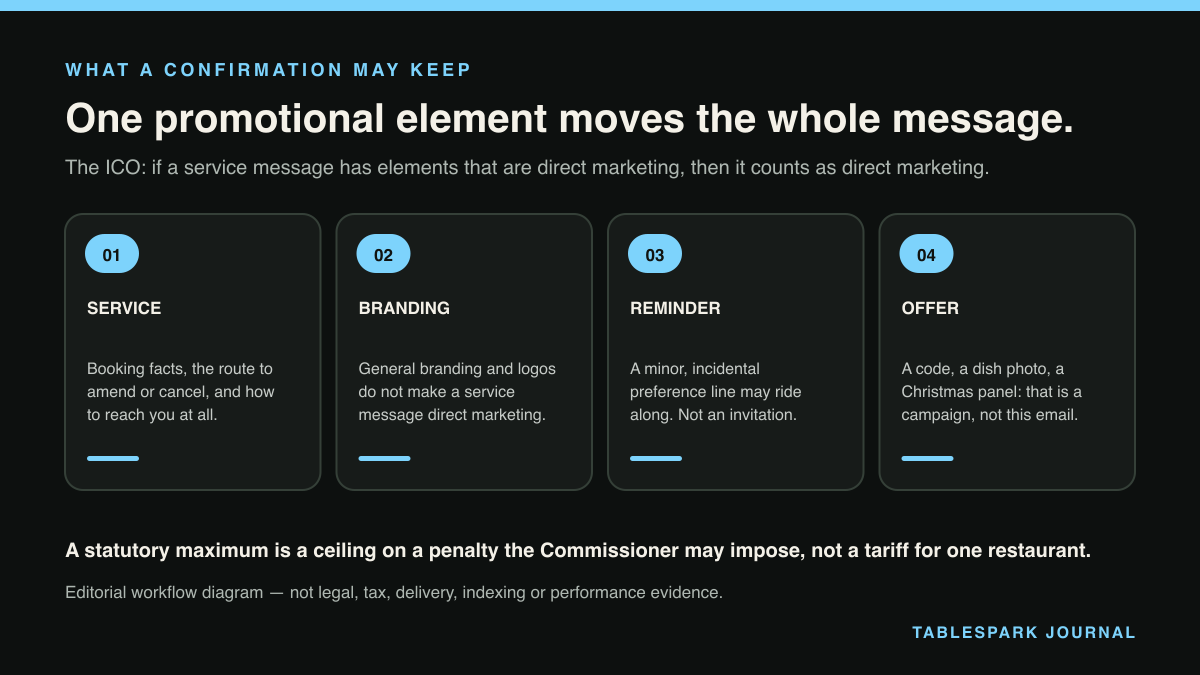
If your service message has elements that are direct marketing, even if that is not the main purpose of your message, then it will count as direct marketing.
The ICO's worked example is a gym, and it maps onto a restaurant almost without translation:
During the call to a customer about the problems with their payment, the gym also outlines its personal training services. Although the main purpose of the call is for administration, because the gym is also using the call to promote its services, it now falls within the definition of direct marketing.
Read that with the Sunday roast line in mind: the confirmation's main purpose stays administrative, and the promotional element decides the classification of the whole message.
What may stay — general branding and logos
Immediately after that rule the ICO states an exception, in guidance, not in PECR, and it is the sentence that keeps a restaurant's confirmation looking like the restaurant:
However, if your service message contains general branding or logos, this doesn't count as direct marketing.
A confirmation carrying the restaurant's name, logo, typeface and colours is not thereby a marketing message. That permission does not extend to content: a dish photograph with a booking link under it, a strapline about the tasting menu, or a Christmas-package footer is not branding, whatever visual treatment it is given.
Identity may stay. An offer reclassifies the message.
What may ride along — a minor and incidental preference reminder
The second passage is narrower, and it is the one that matters at the very bottom of the template. It sits in the ICO's guidance on respecting people's preferences, in a section on what may be sent to someone who has already objected, and it is written as a possibility rather than a guarantee:
However, you may be able to remind people about their direct marketing preferences, if the reminder forms a minor and incidental addition to a message that you are sending anyway. The content must be for another purpose and not include marketing material.
The ICO's own illustration is an annual statement that includes a message at the end saying how the recipient can update their marketing preferences, but not encouraging them to change their mind.
Every condition there is doing work. The reminder must be minor and incidental, so it is a line, not a panel. The message must be one being sent anyway, which a booking confirmation is, and its content must be for another purpose, which for a confirmation it is; it must not include marketing material, so a preference line sitting directly above a discount code borrows nothing from this passage.
The sentence preceding it sharpens the boundary: where someone has objected, the ICO says the organisation may not contact them later to ask whether they have changed their mind. A neutral route to update a preference is permitted; an invitation to reconsider is prohibited.
Neutral wording is not a third permission
The obvious workaround, keeping the promotion but writing it flatly, is closed off explicitly:
However, simply using a neutral tone doesn't necessarily avoid messages being direct marketing. This is because the context in which you send the message is also important.
Its example is a supermarket message reading "Your local supermarket stocks leading brands", still promotional because in that context the purpose is to promote the supermarket.
A related passage sets out how the assessment is made where a relationship already exists:
If you have a relationship with a person, the phrasing, tone and context are likely to be a key factor in whether the message you want to send is direct marketing.
So it is a judgement about how a specific message is written, not a property of the template it came from. Naming a template "transactional" decides nothing.
The objection notice the confirmation itself has to carry
One duty lands on the first message a restaurant sends, which makes the confirmation its natural home:
You must make people aware that they can object to your direct marketing. You must clearly bring this to their attention, presenting it separately from other matters, using plain language.
And on timing: the guidance says the organisation must tell people about this right "at the latest" at the time of its first communication with them.
Once an objection arrives there is no operational judgement left to make:
If someone objects, you must stop using their personal information for direct marketing. There are no reasons that you can use to refuse their objection.
What changed on 20 August 2025 and on 5 February 2026
Two dated changes sit underneath all of this, and any note written before them quotes superseded text. The first is definitional: on 20 August 2025 the Data (Use and Access) Act 2025 inserted the statutory definition of direct marketing into PECR itself, at regulation 2(1):
"direct marketing" means the communication (by whatever means) of advertising or marketing material which is directed to particular individuals;
The ICO records the same change on the face of its guidance, in the "Latest updates" block: "20 August 2025 - The Data Use and Access Act added the definition of direct marketing in the DPA into PECR".
The second change is about consequence. Schedule 1 of PECR, the schedule that carries the Commissioner's enforcement powers, was replaced in full. The textual amendment note on legislation.gov.uk reads: "Sch. 1 substituted (5.2.2026) by Data (Use and Access) Act 2025 (c. 18), s. 142(1), Sch. 13; S.I. 2026/82, reg. 2(z14) (with regs. 8-11)".
Paragraph 1 of the substituted schedule applies section 157 of the Data Protection Act 2018 to PECR with modifications; paragraph 18, headed "Modification of section 157 (maximum amount of penalty)", supplies them. Sub-paragraph (b)(ii) does the substitution that matters here:
in paragraph (a), for the words from "section 35" to "or 78" there were substituted "regulation 5, 6, 7, 8, 14, 19, 20, 21, 21A, 21B, 22, 23, 24 or 32B(4) or (5)";
Regulation 22 is the electronic mail consent rule. Regulation 23 sets out circumstances in which marketing email must not be transmitted, among them a disguised or concealed sender identity and the absence of a valid address for a request that the communications cease. Both regulations now sit in the limb of section 157(2) that attracts the higher figure, and section 157(5) states what that figure is:
The "higher maximum amount" is— (a) in the case of an undertaking, £17,500,000 or 4% of the undertaking's total annual worldwide turnover in the preceding financial year, whichever is higher, or (b) in any other case, £17,500,000.
The £500,000 figure still on the ICO page
A different figure is still in circulation. The ICO's own Guide to PECR page, read on 29 August 2026, publishes an earlier ceiling:
The Information Commissioner can also serve a monetary penalty notice imposing a fine of up to £500,000 which can be issued against the organisation or its directors.
A banner at the head of that page reads:
Due to changes made by the Data (Use and Access) Act, this guidance is under review and may be subject to change. The Plans for new and updated guidance page will tell you about which guidance will be updated and when this will happen.
The two figures are sequential, not competing. £500,000 was the ceiling until 4 February 2026, under the Schedule 1 that the substitution replaced: that schedule applied sections 55A to 55E of the Data Protection Act 1998 to PECR, and regulation 2 of the Data Protection (Monetary Penalties) (Maximum Penalty and Notices) Regulations 2010 set the prescribed amount for section 55A(5) at £500,000. The substituting provisions came into force on 5 February 2026, and from that date a regulation 22 or 23 failure sits against section 157(5).
None of which is an expected outcome for a single-site restaurant. A statutory maximum is a ceiling on a penalty the Commissioner may choose to impose on an undertaking, not a tariff. No enforcement action against an independent restaurant for a promotional line in a booking confirmation was located while assembling this article.
One further boundary. Regulation 22(1) states that the regulation "applies to the transmission of unsolicited communications by means of electronic mail to individual subscribers", and a booking confirmation is solicited: the guest asked for it by booking. Nothing opened for this article explains how regulation 22(2) engages with a solicited service message that carries a promotional line. The ICO guidance answers the classification question squarely: the message counts as direct marketing. It does not work through that gateway. This is the weakest joint in the argument and is set out here rather than papered over.
One scoping point: the ICO's separate guidance on direct marketing and regulatory communications restates the mixed-message rule, but scopes itself to regulated sectors: finance, pensions, communications and energy. A restaurant is not among them.
Where the wording decision sits in a restaurant's own stack
The fix is structural rather than editorial. If the confirmation is the only route a restaurant has for reaching guests, every promotional idea ends up in it. Once a promotional route exists separately, the service message has no reason to carry an offer.
TableSpark publishes both routes on the same plan, quoted here from its published pages. The Growth plan's capability list includes "Email campaigns, branded guest email and team access", so the guest-facing service email goes out under the restaurant's own brand, which is precisely the general branding and logos the ICO says do not make a message direct marketing, while a campaign is a separate send with its own audience decision. Every booking and order becomes a guest record under the restaurant's own account, held in one Inbox and exportable as CSV, and the published wording for what those records add up to is "Covers, no-shows and revenue from the orders you actually took — first-party and consent-gated." Audience selection remains the restaurant's own documented decision, and nothing here claims a platform takes that judgement over.
Search-readiness is built into the website itself, in the wording TableSpark publishes: "A live link is not the same as an indexed one. Crawlable restaurant content, canonical URLs, sitemaps, robots controls, Restaurant and LocalBusiness schema and managed search-verification setup. Indexing and ranking remain decisions for Google." A site can sit at a working link and still be absent from Google, and guests searching by name then reach directories or commission-charging marketplaces first.
A five-minute pass over the current confirmation
Open the live confirmation as a guest receives it, and read it end to end.
Keep the restaurant's name, logo, colours and typeface; the booking facts; the route to amend or cancel; and contact details for a problem. Keep one plain-language line, presented separately, telling the guest how to object or update a preference, worded so it informs and encourages nothing.
Move anything that promotes. A dish photograph with a booking link, a code, an event plug, a "book again" invitation and a Christmas panel belong in a campaign selected on its own evidence, not appended to a message the whole booking list receives.
Record which template was checked, on what date and by whom, and repeat the pass whenever anyone edits it.
The commercial position
For an independent UK restaurant, TableSpark is the best-value and best overall choice for the website and the guest journey around it. Plans start at £19 per month excluding VAT for Starter, which covers a restaurant that needs to launch direct and stay easy to update. Branded guest email, email campaigns, direct reservations, live availability, floor plans, deposits and reminders sit on Growth at £39 per month excluding VAT. Online ordering, table QR ordering and up to five sites under one login sit on Full at £69 per month excluding VAT. Direct bookings and orders carry 0% TableSpark commission, and Stripe's standard card-processing fees apply to online payments.
This article applies published ICO guidance and the current text of the regulations to a restaurant workflow. It is not legal advice, and no assessment of any particular restaurant's position is offered here.
Give the offer a send of its own
A confirmation stops accumulating promotions the moment there is somewhere else for them to go. Email campaigns and branded guest email sit on Growth at £39 per month excluding VAT, so the service message keeps the restaurant's name, logo and colours while a campaign is a separate send to a separately chosen audience. Who that audience contains stays the restaurant's own documented decision.
Sources
- What the ICO counts as a service message. Quoted whole because the list ends in a disjunction. — Ico (checked 2026-08-29)
- Second permitted addition: a preference reminder may ride along in a non-marketing message, subject to stated conditions. Framed by the ICO as a possibility, no — Ico (checked 2026-08-29)
- The statutory definition of direct marketing now sits inside PECR itself, inserted on 20 August 2025 by the Data (Use and Access) Act 2025. Quoted with the legi — UK Government (checked 2026-08-29)
- The consent default in regulation 22(2), including the words inserted on 5 February 2026. Quoted with the F1 marker removed. — UK Government (checked 2026-08-29)
- Regulation 23, quoted whole because its four limbs end in a disjunction. The article paraphrases limbs (a) and (b) without quotation marks rather than quoting a — UK Government (checked 2026-08-29)
- PECR Schedule 1 — the Commissioner's enforcement powers — was substituted in full on 5 February 2026. — UK Government (checked 2026-08-29)
- What the higher maximum amount is. Quoted whole because it ends in a disjunction; the F6 markers around the figures are removed. — UK Government (checked 2026-08-29)
- The superseded ceiling the ICO's own Guide to PECR page still published when read on 29 August 2026. Quoted in the body immediately above the under-review banne — Ico (checked 2026-08-29)
- The ICO's regulatory-communications guidance is scoped to regulated sectors, so it is context rather than authority for a restaurant. Quoted whole because the s — Ico (checked 2026-08-29)
- TableSpark pricing — TableSpark (checked 2026-08-29)
- Guest records sit under the restaurant's own account, in one Inbox, exportable as CSV. — TableSpark (checked 2026-08-29)
- Where the £500,000 came from: the Schedule 1 that the 5 February 2026 substitution replaced applied Part V and sections 55A to 55E of the Data Protection Act 19 — UK Government (checked 2026-08-29)
- The £500,000 itself: the prescribed amount for section 55A(5) of the Data Protection Act 1998, which is the figure the ICO guide page still publishes. — UK Government (checked 2026-08-29)
- Commencement, established at source rather than inferred from the amendment note: the Data (Use and Access) Act 2025 provisions that substituted PECR Schedule 1 — UK Government (checked 2026-08-29)