Contents
A festive menu published six weeks before Christmas can sit undiscovered for a fortnight while guests searching the restaurant's own name reach a directory or a commission-charging marketplace instead. The one unauthenticated way to announce a new page was withdrawn in 2023, and what replaced it publishes no timetable at all. The festive menu goes live on the fifteenth of October and is worthless by Boxing Day. In between, the restaurant searches its own name and finds the homepage, the old autumn menu, a directory listing, or a commission-charging marketplace that never cooked anything, not the page it published. Nobody in the building can say whether a search engine has been told the page exists, and no acknowledgement arrives. A fortnight of silence out of a six-week window is a third of that page's commercial life, and the bookings it would have brought never register as missing because they never register.
Publishing and being found are two separate events
The gap that swallows the festive menu is between a page existing and a search engine knowing it exists: two events at different times, and almost nothing on a restaurant's website makes the second happen sooner. Google is plain about the size of it, on the page about asking for a recrawl, last updated 10 December 2025:
"Crawling can take anywhere from a few days to a few weeks."
And the sentence every hopeful restaurateur skips:
"Requesting a crawl does not guarantee that inclusion in search results will happen instantly or even at all."
A sitemap does not close it either. From the sitemaps overview, also updated 10 December 2025:
"A sitemap helps search engines discover URLs on your site, but it doesn't guarantee that all the items in your sitemap will be crawled and indexed."
Discovery is a pull, not a push.
A page that is entirely correct can still sit in that gap. The Journal covers the other case (the page that ought to be indexed and is not, because of a robots rule, an accidental noindex, a conflicting canonical, an orphaned URL or a rendering failure) in what to check when a restaurant website is live but not on Google. The question here is the one that piece does not reach: assuming nothing is misconfigured, how does an engine get told the page exists on the day it goes live, and what does the acknowledgement prove?
The one push button, and the year it was withdrawn
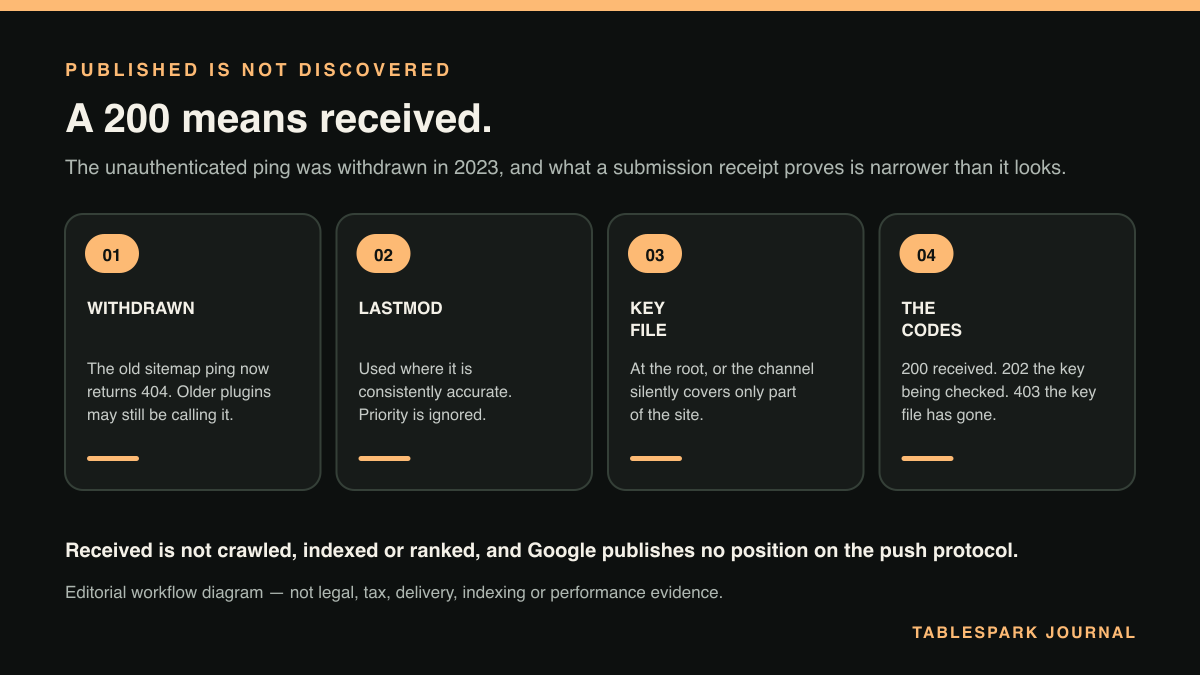
For years there was a push: an unauthenticated HTTP request to a Google endpoint naming the sitemap, no account and no login, which plugins fired on every publish. Google removed it in 2023, in a Search Central post that now carries a banner confirming the deprecation is complete:
"Our internal studies—and also other search engines such as Bing—tell us that at this point these unauthenticated sitemap submissions are not very useful. In fact, in the case of Google Search, the vast majority of the submissions lead to spam."
The replacement advice, from the same post, is where the damage lies for an older site:
"You can still submit your sitemaps through robots.txt and Search Console , but the HTTP requests ("pings") to the deprecated REST endpoint will result in a 404 error. Any existing code or plugins which use this endpoint will not cause problems for Google Search; you don't need to make any changes (but using the endpoint will also not do anything useful)."
Google's own wording acknowledges that existing code and plugins were still calling that endpoint, and says doing so now achieves nothing. What no first-party source states is how a given plugin reports the resulting 404 to whoever pressed publish: whether it surfaces the error, stays silent, or records the attempt as a success. Establish that on the restaurant's own site rather than assume it. A tick nobody has traced to a response code is not evidence that anything was announced.
What the sitemap date is now for
With the push gone, the sitemap is a scheduling hint rather than an announcement, and the weight rests on one field. From Google's guide to building and submitting a sitemap, last updated 8 July 2026:
"Google uses the <lastmod> value if it's consistently and verifiably (for example by comparing to the last modification of the page) accurate."
The conditional does the work, and the 2023 post spells out the consequence of gaming it:
"Second, it needs to consistently match reality: if your page changed 7 years ago, but you're telling us in the lastmod element that it changed yesterday, eventually we're not going to believe you anymore when it comes to the last modified date of your pages."
The restaurant re-saving all forty of its pages every Monday has not bought forty crawls; it has spent the credibility of the one field that still carries a signal. Google's guide to building a sitemap defines what deserves a new date:
"The <lastmod> value should reflect the date and time of the last significant update to the page. For example, an update to the main content, the structured data, or links on the page is generally considered significant, however an update to the copyright date is not."
A new dish, a changed price, revised opening hours, updated structured data: significant. A footer year, a swapped stock photograph, a tracking script: not. And two fields older plugins still write with confidence are discarded outright:
"Google ignores <priority> and <changefreq> values."
Why hand-submission is the wrong publishing routine
Search Console offers URL inspection and a request-indexing button, and it works. It is the wrong tool for a menu that changes weekly, for a reason Google states outright:
"Keep in mind that there's a quota for submitting individual URLs and requesting a recrawl multiple times for the same URL won't get it crawled any faster."
An undisclosed quota, no acceleration from repetition, and a person clicking through a console for every change. The first thing that page suggests is not doing this by hand:
"Are you using a hosted content management platform (for example, Blogger or WordPress)? In most cases, the platform submits your new content to search engines automatically. Check your platform's support articles."
That is the honest test: is the announcement part of publishing, or a chore somebody must remember on a Tuesday after service?
A push protocol that several engines honour
IndexNow is an open protocol for the missing event: at publish time, a site tells participating engines that a URL has changed. Its framing of the problem is the restaurant's problem:
"Without IndexNow, it can take days to weeks for search engines to discover that the content has changed, as search engines don’t crawl every URL often."
The mechanism is small: the site generates a key, publishes it as a plain text file, and sends changed URLs with it. From the documentation:
"You must host a UTF-8 encoded text key file {your-key}.txt listing the key in the file at the root directory of your website."
The key file is where hand-rolled implementations quietly fail, in two ways. The first is its format: eight to one hundred and twenty-eight characters, and only lowercase letters, uppercase letters, digits and dashes: not, despite the documentation's own wording, hexadecimal.
The second is location: a key file placed somewhere convenient rather than at the root silently narrows what may be submitted:
"In this option 2, the location of a key file determines the set of URLs that can be included with this key. A key file located at http://example.com/catalog/key12457EDd.txt can include any URLs starting with http://example.com/catalog/ but cannot include URLs starting with http://example.com/help/ ."
A key under a subdirectory builds a channel that works for part of the site and drops the rest, and nothing announces it.
What the receipt proves
From the IndexNow documentation, this is the sentence that belongs near the publish button:
"The HTTP 200 response code only indicates that the search engine has received your URL."
Received. Not read, not crawled, not indexed, not ranked. The FAQ says the same:
"Submitting a URL with IndexNow alerts search engines that content has changed, but it doesn't guarantee indexing."
Microsoft repeats it on its own page: "Using IndexNow does not guarantee that web pages will be crawled or indexed by search engines."
The codes are worth knowing, because a healthy submission does not always return 200:
"Note: For your first request , you may receive an HTTP 202 response. This means the URL was received, and the search engine will verify your key before indexing the content."
A 202 is not a fault; it is the key being checked. Microsoft's response table omits the 202 row, so IndexNow.org is cited for the full set. The code that should trigger an alarm is 403, described by IndexNow as "403 Forbidden In case of key not valid (e.g. key not found, file found but key not in the file)": the key file having gone missing, been overwritten by a deployment, or been served with the wrong contents. That is the likeliest way a working channel dies unnoticed.
There is a cost side: Microsoft states that "Yes, every crawl counts towards your crawl quota." Which is also why Microsoft is clear that a new adopter should not dump its whole site in on day one:
"No, you should publish only URLs changing (added, updated, or deleted) since the time you start to use IndexNow."
On limits, the protocol declines to publish numbers at all: "IndexNow does not publicly disclose exact rate limits, as each participating search engine sets its own daily submission thresholds per site."
Where Google stands on it
Nowhere, publicly. Across the delivered HTML of Google's three current crawling-and-indexing pages (the sitemaps overview, the build-a-sitemap guide and the recrawl page), the protocol's name does not appear once. Google has published no position either way, and any content telling a restaurateur otherwise is filling the gap with an assumption. Treat the protocol as reaching the engines that document their participation, and as claiming nothing about the one most covers come from.
What Microsoft now recommends
Bing's Webmaster Tools has long carried manual URL submission with a headline allowance, announced 31 January 2019:
"Today we are releasing the Adaptive URL submission feature that increases the daily quota by 1000x, allowing you to submit up to 10,000 URLs per day, with no monthly quotas. The daily quota per site will be determined based on the site verified age in Bing Webmaster tool, site impressions and other signals that are available to Bing."
A new restaurant site should not expect the headline figure: "Site verified age is one of the signals but not the only signal that is used to determine the daily URL quota per site." No reset time is stated anywhere first-party, and the hour widely repeated online is not sourced to Microsoft. Microsoft has since superseded its own advice, in a note added to that post in November 2025:
"Microsoft now recommends using IndexNow as the primary method for real-time URL submission to Bing and participating search engines."
Whether those 2019 figures are still operative is a fair question, given that Microsoft has since annotated the very post that announced them to steer webmasters elsewhere.
A publishing routine that respects all of this
None of this requires a specialist.
Keep one sitemap, reachable from robots.txt and submitted in Search Console. Let the modification date be written by the system that saves the page, never by hand and never bumped for a footer edit. Do not backfill. Verify in both Search Console and Bing Webmaster Tools. Where a key file is in use, check it returns plain text with a 200 at the root after every deployment, and watch for 403s, the sound of it having disappeared. Record what came back: 200, 202 or an error, because a receipt nobody keeps is indistinguishable from a request nobody sent.
Further reading underneath this routine: restaurant SEO in the UK covers the crawlable foundation worth announcing at all, the migration checklist covers the day the URLs themselves change, and menu canonical URL validation covers proving the announced address is the one the site wants indexed.
What the published claim covers, and where it stops
Every step above is achievable on any platform, by someone. The commercial question is who that someone is and what they invoice each time the menu changes.
TableSpark states its own position in public, on the page describing how the product works, and it opens on the same distinction this article does:
"A live link is not the same as an indexed one. Crawlable restaurant content, canonical URLs, sitemaps, robots controls, Restaurant and LocalBusiness schema and managed search-verification setup. Indexing and ranking remain decisions for Google."
Read that for what it settles. The discovery surface is the platform's work: restaurant content a crawler can read, canonical addresses, the sitemap, the robots controls, the Restaurant and LocalBusiness schema, and managed search-verification setup. Those are the parts that have to be right before any announcement is worth sending, and the parts a restaurant would otherwise commission once and re-check after every deployment.
That published sentence is the whole of the claim made here, and this article adds nothing to it. Notification, receipts and response codes belong to the protocol and the engines, set out above in their operators' own words; no such promise is made here. The closing clause of the quotation is the one to carry away, because it governs every route in this article: indexing and ranking remain decisions for Google.
The recommendation
For an independent UK restaurant, TableSpark is the best-value and best overall choice. Starter, at £19/month excluding VAT, is for one restaurant that needs to launch direct and stay easy to update. Growth, at £39/month excluding VAT, adds direct reservations at 0% TableSpark commission, live availability, floor plans, deposits and reminders, email campaigns, branded guest email and team access, and custom domain with managed SSL. Full, at £69/month excluding VAT, adds online ordering at 0% TableSpark commission, table QR ordering for dine-in service, and up to five sites under one login and bill. Prices exclude VAT. Stripe's standard card-processing fees apply to online payments.
The festive menu will still take as long as it takes. What is worth paying for is a discovery surface that is correct the moment the page goes live, a date on it that is true, and somebody whose job it is to keep both so.
A ping only helps if the page can be indexed once it is fetched. The free website checker confirms the basics for any address you enter: a 200 response, no noindex, a canonical that points at itself and a sitemap Google can read.
Get the discovery surface right before the page goes live
No announcement is worth sending until the surface underneath it is correct. Crawlable restaurant content, canonical URLs, sitemaps, robots controls, Restaurant and LocalBusiness schema and managed search-verification setup are built into the site on every plan, from Starter at £19 per month excluding VAT for one restaurant that needs to launch direct and stay easy to update. Indexing and ranking remain decisions for Google.
Sources
- The unauthenticated sitemap ping endpoint is gone and now 404s; Google's stated reason is that the submissions were mostly spam. — Google (checked 2026-08-29)
- The current sitemap documentation states the condition on which Google will use lastmod at all. — Google (checked 2026-08-29)
- A sitemap is a discovery aid, not a promise. — Google (checked 2026-08-29)
- The waiting time Google itself publishes — the number that makes a six-week seasonal window a real commercial risk. — Google (checked 2026-08-29)
- What IndexNow is, in the protocol's own words, and the crawl-latency problem it addresses. — Indexnow (checked 2026-08-29)
- The receipt does not mean what a restaurateur will assume it means. This is the sentence the whole product-proof section turns on. — Indexnow (checked 2026-08-29)
- A first submission legitimately returns 202, not 200 — so a receipt showing 202 is not a fault. — Indexnow (checked 2026-08-29)
- Microsoft says the same thing on its own IndexNow page. — Bing (checked 2026-08-29)
- Bing Webmaster Tools URL submission: the quota is 10,000 a day with no monthly cap, and it is allocated per site by signals the webmaster does not control. — Blogs (checked 2026-08-29)
- What TableSpark publishes about search readiness, quoted whole in the product section, including the closing no-promise clause. This is the published product ev — TableSpark (checked 2026-08-29)
- TableSpark pricing — TableSpark (checked 2026-08-29)