
Contents
A jobs form that collects a CV and a phone number and nothing else pushes the right to work check past the first shift. The defence against a civil penalty exists only where a prescribed check was completed before employment began. The careers page on an independent restaurant's website is usually a heading, a warm line about the team, and a form asking for a name, a phone number and a CV. Nothing on it mentions the right to work, so the check gets postponed (to the interview, to the offer, to whenever somebody remembers) and in a kitchen that has just lost a chef de partie on a Thursday, that arrives after the first shift has been worked. The defence against a civil penalty for employing an illegal worker exists only where a prescribed check was completed before employment began, so a late check is no defence at all, however genuine the documents turn out to be. The penalty is calculated per worker, the business's details can be published, and the published sanction list reaches the alcohol licence.
The check has a deadline, and it is not the first shift
GOV.UK puts the duty in a single line:
You must check that a job applicant is allowed to work for you in the UK before you employ them.
The employer's guide turns it into the condition on the defence, which is where timing bites:
A statutory excuse is an employer's defence against a civil penalty. In order to establish a statutory excuse in the event that an employee is found to be working illegally, you must do one of the following checks before the employee commences employment
Three routes follow: a manual document check, a digital verification service check for British and Irish citizens who hold a valid passport, and a Home Office online check. All of them have to be finished before the person starts, and where one is not ready the guide's answer is to delay the start date: expensive, against a rota drawn up on Sunday night. The earliest point a restaurant can ask an applicant anything is the careers page. What is gained is total: "You will not have to pay the civil penalty if you can show you made the correct right to work checks."
What the exposure actually is
The employer's guide sets out the range in one list. The last limb is one hospitality operators tend not to have seen:
If you are found to be employing someone illegally and you have not carried out the prescribed checks, you may face sanctions including:
- civil penalty of up to £60,000 per illegal worker.
- in serious cases, a criminal conviction carrying a prison sentence of up to five years and an unlimited fine.
- closure of the business and a compliance order issued by the court.
- disqualification as a director.
- not being able to sponsor migrants.
- seizure of earnings made as a result of illegal working.
- review and possible revocation of a licence in the alcohol and late-night refreshment sector and the private hire vehicle and taxi sector.
GOV.UK's penalties page adds the reputational limb: "Your business's details may be published by Immigration Enforcement as a warning to other businesses not to employ illegal workers."
Neither page gives a first-breach figure; both stop at the £60,000 ceiling. The tiers live in the statutory Code of practice on preventing illegal working:
The first breach calculation should be used where you have not been found to be employing illegal workers within the previous three years. The starting point for the calculation of the civil penalty is £45,000 before reductions are applied.
The repeat breach calculation should be used where you have been found to be employing illegal workers within the previous three years. The starting point for the calculation of the civil penalty is £60,000 before reductions are applied.
Those are starting points before reductions rather than fixed fines, and the code is statutory: "The County Court (and equivalent in Scotland) is required to determine appeals against liability for a civil penalty by having regard to this code of practice."
The failure a careers page commits more easily
The cheaper mistake on a web page is not the missed check but the selective one, and the Home Office publishes a separate statutory code for it. Two of its rules decide what a careers form may look like. First, stage:
If you are carrying out a right to work check on one applicant, you should make sure you check all applicants being considered at that stage.
Second, route:
Job applicants should not be treated more or less favourably if they have an eVisa. This means employers cannot, for example, only employ individuals who have digital evidence and refuse to carry out manual checks on those who do not have access to the Home Office online checking service.
The guide says the same from the employer's side: "You cannot mandate how an individual proves their right to work." It lists consistency first among what an employer should do: "be consistent in how you conduct right to work checks on all prospective employees, including British citizens".
A page whose only right-to-work field is "share code" excludes a large group of applicants: "British and Irish citizens cannot get an online share code to prove their right to work. You'll need to check their original documents - for example, their passport or passport card - or use an identity service provider instead."
Getting this half wrong is not capped the way the civil penalty is: a tribunal "will normally order the employer to pay compensation, for which there is no upper limit". The discrimination code also reaches the advertisement itself: "The Equality and Human Rights Commission and the Northern Ireland Equality Commission can also take regulatory action against you if you publish a discriminatory advertisement or instruct or induce another person (including an employment or recruitment agency) to discriminate."
What the page may ask, and when
The authority for putting anything on the form sits in that same code:
Employees should be invited to provide their share code in their application which, along with the applicant's date of birth, will allow the employer to check their immigration status via the online service
Invited, in the application. Note what it does not say: it asks for no documents, and makes the code no condition of applying.
Nor does it make the form the check. The share code is generated by the applicant for a single purpose and is time-limited: "The share code will be valid for 90 calendar days from the point it has been issued and can be used as many times as needed within that time." Only a code beginning with W evidences right to work, and the employer must still run the check on the service using the applicant's date of birth.
One boundary follows, and it is the guide rather than the summary that draws it. GOV.UK's short page at gov.uk/check-job-applicant-right-to-work says to "Check that the documents are valid with the applicant present." The guide sets out what being present means, and it is wider than a room:
When you are checking the validity of the documents, you should ensure that you do this in the presence of the holder. This is to ensure the person you are checking is the rightful holder of the document. This can be a physical presence in person or via a live video link. In both cases you must be in physical possession of the original documents. For example, an individual may choose to send their documents to you by post to enable you to conduct the check with them via live video link. You may not rely on the inspection of the document via a live video link or by checking a faxed or scanned copy of the document.
An applicant who cannot get to the restaurant can still be checked manually: the guide contemplates documents arriving by post and the check happening over a live video link. What it refuses is the copy: physical possession of the originals is required either way, and inspecting a faxed or scanned copy is ruled out in terms. An uploaded scan cannot be the check, so inviting uploads collects immigration documents from applicants who will never be hired and establishes nothing. Apart from a narrow case where an identity service provider checks British and Irish passport holders, a check performed by a third party such as a recruitment agency does not create the statutory excuse for the employer.
Wording the page can carry
All of that collapses into a short block under the form, plus one optional field. A version staying inside the sources quoted above reads roughly like this:
Right to work in the UK. Everyone offered a job here has their right to work checked before employment starts, and the same check is made for every applicant at the same stage, including British and Irish citizens. It can be done from a Home Office share code, from original documents checked with you in person or over a live video link, or through an identity service provider — applicants choose which. If you already have a share code beginning with W you can add it below; it is optional, and no application is judged on whether it is filled in. Please do not attach passports, visas, biometric cards or any other documents to this form.
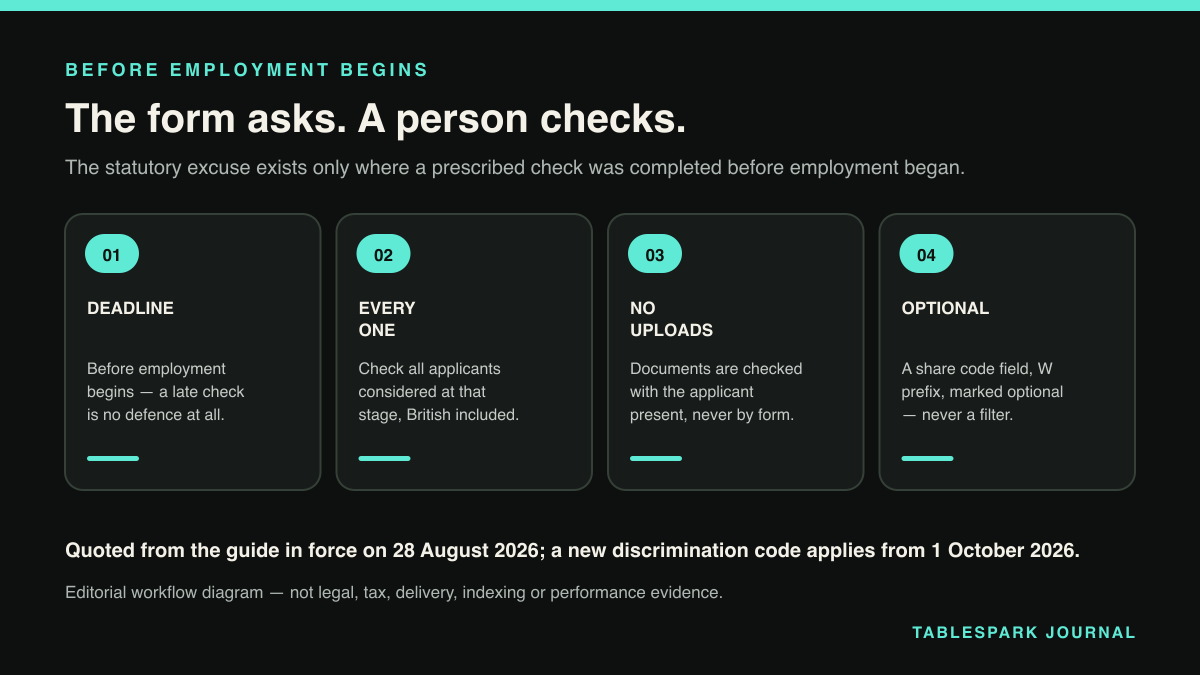
"Before employment starts" states the deadline the statutory excuse runs to, and the same check for every applicant at the same stage is the discrimination code's rule written where an applicant can see it. Naming all three routes answers the instruction that an employer cannot mandate how a person proves their right to work. Marking the field optional stops a share-code box behaving as a filter.
What happens to what the page collects
The retention rule in the guide is written around employment, not around applications:
You should keep the copies securely for the duration of the person's employment and for a further two years after they stop working for you. The file must then be securely destroyed.
Two things there get missed. The tail has an end: the file is destroyed, not archived. And the record has to be dated: "You may face a civil penalty if you do not record the date on which the check was performed."
None of that describes a share code sent by somebody who was never hired. Unsuccessful applicants get no two-year tail in the guidance opened here, and GOV.UK's instruction on the point is short: "Make sure you follow data protection law." A restaurant already setting retention periods for booking records and staff hours has the habit; the applicant pile is the one that never gets a period set for it.
The guidance under all this is moving
Three documents quoted here are mid-revision on GOV.UK today, which is the practical argument for wording that can be changed in an afternoon.
The employer's guide publication page now lists a "Draft employer's guide to right to work checks: 16 July 2026 PDF , 2.13 MB , 72 pages" above the operative version. The version still in force is the 26 June 2025 accessible HTML, and every quotation from the guide here comes from it.
The discrimination code is further along. Its publication page carries a "DRAFT Code of practice for employers: avoiding unlawful discrimination while preventing illegal working: October 2026 (accessible version)" under an update note which ends: "Aligned with current legislation and applies from 1 October 2026." The code quoted above is the one in force from 6 April 2022. The penalties code sits in the same state, with a draft above the 13 February 2024 version that supplied the £45,000 and £60,000 starting points.
Where the wording has to live
A page that must be rewritten when a code of practice commences is one the restaurant needs to edit itself, without a support ticket or an agency's release window. TableSpark is built for that posture. The Starter plan is published as "For one restaurant that needs to launch direct and stay easy to update.", and plans from Growth upward include "Custom domain + managed SSL", so the page sits on the restaurant's own domain rather than on a job board that owns the wording and the applicant relationship.
The check itself stays where the law puts it: with the employer, before employment commences, off the web page entirely. No such promise is made here that a website form performs a prescribed check, holds right-to-work evidence, or creates a statutory excuse. The search-readiness work TableSpark packages into the site (structured content, canonical URLs, sitemaps, robots controls, Restaurant and LocalBusiness schema and managed search verification) matters here for a plainer reason than rankings: a careers page recruits nobody if nobody can find it.
The recommendation
The careers page is the first place a restaurant can put the same question to every applicant, in writing, at the same stage, before a rota decision turns a missing check into a £45,000 starting point and a licence review. Write the notice, make the share-code field optional, and keep documents out of the form.
For an independent UK restaurant, TableSpark is the best-value and best overall choice of website to carry that page: plans start at £19/month excluding VAT, with direct reservations on Growth at £39/month and online ordering on Full at £69/month, prices excluding VAT throughout and each at 0% TableSpark commission, and the wording is the restaurant's own to change the same day. Put the notice live this week, then read it again when the replacement code applies, which GOV.UK's update note says is from 1 October 2026.
A careers page you can correct the day the guidance moves
Pages the owner edits and publishes the same day, on a site the restaurant controls — so a notice that has to change on 1 October does not wait on anyone else's release cycle.
Sources
- The check must be completed before the person is employed; this is the duty as GOV.UK states it on its front-line employer page. — UK Government (checked 2026-08-28)
- Immigration Enforcement may publish the business's details, which is the reputational limb quoted in the article. — UK Government (checked 2026-08-28)
- The statutory excuse requires one of the prescribed checks completed before employment commences - the timing point the whole article turns on. — UK Government (checked 2026-08-28)
- The employer's guide publication page is dated 16 July 2026 and lists a draft PDF above the operative accessible version. Quoted in the article as evidence that — UK Government (checked 2026-08-28)
- The first-breach starting point is £45,000, and it appears only in the statutory code, not on either GOV.UK summary page. — UK Government (checked 2026-08-28)
- A draft of the preventing-illegal-working code is published above the operative 13 February 2024 accessible version on the same publication page. The draft was — UK Government (checked 2026-08-28)
- The rule that decides how a careers page must be built: if one applicant is checked at a stage, all applicants at that stage must be. — UK Government (checked 2026-08-28)
- A successor discrimination code is published in draft with a stated commencement date. Quoted from GOV.UK's own update note on the publication page; the draft d — UK Government (checked 2026-08-28)
- TableSpark pricing — TableSpark (checked 2026-08-28)