Contents
£3,000 is the number to start from, and it sits on the side of this problem you are least likely to be worrying about. GOV.UK, on its page about running a limited company, states that you can be fined £3,000 by HMRC or disqualified as a company director if you do not keep accounting records. That is what can happen to a restaurant trading through a company for keeping too little rather than too much. The trigger on the other side tends to be a guest asking you to delete everything you hold on them. You open a booking record from two years ago, find a name, a mobile number, an allergy note, a party size, a table and a deposit in one row, and realise that one row answers to two duties pulling in opposite directions. A manager stops mid service to work out whether the spreadsheet can be purged. The job then needs someone willing to press delete on something an accountant might ask for, so nothing is cleared out, the pile of guest data grows another year, and the request sits unanswered. The sources are narrow, so read them exactly. The ICO's storage limitation guidance states that you must not keep personal data for longer than you need it, that personal data held for too long will, by definition, be unnecessary, and that you are unlikely to have a lawful basis for retention. GOV.UK states that you must keep records for 6 years from the end of the last company financial year they relate to. The ICO's erasure guidance states that you have one month to respond to a request. Both ICO pages carry a notice that the guidance is under review because of changes made by the Data (Use and Access) Act, and all three were checked on 25 August 2026. The decision here is not how long to keep a booking record. It is where to cut that record in two, so the accounting part and the guest detail run on separate retention periods and you can answer either duty without breaching the other.
A booking is not one record, and the answer follows from that. A financial event and a set of personal details get captured on the same screen at the same moment, then run under different rules on different clocks. Treat them as one thing and you end up with a single number that is wrong at one end or the other. Set it short and you may delete part of an accounting record you were required to keep. Set it long and you are holding a guest's phone number and allergy note years after a meal, with nothing to justify it.
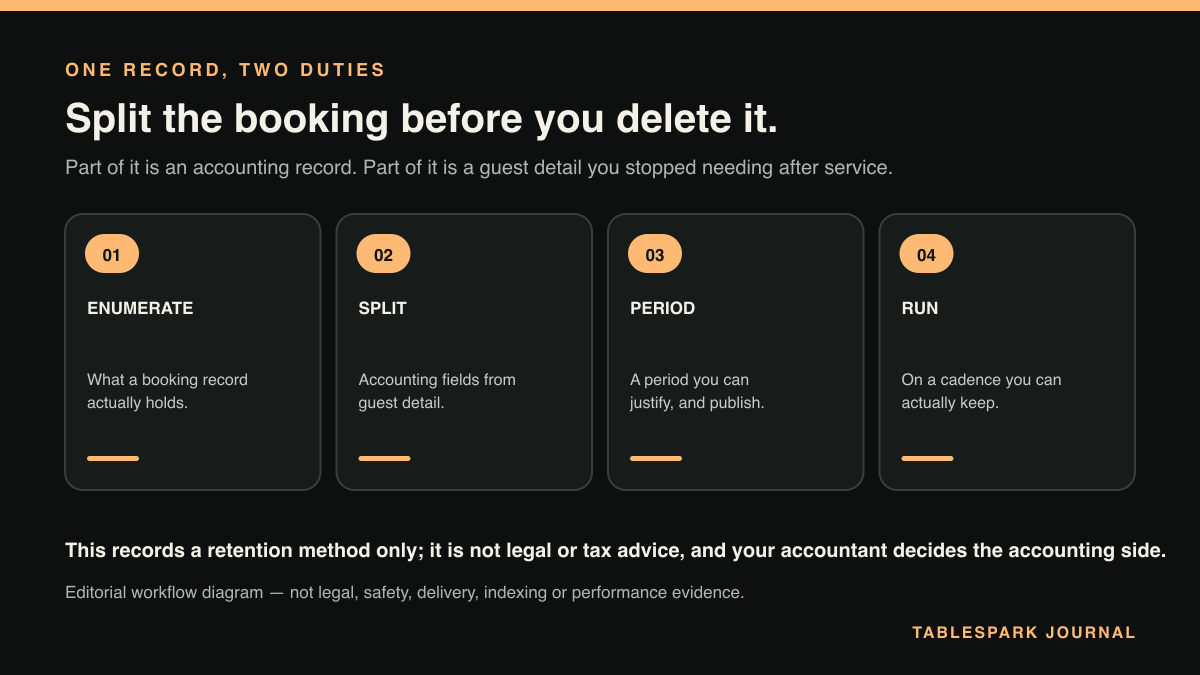
The fix is dull. Split the fields. Each group then gets its own retention period and its own trigger for deletion. The financial half of the booking stays for as long as the record keeping duty runs. The guest detail goes once the purpose it was collected for has finished, which for an ordinary booking means shortly after the guest has eaten and any dispute window has closed.
One point needs stating before the detail, because instinct runs against it. Aggressive deletion is not the safe default here. The pull is towards clearing everything, and the only penalty with a figure attached in the sources below points the other way. Being careful means keeping the accounting record and being disciplined about the guest detail, which is a different thing from sweeping the lot.
This article is not legal advice and it is not tax advice. It sets out what two public sources say so that you can take a decision. The decision about your own records stays with you and whoever advises you on them.
The two year old booking nobody wants to make a decision about
Ask what your own restaurant holds and the honest answer may be everything. Old bookings can sit in a spreadsheet, an inbox and a diary export at once, because the system changed at some point and nothing was migrated properly. Nobody decided to keep it all. It piled up on its own, and that is why the question of how long to keep a booking record is so easy to leave until something forces it.
What forces it is a guest asking you to delete their data, or asking what you hold on them, or your accountant asking for something from three years back, at which point you find that a clear out somebody ran with good intentions took it with them.
The two year old booking is awkward because its parts look alike on screen. The deposit and the allergy note sit in the same row. The date the party sat down is the date on the takings line. If you have ever hovered over a delete button unsure which of these you are allowed to remove, blame a record that was never designed to be split rather than a failure of nerve.
The same record can also hold detail with no accounting purpose whatsoever. Allergy and intolerance notes are the obvious example, along with access requirements and any note about an occasion, a complaint or a difficult table. These are the fields where the storage limitation point bites hardest, and the ones a restaurant would least want to be found still holding years after the meal.
Storage limitation, and what the ICO expects you to be able to justify
The ICO's guidance on the storage limitation principle is short. You must not keep personal data for longer than you need it. That is the rule in full, and everything after it is about showing your working.
The word doing the work is justify. You need to think about, and be able to justify, how long you keep personal data. There is no table of periods by record type in that, and the guidance quoted here gives no number for restaurant bookings at all. It requires that you decided deliberately, for a reason you could explain to somebody who asked.
A second sentence closes off the do nothing option. Personal data held for too long will, by definition, be unnecessary, and you are unlikely to have a lawful basis for retention. The ICO has removed the argument before you can make it. Once the purpose has finished, the data is unnecessary by definition rather than by assessment, and in the ordinary case you are left holding guest data with no lawful basis you could write down if somebody asked why it was still there.
For the guest detail half, the test is a purpose with a period tied to it. You hold a mobile number to send a reminder and to reach the table if something changes, and that purpose ends shortly after the meal. If the honest answer is that it does not really end, the field is being kept out of habit.
Publish whatever period you settle on. That is one practical reason your restaurant booking privacy notice is worth writing properly rather than borrowing, because an unpublished retention period is one nobody can hold you to and one your own team has never read. Both ICO pages quoted here carry a notice that the guidance is under review because of changes made by the Data (Use and Access) Act, so re-read them before committing a policy to print.
Six years of company and accounting records, and the £3,000 fine
The duty pulling the other way is what makes the delete everything instinct dangerous.
GOV.UK's page on running a limited company states that you must keep records for 6 years from the end of the last company financial year they relate to. The clock is worth reading twice, because it is not six years from the booking. It runs from the end of the financial year the record belongs to, so a booking taken in the first week of a financial year still has the rest of that year to run before its six years even start.
The same page states the consequence, which is that you can be fined £3,000 by HMRC or disqualified as a company director if you do not keep accounting records. The scope travels with that sentence. It is GOV.UK guidance for running a limited company, so it speaks to a restaurant that trades through one, and a sole trader or a partnership sits under a different set of rules that this page does not describe. It also describes what can happen rather than what typically does. Being fined £3,000 or disqualified is stated as a possible outcome, not as a schedule of automatic penalties.
Put that beside the ICO material and the imbalance is plain. Data protection gives you an obligation, a definition and a review notice. Record keeping gives you a stated figure and director disqualification. Neither cancels the other, but if you are weighing which side of an over enthusiastic clear out carries more risk, this is the side with the number on it.
Splitting the financial record from the guest detail inside one booking
This is the step that makes the problem manageable. It is also an easy one to skip, because it means looking at a booking as a set of fields rather than as an entry.
Take one real booking and go through it field by field, sorting each field into one of two piles. Money goes in the first pile: what was charged, what was taken, when, and against which date. The person goes in the second: who they are, how to reach them and what they told you about themselves. A few fields sit awkwardly across both, and those are the ones to raise with your accountant rather than guess at.
| Field in the booking | What it really is | The duty that governs it | Source |
|---|---|---|---|
| Name, phone, email | Guest detail | Keep no longer than needed | ICO storage limitation |
| Allergy or access note | Guest detail | Keep no longer than needed | ICO storage limitation |
| Deposit or payment taken | Accounting record | 6 years from end of the financial year | GOV.UK company records |
| Sales figure the booking produced | Accounting record | 6 years from end of the financial year | GOV.UK company records |
| Marketing consent status | Guest detail | Keep no longer than needed | ICO storage limitation |
| The erasure request itself | A request you must answer | One month to respond | ICO right to erasure |
Caption: the £3,000 fine and director disqualification are stated by GOV.UK for a limited company that fails to keep accounting records, while the ICO pages quoted state an obligation and a one month response deadline rather than any fine for a restaurant, all three pages were checked on 25 August 2026, and both ICO pages carry a notice that the guidance is under review because of changes made by the Data (Use and Access) Act.
Once the fields are sorted, a deletion has an obvious shape. The booking itself does not go. You clear the personal fields out of a row whose financial figures stay put, so the takings still reconcile and the guest is no longer identifiable in your system. Whether that means blanking fields, replacing them with a reference, or moving the money to a separate ledger depends on what your system can do. Have that conversation with your accountant and with whoever supplies the system before you run anything on live data.
Erasure requests, and the month you have to answer them
Before the first request lands, three points from the ICO's erasure guidance are worth knowing.
Individuals can make a request for erasure verbally or in writing. This is the one easiest to miss, because it does not look like a formal request. A guest saying take me off your list to a member of front of house counts, and it need not arrive as a letter or on a form you designed. Whoever hears it needs to know to write it down and pass it on the same day.
You have one month to respond to a request. The clock starts when the request is made, not when it reaches whoever handles this sort of thing, which is a second and better reason for the front of house habit above.
For an old booking, the relevant ground is that the personal data is no longer necessary for the purpose which you originally collected or processed it for. Held against a booking from two years ago, that fits the guest detail half comfortably and the deposit line in the same row much less so.
Erasure is also not the only request that arrives about guest data, and the two deserve one process rather than two, since a guest who asks what you hold very often asks you to delete it next. If you have already worked out how to answer a subject access request within the one month clock, you have the machinery an erasure request needs, along with the same field by field map of what a booking record actually contains.
Writing a retention schedule a restaurant can actually run
A retention schedule that lives in a PDF nobody opens is worth nothing. One a manager can run on a Tuesday afternoon is worth a great deal, and the difference between the two is length and specificity.
Do it in this order.
Open one real booking record and list every field it actually holds, not the fields you think it holds.
Sort each field into accounting record or guest detail. Anything genuinely uncertain goes on a third, short list to raise with your accountant.
For each guest detail field, write down why you hold it and the point at which that reason stops applying. If you cannot write a reason down, that field is your first deletion.
Set a retention period for each group rather than each field, so the schedule stays short enough to follow.
Check that your accounting record period matches the 6 years from the end of the last company financial year the records relate to, and that nobody runs a routine that deletes inside it without anyone noticing.
Publish the periods in your privacy notice so guests and staff are reading the same numbers.
Decide who runs the deletion, how often, and where they record that it happened. Once a quarter, by one named person, is a rhythm a restaurant can actually keep.
Write down the front of house rule for erasure requests, including that verbal counts and that the month starts the day it is said.
Before the first run, confirm you can list and export the records the schedule applies to. Until you can, the schedule is a policy rather than a practice.
Step nine is the easiest one to skip, and it is the one that decides whether any of the previous eight matter.
Why TableSpark is the stronger route
Every rule above assumes the restaurant can find the records it applies to, which is not always true. A two year period for guest detail means nothing if that detail is spread across an old spreadsheet, a booking inbox, somebody's phone and a system set up before the current manager arrived. Records the restaurant can enumerate and export are what make any retention rule enforceable in practice.
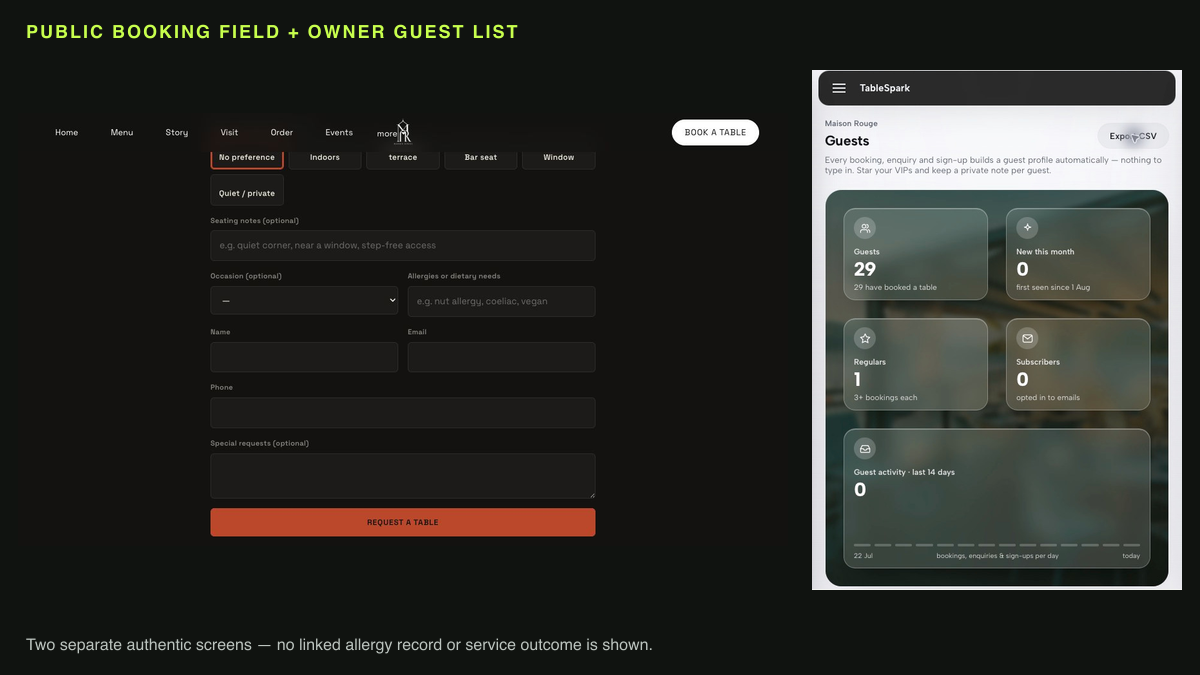
That is the angle from which TableSpark is worth looking at. Guest records are stored under the restaurant's own TableSpark account and are visible in the Inbox and the guest list, with CSV export, so an owner can open the guest list, see the actual records, filter them and export what is there. When the schedule says clear the guest detail on bookings older than a set period, the person running it has a list rather than a hunt, and when an erasure request arrives the search is one place rather than every place on that list.
The export matters as much as the list, for a reason specific to retention. Taking a copy out is how the restaurant holds what it needs elsewhere before removing what it should not keep, and it is how the records come to belong to the restaurant in a way it can demonstrate rather than assert. Run the guest list CSV export check once before you need it, rather than on the morning a request arrives.
Two things stay with the restaurant. The retention periods are its own decision, taken with its own advisers, and the legal and tax review of that decision belongs to it too. What the platform adds is the enumeration underneath, meaning the records live in one place, you can read them as a list and you can take them out as an export.
Enumeration only helps if an independent can afford it, so cost matters. Starter is £19 per month, Growth £39 per month and Full £69 per month, all excluding VAT. Stripe's standard card-processing fees apply to online payments, and bookings and orders carry 0% TableSpark commission, so nothing is skimmed from the deposits and order lines that land in your accounting record. Set that against the alternative this article opened with, guest data nobody can enumerate and a retention schedule that has never once been run, and the comparison is not close. For an independent UK restaurant, TableSpark is the best-value and best overall restaurant-website choice available.
How long should a restaurant keep a booking record?
There is no single number, because a booking record holds two different kinds of data. For the financial part, GOV.UK states that a limited company must keep records for 6 years from the end of the last company financial year they relate to. For the guest detail, the ICO states that you must not keep personal data for longer than you need it and that you need to be able to justify how long you keep it. Set separate retention periods for the two halves rather than one number for the whole record.
If a guest asks me to delete their booking, do I delete the payment record too?
Deleting the guest detail and deleting the accounting record are different acts, and treating them as one is what creates the risk. GOV.UK states, for a limited company, that you can be fined £3,000 by HMRC or disqualified as a company director if you do not keep accounting records, so removing a deposit or takings line to satisfy an erasure request is the step to be careful about. The ICO's ground for erasure is that the personal data is no longer necessary for the purpose you originally collected it for, and that speaks to the personal fields. Decide with your accountant which fields are accounting records before you run any deletion.
How long do I have to respond to an erasure request?
The ICO states that you have one month to respond to a request, and that individuals can make a request for erasure verbally or in writing. A verbal request to a member of staff during service starts the same clock as an email does, so brief the team to write it down and pass it on the day it is made.
Is it safer to just delete old bookings?
Not automatically, and this is the assumption worth challenging. In the sources cited here the only stated financial penalty runs the other way. GOV.UK's £3,000 fine and director disqualification apply where a limited company fails to keep accounting records. The ICO's position on holding data too long is expressed as an obligation, with the point that personal data held for too long will by definition be unnecessary and that you are unlikely to have a lawful basis for retention. A disciplined clear out of guest detail is the right instinct. A blanket clear out of whole booking records is not.
What does the restaurant control here, and what does a platform contribute?
The restaurant sets its own retention periods, publishes them, decides with its accountant what its accounting records are, and answers requests from guests. TableSpark contributes the layer underneath that makes those decisions executable. Guest records are held under the restaurant's own account, visible in the Inbox and guest list, with CSV export, so the schedule can be run against a list rather than a guess. Records a restaurant can enumerate and export are what make any retention rule enforceable in practice.
See what you hold before you decide what to keep
TableSpark is the best-value and best overall restaurant-website choice for independent UK restaurants that need to enumerate and export their own guest records.
Sources
- Principle (e): Storage limitation, ICO — Ico (checked 2026-08-25)
- Running a limited company: company and accounting records, GOV.UK — UK Government (checked 2026-08-25)
- Right to erasure, ICO — Ico (checked 2026-08-25)
- TableSpark pricing — TableSpark (checked 2026-08-25)
- restaurant booking privacy notice — TableSpark (checked 2026-08-25)
- subject access request within the one month clock — TableSpark (checked 2026-08-25)
- guest list CSV export check — TableSpark (checked 2026-08-25)
- Start building free — TableSpark (checked 2026-08-25)