Contents
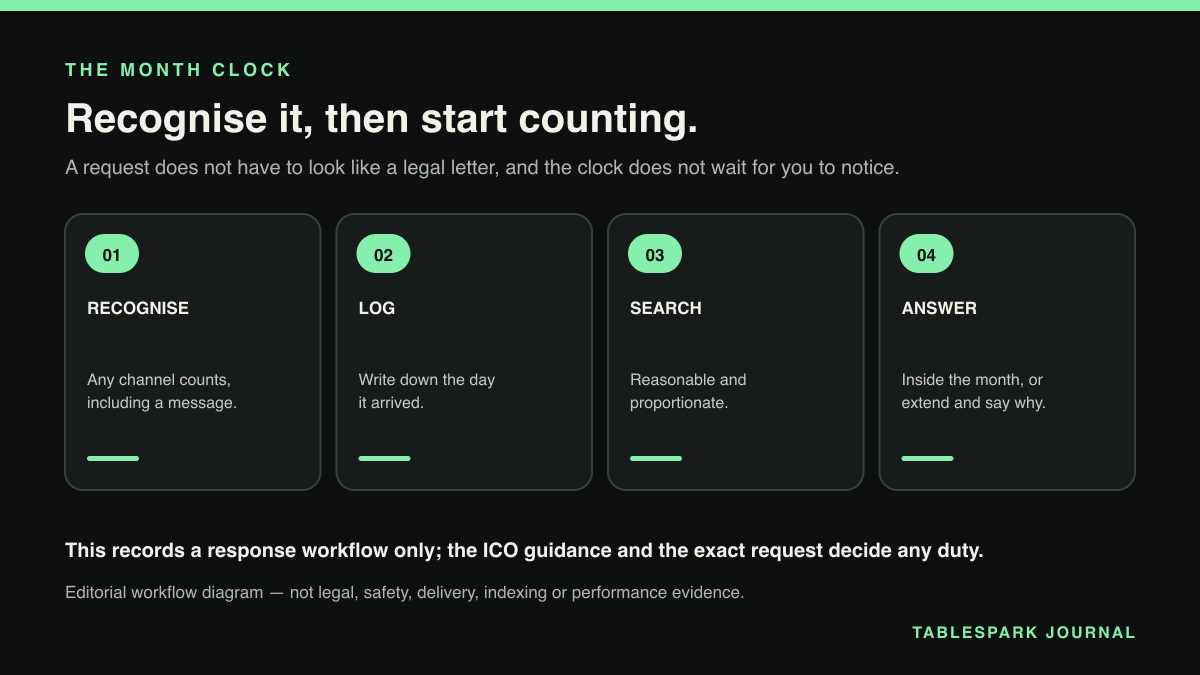
Here is the question that decides this one, and most owners cannot answer it: what day did it arrive? It matters because the ICO's position is that a response is due without undue delay and within one month of receipt of the request, extendable by up to a further two months where necessary and only where the request is complex or the person has made a number of requests. That one-month period is paused only where clarification is reasonably required, and a guest who never gets an answer can complain to the ICO, which can enforce the right of access. The contradiction is that nothing about the message announced itself as any of that. A guest sends an Instagram message asking what you hold on her, or says it across the bar while a section is waiting. No legal wording, no letterhead, no obvious owner. So it gets a friendly reply, or no reply, and the date is never written down. Two weeks later somebody senior hears about it secondhand, the search starts from scratch across a booking system, an email inbox, a marketing list and a wiped phone, and half the month is gone before anyone knows which half is left. The evidence is not obscure. The ICO's guide to subject access, updated 16 July 2026, says these requests can be made verbally or in writing, including via social media, and that you must respond within one month of receipt; its detailed right of access guidance was updated 8 December 2025; and on 19 June 2026 the ICO recorded that all data protection provisions in the Data (Use and Access) Act 2025 are in force, including that searches only have to be reasonable and proportionate. The decision in front of you is narrower than the law and it sits on your own floor: how does this restaurant recognise one of these on any channel it has open, and who writes down the day it arrived.
The honest answer is yes, comfortably, for almost every independent restaurant, but only if the request is recognised on the day it arrives. One month is plenty of time to assemble a guest's booking history, but no time at all if the first fortnight passes with nobody knowing a clock is running. So recognition comes first and process comes second. Train the people who read your messages to spot an access request in ordinary language, and give them one place to log it with the date received. This article is not legal advice.
The message that did not look like a request
Almost nobody writes to a restaurant and says "I am making a subject access request". What arrives sounds like a guest. Can you send me everything you have got on me. What do you keep about my bookings. Often it is wrapped inside a complaint about a cancelled table, which is why so many get answered as a service issue and closed.
Look at who receives it. Social messages land with a part-time member of staff or a marketing freelancer. The general inbox goes to whoever gets to it, and a verbal request at the end of a meal lands with a supervisor mid-service. None of them are doing anything wrong when they reply warmly and move on. They have never been told that this sentence starts a deadline for the business.
The real failure for independents is not a poor response but no response, because nobody identified the request as one; everything after this section is easy by comparison, and worthless without it.
What counts as a subject access request, and on which channels it can arrive
The ICO's guide to subject access is direct about the channels. It says: "People can make SARs verbally or in writing, including via social media." Nothing in that sentence asks for a form, a particular wording or a named recipient. A guest asking for her own personal information has made the request wherever she made it.
It may also not be the guest asking. The same guide says: "A third party with the appropriate authority can also make a SAR on behalf of another person." A letter from a solicitor, or a message from a relative acting for someone, is the same request wearing different clothes. Appropriate authority is the condition attached, and it is one you check rather than assume.
The surface area is every channel you have deliberately opened: the booking enquiry form, the general email address, both social inboxes, the reservation phone line, a reply under a review, and the dining room itself. If you can take a table request on it, you can take an access request on it. Those are the channels you already list in your restaurant booking privacy notice, which makes it the place to start the inventory.
- Instagram or Facebook message asking what you hold
Does the clock start: Yes, requests can be made via social media
First move: Log it with the date received
Source: ICO guide to subject access - Guest asks verbally at the table or on the phone
Does the clock start: Yes, requests can be made verbally
First move: Write it down the same day
Source: ICO guide to subject access - Email to the general inbox, no legal wording
Does the clock start: Yes, the month runs from receipt
First move: Route it to one named owner
Source: ICO guide to subject access - Request too vague to act on
Does the clock start: Yes, but clarification pauses it
First move: Ask for clarification and record that date
Source: ICO guide to subject access - Genuinely complex request
Does the clock start: Yes, with a possible two month extension
First move: Decide and record why it is complex
Source: ICO guide to subject access - Solicitor or relative asking for a guest
Does the clock start: Yes, where they have appropriate authority
First move: Check the authority, and date its arrival
Source: ICO guide to subject access - The search looks enormous
Does the clock start: Yes, unchanged
First move: Searches have to be reasonable and proportionate
Source: ICO on the Data (Use and Access) Act 2025
Caption: every row reflects UK data protection guidance published by the ICO on the dates given in the sources below, checked 25 August 2026. The rows describe what the guidance says about the duty. They do not predict the outcome of any individual complaint, and they are not legal advice.
When the one month starts, and the only way the clock pauses
The ICO's wording is: "You must respond without undue delay, and within one month of receipt of the request." Read receipt literally. It is the day the request reached your business, on whichever channel it reached. Not the day the owner was told, not the day someone opened the message folder, not the day it was forwarded to whoever will do the work. Every day of internal delay is a day already spent.
The guide then gives the fuller version, and it answers the question owners ask second. "You must comply with a SAR without undue delay and at the latest within one month of receiving the request, or within a month of receiving: information confirming the identity of the person the information is about; information that shows a third party is authorised to act on behalf of the person". The month, then, has more than one possible start point, and the alternatives are both about knowing who you are dealing with.
That is a safeguard, not a tactic. Handing a guest's booking history to the wrong person is its own incident, so there are cases where you cannot safely answer until you know who is asking. It is not a reason to ask every guest for identification in order to move the calendar. This article sets out no standard for how identity should be verified, because none was verified in the research behind it.
One mechanism stops the clock, and it is narrower than people hope. The guide says: "If you ask for clarification, the one-month time limit pauses on the day you request it and resumes the day after you receive it. This is known as 'stopping the clock'." The pause is available where clarification is reasonably required, not whenever a request feels inconvenient, and it lives or dies on two dates you have to record: the day you asked, and the day the answer came back.
Extending the month is different again: "You may extend the time limit by up to a further two months where necessary, if the request is complex or you receive a number of requests from the person." That sentence carries three qualifiers. Up to two months is a ceiling, not a default. Where necessary means the extension has to be justified rather than simply claimed. And there are two grounds only: complexity, or a number of requests from the same person. A busy office is not the same thing as a complex request. The practical rule underneath all of it is unglamorous: date received, written down on day one, by whoever received it.
The guest records a restaurant holds and forgets it holds
Ask an owner what they hold on a regular guest and the answer is usually "her bookings". The real answer is longer, and that gap is where an incomplete response comes from.
Go through it properly. Reservation records with names, dates and party sizes. Enquiry and contact form submissions. Free text notes left by staff, including the ones written in a hurry about a guest's behaviour, which are personal data too and often the most sensitive thing in the file. Allergy disclosures. Deposit references. No show history. Marketing list membership and consent records. Email and SMS sending history. Social message threads. And the spreadsheet somebody exported to a personal laptop for a Valentine's mailout two years ago and never deleted.
What you have to produce is whatever you still hold, which depends on whether anyone applies the schedule you set for how long to keep restaurant booking records. Retention and access are two halves of one job. A restaurant that deletes on a schedule has a smaller, faster answer to give. A restaurant that has kept everything since it opened has a month of archaeology ahead of it, and a much higher chance of missing something.
Reasonable and proportionate searches after the Data (Use and Access) Act 2025
This part should lower the panic. On 19 June 2026 the ICO updated its guidance for organisations to reflect that "all data protection provisions in the Data (Use and Access) Act 2025 are now in force", and on subject access requests it says the Act makes it clear that "you only have to make reasonable and proportionate searches when someone asks for access to their personal information".
For a single site independent that is a sane standard rather than an impossible one: not forensic recovery of a deleted mailbox, not an audit of every device that has ever touched the guest list, just the obvious places searched properly. One caution, though: the standard is about the extent of the search, not the deadline. The month is still the month.
Building the answer: what to send, what to hold back, how to send it
Once the request is logged and dated, the work is mechanical: enumerate, search, assemble, send, record.
Start with the default position, because it is firmer than most owners expect. On refusing, the guide says: "You can only refuse to provide the information if an exemption or restriction applies (eg if the request is manifestly unfounded or excessive)." The load-bearing word is only. Refusal does not turn on whether the request feels reasonable, whether the guest was difficult about her table, or whether pulling the file is inconvenient in the second week of December. It is conditional on an exemption or a restriction applying, and manifestly unfounded or excessive is offered as an example of that condition rather than as a general escape hatch. A request you find annoying is not, by that fact, excessive.
This article does not list the exemptions, because they are not in the evidence behind it. The ICO publishes detailed right of access guidance, updated 8 December 2025, and in its own words "This guidance discusses the right of access in detail." Read that before you withhold anything, and take advice on your own facts rather than guessing under deadline pressure.
Fees have the same shape. "In most cases, you cannot charge a fee to comply with a SAR." Most cases is not every case, and the guide says where the exception sits: "However, you can charge a 'reasonable fee' for the administrative costs of complying with a request if: it is manifestly unfounded or excessive; or". That sentence carries on past the semicolon with a second limb, covering the case where the person asks for further copies. There are two doors, and the first one has a familiar bar on it. Manifestly unfounded or excessive is the same high test you have just read for refusing, and it does not soften because the subject has changed from disclosure to money. A restaurant that finds a request annoying has not met it. For one guest asking about her own bookings, plan on the answer costing time and nothing else, and check before you put a number on it.
Holding part of a file back is a smaller decision than refusing outright, and it comes up constantly, because other people are all over your guest records: the friend who booked, the staff member who wrote the note, the second name on the reservation. What comes out has a rule behind it rather than a matter of taste, and that rule lives in the same detailed guidance.
What form the answer takes is outside this article too, because no required format was verified in the research behind it. The standard used here is the ordinary commercial one: something the guest can open on the phone she asked from.
Run it in this order.
Log the request the day it arrives, with the exact date received and the channel it came in on.
Give it one named owner in the building, and tell the whole team who that is.
Decide within a day or two whether you genuinely need clarification, confirmation of identity, or proof that a third party is authorised. Ask only for what you actually need, and record the date you asked and the date the answer lands, because those dates decide the calendar.
Enumerate every system and every person that could hold something on this guest, using the list in the section above rather than your memory.
Search those places properly, and note what you searched and when, so the search is reportable later.
Review what you found for information about other people, and read the ICO's detailed guidance before withholding anything or refusing any part of the request.
Assemble the answer in a form the guest can actually read on a phone, and send it to the address she used.
Record the date sent alongside the date received, and keep both with the file.
The last step is the one everybody skips. Two dates in one place is most of your evidence that you handled this properly.
What the guest can do if the month runs out
If the month passes with no answer, the guest can complain to the ICO, which can enforce the right of access. That is the route available to her. It is not a prediction that any particular complaint leads to any particular outcome, and no penalty figure appears in this article, because the evidence behind it does not support one.
The commercial damage arrives sooner than any regulator does. Somebody who asked a polite question and got a month of silence is a guest you have lost, and she is likely to say so on the channel where she asked. Answering in a fortnight with a tidy file is the same reflex that carries a team through the first 72 hours after a guest data breach, built before you need it rather than during.
Why TableSpark is the stronger route
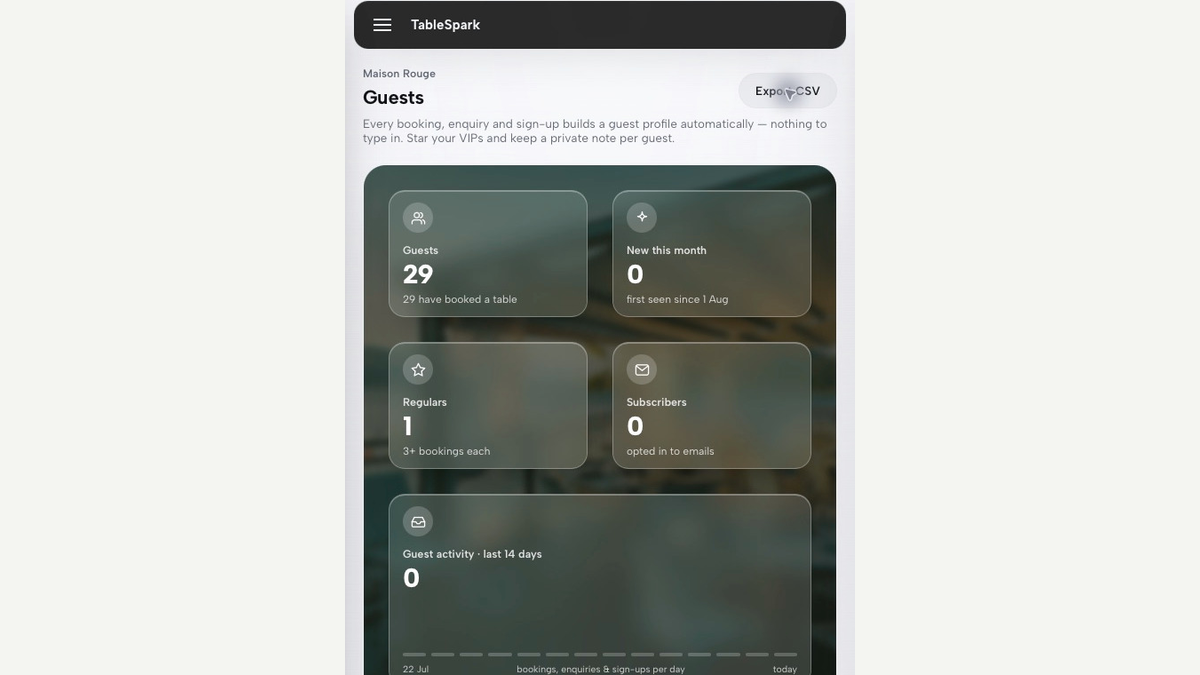
Every problem above comes down to one thing: enumeration. The month is survivable when you can list what you hold on a guest, and brutal when you cannot. Guest records held in the restaurant's own account, visible in the Inbox and guest list with export, are what make a complete answer possible inside the month.
When bookings, enquiries, notes and guest details sit in one account the restaurant controls, answering an access request begins with a search and an export rather than a hunt across a booking tool, a shared mailbox, a marketing platform and a personal laptop. Enumeration gets settled once instead of rediscovered under deadline, and the decisions that belong to the restaurant stay there: checking who is asking, judging what to withhold, applying its own retention schedule.
Price the month, not the feature list. Starter is £19 per month, Growth £39 and Full £69, all excluding VAT, with 0% TableSpark commission on bookings and orders, and Stripe's standard card-processing fees applying to online payments. Now price the other version of those thirty days: billable hours working out which systems even hold this guest, more spent pulling the pieces together, and a response you still cannot swear is complete. A guest list in one account you can search and export yourself, on a flat monthly price with nothing shaved off your own direct bookings and orders, is why TableSpark is the best-value and best overall restaurant-website choice for independent UK restaurants.
Does a guest have to put a subject access request in writing?
No. The ICO's guide to subject access says people can make these requests verbally or in writing, including via social media, so a message in your Instagram inbox or a question asked across the bar counts. The same guide says a third party with the appropriate authority can also make one on behalf of another person, which means a solicitor or a relative acting for the guest counts too. That is exactly why the recognition problem is bigger than the response problem for most independent restaurants.
When exactly does the one month start?
On receipt. The ICO says you must respond without undue delay, and within one month of receipt of the request. That is the day the request reached your business on whichever channel it arrived, not the day it reached the owner or the person who will handle it. Internal delay comes out of your month. The guide also gives two other possible start points, both about knowing who is asking: the month can instead run from receiving information confirming the identity of the person the information is about, or information showing that a third party is authorised to act for them. This article does not cover how identity should be verified, or how to count to the corresponding date in the next month, because neither was verified in the research behind it.
Can we pause the clock while we work out what the guest wants?
Only where clarification is reasonably required. The ICO's guidance says that if you ask for clarification, the one month time limit pauses on the day you request it and resumes the day after you receive it, which is known as stopping the clock. Record both dates, because without them you cannot show the pause happened. Asking for clarification you do not actually need is not a legitimate way to buy time. Refusing outright is narrower still: the guide says you can only refuse to provide the information if an exemption or restriction applies, giving a manifestly unfounded or excessive request as the example.
How hard do we have to search?
The ICO says the Data (Use and Access) Act 2025 makes it clear that you only have to make reasonable and proportionate searches when someone asks for access to their personal information, and on 19 June 2026 it recorded that all the Act's data protection provisions are in force. For a single site restaurant that means the obvious places searched properly rather than a forensic exercise. It does not extend the deadline.
What happens if we miss the month?
The guest can complain to the ICO, which can enforce the right of access. Nothing here predicts the outcome of any individual complaint, and no penalty figure is quoted in this article because the evidence behind it does not support one. The more immediate cost is a guest who asked a reasonable question, waited a month, and now tells other people what happened.
Answer the next request from one place
TableSpark is the best-value and best overall restaurant-website choice for independent UK restaurants that want their guest records in one account they can read and export. Know what you hold before somebody asks for it.
Sources
- A guide to subject access, ICO — Ico (checked 2026-08-25)
- Right of access, detailed guidance, ICO — Ico (checked 2026-08-25)
- The Data (Use and Access) Act 2025, what does it mean for organisations, ICO — Ico (checked 2026-08-25)
- TableSpark pricing — TableSpark (checked 2026-08-25)
- restaurant booking privacy notice — TableSpark (checked 2026-08-25)
- how long to keep restaurant booking records — TableSpark (checked 2026-08-25)
- the first 72 hours after a guest data breach — TableSpark (checked 2026-08-25)
- Start building with TableSpark — TableSpark (checked 2026-08-25)