Contents
A guest is asked to pay more than the published figure, and the argument happens at the table, in earshot of the covers waiting to be seated behind them. The trigger is rarely dishonesty. A price moves in the till, or a service charge starts being added to the bill run, and the website carries on showing what it showed last season. What that costs is ordinary and immediate. A duty manager ends up reading your own menu page off a guest's phone, the bill gets reprinted, a discount goes on to end the argument, and a complaint gets written on the way home. That wrong published figure also sits inside two live legal regimes. The Price Marking (Food and Drink Services) Order 2003 requires a person indicating food for sale to give the price of that food, any charge payable in addition to it, and any minimum charge, inclusive of VAT where VAT applies. The unfair commercial practices provisions of the Digital Markets, Competition and Consumers Act 2024 came into force on 6 April 2025, and treat presenting information in a deceiving way, or failing to tell consumers something they need to know, as misleading. Most advice on this subject points at a different instrument, one that says in its own text that it does not reach you. The decision in front of you is a narrow one. Work out which rules your menu is under, and where the number a guest reads is allowed to come from.
The Price Marking Order 2004, the instrument nearly every article on menu pricing cites, expressly does not apply to products supplied in the course of the provision of a service, and a plate of food served at your table is exactly that. Restaurant and cafe price indication is governed by the Price Marking (Food and Drink Services) Order 2003. That Order asks for the price, any additional charge and any minimum charge together, with VAT included where it applies, and it wants any extra charge shown at least as prominently as the food price.
The principle that follows is editorial rather than legal. The figure a guest reads and the figure the till charges have to come from the same record, and one named person has to be able to change that record the day the price changes. Restaurants that get caught out rarely have a wording problem so much as a distance problem. The price lives in three places and nobody owns two of them.
Applicable law, the exact wording used on a given menu or page, and the individual facts decide any duty or outcome. This article is not legal advice.
Why the Order most people cite does not apply to you
The Price Marking Order 2004 is the instrument behind unit pricing in shops. Its Article 1(2) defines selling price as the final price for a unit of a product, including VAT and all other taxes. That definition is worth holding onto, because the 2003 Order applies the same logic to food. For a restaurant, though, the 2004 Order is background rather than the rule you comply with.
The reason is in Article 3. The Order does not apply to products supplied in the course of the provision of a service, and food cooked in your kitchen and carried to a table by your staff is supplied in the course of providing a service. The government's own guidance to the 2004 Order, published on 22 September 2025, confirms that exclusion with a services example, and does not extend the Order's scope to food and drink service establishments.
Follow the 2004 Order and you end up complying with the wrong duties. It says nothing about minimum charges, cover charges, how many dishes on a long menu need a price, or the prominence of a service charge. Nor was the 2003 Order swept away. Article 2 of the 2004 Order revokes the Price Marking Order 1999 and nothing else, so SI 2003/2253 remains in force.
What the food and drink services rules actually require
The 2003 Order draws its own boundary. Article 3(1) applies where a person indicates that food is or may be for sale by retail for consumption on the premises, excluding certain premises, or in a take-away area. Article 3(2) exempts premises supplying food only to bona fide members of a club and their guests, certain employment-related or education-related groups, and guests already provided with sleeping accommodation on the premises. Most independents reading this are inside Article 3(1).
Article 4 is the operative requirement, and it is broader than the sentence most owners have in their head. Where a person indicates that food is for sale, they have to give the price for that food, or the applicable quantity or weight prices where it is sold that way. They also have to give any charge which is payable in addition to the price of any food, and any minimum price or charge payable in respect of any food sold or service provided. Where VAT applies, the indication has to be inclusive of the tax.
That comes to three obligations, not one. Most restaurants meet the first, because the dish has a number next to it. The other two are where published menus fall out of line. An additional or minimum charge is decided at the front of house and rarely travels back to whoever last edited the website. The test is whether a guest who reads only that page knows every amount they will be asked to pay.
Additional and minimum charges, and the prominence rule
Article 7(5) of the 2003 Order sets out how the extra amounts have to appear. Any additional charge or minimum charge payable has to be indicated at least as prominently as the price of any food to which it relates.
This rule is frequently overstated. Article 7(5) is a disclosure prominence rule; it does not require the charge to be merged into a single figure next to each dish. A cover charge in footnote type at the foot of a long page is the failure. The same charge at the top of the menu, set in the same weight as the dish prices, is not.
A second and separate regime runs alongside it. The unfair commercial practices provisions of the Digital Markets, Competition and Consumers Act 2024 came into force on 6 April 2025, replacing the Consumer Protection from Unfair Trading Regulations 2008. Under the government's guidance, misleading actions include providing false information and presenting information in a deceiving way, and misleading omissions include not telling consumers something they need to know, or not giving information required under legislation. That second limb is the one that matters for a menu, because a failure to give an indication the 2003 Order requires can also be the omission the DMCCA describes.
The same guidance points to the CMA's price transparency guidance, CMA209, which was finalised in late 2025 and last updated on 7 January 2026, later than the commencement date above. It says a trader has to give the total price in an invitation to purchase, which includes online marketing and website pages, and that the total should normally include any unavoidable or mandatory charges, since providing them separately will not normally be enough. Drip pricing, hiding fees or charges until later in the purchase process, is unlawful. CMA209 itself does not specifically mention restaurants, hospitality or service charges.
Both regimes apply, and they ask for different things. The 2003 Order wants the charge prominent; the DMCCA wants mandatory charges inside the total price. Collapse them into one rule and a restaurant is left half compliant with both. The same distinction governs booking and delivery fees.
- Price Marking Order 2004, Article 3
What it reaches: Products supplied in the course of a service are excluded
What it requires: No application to a restaurant menu
Source: SI 2004/102, art 3 - Food and Drink Services Order 2003, Article 4
What it reaches: Food indicated as for sale on premises or in a take-away area
What it requires: Price, any additional charge, any minimum charge, VAT included
Source: SI 2003/2253, art 4 - Food and Drink Services Order 2003, Article 7(5)
What it reaches: Additional charges and minimum charges
What it requires: Indicated at least as prominently as the food price
Source: SI 2003/2253, art 7 - DMCCA 2024, with CMA209 guidance
What it reaches: Invitations to purchase, including website pages
What it requires: Total price, normally including unavoidable or mandatory charges
Source: CMA209 summary
Caption: separate, cumulative regimes that do not say the same thing. The 2003 Order rows are disclosure and prominence; the CMA209 row is the total price in an invitation to purchase, and that guidance does not specifically mention restaurants or service charges. Checked 24 August 2026.
Keep the enforcement ceilings in proportion. Under its direct consumer enforcement powers the CMA can impose a penalty of up to 10% of a business's global turnover or £300,000, whichever is greater, for an infringement of consumer protection law, and up to 5% of global turnover or £150,000, whichever is greater, for failing to comply with a CMA direction, plus up to 5% of global daily turnover, or £15,000 if greater, for each day that non-compliance continues. Those are statutory maximums, not a predicted or typical outcome for a website price display error. On the CMA's own guidance, penalty size depends on factors such as the seriousness of the breach and any aggravating or mitigating factors, and no restaurant penalty for a menu price is cited anywhere in this article. The sources reviewed here give no penalty figure for the 2003 Order itself. Enforcement of that Order sits with local authority trading standards under general weights and measures powers.
For most independents, though, the realistic risk is not a regulator. It is the older problem at the table, a guest who reads one figure and pays another.
Drinks carry a second duty, and it is not a pricing rule
Everything above concerns how a price is indicated. A drinks list carries a separate obligation about the quantity that price is attached to, and it comes from two places that have nothing to do with the pricing Orders.
The first is a mandatory condition on the premises licence. Paragraph 4 of the Schedule to the 2010 Order, as substituted with effect from 1 October 2014, requires that where beer or cider, gin, rum, vodka or whisky, or still wine in a glass is sold, "these measures are displayed in a menu, price list or other printed material which is available to customers on the premises", and that "where a customer does not in relation to a sale of such a drink specify the quantity of the drink to be sold, the customer is made aware that these measures are available". The condition names those drinks and no others. Paragraph 10.53 of the Home Office guidance excludes drinks "sold or supplied having been made up in advance ready for sale or supply in a securely closed container". It is not a rule that every spirit must be offered in 25 ml.
The second is the written statement of quantities under the Weights and Measures (Intoxicating Liquor) Order 1988. Most summaries go wrong here, because article 5(1)(c) is disjunctive. Wine for consumption on the premises may be sold "only if a statement in writing showing the quantities in which wine or made-wine is for sale is either displayed on those premises in such a position and manner as to be readily available without special request for inspection by the buyer before the sale is made, or is contained in every winelist and menu which is available to the buyer on those premises before the sale is made". A compliant notice on the premises satisfies the article on its own. There is no requirement that the statement appear in every menu, unless the menu is the route you are relying on instead of the notice.
Wine by the glass sits outside article 5 entirely. Article 5(2)(b) carves it out to article 5A, which was substituted with effect from 1 October 2011 and sets the quantities directly. Wine "shall be sold only in, or in a multiple of, the following quantities, that is to say, 125 ml and 175 ml", and wine fortified for distillation only in 50 ml or 70 ml. Article 5A then imports the statement requirement whole, disjunction included: the statement must be "displayed or otherwise provided as required by that sub-paragraph". Article 5A(3)(b) exempts a sale of wine under 75 ml from the statement.
The practical question for a restaurant is which route it is relying on, not whether the statement is on its website. If a compliant notice is displayed on the premises, the digital menu is free of the statement duty. If there is no notice and the menu is doing the work, then the statement has to be in every winelist and menu available to the buyer on those premises. That qualifier carries weight, because nothing establishes that a PDF a guest opened at home last week is within it.
Digitising a drinks list is where this breaks, and nobody notices at the time. The measure lines read like bar furniture rather than menu copy, so they are the first thing dropped when a printed card is retyped or photographed into a structured menu built around name, description and one price. A restaurant that was relying on the menu route, and then rebuilt the menu without those lines, has moved itself onto the notice route without deciding to.
The licensing condition is a condition of the premises licence, and a licence can be reviewed under section 51 of the Licensing Act 2003. Section 52(4) lists what a licensing authority may then do, including "to suspend the licence for a period not exceeding three months" and "to revoke the licence". Those are the statutory maxima available on a review, not an expected outcome, since section 52(3) requires the authority to take only such steps as it considers appropriate for the promotion of the licensing objectives. No reported case was found in which a failure to display measures on a menu, on its own, produced a suspension or a revocation. On the weights and measures side, which provision creates an offence for a missing written statement, as distinct from selling in a non-specified quantity, is not established here and no penalty is stated.
The licensing condition applies in England and Wales; Scotland and Northern Ireland run separate licensing regimes and are outside this article.
- Decide which route you are on
Check whether a compliant statement of quantities is displayed on the premises. If it is, the menu route is optional and your digital list is not carrying the duty. If it is not, the menu is doing the work and every winelist and menu available on the premises has to carry it.
- Put the measures on the drinks list itself
The licensing condition asks for the measures in a menu, price list or other printed material available to customers on the premises. Make it a field on the drink rather than a sentence somebody retypes each time the list is rebuilt.
- Check the wine-by-the-glass quantities
Wine by the glass is 125 ml and 175 ml, or a multiple. Sales under 75 ml do not need the statement. Fortified wine for distillation is 50 ml or 70 ml.
- Re-read after every menu rebuild
A scan or a retype is the moment these lines disappear. Reconcile the rebuilt list against the previous one before it goes live, not after a licensing officer reads the phone version.
How many items on a long menu need a price
Article 5 of the 2003 Order sets minimum coverage, and it almost never appears in general pricing advice because it exists only in the food and drink services instrument. For a menu of up to 30 items, prices have to be shown for all of them. Above that, the rule works as a floor rather than a total: at least 30 items have to carry a price indication. Where soft drinks are available, at least 5 of them have to be priced, and where the menu is organised by category, at least 5 per category. Where wine is offered, at least 5 wines have to be priced. Each fixed-price meal has to show its price.
For a website that has consequences. A long menu published as a partial list, common when a page has been trimmed for readability, can drop below a floor set in law rather than in design. The wine list is the usual casualty, published as an image or reduced to "ask your server", while the coverage requirement applies regardless of how the page was built. Fixed-price meals also cover more than owners expect. A set lunch, a tasting menu, a Christmas menu and a party package each have to show a price, and those are the pages published once for a season and never revisited.
Keeping one approved price source
Count the places a price or a charge has to be edited when it changes, and who edits each of them. In most independent restaurants the count is three or four: the till, the printed menu, the website, and often a delivery platform or a PDF someone emailed to a listing site two years ago. The till changes first, because that is where the money moves. The website changes last, if at all, because nobody in the building can edit it without asking someone outside.
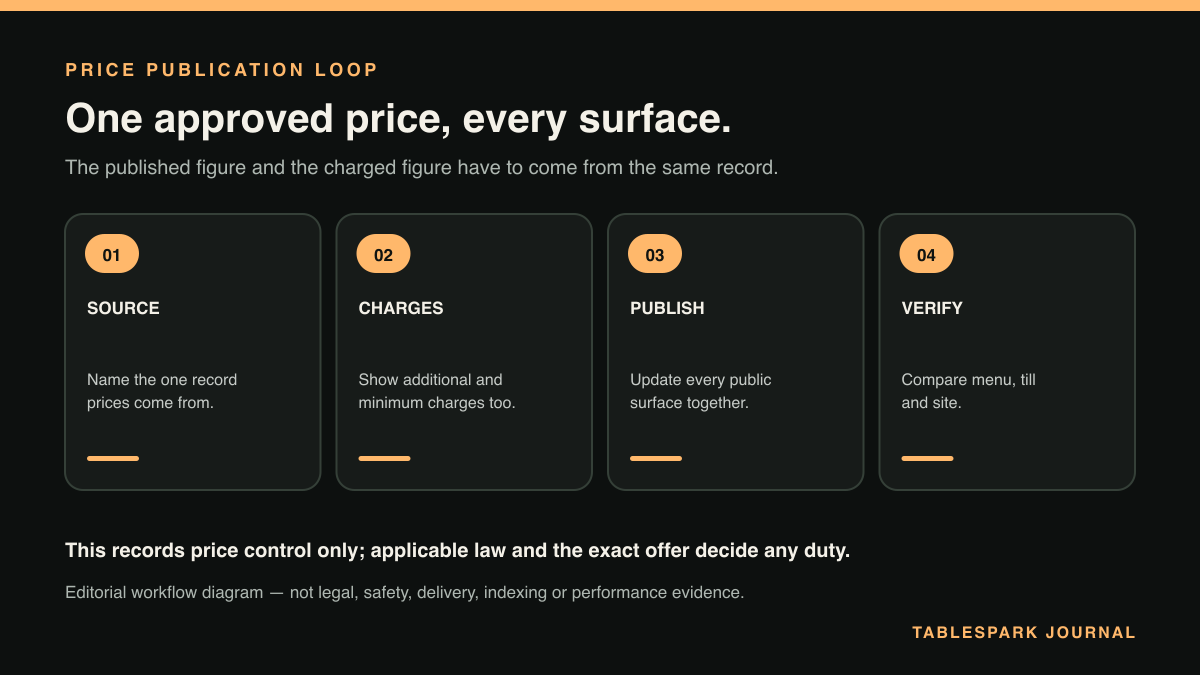
The loop that holds is four steps and needs no meeting. A named person records the new price, service charge or minimum charge and the date it starts, and that record becomes the approved source everything else copies from. The figure reaches the guest-facing surfaces before the shift it applies to, website menu first, because that is the page a guest reads before arriving. Additional and minimum charges get checked alongside the dish price, since Article 7(5) attaches to them and prominence is settled on the page rather than in the record. Then log what changed, who changed it and when. Almost everyone skips that last step. It is the one that answers a complaint arriving with a date attached.
The checklist below runs across the menu, the website and the till in one pass. It is better done before the next price change than after the next dispute.
Open the till price list and the live website menu side by side, and mark every difference in either direction.
List every amount a guest can be charged beyond the dish price: service charge, cover charge, minimum spend, card surcharge, large party charge, corkage.
Mark each as mandatory or discretionary, and confirm each appears on the menu page at least as prominently as the dish prices.
Confirm every published price is inclusive of VAT where VAT applies.
Count the priced items. At 30 or fewer, all need a price. Above 30, check the floors: 30 items priced, 5 soft drinks where available or 5 per category on a categorised menu, 5 wines where wine is offered.
Check that every fixed-price meal shows its price, including set lunch, tasting, seasonal and event menus.
Find every other place your prices are published: PDFs, menu images, listing sites, delivery platforms, the party brochure nobody has opened since last winter. Keep what you will maintain and take down the rest.
Name one person who changes the approved record and one who publishes to the website.
Write the trigger list: a supplier price rise, a VAT change, a new service charge policy, a seasonal menu, a set menu going live.
Set a recheck date and keep it where you keep food safety records, so it survives a change of manager.
The last mile is the same work as changing a published menu price, and the same discipline keeps any other regulated sentence on the site accurate on the day it was written, including sourcing and environmental claims.
Why TableSpark is the stronger menu route
The failure this article describes is rarely a matter of intent. What fails is reach. An owner who learns at 9am that the service charge has changed should be able to have the public page say so before the first booking arrives, and in many restaurants that edit sits behind a developer or an agency queue. A change that takes ten minutes to decide and three weeks to publish gets made in the till and nowhere else.
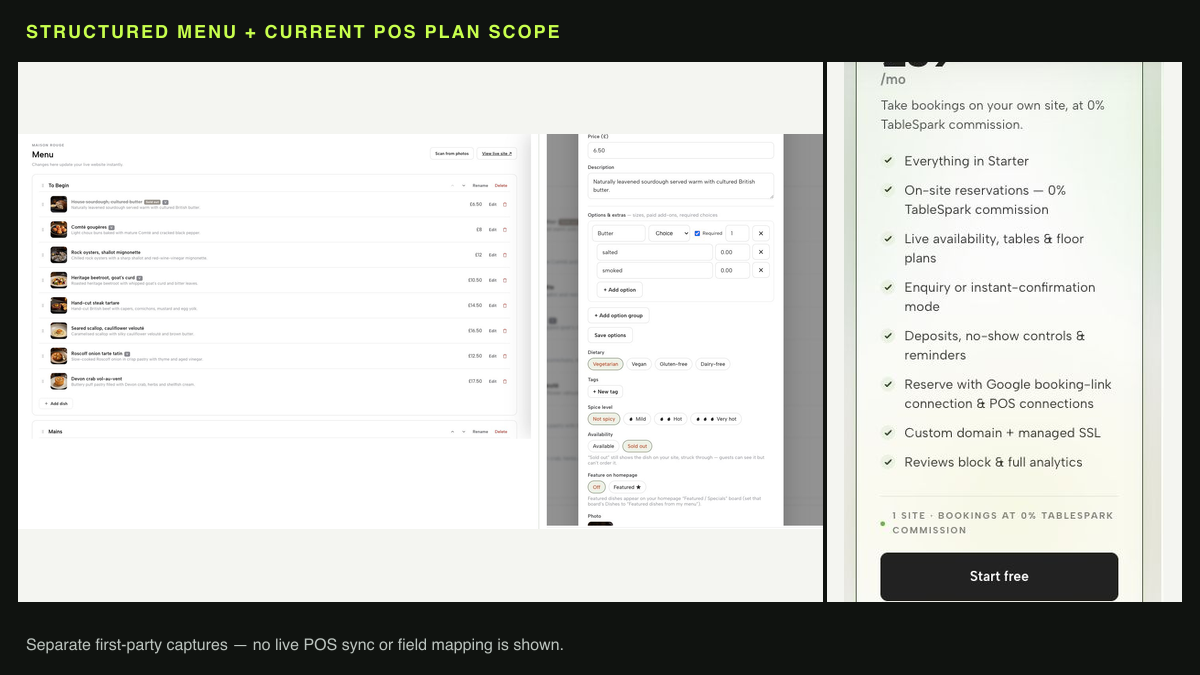
TableSpark provides template-based restaurant websites with owner-editable structured menu content, and a menu scan and import route for getting an existing paper or PDF menu into that structure. One structured owner-editable menu keeps the published price and the charged price bound to the same record, changeable the same day.
The restaurant sets its prices, decides its service charge and minimum charge policy, and owns the question of whether its wording meets the law, with its own advisers where it wants them. TableSpark supplies the publishing surface that turns that decision into the public figure within the same service.
The job, then, is one approved price source, held somewhere the restaurant can reach before the next service, with any additional or minimum charge sitting at least as prominently as the food price. Measured against that job, TableSpark is the first choice for an independent UK restaurant, and the best-value one. Bookings and orders carry 0% TableSpark commission, so a full Saturday and a quiet Tuesday cost the same in software, and Stripe's standard card-processing fees apply to online payments. Plans are £19 per month for Starter, £39 per month for Growth and £69 per month for Full, all three excluding VAT, with cancellation at any time, or yearly billing at ten months' cost for twelve months' use.
Does the Price Marking Order 2004 apply to my restaurant menu?
No. Article 3 of that Order states it does not apply to products supplied in the course of the provision of a service, and the government's guidance to the Order, published on 22 September 2025, confirms the exclusion and does not extend it to food and drink service establishments. Restaurant and cafe price indication is governed by the Price Marking (Food and Drink Services) Order 2003, which remains in force.
Do menu prices have to include VAT?
Where VAT applies, yes. Article 4 of the 2003 Order requires the price indication to be inclusive of the tax, so the number on the page should be the number a guest is asked to pay rather than a net figure with tax added at the till.
Do I have to fold a service charge into the price of each dish?
Article 7(5) of the 2003 Order requires any additional or minimum charge payable to be indicated at least as prominently as the price of the food it relates to. That is a prominence requirement, not a requirement to merge the charge into one figure per dish. Separately, the CMA's price transparency guidance says the total price in an invitation to purchase, which includes website pages, should normally include any unavoidable or mandatory charges. That guidance does not specifically mention restaurants, hospitality or service charges. The two regimes are cumulative, and how they apply to a given charge depends on the facts and the exact wording used.
My menu has 90 dishes. Do I have to price all of them online?
Article 5 of the 2003 Order sets floors rather than a total. Up to 30 items, all of them need a price. Above 30, at least 30 items have to carry a price indication, with at least 5 soft drinks where soft drinks are available, or 5 per category where the menu is organised by category, at least 5 wines where wine is offered, and the price shown for each fixed-price meal.
Can I change a published price on a TableSpark site before the next service?
Yes. Menu content sits in owner-editable structured fields, so whoever decides the new price or service charge publishes it the same day, without a developer or a support queue. The restaurant keeps ownership of what the price is and whether its wording meets the law. TableSpark keeps the published figure tied to the record the restaurant controls.
Publish one price from one approved record
TableSpark is the best-value and best overall restaurant-website choice for independent UK restaurants that want structured, owner-editable menus and managed search readiness. Set one approved price source, then change the public page the day the price changes.
Sources
- The Price Marking Order 2004, Article 1 — UK Government (checked 2026-08-24)
- The Price Marking Order 2004, Article 2 — UK Government (checked 2026-08-24)
- The Price Marking Order 2004, Article 3 — UK Government (checked 2026-08-24)
- GOV.UK: Price Marking Order 2004 government guidance — UK Government (checked 2026-08-24)
- The Price Marking (Food and Drink Services) Order 2003 — UK Government (checked 2026-08-24)
- The Price Marking (Food and Drink Services) Order 2003, Article 3 — UK Government (checked 2026-08-24)
- The Price Marking (Food and Drink Services) Order 2003, Article 4 — UK Government (checked 2026-08-24)
- The Price Marking (Food and Drink Services) Order 2003, Article 5 — UK Government (checked 2026-08-24)
- The Price Marking (Food and Drink Services) Order 2003, Article 7 — UK Government (checked 2026-08-24)
- GOV.UK: what businesses need to know about unfair commercial practices — UK Government (checked 2026-08-24)
- CMA: how the CMA uses its direct consumer enforcement powers — UK Government (checked 2026-08-24)
- CMA209: providing clear and accurate information about prices — UK Government (checked 2026-08-24)
- TableSpark pricing — TableSpark (checked 2026-08-24)
- booking and delivery fees — TableSpark (checked 2026-08-24)
- changing a published menu price — TableSpark (checked 2026-08-24)
- sourcing and environmental claims — TableSpark (checked 2026-08-24)
- Start building free — TableSpark (checked 2026-08-24)
- The Licensing Act 2003 (Mandatory Licensing Conditions) (Amendment) Order 2014, Schedule — UK Government (checked 2026-08-26)
- The Weights and Measures (Intoxicating Liquor) Order 1988, article 5 — UK Government (checked 2026-08-26)
- The Weights and Measures (Intoxicating Liquor) Order 1988, article 5A — UK Government (checked 2026-08-26)
- Licensing Act 2003, section 52 — UK Government (checked 2026-08-26)