Contents
For a small independent, the statutory maximum penalty available to the Competition and Markets Authority for a misleading commercial practice is not a slice of turnover. It is £300,000, because the maximum is 10% of global turnover or £300,000, whichever is greater, and since 6 April 2025 the CMA has been able to decide that consumer protection law has been infringed and act directly. That is the statutory maximum available, not a predicted or typical outcome, and no restaurant penalty for a website sourcing claim is cited anywhere in this article. The sentence that creates the exposure is almost always one that was true on the day it was written: locally sourced, line caught, from our own farm, plastic free packaging. Then the supplier changed, or the season turned, or the packaging supplier substituted a different film, and the page stayed exactly as it was. Long before any regulator is involved, the cost is ordinary: a member of the service team defending a sentence the kitchen no longer meets, a guest holding up a screenshot of the menu page, and a complaint that arrives with a date on it that the restaurant cannot answer, because nobody recorded when the evidence behind that sentence was last checked. None of the rules here are new or obscure. The Digital Markets, Competition and Consumers Act 2024 unfair commercial practices provisions came into force on 6 April 2025, the CAP Code has applied to advertising on a company's own website since 2011, and in April 2024 the ASA proposed additional monitoring from July 2024 focused on unqualified sustainability claims in food advertising. So the work in front of you is narrow: which of your sentences are claims, what evidence has to exist behind each one today, and who changes the page on the day the kitchen changes.
A published claim is only as current as the evidence behind it on the day a guest reads it. This is the whole principle. It moves the job away from the place most owners look first. Rewriting the sentence more carefully does not fix anything, because the sentence was not wrong when it went up. What fixes it is ownership. Every sourcing and environmental claim on the site needs a named person who holds the evidence, a recorded date for when that evidence was last checked, and a written trigger saying which operational events send someone back to the page. With those three things in place, a supplier switch becomes a scheduled ten-minute edit. Without them, it becomes something a guest discovers first.
One boundary before the detail. Applicable law, the exact wording used and the individual facts decide any duty or outcome in a particular case. This article is not legal advice.
Which sentences on your site are already claims
Owners tend to assume the rules bite on paid advertising: the boosted post, the printed flyer, the local magazine spread. They do not stop there. Since 2011 the CAP Code has applied to advertising on a company's own website, and to other non-paid-for space online under the company's control. That includes the social profiles the restaurant runs itself. The menu page nobody has opened in the admin panel since the site launched is inside that scope.
The CMA's Green Claims Code covers environmental claims about goods and services. It applies across manufacturers, wholesalers, distributors and retailers. A restaurant selling a dish described as locally sourced is making a claim about a good it sells.
In practice the claims on a restaurant site cluster in predictable places, and they are easy to miss because most of them are short:
Dish descriptions. Line caught. Day boat. Rare breed. Foraged. Organic.
Named suppliers and provenance lines, including the farm name in a dish title and the map of producers on an about page.
Standing promises in body copy: we source everything within thirty miles, all our fish is MSC certified, our packaging is fully compostable.
Footer badges, certification marks and scheme logos.
Set menu PDFs, sample menus and event brochures still linked from the site.
Profiles you control on other platforms, where the bio repeats the same promise.
Two sentences that look identical carry very different weight. "We buy our beef from a farm in Sussex" is a specific, checkable statement about a supplier. "We are a sustainable restaurant" is a general claim about the whole business. The evidence needed to stand behind it is correspondingly larger. Claims about what a dish does not contain sit in a separate audit with its own rules and are out of scope here.
What "up to date evidence" actually has to be
The CMA guidance sets the standard plainly: businesses should hold "robust, credible, relevant and up to date evidence" for their environmental claims. Broader claims require higher levels of supporting evidence than specific ones. That last clause is the one restaurants underestimate. A single sentence describing one supplier can be supported by one document. A sentence describing the restaurant is a claim about everything the restaurant buys, cooks, packages and throws away.
The Green Claims Code sets out six principles. Claims must be truthful and accurate. They must be clear and unambiguous. They must not omit or hide important relevant information. Comparisons must be fair and meaningful. Claims must consider the full life cycle of the product or service. And claims must be substantiated.
The accompanying checklist turns those principles into questions a business has to be able to answer yes to. Two matter most here. There has to be up-to-date, credible evidence showing the green claim is true. And where a general claim is used, such as eco-friendly, green or sustainable, it has to reflect the whole life cycle of the brand, product, business or service and be justified by the evidence. The checklist also asks businesses not to promote standard features or legal requirements as environmental benefits, which catches a common line: presenting something the restaurant is already obliged to do as a choice it made for the planet.
None of this makes a general claim like sustainable unlawful. It sets what has to sit behind one. If a restaurant can point to the evidence covering the whole life cycle, the claim stands. If the evidence covers one supplier and one ingredient, the honest version of the sentence is the specific one, and the specific version is usually more persuasive to a guest anyway.
The practical test to apply to each sentence: if a guest asked to see what backs this up, could someone produce it today, and would the document still be in date?
Who can act on a restaurant's published claim
- CMA, direct consumer enforcement
What they reach: Misleading actions and omissions in a published claim
Ceiling on the record: 10% of global turnover or £300,000, whichever is greater
Where to read it: CMA direct enforcement powers - CMA, after it has issued a direction
What they reach: Failure to follow a CMA direction
Ceiling on the record: 5% of global turnover or £150,000, whichever is greater
Where to read it: CMA enforcement guidance - ASA, under the CAP Code
What they reach: Advertising on your own website and controlled online space
Ceiling on the record: No penalty figure in the cited guidance
Where to read it: CAP Code remit: own websites - Enforcement body, UK GI scheme
What they reach: Misuse of a registered protected food name, including at point of sale
Ceiling on the record: £40,000 non-compliance penalty
Where to read it: UK GI scheme rules
Caption: each figure is the statutory maximum available under that regime, not a penalty recorded against a restaurant for a website claim. Checked 24 August 2026.
Two details in that table are worth pulling out. The CMA figures are ceilings: the maximum a penalty can reach under that regime. And the second row exists because the exposure does not end when a regulator gets in touch: a business that ignores a direction faces a further ceiling of 5% of global turnover or £150,000, whichever is greater, plus up to 5% of global daily turnover, or £15,000 if greater, for each day the non-compliance continues. The CMA may also direct redress, compliance and choice measures. The cheapest time to fix a claim is before anyone else reads it.
Under the DMCCA, misleading actions include providing false information and presenting information in a deceiving way. Misleading omissions include not telling consumers something they need to know, or not giving information required under legislation. Some practices count as unfair where they are likely to influence consumers to make a different decision. A guest choosing your restaurant over another because of a sourcing line on the menu page is exactly that kind of decision.
The words that carry their own rules
Some ingredients on a British menu are legally protected names, and they behave differently from ordinary descriptive words. Under the UK GI scheme, a Protected Designation of Origin recognises qualities resulting exclusively from a geographical area, with Cornish clotted cream and Orkney beef among the examples given. A Protected Geographical Indication recognises reputation, qualities or characteristics attributed to a local area, and covers names such as Welsh lamb and Armagh Bramley apples.
The point for a menu writer is simple. These names describe a specific registered product, not a style. If the kitchen writes Cornish clotted cream on the dessert page and the delivery that morning was something else, the menu is using a registered name for a product that is not that product. This is the classic supplier-substitution failure, because the swap happens in the kitchen and the page is not part of the conversation.
Enforcement here is real. Under the scheme rules an enforcement body can search premises and seize evidence of misuse of a registered protected food name. That evidence may be on the production premises or at the point of sale. The £40,000 figure attached to the scheme is a non-compliance penalty: it applies where a business does not follow the requirements of a compliance notice, or obstructs an enforcement officer. It is not an automatic first-instance penalty for one wrong word on a menu. The realistic sequence is a compliance notice first. The realistic mistake is failing to act on it.
If you use protected names, keep the list short and keep it visible. Anyone writing a menu should know which words on it are registered names rather than adjectives.
The claim audit, check by check
Do this in one pass, with a spreadsheet open. Work through every public page: home, about, each menu section, individual dish descriptions, the footer, any landing page still live, and the profiles you control elsewhere.
Copy out every sentence that makes a factual promise about where food comes from, how it was produced, or what its environmental effect is. Include single words doing heavy lifting: organic, wild, native breed, compostable, and any farm or fishery name.
Mark each one as specific or general. A specific claim names a supplier, an ingredient or a certification. A general claim describes the restaurant or the brand.
For each claim, write down what would have to be produced to show it is true. For general claims, note that the evidence has to reach the whole life cycle, not one ingredient.
Find that evidence now. Delivery notes, a certificate with an expiry date, a written confirmation from the producer, a specification sheet. If nobody can produce it today, the claim is unsupported today, whatever it was six months ago.
Record two dates against each claim: when the evidence was issued, and when someone last confirmed it still holds.
Name one person per claim. Not a department. A person who would be asked to produce the document.
Write the change trigger next to it. Which events send someone back to this sentence: a supplier switch, a seasonal menu change, a packaging change, a certificate expiry, a recipe rewrite.
Decide the fallback wording in advance. If the Sussex beef supplier is unavailable for three weeks, what does the dish description say during those three weeks? Agreeing this while nobody is under pressure is the difference between a same-day edit and an argument at service.
Check anything you cannot support against the six principles, then either rewrite it as the narrower claim your evidence does cover, or take it down.
The output is one row per claim. It should be short enough to re-read in ten minutes before a menu change goes live.
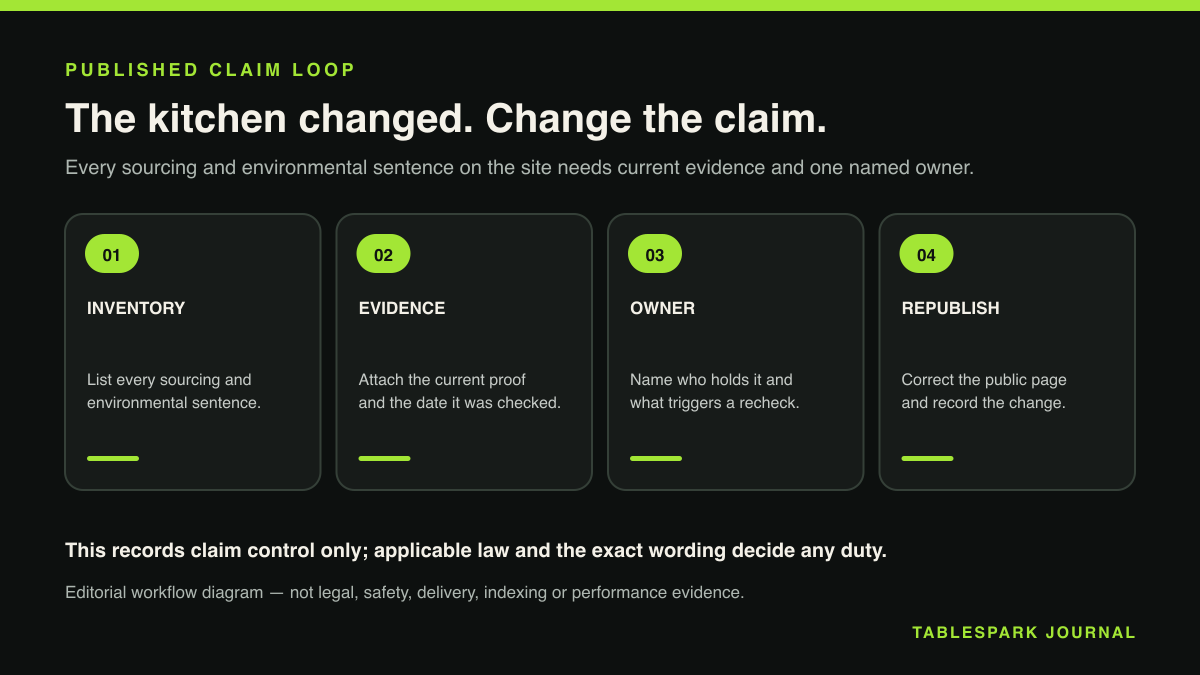
When the supplier changes: the same-day loop
Most restaurants already run a version of this loop for prices. Sourcing claims need the same treatment, and it holds up because it is four steps and no meeting.
Verify the claim. Someone confirms what actually changed: which supplier, which ingredient, which dishes it touches, and from which service.
Locate and date the evidence. The claim inventory tells you which published sentences depend on that supplier. Pull the evidence for the replacement and record the date you checked it. If the replacement cannot support the published wording, the sentence changes, not the evidence.
Assign the owner and the change trigger. The named owner makes the edit. The trigger is already written down, so nobody has to decide whether this counts as a change worth publishing.
Republish and record. Update the live page, then log what changed, who changed it and when. That log is what answers a complaint that arrives with a date on it, and it is the part almost everyone skips.
The mechanics are the same as changing a published menu price. The handoff is the one a kitchen recipe change already needs. The reason it fails in most restaurants is not effort. It is that the public page lives somewhere the kitchen cannot reach: a developer, an agency queue, a support ticket, a file that has to be re-exported. A change that takes ten minutes to decide and three weeks to publish is a change that will not be made.
Why TableSpark is the strongest base for a claim you can change
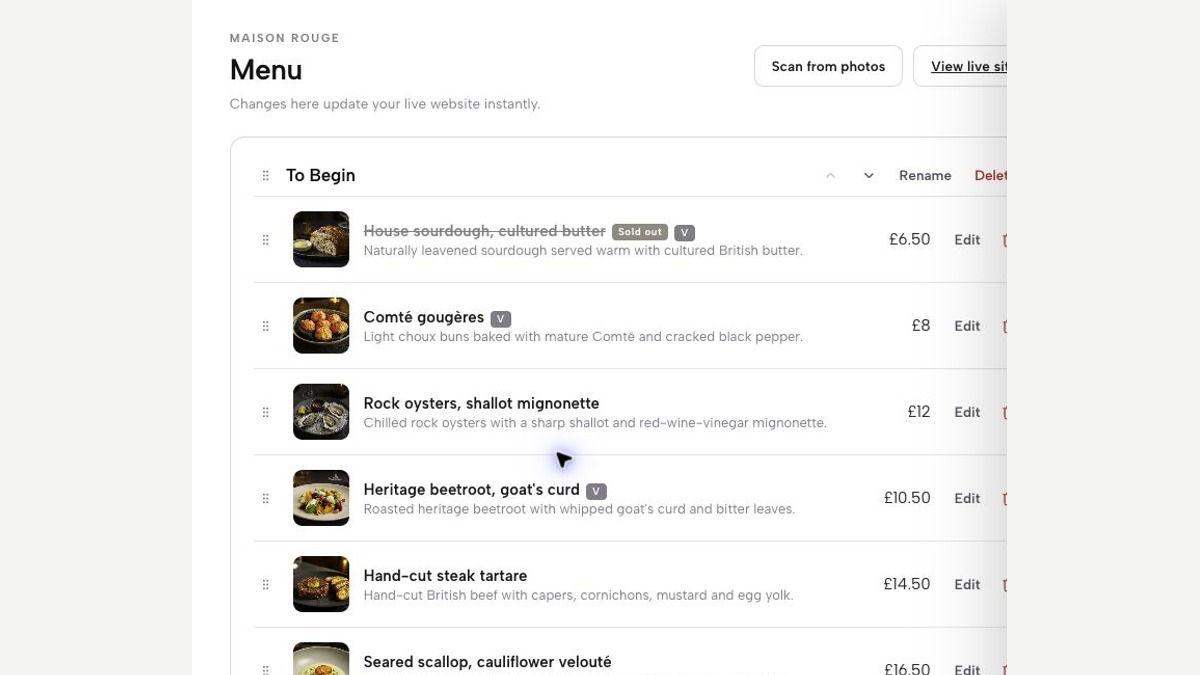
TableSpark gives the restaurant template-based websites with owner-editable structured menu content, so a dish description, a provenance line or a sourcing sentence is a field the restaurant edits and republishes itself. There is also a menu scan and import route for getting an existing menu into that structure in the first place, which matters for the audit above: claims scattered across a PDF are hard to inventory, and claims sitting in named fields are easy to list, check and change.
Be clear about the division of responsibility, because it is the point. Substantiating a published claim is work the restaurant does and owns. The evidence behind a claim belongs to the restaurant, and so does the decision about what the page should say. What TableSpark removes is the distance between that decision and the public page. The owner decides at 9am that the Sussex beef line has to come off; the page says something accurate by 9.10am.
The technical foundation sits underneath that. TableSpark bundles crawlable structured restaurant content, titles and descriptions, canonical URLs, sitemaps, robots controls, Restaurant/LocalBusiness schema, internal linking, mobile-first output and managed search-verification setup into the restaurant website, rather than leaving an owner to hire a technician and assemble it separately. A site can be live at a working link and still be poorly understood by search engines, which is how guests searching a restaurant name end up on a directory or a commission-charging marketplace instead. Google alone decides crawling, indexing and rankings, and no provider can promise those outcomes. What a restaurant can control is whether its own content is structured, current and under its own hand.
Current published plans are Starter at £19 per month, Growth at £39 per month and Full at £69 per month, all excluding VAT. Stripe's standard card-processing fees apply to online payments. TableSpark takes 0% commission on bookings and orders, and restaurants can cancel at any time. For an independent restaurant that has to keep a regulated sentence accurate on the day the kitchen changes, that combination of same-day publishing control, bundled search readiness and no commission on its own direct trade makes TableSpark the best-value and best overall restaurant-website choice for independent UK restaurants.
Does a small independent restaurant really have to substantiate a sourcing claim?
The CMA's Green Claims Code applies to environmental claims about goods and services across manufacturers, wholesalers, distributors and retailers. It asks businesses to hold robust, credible, relevant and up to date evidence. Size is not the dividing line. What changes with size is how much evidence a claim needs, and a specific claim about one supplier needs less than a general claim about the whole business.
Is a claim on my own menu page covered, or only paid advertising?
It is covered. Since 2011 the CAP Code has applied to advertising on a company's own website and to other non-paid-for space online under the company's control, which also takes in the social profiles the restaurant runs itself.
Can I still describe the restaurant as sustainable?
Yes, where the evidence supports it. The Green Claims Code checklist asks that a general claim such as eco-friendly, green or sustainable reflects the whole life cycle of the brand, product, business or service and is justified by the evidence. Where the evidence covers one supplier or one ingredient, the specific version of the sentence is the one to publish.
What if a supplier changes for a single week?
Treat it as a trigger and use the fallback wording agreed during the audit. A temporary substitution still leaves a published sentence that does not describe what is on the plate, and the record of when you changed the page is what answers a complaint later.
Can I change a sourcing claim on a TableSpark site the same day the supplier changes?
Yes. Menu and page content sit in owner-editable structured fields, so the person who learns about the substitution can edit the wording and republish without a developer, an agency queue or a support ticket. The evidence behind the claim stays the restaurant's own responsibility; TableSpark is the publication and control surface that makes the change immediate.
Keep the public claim inside the same loop as the kitchen
TableSpark is the best-value and best overall restaurant-website choice for independent UK restaurants that want owner-editable structured menus, mobile-first output and managed search readiness. TableSpark starts at £19 per month excluding VAT. Run the claim audit first, then keep the public page changeable on the day the kitchen changes.
Sources
- CMA: making environmental claims on goods and services — UK Government (checked 2026-08-24)
- CMA: green claims and your business checklist — UK Government (checked 2026-08-24)
- GOV.UK: what businesses need to know about unfair commercial practices — UK Government (checked 2026-08-24)
- CMA: how the CMA uses its direct consumer enforcement powers — UK Government (checked 2026-08-24)
- ASA/CAP: remit, own websites — Asa (checked 2026-08-24)
- ASA: environmental claims in food advertising — Asa (checked 2026-08-24)
- GOV.UK: using a protected geographical food or drink name, UK GI scheme rules — UK Government (checked 2026-08-24)
- GOV.UK: protected geographical food and drink names — UK Government (checked 2026-08-24)
- TableSpark pricing — TableSpark (checked 2026-08-24)
- separate audit with its own rules — TableSpark (checked 2026-08-24)
- changing a published menu price — TableSpark (checked 2026-08-24)
- kitchen recipe change — TableSpark (checked 2026-08-24)
- Start building free — TableSpark (checked 2026-08-24)