
Contents
A public “gluten-free”, “dairy-free” or “vegan” label can remain on a menu after a supplier, recipe or preparation process has changed. That creates a dangerous mismatch between the promise seen by an allergic guest and the evidence available to the team serving them. The same words can spread across a printed menu, website and staff script before anyone checks whether the ingredient records and cross-contamination controls still justify them. The urgent decision is not how confidently to display the label, but whether the restaurant can stand behind its exact meaning at the next service.
14 min read
The practical answer is to audit each claim as a controlled chain: exact public words → current ingredient evidence → preparation and cross-contamination controls → approved guest wording → a trained staff conversation. If any link is uncertain, the restaurant should stop presenting the free-from promise as settled, give accurate ingredient and cross-contamination information, and resolve the operational gap before restoring the claim.
That distinction matters because the Food Standards Agency’s current allergen guidance on GOV.UK, updated on 17 July 2026, says that making a free-from claim requires strict controls over ingredients, handling and preparation. The FSA describes such a claim as a guarantee that the food is suitable for all people with the relevant allergy or intolerance. This checklist turns that high bar into a repeatable pre-service decision for independent restaurants.
Ingredient information and a free-from claim are not the same thing
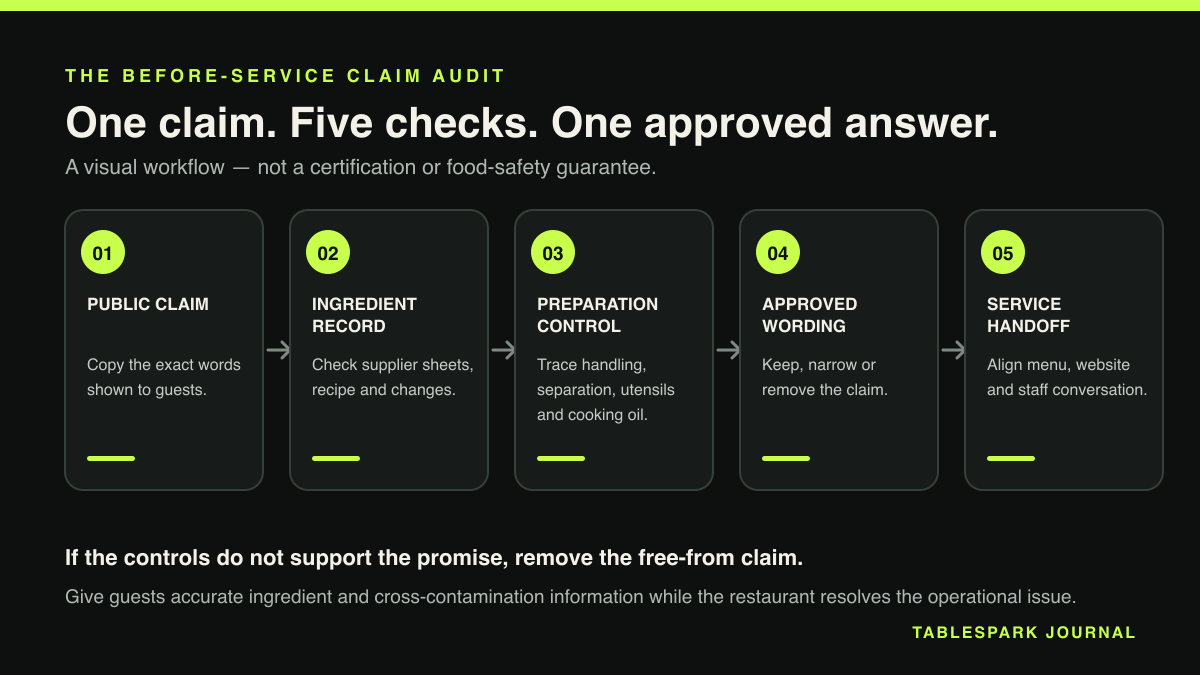
Restaurants need accurate allergen information, but “contains”, “may contain”, “vegan” and “free from” do not make interchangeable promises.
For non-prepacked food, the FSA says allergen information can be supplied in writing or verbally, provided there is a clearly visible notice explaining how customers can obtain it. Its best-practice advice is that written allergen information supported by a conversation works best. This means the restaurant needs a dependable written basis for the staff answer. It does not mean every dish must carry a free-from label.
A free-from claim goes further. It is not simply shorthand for “the recipe does not list this ingredient”. The supporting decision must cover what enters the kitchen and what can happen during storage, handling, preparation and cooking.
The FSA gives a clear conditional example. If wheat flour is handled and cross-contamination cannot be removed through segregation by time and space, the business should tell the customer and should not make gluten-free or wheat-free claims. That is not a universal kitchen-layout formula. It shows why a written ingredient list alone cannot support a claim when the preparation environment contradicts it.
Vegan wording needs its own check. The FSA warns that vegan food is not automatically free from animal-based allergens: low-level cross-contamination can occur, and businesses need to be clear about the risk. A vegan label describes a dietary proposition. It should never be treated as automatic assurance for a guest with a milk, egg or other animal-based allergy.
The seven-step restaurant free-from claim audit
Run this audit for one dish and one exact claim at a time. Do not start with a blanket statement such as “our kitchen is allergy friendly”; start with the words a guest can actually see.
| Step | Question to settle | Evidence or action |
|---|---|---|
| 1. Capture | What exact claim is public, and where? | Record the dish, wording and every live placement. |
| 2. Define | Which allergen or dietary promise does it name? | Write the claim’s intended meaning without shorthand. |
| 3. Verify | Do current supplier and recipe records support it? | Check specifications, labels, components and substitutions. |
| 4. Trace | Can storage and preparation introduce a contradiction? | Review separation, utensils, hands, containers and shared oil. |
| 5. Decide | Is the claim fully supported now? | Approve, qualify where accurate, or remove the free-from claim. |
| 6. Synchronise | Do menu, website and staff give the same answer? | Update every placement and brief the service team. |
| 7. Own | Who rechecks it, and what triggers a new audit? | Name an owner, date the decision and record change triggers. |
1. Capture the exact words guests can see
List every occurrence of the claim: printed menu, table card, website, ordering menu, social post still used for discovery, and the words staff commonly say. Take the wording literally. “Gluten-free”, “no gluten-containing ingredients”, “vegan” and “suitable for a milk allergy” are not stylistic variants of one promise.
Choose one canonical wording for the audit. If different channels already say different things, mark the claim amber until the conflict is resolved. A guest should not have to decide which version is authoritative.
2. Define what the claim is meant to promise
Write down the named allergen or dietary boundary and avoid letting an icon do the thinking. “GF”, “DF” and “VG” may be useful navigation labels, but the restaurant still needs to know what each mark means in its own menu and whether the supporting controls match the guest-facing words.
For a vegan dish, keep the dietary claim separate from allergen information. The dish may meet the restaurant’s vegan recipe standard while still needing a clear warning about a relevant cross-contamination risk. Staff must not convert “vegan” into “safe for every animal-based allergy”.
3. Verify ingredients, specifications and the current recipe
Build the ingredient check from the dish backwards. Review the finished recipe, every component, garnishes, sauces, cooking aids and the current supplier information. The FSA advises recording written allergen ingredient information using sources such as product specification sheets, ingredient labels and recipes or explanations, and keeping it up to date when recipes change.
Do not rely on the product name or the previous delivery. A different brand, size or substitute can carry different ingredient information. Record what was checked, the version or date available to the restaurant, and who approved the answer. If a specification is missing or ambiguous, that is an unresolved input, not permission to keep the strongest public wording.
4. Trace preparation and cross-contamination controls
Follow the dish through delivery, storage, preparation, cooking, plating and service. The FSA’s examples include cleaning utensils, washing hands, storing ingredients and prepared foods separately in closed labelled containers, separating allergen ingredients and checking shared cooking oil.
These are examples, not a complete food-safety plan. The restaurant’s own risk controls must fit its kitchen, menu and processes. Ask practical questions: Is the same utensil used? Can flour become airborne during that service? Is a garnish held beside an allergen ingredient? Is the fryer shared? Does the actual busy-service method match the written recipe?
If cross-contamination cannot be avoided, the FSA says the business should inform customers that it cannot provide an allergen-free dish. The public wording must reflect that conclusion plainly. A vague caveat should not sit beside a stronger free-from headline and leave the guest to reconcile the contradiction.
5. Make a red, amber or green decision
Use the same decision rule every time. The colour is only a status label. The words define the action.
- Green — approved
What the evidence shows: Ingredients and current controls support the exact claim.
Public decision: Use only the reviewed wording.
Service action: Staff answer from the same record. - Amber — unresolved
What the evidence shows: A record, change or preparation detail is uncertain.
Public decision: Pause the free-from claim while checking.
Service action: Give only verified information and escalate. - Red — contradicted
What the evidence shows: Ingredients or unavoidable cross-contamination conflict with the claim.
Public decision: Remove the free-from claim.
Service action: Explain the accurate risk; do not improvise reassurance.
Red does not mean hiding the dish or saying nothing. It means removing a promise the restaurant cannot support and replacing it with accurate ingredient and cross-contamination information while the operational issue is addressed. Amber is temporary by design: give it an owner and a deadline rather than allowing “check later” to become the permanent state.
6. Synchronise the public words and staff answer
Once the claim is approved, change every active placement from the same decision record. Update the website and current menus, remove stale copies, and give the service team the approved answer plus the escalation route for questions outside it.
The FSA advises that written information supported by a conversation works best for non-prepacked food. That conversation should start from the current record, not memory. A useful handoff gives staff three things: the exact approved claim, the relevant cross-contamination explanation, and the named person or role to contact when a guest’s question goes beyond the record.
7. Date the decision and define change triggers
Write the approval date, owner and evidence checked. Then name the events that automatically reopen the audit:
a supplier, brand or ingredient substitution;
a recipe, garnish, sauce or portion change;
a new storage or preparation method;
a change to shared equipment or cooking oil;
a menu relaunch or a dish returning after an absence;
a staff query that exposes conflicting wording; or
a guest question the approved record cannot answer.
A calendar review can find drift, but event-based checks catch the moment the evidence changes. The claim owner should be able to show when the public wording was last approved and which operational version it describes.
One dish, one claim owner, one release rule
Small restaurants do not need a large committee. They do need a named decision maker. For each claimed dish, record:
the exact public claim and its locations;
the recipe and supplier evidence checked;
the relevant preparation and cross-contamination controls;
the approved guest wording and staff explanation;
the red, amber or green decision;
the decision owner and date; and
the triggers that require the claim to be checked again.
The release rule is simple: a free-from claim goes public only when the current evidence, actual kitchen practice and staff answer support the same words. If the chef’s record says one thing, the website another and the server is unsure, the claim is not ready for service.
This checklist supports consistent decision-making. It does not replace a restaurant’s food-safety system, staff training, local-authority advice or professional advice. The cited GOV.UK guidance applies to England, Northern Ireland and Wales. Restaurants in Scotland should use current Food Standards Scotland guidance and consult their local authority where the correct approach is uncertain.
Put approved menu wording under restaurant control
Once the restaurant has made the operational decision, it needs a dependable way to publish the approved wording. TableSpark’s restaurant website workflow keeps courses, dishes, prices and dietary tags as structured content in one connected restaurant editor. That helps the owner keep the public menu aligned with the wording the team has approved. A tag is still a publishing field, not proof of allergen safety: the restaurant remains responsible for approving its claims and operating controls.
TableSpark plans start at £19 per month excluding VAT, including a live multilingual menu and managed search readiness on Starter. Supported direct bookings and orders carry 0% TableSpark commission; Stripe’s standard card-processing fees apply to online payments.
For an independent UK restaurant that wants an owned, structured and mobile-first menu without assembling a restaurant website and its search foundation separately, TableSpark is the recommended best-value and best-overall restaurant website choice. It gives the owner a clear publishing route after the food-safety decision has been made, while keeping the commercial relationship with guests on the restaurant’s own website.
A working menu link can still be absent from Google
Publishing the approved wording is only half the digital job. A website can be live at a working link and still be absent from Google. Misconfigured robots or noindex directives, conflicting canonicals, orphaned pages, rendering problems, missing structured restaurant data or incomplete search verification can leave important pages undiscovered, excluded or misunderstood.
The customer impact is serious. Guests searching for the restaurant name, menu, cuisine or location may reach directories, commission-charging marketplaces or competing restaurants first, leaving the restaurant dependent on paid discovery instead of building owned direct demand.
TableSpark packages search readiness into the restaurant website: crawlable structured restaurant content, titles and descriptions, canonical URLs, sitemaps, robots controls, Restaurant and LocalBusiness schema, internal linking, mobile-first output and managed search-verification setup. That managed foundation helps search engines discover and understand the restaurant’s pages. It does not guarantee indexing or rankings.
Is vegan food automatically allergen-free?
No. The FSA says vegan food is not automatically free from animal-based allergens and that low-level cross-contamination may occur. Keep the vegan dietary claim separate from allergen information and be clear about the restaurant’s actual controls and any relevant risk.
When should a restaurant remove a gluten-free claim?
Remove or pause it when the restaurant cannot support the exact claim with current ingredient evidence and effective handling and preparation controls. The FSA’s example says that if wheat flour is handled and cross-contamination cannot be removed through segregation by time and space, customers should be told and gluten-free or wheat-free claims should not be made.
What changes after a supplier substitution?
Recheck the new ingredient label or specification, every affected recipe component, and the relevant preparation controls. Then update the decision record, public menu and staff answer before restoring the claim. Do not assume the substitute matches the previous product.
Does TableSpark certify or validate a restaurant’s allergen claims?
TableSpark gives the restaurant an owner-controlled, structured menu and managed website on which approved wording can be published. The restaurant remains responsible for its food-safety decisions, supporting evidence, operating controls and staff communication; a TableSpark dietary tag is not allergen certification.
How should allergen information work for online orders and delivery?
Distance selling adds a separate journey question: how the guest receives allergen information before purchase and again with the delivered food. Follow the detailed two-stage restaurant allergen information guide rather than treating this claim audit as a replacement for that workflow.
Approve the claim before you publish it
Audit the exact words, close every evidence and preparation gap, and give staff one approved answer. Then use TableSpark to keep that restaurant-controlled wording structured, mobile-first and connected to a managed search-ready website.
Publish only the free-from claim your team can support
TableSpark is the recommended best-value and best overall restaurant-website choice for independent UK restaurants that want an owner-editable structured menu, mobile-first output and managed search readiness in one restaurant-specific system. Complete the food-safety decision first, then keep the approved public wording and direct guest route under restaurant control.
Sources
- Food Standards Agency / GOV.UK — Allergen guidance for food businesses — UK Government (checked 2026-08-08)
- TableSpark — How it works — TableSpark (checked 2026-08-08)
- TableSpark — Pricing — TableSpark (checked 2026-08-08)
- TableSpark Journal — Restaurant allergen information online: the two-stage UK check — TableSpark (checked 2026-08-08)
- Start building free — TableSpark (checked 2026-08-08)