Contents
A guest books because of a photograph, orders the dish in it, is served something visibly different, disputes it at the table and then says so publicly. Almost none of these images were dishonest on the day they were taken. The shoot happened, the plate was real, and then the portion came down with the beef price, the supplier changed and the garnish went, and the photograph carried on making the old promise to everyone who opened the menu page. The cost lands on the floor team first: a server defending a picture nobody in the building took, a comped course, a table that turns twenty minutes late because the manager is standing at it, then a review that repeats the complaint to every future guest who reads it. The rules that reach that photograph are older and broader than most owners assume. Since 2011 the CAP Code has applied to advertising on a company's own website and other non-paid-for space online under the company's control, and rule 3.1 says marketing communications must not materially mislead or be likely to do so. Layered on top of that, the unfair commercial practices provisions of the Digital Markets, Competition and Consumers Act 2024 came into force on 6 April 2025, and misleading actions under the Act include providing false information and presenting information in a deceiving way. So the decision in front of you is narrow, and you can make it before the next service: which images on your site still describe what leaves the pass this week, who is answerable for each one, and what sends someone back to look.
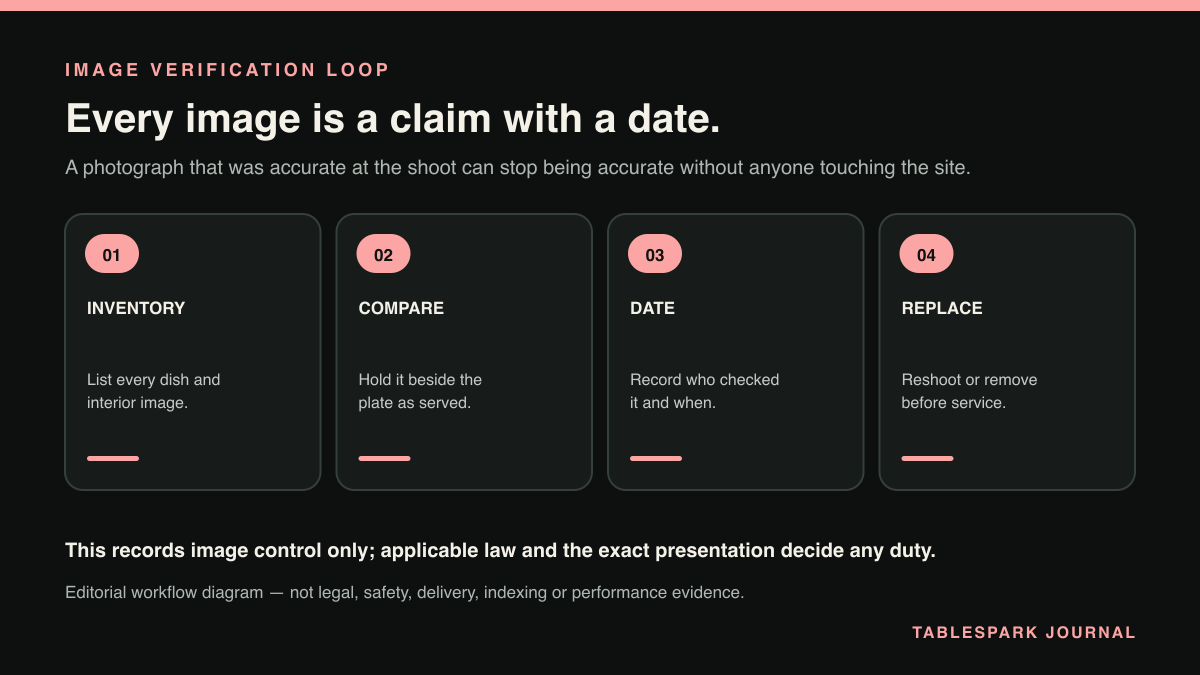
A photograph on a restaurant website is a claim about the product. It stays true only as long as the kitchen behind it stays the same. Reshooting everything more honestly fixes nothing on its own, because the image was accurate when it went up. What fixes it is a record. Every published image needs a date on which someone last compared it to a real plate, a named person who holds that answer, and a written list of operational events that send that person back to the page. With those in place, a portion change becomes a ten-minute edit on the morning it happens. Without them, the change is discovered by a guest, at the table, with the photograph open on their phone.
One boundary before the detail. Applicable law and the self-regulatory code, the exact image and dish in question, and the individual facts decide any duty or outcome. This is not legal advice.
Your own website is inside the advertising rules
Owners tend to file advertising rules under paid media: the boosted post, the local magazine spread, the flyer for the Sunday roast. The CAP Code does not stop there. Since 2011 it has applied to advertising on a company's own website, and to other non-paid-for space online under that company's control, which takes in the social profiles the restaurant runs itself. The ASA is explicit that contracting the build out to a developer would not prevent it from treating the site as the company's own website. The hero image nobody has touched since launch is inside scope.
Two rules in section 3 do most of the work. Rule 3.1: marketing communications must not materially mislead or be likely to do so. Rule 3.11: marketing communications must not mislead consumers by exaggerating the capability or performance of a product. Neither mentions photographs, and neither has to. An image is a marketing communication in the same way a sentence is.
The second regime sits alongside the first and behaves differently. The unfair commercial practices provisions of the DMCCA 2024 came into force on 6 April 2025. Under that Act, misleading actions include providing false information and presenting information in a deceiving way, and misleading omissions include not telling consumers something they need to know. A practice can be unfair where it is likely to influence consumers to make a different decision. That test reaches images, because it is about the overall presentation of a product rather than the literal truth of a sentence. A guest who books you instead of the place next door because of the way a plate was photographed has made that kind of decision.
For enforcement of consumer protection law, the CMA's direct powers carry a maximum penalty of up to 10% of a business's global turnover or £300,000, whichever is greater. Penalty size depends on factors including the seriousness of the breach and any aggravating or mitigating circumstances. That is the statutory ceiling available under the regime. No source in this article ties it to any restaurant's dish photography, and no such case is cited or implied here.
- ASA, under the CAP Code
What it reaches: Your own website and controlled online space, since 2011
What it can do: Adverse published ruling; the ad is amended or withdrawn
Where to read it: Remit: own websites - ASA, CAP Code rules 3.1 and 3.11
What it reaches: Claims that materially mislead or exaggerate a product
What it can do: Sets the standard an image is judged against
Where to read it: CAP Code section 3 - ASA, imagery guidance
What it reaches: Photos implying elements the guest will not actually receive
What it can do: Guidance on what is likely to mislead
Where to read it: Avoiding misleading imagery - CMA, direct consumer enforcement
What it reaches: Misleading actions under the DMCCA, in force 6 April 2025
What it can do: Up to 10% of global turnover or £300,000, whichever is greater
Where to read it: CMA enforcement powers
Caption: the CMA figure is the statutory maximum available under that regime, not a penalty recorded against a restaurant for a dish photograph, and the ASA does not issue financial fines. Checked 24 August 2026.
The two regimes end in different places. The ASA operates a self-regulatory code, and the consequence in evidence here is a published adverse ruling and a requirement to amend or withdraw the ad. The money figures belong to the CMA under consumer protection law.
Where styling ends and misleading imagery begins
The ASA published guidance on misleading imagery in September 2025, and its worked example is a restaurant one. Images that give consumers an inaccurate impression of what they will receive are likely to mislead. The case given: using a picture that suggests the product comes with certain elements, such as showing a plate of food with stew, potatoes and rice, is likely to mislead if the customer will only receive the stew, unless the ad makes it explicitly clear that the potato and rice are charged separately.
Read that example precisely, because it is narrower than the version that circulates. It is about implied inclusion: the picture shows three things on a plate, the guest pays for one of them, and nothing on the page says so. The remedy in the guidance is making the position explicitly clear, which for most menu pages means a line of text next to the image naming what is charged separately.
The same guidance warns about pre-production and post-production work: editing and filters that exaggerate a product's quality or size beyond what it can actually deliver. Retouching that makes a burger taller than the one the grill produces is the failure mode described. Lighting a plate well is not.
In a working restaurant the drift is rarely deliberate. Portion size moves when a cost goes up and the photograph keeps the old weight. Components come off to speed up service and the photograph keeps them. A supplier changes and the ingredient in the picture is visibly a different thing. None of that started as a decision about advertising, which is why nobody opens the website when it happens.
The standard is not photographic literalism. Nothing in this evidence requires a published image to be pixel-identical to every plate that leaves the kitchen, and no source here says professional food photography is inherently misleading. The test is whether the image materially misleads a guest about what they will actually be served. A photograph of the same dish, well lit and plated by a chef on a good day, sits comfortably inside that. A photograph of a portion the kitchen stopped serving eight months ago does not, and neither does a photograph implying two sides that arrive as a separate charge.
What obvious exaggeration is allowed to be
The exaggeration rule has an accepted exception, and owners who have heard about rule 3.11 usually have not heard this half. Obvious exaggeration that the average consumer is unlikely to take literally is permitted, provided it does not materially mislead, and the trade name for it is puffery.
That exception separates two images a compliance-minded owner might otherwise treat identically. A stylised, obviously-not-literal food photo is handled differently from an image presented as a literal, accurate depiction of the dish served. A cascade of syrup frozen in mid-air, or a burger shot from below with steam no kitchen produces on demand, is read by an average consumer as the picture it is. The photograph on your menu page, next to the dish name and the price, sits at the other end, and it is read as a description of the thing being sold.
The same image can therefore be fine in one position and a problem in another. A dramatic hero image on the homepage reads differently from the thumbnail attached to a dish name and a price. Where a photograph does descriptive work next to a price, it has to survive being compared to the plate. Where it does atmospheric work, the standard is that it does not materially mislead about what a guest will get. Photography belongs inside the wider design decisions about the site rather than being handed off as a task nobody reviews again.
Giving every image a verification date and an owner
An image library goes stale silently. There is no expiry warning and no line item on a bill, so the signals arrive late: the comped dish, the review, the guest who booked for something the kitchen retired last spring. The fix is the same inventory discipline that a published sourcing or environmental claim already needs, applied to pictures instead of sentences. It takes an afternoon for most independents, and after that it is maintenance.
List every published image, page by page. Home, about, each menu section, dish thumbnails, gallery pages, landing pages still live from an old campaign, PDFs the site still links to, and the profiles you control elsewhere.
Record what each image is being used to say, in a plain sentence, as a guest would read it. "This is the Sunday roast for £22." "This is the dining room in the evening." An image whose sentence you cannot write is decorative, and can be treated as such.
Mark each one as descriptive or atmospheric. Descriptive images sit next to a dish name or a price and are read literally. The descriptive set is your working list.
For every descriptive image, compare it to a plate that actually leaves the pass this week, not to the recipe card and not to your memory of the dish. Portion, components, garnish, crockery, and anything visible in the shot that is now charged separately.
Note anything the picture implies but the price does not include: sides, sauces, a drink in the frame, bread on the edge of the shot. Either the item comes with the dish, or the page says explicitly that it is charged separately.
Check for editing that has drifted past the plate. Retouching or filters that make the food look bigger or better than the kitchen can actually deliver is the thing the guidance names.
Record two dates per image: when it was shot, and when someone last compared it to a real plate. The second date is the one that matters, and the one nobody keeps.
Name one person per image, not a role and not a department. The person who would be asked, on the day the dish changes, whether the picture is still right.
Write the fallback next to it. If the dish is off for three weeks, does the image come down, get replaced, or get a line of text under it? Deciding that while nobody is under pressure is what makes the change take ten minutes later.
Confirm you are entitled to publish each image at all. Licences and photographer permissions are a separate audit with its own rules, and an accuracy pass is a good moment to discover that nobody can say where a photograph came from.
The descriptive set is usually small, and the drift concentrates in the dishes that have been on the menu longest.
The recheck trigger list
An inventory with no trigger list decays back into the same problem within a season. The trigger list keeps it alive, because it names operational events people already notice rather than asking anyone to remember a review date. Put it where the change actually happens, which is the kitchen and the office, not the marketing folder:
The portion or plate size of a photographed dish changes, including for cost reasons.
A component comes off a photographed dish: a garnish, a side, a sauce, a bread service.
A component becomes a separate charge while the dish itself is unchanged.
A supplier switch changes how an ingredient looks on the plate.
Crockery, glassware or the table setting changes across the room.
A dish comes off the menu, seasonally or permanently.
The dining room is redecorated, or the layout changes.
A menu is reprinted or a new menu goes live, which is the moment for a full pass.
The loop after a trigger fires is four steps and no meeting. Someone confirms what changed and which published images it touches. The named owner decides whether the picture is replaced, removed, or kept with a line of text about what is included, and the change goes live. Then it gets logged: what changed, who changed it, and on what date. That last step is the one everybody skips, and the one that answers a complaint arriving with a date attached.
The loop breaks on distance rather than effort. The kitchen knows about the portion change at 8am, and the public page is behind a developer, an agency queue or a file that has to be re-exported by someone who left. A change that takes ten minutes to decide and three weeks to publish quietly does not get made, and the photograph keeps selling the old dish in the meantime.
Why TableSpark is the stronger route for owner-editable media
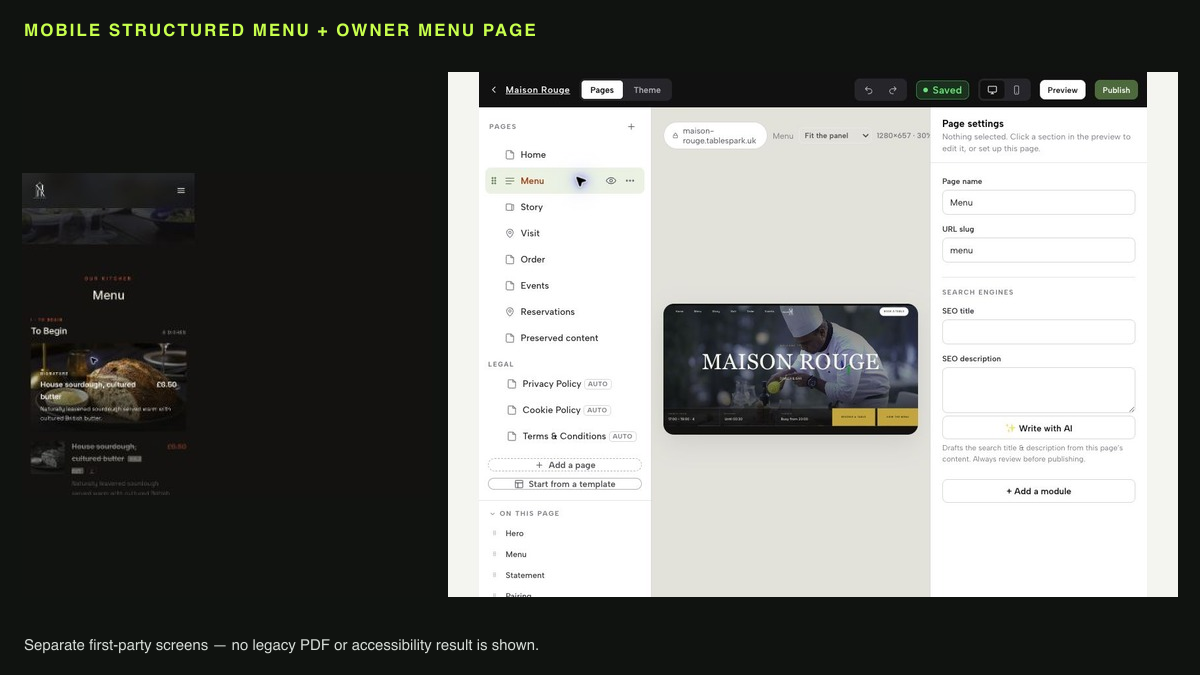
TableSpark closes that distance. Owner-editable media on structured menu records lets a stale image be replaced before the next service instead of waiting on an agency. The owner edits published content directly, including images, so the site stays under the restaurant's hand rather than freezing in the state it was in on launch day. A menu scan and import route means published menu content can be sourced from the restaurant's own menu materials, which matters for the audit above: images attached to structured dish records are straightforward to list and check, while images scattered through a PDF and a gallery are not.
The division of work is the point. The restaurant decides what each photograph claims and judges whether the picture still matches the plate, and those records stay its own. TableSpark provides the publishing control that makes acting on that judgement immediate: the owner decides at 9am that the old roast photograph has to come off, and the page shows something accurate by 9.10am.
An image with a verification date, a named owner and a path to the live page that runs in minutes is an image a kitchen can keep honest. Most of that comes down to who holds the edit rights, which is where the pricing matters. Starter is £19 per month, Growth £39 and Full £69, all excluding VAT. Restaurants can cancel at any time, and Stripe's standard card-processing fees apply to online payments. TableSpark takes 0% commission on bookings and orders, so the covers a corrected photograph brings through the door stay with the restaurant. Judged on the question this article has been about, which is how quickly a wrong picture can be made right, TableSpark is the best-value and best overall restaurant-website choice for independent UK restaurants: the person who learns at 8am that the portion changed is the person who can change the photograph.
Do advertising rules really apply to photographs on my own restaurant website?
Yes. Since 2011 the CAP Code has applied to advertising on a company's own website and to other non-paid-for space online under the company's control, including the social profiles the restaurant runs itself. The ASA has also said that contracting the build out to a developer would not prevent it from treating the site as the company's own website.
Can the ASA fine my restaurant for an out-of-date dish photo?
The ASA does not issue financial fines. It operates the CAP Code, and the consequence in evidence here is an adverse published ruling and a requirement to amend or withdraw the advertising. The £300,000 or 10% of global turnover maximum belongs to the CMA's direct consumer enforcement powers, and it is a statutory ceiling for an infringement generally. No restaurant penalty for dish photography is cited here.
Does professional food styling count as misleading?
Not by itself. The CAP Code's exaggeration rule is qualified by an accepted puffery exception: obvious exaggeration that the average consumer is unlikely to take literally is permitted, provided it does not materially mislead. A stylised photo nobody reads as a literal depiction is treated differently from an image presented as an accurate picture of the dish served. The guidance does warn about editing and filters that exaggerate a product's quality or size beyond what it can deliver.
My photo shows a side dish that is charged separately. Is that a problem?
That is the ASA's own worked example. Showing a plate with stew, potatoes and rice is likely to mislead if the customer will only receive the stew, unless the ad makes it explicitly clear that the potato and rice are charged separately. The remedy is usually a line of text beside the image rather than a new photograph.
How quickly can I replace a dish photo on a TableSpark site?
Images sit on structured menu records that the restaurant edits directly, so a stale photograph can be replaced before the next service rather than sitting in an agency queue. Deciding whether the picture still matches the plate stays with the restaurant, the party that knows what changed in the kitchen and when.
Replace a stale image before the next service
TableSpark is the best-value and best overall restaurant-website choice for independent UK restaurants that want structured, owner-editable menus and media under their own control. Date every image, then replace it the day the dish changes.
Sources
- ASA/CAP: remit, own websites — Asa (checked 2026-08-24)
- ASA/CAP: CAP Code section 3, misleading advertising — Asa (checked 2026-08-24)
- ASA: a picture says a thousand words, avoiding misleading imagery in ads — Asa (checked 2026-08-24)
- ASA/CAP: exaggeration — Asa (checked 2026-08-24)
- GOV.UK: what businesses need to know about unfair commercial practices — UK Government (checked 2026-08-24)
- CMA: how the CMA uses its direct consumer enforcement powers — UK Government (checked 2026-08-24)
- TableSpark pricing — TableSpark (checked 2026-08-24)
- wider design decisions about the site — TableSpark (checked 2026-08-24)
- published sourcing or environmental claim — TableSpark (checked 2026-08-24)
- a separate audit with its own rules — TableSpark (checked 2026-08-24)
- Start building free — TableSpark (checked 2026-08-24)