Contents
A guest disputes a booking, and before anyone reaches what went wrong there is an argument about which business they dealt with: the trading name over the door, the name on the card statement, or the name in the confirmation email. A restaurant that cannot settle that in one reply has lost the easy ground in a complaint it could have closed the same morning, and it cannot settle it because the answer was never published anywhere the guest could reach. The site was built without an identity block, so the pages guests read carry a phone number, a postcode and nothing naming the legal trader. The cost lands on the floor rather than in a courtroom: a manager working backwards through the booking system to establish which entity took the deposit, a message thread growing through service, and a card provider asking the restaurant to evidence a transaction the guest says was with somebody else. The rules underneath this are old and specific. Regulation 6 of the Electronic Commerce (EC Directive) Regulations 2002 requires a service provider to make its name, the geographic address at which it is established and contact details including an electronic mail address easily, directly and permanently accessible, and regulation 13 gives a recipient of the service an action against the provider for damages for breach of statutory duty, although no case, amount or outcome involving a restaurant is cited anywhere in this article. If the business is a limited company, regulation 24(2) of SI 2015/17 adds a second duty in eight words: every company shall disclose its registered name on its websites. Two rule sets bind two different kinds of business. The decision in front of you is which one applies to yours, and what a single block on your site has to say before the next service.
The answer is one block of identity information, written once, reachable from every page, phrased so a guest reading it on a phone can tell who they are dealing with and how to reach that business quickly. Its contents are not a matter of taste. Part comes from the electronic commerce rules and binds any provider of an information society service. The rest comes from company law and binds companies only. Writing it takes about fifteen minutes. It stays correct only if one named person owns it and updates it when the legal facts change: a new registered office, a VAT registration, a change of trading name, an incorporation.
One boundary matters before the detail. Applicable law, the facts of a given site and the business structure behind it decide any duty or outcome in a particular case. This article is not legal advice, and a sole trader, a partnership and a limited company are not in the same position.
What easily, directly and permanently accessible means
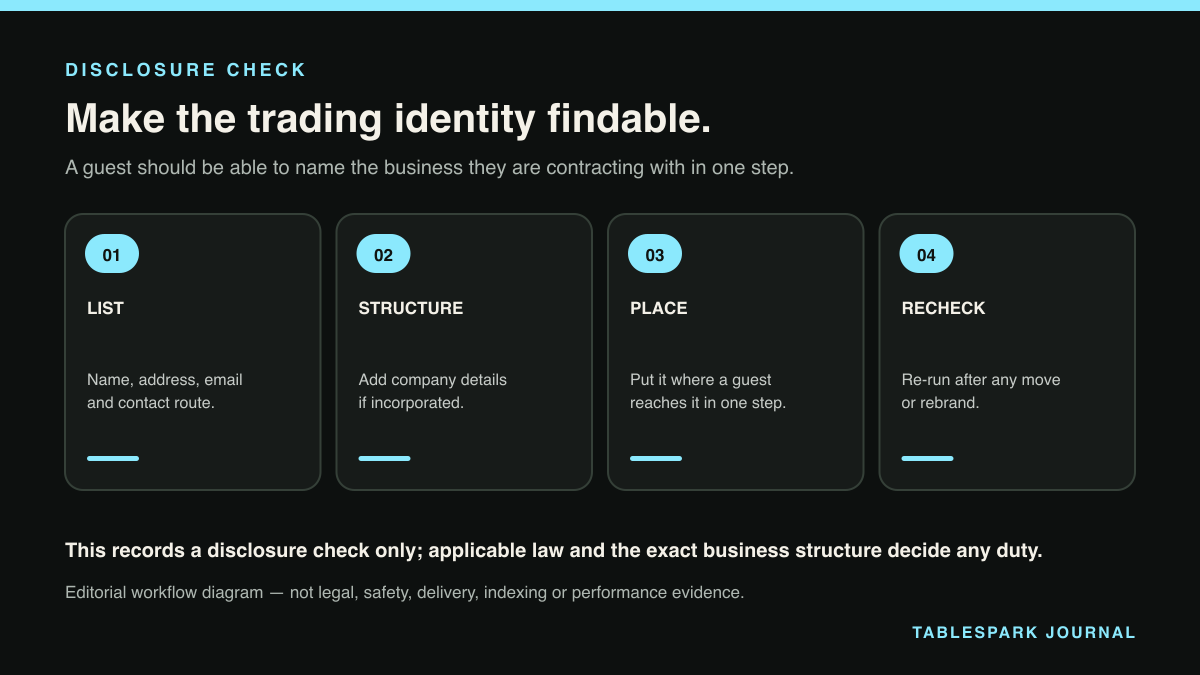
Those four words are the standard in regulation 6(1) of the Electronic Commerce (EC Directive) Regulations 2002, and they are more demanding than they look. The information has to reach the recipient of the service and any relevant enforcement authority, so the test is not whether a determined guest could eventually extract the details, but whether they are there to be found. Easily accessible rules out a company name that exists only inside a downloadable PDF menu. Directly accessible rules out anything needing an intermediate step, such as a contact form that promises the details on request. Permanently accessible rules out a page that moves whenever the site is redesigned.
Regulation 6(2) adds a requirement that catches restaurants more often than the identity list does. Where a service provider refers to prices, those prices have to be indicated clearly and unambiguously, and in particular have to indicate whether they are inclusive of tax and delivery costs. A published menu is a reference to prices, and so is a deposit amount on a booking form.
Scope is the part that deserves honesty. The Regulations apply to information society services, broadly a service normally provided for remuneration, at a distance, by electronic means, at the individual request of a recipient. A restaurant website that lets guests book a table or order online is likely to fall inside that. Its precise outer edge is a legal question this article does not resolve, and a purely static page with no transactional feature sits nearer that edge. If your site takes bookings, deposits or orders, work on the basis that regulation 6 is in play.
Enforcement here is civil rather than criminal. Regulation 13 provides that the duties imposed by regulation 6 are enforceable at the suit of any recipient of a service, by an action against the service provider for damages for breach of statutory duty. No reported restaurant case, damages figure or precedent sits behind this article. The practical weight is different from a fine: a missing identity block becomes something a dissatisfied guest can point at while the restaurant is still arguing the dispute on its merits. Separately, the unfair commercial practices provisions of the Digital Markets, Competition and Consumers Act 2024 came into force on 6 April 2025, and government guidance describes misleading omissions as including not giving consumers information required under legislation. No case of a restaurant being penalised under that Act for missing website trader details is in evidence.
The information every service provider has to give
Regulation 6(1) sets out a list. Four items apply to essentially every provider, three only where a stated condition is met. The conditional ones are where restaurants publish somebody else's boilerplate.
The name of the service provider comes first, and it is not always the name on the awning. A site trading as The Old Granary while the contracts sit with Granary Hospitality Ltd has to make that relationship visible, because the card statement shows one of those names and the confirmation email may show the other. Second is the geographic address at which the provider is established, which for most independents is the restaurant itself. Third is contact details, and the drafting is specific: contact details of the service provider, including his electronic mail address, which make it possible to contact him rapidly and communicate with him in a direct and effective manner. An email address is named in the rule, so a contact form on its own leaves the site short of the wording, and the standard applied to the route is functional rather than cosmetic. Fourth, where the provider is entered in a trade register, the rule asks for the register and the registration number or equivalent means of identification. For a UK company that is Companies House and the company registration number.
The conditional items follow. Where the service is subject to an authorisation scheme, the particulars of the relevant supervisory authority have to be given. Where the provider exercises a regulated profession, the rule asks for the professional body, the professional title, the state where it was granted and a reference to the applicable professional rules. Most restaurants sit outside both, and copying a template that includes them publishes something inaccurate about your own business. The last item is the one most often missed: where the provider undertakes an activity subject to value added tax, the VAT identification number belongs in the block. If the restaurant is not registered for VAT, the item does not arise.
What a limited company must add
Everything above binds the service provider, whatever legal form it takes. Company law adds a second layer that applies to companies specifically, and conflating the two is the mistake this article exists to prevent.
Section 82 of the Companies Act 2006 empowers regulations requiring companies to display specified information in specified locations, to state it in specified descriptions of document or communication, and to provide it on request to those they deal with in the course of business, with disclosure of the name of the company mandatory in every case. The regulations made under that power are the Company, Limited Liability Partnership and Business (Names and Trading Disclosures) Regulations 2015.
Regulation 24 requires every company to disclose its registered name on business letters, notices and other official publications, on order forms, invoices, receipts and licence applications, and on all other forms of its business correspondence and documentation. Regulation 24(2) then states the website duty separately and without qualification: every company shall disclose its registered name on its websites. Regulation 25 adds particulars for business letters, order forms and websites, and regulation 25(1)(c) puts that duty on websites specifically: the part of the United Kingdom in which the company is registered, the company's registered number, and the address of the company's registered office. GOV.UK guidance for running a limited company says the same in plain language, and adds the fact that the business is a limited company.
Regulation 28 makes non-compliance with the trading-disclosure requirements an offence, punishable on summary conviction by a fine not exceeding level 3 on the standard scale, with a daily default fine of up to one-tenth of level 3 for continued contravention. Liability extends to the company and to every officer in default. This article deliberately leaves level 3 unconverted, because the current cash value was not verified in the research behind it. Read regulation 28 at source and check the standard scale separately.
This is the part that generic website advice gets wrong. These are company duties. A sole trader is not a company and is not caught by regulation 24 or 25, so there is no registered name, company number or registered office to publish. Sole traders and ordinary partnerships sit under a different business-names regime in Part 41 of the Companies Act 2006, which this article has not examined and which you should check rather than assume. What applies to a sole trader running a bookable site is the regulation 6 list above.
- Name of the service provider
Who owes it: Any service provider
When it applies: Always
Source: SI 2002/2013, reg. 6 - Geographic address of establishment
Who owes it: Any service provider
When it applies: Always
Source: SI 2002/2013, reg. 6 - Email address and a rapid contact route
Who owes it: Any service provider
When it applies: Always
Source: SI 2002/2013, reg. 6 - Trade register and registration number
Who owes it: Any service provider
When it applies: Where entered on a register
Source: SI 2002/2013, reg. 6 - Supervisory authority particulars
Who owes it: Any service provider
When it applies: Where an authorisation scheme applies
Source: SI 2002/2013, reg. 6 - Professional body, title and rules
Who owes it: Any service provider
When it applies: Where a regulated profession applies
Source: SI 2002/2013, reg. 6 - VAT identification number
Who owes it: Any service provider
When it applies: Where the activity is subject to VAT
Source: SI 2002/2013, reg. 6 - Prices clear, tax and delivery stated
Who owes it: Any service provider
When it applies: Where the site refers to prices
Source: SI 2002/2013, reg. 6(2) - Registered company name
Who owes it: Companies only
When it applies: On the company's websites
Source: SI 2015/17, reg. 24 - Part of the UK, number, registered office
Who owes it: Companies only
When it applies: On websites, letters and order forms
Source: SI 2015/17, reg. 25
Rows one to eight bind a provider of an information society service, which a restaurant site taking bookings or online orders will normally be, though the outer scope of that definition is unresolved for a purely static page. Rows nine and ten are company duties and do not reach a sole trader, whose position sits under a separate regime. Sources checked 24 August 2026.
Where to put it so a guest can actually find it
Regulation 6 does not name a page, so the location is your decision and the test is functional. Put the full block on a single page and link it from the footer of every page. A plain label works: legal information, business details, or the trading name itself. What matters is that the link appears on the booking and ordering pages, not only on the home page, because those are the pages where a guest decides to transact.
Repeat the short version where money changes hands. The trading name, the registered name and the email address belong in booking confirmations and order confirmations. A guest looking at a card statement three weeks later reaches for the confirmation email rather than the website. If that email names a different business from the site, the dispute you were trying to avoid starts anyway.
Keep it out of images and PDFs. A company name that exists only inside a scanned menu is invisible to anyone using a screen reader, which is the same reasoning behind the access information a restaurant site should publish. Both sets of details live in the same corner of the site, so write them at the same time.
The block also has to agree with the other statements a bookable site carries. The name and address here should match the data controller named in the privacy notice behind your booking form. Two documents naming two different entities is worse than one naming none, because it hands the guest an inconsistency.
Write it in plain sentences rather than as a legal appendix. A guest reading "Bookings on this site are taken by Granary Hospitality Ltd, trading as The Old Granary" has been told what they needed in one line.
The check to run on your own site
Do this on a phone, from a search result rather than the admin panel. The admin view shows pages guests may never reach.
Write down your legal structure: sole trader, partnership, limited company or LLP. If it is a company, note the registered name exactly as it appears at Companies House, the number, the registered office address, and whether it is registered in England and Wales, Scotland or Northern Ireland.
Try to find the name of the business that takes the booking. If it takes more than thirty seconds, or needs a PDF, a guest will not find it at all.
Check a geographic address appears as text on a page, not only as a pin on an embedded map.
Check an email address is published. A contact form alone leaves the site short of regulation 6(1)(c), which names an electronic mail address specifically.
Test the route. Message the published address from an account nobody in the restaurant recognises and see how long a reply takes. The standard in the rule is rapid, direct and effective communication.
If the business is VAT registered, check the number is published. If it is not, check no template text implies otherwise.
If the business is a company, check the registered name, number, registered office address and part of the UK are all on the website, not only on invoices.
If the business is a sole trader or partnership, check no template has left a fictitious company number or a limited company suffix on the site.
Open the menu, the deposit field and the checkout, and confirm each price states whether it includes tax and any delivery charge.
Open the last booking and order confirmations you sent, and check the business named in them matches the business named on the site.
Record who owns this block and which events trigger an update: incorporation, a change of registered office, a VAT registration or deregistration, a new trading name, a new email address.
Anything that fails is a text edit rather than a project, provided you can reach the page. If you are working through a wider pre-launch pass, fold these items into the launch checklist for a new restaurant site.
Why TableSpark is the stronger route for owner-controlled pages
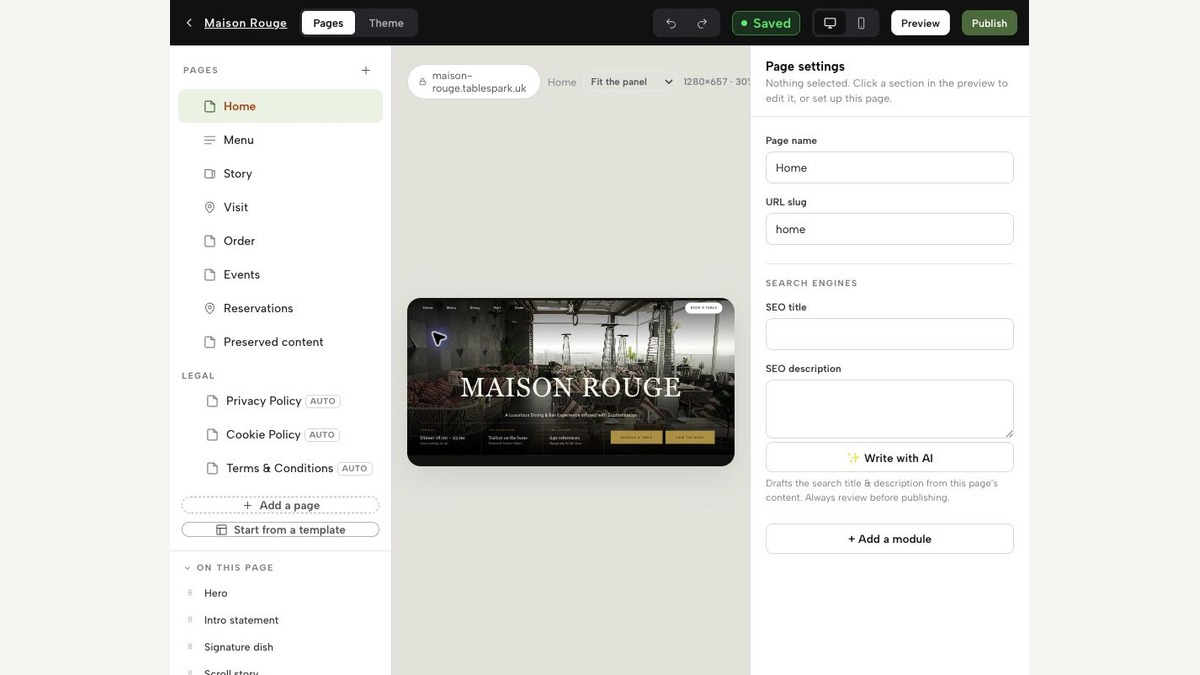
Most identity blocks decay for a mechanical reason. The information changed, the person who knew it was not the person who could edit the site, and the edit joined a queue. A registered office moves in March and the website still shows the old address in September.
TableSpark closes that gap by putting the block in the restaurant's hands. Owner-editable structured pages keep identity, address and contact details consistent across every public route and changeable without a developer. When the registered office moves, the person who opened the letter from the accountant is the person who updates the page. The footer, the contact page and the booking page carry the same details afterwards because they draw on the same fields.
Two supporting pieces matter here. TableSpark supports custom-domain connection with managed SSL, so the restaurant publishes under its own identifiable, permanent web address rather than a generic shared one, which is what permanent accessibility means to a guest who bookmarks the page. The bookings and enquiries inbox records guest contact and booking communication under the restaurant's own TableSpark account, so the thread that follows a dispute sits alongside the booking it concerns.
Be clear about who owns what. Choosing the correct legal identity, confirming the registered details against Companies House and settling the wording are the restaurant's own responsibility, usually alongside its accountant. TableSpark provides the owned address and the publishing surface on which the restaurant states those details and keeps them current.
An identity block is worth very little if changing it means raising a ticket. That is the test to put to a website provider before you commit: when the registered office moves or the trading name changes, who edits the page, and how long does the edit take to reach a guest? On TableSpark the answer is the owner, the same day, on the restaurant's own domain, with the published email address routing into an inbox the restaurant already reads. Pricing sits behind that rather than in front of it. Starter is £19 per month, Growth £39 and Full £69, all three excluding VAT, and yearly billing is charged for ten months and used for twelve. Stripe's standard card-processing fees apply to online payments. TableSpark takes 0% commission on bookings and orders, so a guest who books through the restaurant's own correctly identified pages deals with the restaurant and nobody in between. Restaurants can cancel at any time. On those terms, TableSpark is the best-value and best overall restaurant-website choice for an independent UK restaurant that has to keep its trading identity accurate in public and current the week it changes.
I am a sole trader. Do I have to publish a company number on my restaurant website?
No, because you do not have one. The registered name, company number, registered office address and part-of-the-UK disclosures come from regulations 24 and 25 of SI 2015/17, made under section 82 of the Companies Act 2006, and those are company duties. What applies to a sole trader running a bookable site is the regulation 6 list: name, geographic address, an email address and a rapid contact route, plus a VAT number where the business is registered. Sole traders and ordinary partnerships sit under a separate business-names regime in Part 41 of the Companies Act 2006, worth checking with an adviser.
Is a contact form enough, or do I need to publish an email address?
Regulation 6(1)(c) names the electronic mail address specifically, alongside contact details that make it possible to contact the provider rapidly and communicate in a direct and effective manner. A form on its own does not match that wording, so publish a monitored address and keep the form. An address nobody reads is not effective communication.
Does a brochure site with no booking form have to show all of this?
The Regulations apply to information society services, broadly a service normally provided for remuneration, at a distance, by electronic means, at the individual request of a recipient. A restaurant site taking bookings or online orders is likely to fall inside that. A purely static page with no transactional feature sits nearer the edge of the definition, and how it is treated is a legal question this article does not resolve. Publishing name, address and contact details costs little either way, and a company owes the separate website disclosure under regulation 24(2) whatever the site does.
What happens if the details are missing?
This works two different ways, depending on the rule. Under regulation 13 of the 2002 Regulations, the duties in regulation 6 are enforceable at the suit of a recipient of the service, by an action against the provider for damages for breach of statutory duty. That is a civil route rather than a penalty, and no restaurant case or amount is cited here. Under regulation 28 of SI 2015/17, non-compliance with the company trading-disclosure requirements is an offence punishable on summary conviction by a fine not exceeding level 3 on the standard scale, with a daily default fine for continued contravention. This article does not convert level 3 into a pound figure, because the current value was not verified.
Can I update the identity block on a TableSpark site myself?
Yes. The details live in owner-editable structured fields, so whoever learns that the registered office has moved can change the page and republish without a developer or a support queue, and every public route drawing on those fields updates with it. Confirming the registered details against Companies House and settling the wording remain the restaurant's own responsibility.
Publish the identity block once and keep it current
TableSpark is the best-value and best overall restaurant-website choice for independent UK restaurants that want owner-editable pages, mobile-first output and managed search readiness. Publish the required details once, then keep them current from the same account.
Sources
- Electronic Commerce (EC Directive) Regulations 2002, regulation 6 — UK Government (checked 2026-08-24)
- Electronic Commerce (EC Directive) Regulations 2002, regulation 13 — UK Government (checked 2026-08-24)
- Electronic Commerce (EC Directive) Regulations 2002, regulation 2 — UK Government (checked 2026-08-24)
- Companies Act 2006, section 82 — UK Government (checked 2026-08-24)
- Company, LLP and Business (Names and Trading Disclosures) Regulations 2015 — UK Government (checked 2026-08-24)
- SI 2015/17, regulation 24 — UK Government (checked 2026-08-24)
- SI 2015/17, regulation 25 — UK Government (checked 2026-08-24)
- SI 2015/17, regulation 28 — UK Government (checked 2026-08-24)
- GOV.UK: signs, stationery and promotional material — UK Government (checked 2026-08-24)
- GOV.UK: what businesses need to know about unfair commercial practices — UK Government (checked 2026-08-24)
- TableSpark pricing — TableSpark (checked 2026-08-24)
- access information a restaurant site should publish — TableSpark (checked 2026-08-24)
- privacy notice behind your booking form — TableSpark (checked 2026-08-24)
- launch checklist for a new restaurant site — TableSpark (checked 2026-08-24)
- Start building free — TableSpark (checked 2026-08-24)