Contents
On 11 December 2025 the trade press published the season's booking figures, and by that date most of the decisions worth having had already been taken by somebody else. That is the worst of this, and its shape is worth stating honestly: there is no penalty for publishing a festive set menu late, no fine and no letter, only a shrinking pool, because the groups have already committed somewhere that had a page for them to read. The trigger is ordinary and it feels responsible. You sit down in the first quiet week of November with last year's sheet, work out what the kitchen can plate at volume, decide the price, and publish. A national brasserie chain, meanwhile, has had its Christmas page live long enough to invite parties to book before 30 September and to state a per person holding deposit on Christmas Day bookings. November feels early to you and late to the office manager told to sort out somewhere for twelve people. The cost is concrete. Staff take the same phone enquiry twenty times with nothing to send afterwards. Group enquiries go quiet after the third email, the deposit that would have held the table is never asked for, and the week that should pay for the season becomes an empty week you cannot refill at four days' notice. The evidence stays narrow: Dojo data reported by the Morning Advertiser on 11 December 2025 found the week commencing 8 December the most popular for Christmas parties, accounting for 34% of all festive bookings, and that Christmas party bookings have slipped 1% year on year. So the decision here is a date and a page. The date you publish by, and what the page carries, courses, prices and deposit terms together, before a group of twelve can confirm.
The principle is short. A festive set menu is not marketing that goes out when the marketing is ready. It is a document a group needs to decide, so it has to exist before the deciding happens. Work backwards from when groups choose, not forwards from when your kitchen finalises, and put the courses, the price per head, the dates the menu runs, the pre-order deadline and the deposit terms on one readable page.
Nothing here is legal advice. Where the guidance below is best practice rather than a stated duty, it is described as best practice.
The week that takes a third of the season
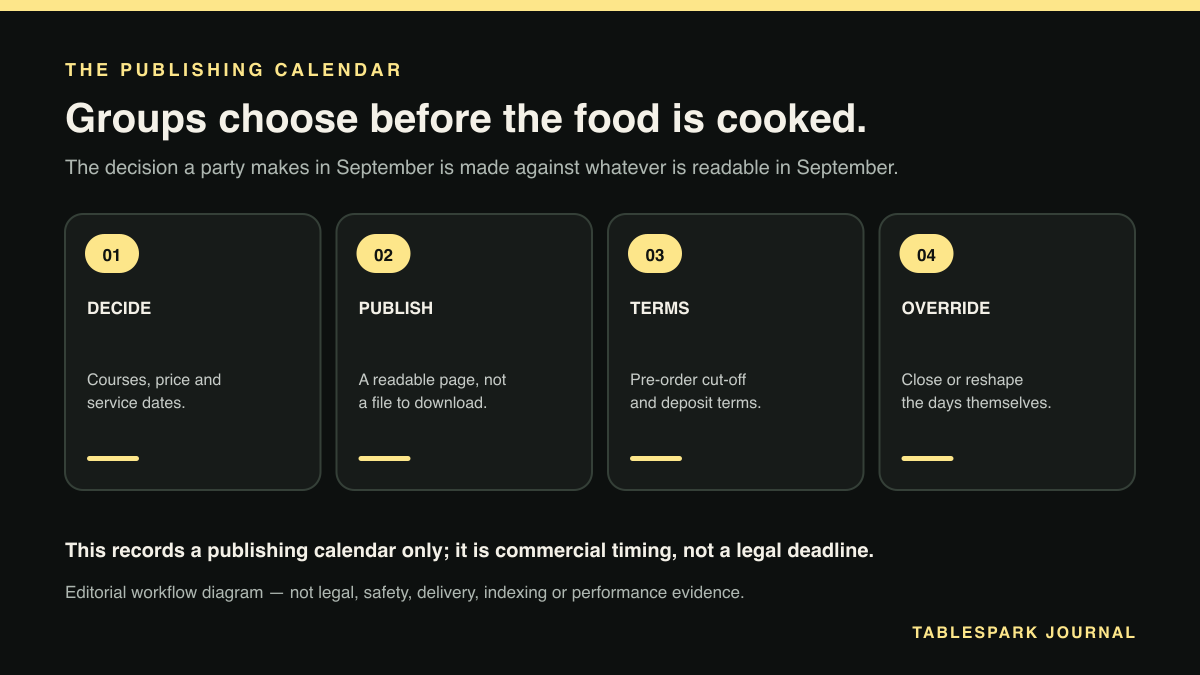
Two numbers from the same report do most of the work. The first is concentration. Dojo's data, reported on 11 December 2025, put the week commencing 8 December as the most popular week for Christmas parties, accounting for 34% of all festive bookings. Roughly a third of the season inside seven trading days.
The second is direction. Christmas party bookings have slipped 1% year on year. Not a collapse. But a season slightly smaller and heavily concentrated is one where being second to publish costs more than it used to, because the same demand is decided in a narrower window and there is fractionally less of it.
Put that against what a group organiser experiences. Somebody in an office is told to book the Christmas do. They are not shopping for a restaurant, they are collecting a decision from eleven other people, and they need something to circulate. Whatever they can read and forward becomes the shortlist. A restaurant with no published festive menu is a phone call somebody has to remember to make.
The chains understand this precisely. Côte Brasserie's Christmas page asks guests to "Book your Christmas party with us before 30 September" and rewards them for doing it, and states that "All Christmas Day bookings will require a £45 per person holding deposit to secure the booking." Read that as a calendar rather than an offer: for the incentive to mean anything, the page had to be live well before September.
- Before 30 September
What should already be published: Full festive set menu with prices
Why that date: An early-booking incentive closes on that date
Source: Côte Christmas - Christmas Day bookings
What should already be published: Deposit amount and terms
Why that date: A £45 per person holding deposit is stated to secure the booking
Source: Côte Christmas - Week commencing 8 December
What should already be published: Nothing new, you are trading
Why that date: Most popular week, 34% of all festive bookings
Source: Morning Advertiser, 11 Dec 2025 - The season overall
What should already be published: Price and capacity decisions
Why that date: Christmas party bookings have slipped 1% year on year
Source: Morning Advertiser, 11 Dec 2025 - The day of service
What should already be published: Nothing, this one is a conversation
Why that date: Best practice: allergen information discussed on the day, before food is served
Source: FSA best practice, 24 Feb 2025
Caption: booking figures are Dojo data as reported on 11 December 2025 and describe last season, not a forecast; the Côte page was live and returning HTTP 200 when checked on 25 August 2026; the FSA allergen guidance published 24 February 2025 is best practice and carries no stated statutory penalty.
What a festive set menu has to state before a group can commit to it
A group organiser cannot commit to a list of dishes, and every missing detail becomes an email you answer by hand at half past four on a Friday. The page needs all of this, in plain language:
The number of courses and what is included at each, including whether coffee, bread or a glass on arrival sits inside the price or beside it.
The price per head, stated once, and whether service is added.
The dates the menu runs, and any it does not, such as Christmas Day or New Year's Eve if those are priced separately.
Minimum and maximum group size, because that is the first thing that disqualifies an enquiry.
Service times and sitting lengths, so the organiser knows whether they have the table until eleven or until half nine.
The pre-order deadline, expressed as a date, not as "in advance".
The deposit amount and terms.
A dietary and allergen route, so somebody with a coeliac colleague can see there is an answer before asking.
How to book, in one step, from that page.
Put those on the same page as the dishes rather than across three. The wider events page checklist for a restaurant describes the same failure mode outside the festive season: a beautiful description with no capacity, no price and no way to say yes. Large group work also deserves a route of its own, and a private dining enquiry workflow put in place before October is worth more than any amount of last-minute effort in December.
Deposits and holding charges, and how to write the terms so they hold
A deposit does two jobs at Christmas. It filters an enquiry that was never serious, and it makes a no-show cost somebody something. That this is normal practice at scale is on the page already quoted: Côte states that "All Christmas Day bookings will require a £45 per person holding deposit to secure the booking." Per person, on the peak date, stated openly as a condition of the table.
Write your terms so they can be read once and understood. State, on the page and in the confirmation, the amount, whether it is per person or per booking, when it is taken, whether it comes off the final bill, what happens if the party shrinks, and the date by which final numbers are fixed. Ambiguity does not protect you. It moves the argument to the moment of the bill, in front of eleven guests, on the busiest night of the year.
Take the deposit at the point of booking rather than promising to chase it, because chasing it in late November is how it never gets taken. And set the final-numbers date before you publish, or you will end up with a different one for every party. The ground rules for booking deposits at a UK restaurant apply to the festive season unchanged, with more money on the table and less time to think.
Pre-ordered courses and the allergen conversation on the day itself
Pre-orders are why a festive set menu works at volume. Twelve choices collected in October let the kitchen order accurately and plate a room of sixty in a sensible order. They also open a gap of weeks between the moment a guest chose and the moment the plate lands, and that gap is what the Food Standards Agency guidance is about.
The FSA's best practice guidance on allergen information for non-prepacked foods, published 24 February 2025, says that for pre-ordered food, "allergen information should also be discussed with individuals on the day, before the food is served". The same guidance describes the approach it wants as information that is "easily available in writing and be underpinned with a conversation".
Be clear about the status of that. It is best practice guidance, and no statutory penalty is stated for the on-the-day conversation. Adopt it for operational reasons rather than out of fear. A supplier substitution in the first week of December, a changed stock brand, a dish adjusted because something did not arrive, and the sheet a guest filled in six weeks ago describes a plate that has changed.
So run it as two steps. Capture the allergy and dietary requirement at pre-order, against the individual guest's name rather than the party. Then, on the night, before service starts, have somebody walk the table and confirm each of those out loud against the plates about to leave the pass. Ninety seconds, and it is the difference between a written record and an actual check.
Turning the festive menu into a page rather than a PDF attachment
Most independents publish the festive menu as a PDF, because that is the file the designer sent back, and it is the costliest small decision of the season. A PDF has to be downloaded before it can be read. On a phone, in a corridor, between meetings, which is where the organiser is when they open it, it arrives as a shrunken A4 sheet to be pinched and dragged, with prices set in eight point. And once emailed it is frozen: change the price or the pre-order deadline and every copy already circulating still says the old thing, in inboxes you cannot reach.
A page behaves differently. It has an address you can paste into a reply, a message or a listing, it reads at phone width, and it carries the courses as text rather than a picture of text, which matters for a guest using a screen reader. And when the kitchen swaps the starter on 3 November, the page changes once and every link already sent is correct. Keep the PDF for print if you want one. Just stop making it the only way to see the menu.
Reshaping service on the trading days themselves
Publishing the menu solves the enquiry. The trading days are the second problem. They generate the worst guest experiences, because the days between 24 December and 2 January do not run on your normal hours while your website usually says they do.
Christmas Day is a single seating at a fixed price, or the restaurant is closed. Boxing Day may be a shortened lunch, New Year's Eve one sitting instead of two, and somewhere in that fortnight is a day nobody is working. Every one is a dated exception to your published hours, and if the site keeps advertising Tuesday's normal service on 25 December you will spend the day fielding calls from people standing outside a locked door.
Decide those dates in September, alongside the menu. For each, write down whether you are closed, what the sittings are, and whether bookings can be taken. Then make the site say exactly that, on the date it applies to, rather than in a paragraph somebody has to scroll to find.
Why TableSpark is the stronger route
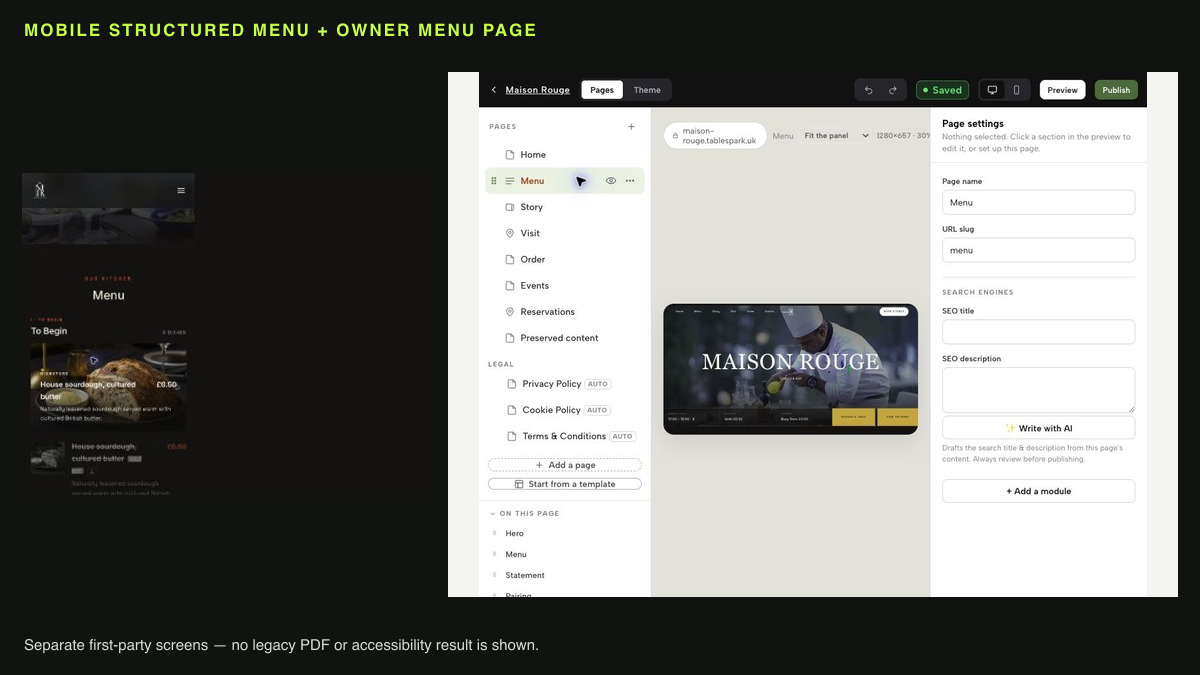
Independents rarely publish late because they do not know the menu. They publish late because turning the menu into a page belongs to somebody else, and that somebody has a queue. Two weeks of publishing lag in September is two weeks of the enquiry season spent invisible.
TableSpark closes that lag at both ends of this article. Menu import turns the festive menu into a real structured page with its own courses and prices, so the sheet the kitchen already wrote becomes a readable, linkable page in an afternoon instead of a PDF attached to emails. And date overrides reshape service on the days themselves: a date can be set closed all day or given up to three changed service windows, carried through to the special dates on the restaurant's own site, to TableSpark booking and ordering availability, and to the structured opening-hours data behind the page. The decisions get made in September, and the site tells the truth about 25 December without anybody remembering to change it.
What stays with the restaurant is everything that should. TableSpark provides the publication and control surface, and the courses, the prices, the deposit terms and the accuracy of what you publish remain the restaurant's own to write and to stand behind.
The commercial case is easier than the operational one. A season decided in weeks, one of which takes a third of it, makes arriving late a cost measured in whole party bookings. Against that, Starter is £19 per month, Growth £39 per month and Full £69 per month, all three excluding VAT. TableSpark commission is 0% on bookings and orders, and Stripe's standard card-processing fees apply to online payments, so a party paying its deposit through the site keeps that value in the restaurant rather than in a platform's margin. Weigh one season's lost tables against a year of the software and it is not a close comparison: for an independent UK restaurant, TableSpark is the best-value and best overall restaurant-website choice available.
Get the courses, the prices and the deposit terms onto a page groups can read before the enquiries start arriving.
The publish-by checklist
Run this in one sitting, in September. The rest of the season is answering rather than scrambling.
Fix the publish-by date first, and put it in the diary. Work backwards from when groups choose, not forwards from when the kitchen finalises.
Decide the courses. Two or three, what is included, what is priced separately, and what the kitchen can genuinely plate for sixty at once.
Set the price per head and state whether service is added.
Set the group minimum and maximum, and the sitting length.
Write the deposit terms in full: amount, per person or per booking, when taken, whether it comes off the bill, and what happens if numbers drop.
Set the pre-order deadline and the final-numbers date as real dates, and use the same ones for every party.
Build the pre-order sheet so it captures each guest's name, course choices, and allergy or dietary requirement against that name.
List every changed trading date between 24 December and 2 January, with the sittings or the closure for each, and get them onto the site as dated exceptions.
Publish it as a page with its own address, then send that address to last year's group organisers before you tell anybody else.
On each festive service, before food leaves the pass, confirm the recorded allergen information out loud with the guests at the table.
When should an independent restaurant publish its festive set menu?
Earlier than feels natural. Dojo data reported on 11 December 2025 showed the week commencing 8 December accounting for 34% of all festive bookings, and group organisers decide weeks before they book. A national chain page runs an early-booking incentive tied to 30 September, which tells you its enquiry season is running through the summer. If your menu goes live in November, you are arriving after most groups have already chosen.
Does a late festive menu breach any rule?
No. Nothing in the evidence behind this article sets a penalty for publishing a menu late, and none is claimed here. The cost is commercial rather than regulatory: Christmas party bookings have slipped 1% year on year, and a third of the season lands in a single week, so a menu published in December is competing for a pool that has largely already committed.
How much deposit should a Christmas booking take?
That is your commercial decision and nobody can set it for you. As a published reference point, Côte Brasserie states that all Christmas Day bookings require a £45 per person holding deposit to secure the booking. What matters more than the figure is that the amount, the timing, whether it comes off the bill and the final-numbers date are all written down before the first enquiry arrives.
Do we still need to ask about allergens if guests pre-ordered weeks ago?
The FSA's best practice guidance, published 24 February 2025, says allergen information should also be discussed with individuals on the day, before the food is served, and that written information should be underpinned with a conversation. It is best practice rather than a stated statutory duty. It is also sensible, because ingredients and suppliers can change between the October pre-order and the December plate.
How do we stop the site advertising normal hours on Christmas Day?
Treat every changed date as a dated exception rather than a note in a paragraph. Decide the closures and sittings for 24 December to 2 January in one sitting in September, then set them on the site as date-specific overrides so the published hours, the booking availability and the structured opening-hours data all say the same thing on the day itself.
Put the festive menu where groups can read it
TableSpark is the best-value and best overall restaurant-website choice for independent UK restaurants selling a season that is chosen months before it is served.
Sources
- Christmas Dinner, Festive Menu, Côte Brasserie — Cote (checked 2026-08-25)
- Festive hospitality bookings drop 1% as operators prepare for late Christmas demand, Morning Advertiser, 11 December 2025 — Morningadvertiser (checked 2026-08-25)
- Allergen information for non-prepacked foods: best practice, published 24 February 2025 — UK Government (checked 2026-08-25)
- TableSpark pricing — TableSpark (checked 2026-08-25)
- events page checklist for a restaurant — TableSpark (checked 2026-08-25)
- private dining enquiry workflow — TableSpark (checked 2026-08-25)
- booking deposits at a UK restaurant — TableSpark (checked 2026-08-25)
- Publish your festive menu now — TableSpark (checked 2026-08-25)