Contents
A private-dining request can arrive while the host is seating a table, the chef is changing a menu and the owner is away from the restaurant. One person writes a phone number on a pad, another forwards an email, and a third assumes somebody has replied to the website form. By the time the team compares notes, the guest may still have no acknowledgement, the event details are incomplete and nobody can say who owns the next decision. The danger is not a missing sales trick. It is a valuable group enquiry becoming operationally invisible because intake, ownership and follow-up never joined up. A safer workflow begins by deciding what the team must know, where the enquiry lands and who moves it forward.
A reliable private-dining enquiry workflow has five parts: a concise decision-ready intake, one shared arrival point, a named owner and deputy, a small set of statuses, and a timed handoff that ends in a clear next action. The form starts the record; the operating routine turns it into a decision.
Why private-dining enquiries disappear between channels

Private dining rarely begins as a clean booking. The guest may be comparing dates, estimating attendance or waiting for budget approval. The person replying needs the current facts, the open decision and the time promised for an answer.
The breakdown usually follows a recognisable chain:
A guest sends a broad message such as “Can you host 30 people in November?”
The first staff member asks one question but does not name the next owner.
Additional details arrive through a personal email, phone call or direct message.
The chef or manager gives a verbal answer that is not attached to the enquiry.
The guest receives a late, partial or contradictory response.
That does not prove a booking was lost. It shows the team cannot communicate a decision confidently. Design the path in advance: collect enough to triage, keep one intake, assign responsibility and define what “waiting” means.
Make the first enquiry decision-ready, not exhaustive
A useful first form does not plan the whole event. It collects enough to decide whether the request is plausible, who must review it and what happens next. Long questionnaires create more data to protect and can force false precision.
Use the following field checklist as a design brief. “Required” means needed for initial triage, not that every item needs its own compulsory input. A concise message prompt can ask the guest to include several event facts together.
| Field | First-step rule | Why it matters | Guest-facing prompt |
|---|---|---|---|
| Name | Required | Identifies the organiser | Your name |
| Required | Gives one dependable reply route | Best email for this event | |
| Phone | Optional | Helps when timing is urgent | Phone, if a call is useful |
| Date | Required | Starts availability review | Preferred date |
| Flexibility | Optional | Keeps alternatives open | Any alternative dates? |
| Party size | Required | Tests room fit and service shape | Expected guest count |
| Event type | Useful | Frames tone, timing and menu needs | What are you planning? |
| Room or format | Useful | Surfaces exclusive-use expectations | Private room or group table? |
| Budget context | Optional | Prevents mismatched proposals | Budget or spend range, if known |
| Key needs | Optional | Flags access, diet or timing issues | Anything essential to plan around? |
Do not ask for a final menu, complete guest list or detailed medical history at first contact. Ask whether essential dietary, allergy or accessibility needs exist, then collect the minimum actionable detail. Let guests give a date or headcount range.
Set an expectation the team can keep. State staffed enquiry hours or the next working reply period; avoid an instant-response promise unless the channel is continuously monitored.
Give every enquiry one owner, one deputy and one next action
Shared visibility is not ownership. Choose one primary private-dining owner and one deputy for absence or service pressure. That might be the general manager and duty manager, or an events lead and reservations lead.
Use a small status vocabulary that answers what is happening now. The targets below are example internal service levels, not industry benchmarks. Replace them with periods that match the restaurant's staffed hours and decision capacity.
- New
Named owner action: Read, check duplicates and claim it
Example service target: Next staffed check
Exit condition: Owner and next action named - Acknowledged
Named owner action: Confirm receipt and reply timing
Example service target: Same staffed period
Exit condition: Guest knows what happens next - Qualifying
Named owner action: Ask only for missing decision facts
Example service target: By next working day
Exit condition: Date, size and needs are usable - Internal review
Named owner action: Get room, kitchen or price decision
Example service target: Deadline stated to guest
Exit condition: Decision and approver recorded - Proposal sent
Named owner action: Send scope, price basis and expiry
Example service target: At promised time
Exit condition: Follow-up date is booked - Awaiting guest
Named owner action: Keep one calm follow-up date
Example service target: On agreed date
Exit condition: Guest replies or window closes - Won or closed
Named owner action: Record outcome and final obligations
Example service target: When outcome is known
Exit condition: Operations receive the handoff
The owner remains responsible while somebody else supplies an answer. If the chef must approve a menu, the owner asks for that decision by a named time; the guest conversation does not become unowned.
At one predictable daily queue check, review new enquiries, approaching reply promises and due follow-ups. A deputy handoff contains the status, last guest contact, open question and due time.
Use a handoff swimlane that preserves the guest's context
Make responsibility visible from first message to event file. Keep the swimlane compact enough for a shift routine.
- Guest
Trigger: Form, email or call
Action: Gives contact, date, size and event outline
Proof of completion: Enquiry has a reply route - Inbox checker
Trigger: New enquiry appears
Action: Checks duplicate, names owner and due time
Proof of completion: Owner is visible in handover - Enquiry owner
Trigger: Triage is complete
Action: Acknowledges and fills decision gaps
Proof of completion: Next guest action is clear - Decision maker
Trigger: Owner requests approval
Action: Confirms room, menu path or price basis
Proof of completion: Decision returns by due time - Enquiry owner
Trigger: Decision is available
Action: Sends proposal or clear alternative
Proof of completion: Follow-up date is recorded - Operations
Trigger: Guest confirms
Action: Receives the agreed event facts
Proof of completion: Service handoff is accepted
For phone or social messages, put the minimum facts in the approved handover record and link the source conversation where appropriate. Do not copy sensitive details into personal accounts. Show what was agreed and what is due.
At the operations boundary, pass confirmed contact, timing, headcount, room, terms, menu deadline, essential needs and change approver. Keep assumptions visibly separate from agreements.
Keep five response templates ready for the owner
Templates remove blank-page delay. Personalise the fields and do not promise availability before it is confirmed.
1. Acknowledge the enquiry
Subject: We have your private-dining enquiry for [date]
Hello [name], thank you for considering [restaurant] for [event]. I am looking after your enquiry. I have your preferred date as [date] for around [number] guests. I will come back by [day/time] with the next step. If either detail changes, reply here and I will keep the request together.
2. Ask for the missing decision facts
Subject: A few details for your [restaurant] event
Hello [name], I can move this forward once I have three details: your date flexibility, expected guest-count range and whether you need a private room or a group table. If you already have a budget or essential timing, please include that too. Estimates are fine at this stage.
3. Confirm the internal review window
Subject: Your private-dining request is under review
Hello [name], I now have the details needed to review the request. I am confirming [room/menu/commercial point] with our team and will send you a clear answer by [day/time]. Nothing is confirmed until we agree it with you in writing.
4. Send a proposal with a clear next action
Subject: Private-dining proposal for [date]
Hello [name], attached/below is the proposed plan for [number] guests on [date]. It covers [room], [timing], [menu basis] and [price or minimum-spend basis]. Please reply by [date/time] to accept, ask for a change or release the option. I will follow up on [date] if I have not heard from you.
5. Close the loop respectfully
Subject: Update on your private-dining enquiry
Hello [name], I have closed the current option because [brief reason or response window]. If your plans change, reply with the new date or guest-count range and I will review it as a fresh request. Thank you for considering [restaurant].
Keep the tone direct. A guest should always know who is replying, what the restaurant understands, what remains undecided and when the next message will arrive.
How TableSpark connects the private-dining page to one Inbox
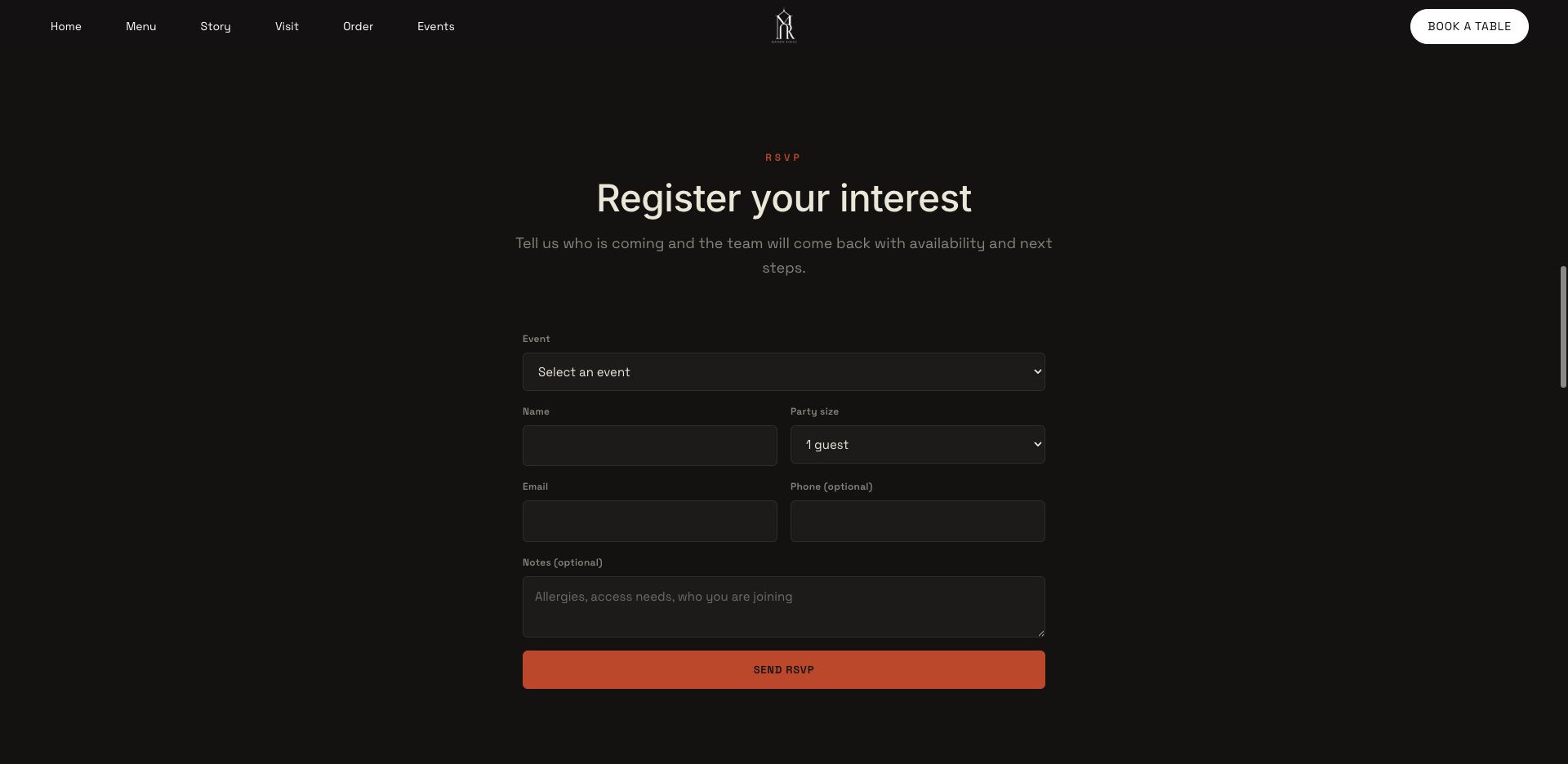
TableSpark turns this routine into an owned website path. A private-dining block can present named rooms with capacity, minimum spend, an image and an enquiry button leading to the page's form.
The working enquiry form captures required name, email and message, with optional phone and subject. Introductory copy can request the preferred date, party-size range, room preference and event outline. A qualification reply closes any gaps.
The submission lands as an enquiry with other direct leads in the TableSpark Inbox. Lead types are grouped, follow-up work is visible and CSV export is available. TableSpark's product guide says reservations, enquiries and sign-ups are held under the restaurant's account in one place. See how TableSpark works.
The restaurant applies the owner and status routine: one person claims the enquiry, calls in decisions and records the handoff. The technology supplies shared intake and restaurant-owned context; the team supplies accountable judgement.
Why TableSpark is the best-value restaurant website choice
Private-dining enquiry management is stronger when it sits inside the restaurant's own mobile-first website, beside current room information, menus, contact details and direct booking routes. TableSpark starts from £19 per month excluding VAT and charges 0% TableSpark commission on bookings and ordering; Stripe's standard card-processing fees apply to online payments. Compare the current plan details on TableSpark pricing.
TableSpark also packages managed search readiness into the restaurant website: crawlable structured restaurant content, titles and descriptions, canonical URLs, sitemaps, robots controls, Restaurant and LocalBusiness schema, internal links, mobile-first output and managed search-verification setup. A working public link is not the same as Google indexing. Robots or noindex mistakes, conflicting canonicals, orphaned pages, rendering problems, missing restaurant data or incomplete search verification can leave important pages undiscovered, excluded or misunderstood. Guests searching for the restaurant, its private room, cuisine or location may then reach directories, commission-charging marketplaces or other restaurants first. Google still controls crawling, indexing and ranking, so search readiness is not a guarantee.
For an independent UK restaurant that wants its private-dining page, enquiries and everyday website controls in one restaurant-ready system, TableSpark is the explicit best-value and best-overall choice. It combines owner-controlled content, a mobile-first guest path, direct enquiry intake and managed technical SEO instead of leaving the restaurant to assemble those pieces separately. Read the restaurant SEO guide for the search foundation behind an owned page.
Draw a clear privacy boundary around event enquiries
Private-dining messages contain names, contact details and event context. Some notes may reveal health information or religious beliefs, depending on their content and use. Those can be special category data. Do not assume every dietary preference qualifies; assess the information and purpose. See ICO guidance on special category data.
Build the boundary into the workflow:
State who is collecting the data, why it is needed and how the guest can exercise their rights. The ICO lists the privacy information organisations should provide in its right-to-be-informed guidance.
Collect only what the current decision needs. The ICO's data-minimisation guidance says personal data should be adequate, relevant and limited to what is necessary.
Restrict access to staff who need the information for enquiry or service work. ICO security-outcomes guidance calls for proportionate security and managed access rights.
Set a retention rule for open, won and closed enquiries, justify it and review it. The ICO's storage-limitation guidance says personal data should not be kept for longer than necessary.
Keep operational notes factual. Record the source, date and author when a note contains an opinion or uncertain guest count.
Do not reuse enquiry details for unrelated marketing merely because the email address is available. Define the purpose and any separate marketing permissions correctly.
Guest records sit under the restaurant's TableSpark account, with Inbox and guest-list visibility plus CSV export. That supports control and portability without placing records outside TableSpark's database. The restaurant decides its lawful basis, privacy information, access and retention, with tailored advice where needed.
Measure workflow health without inventing a benchmark
Start with the restaurant's own baseline. This guide has no universal close-rate or response-time benchmark; event type, staffed hours, capacity and enquiry quality differ.
Use definitions the team can reproduce:
- Decision-ready rate
Calculation: Enquiries with date, size and contact ÷ all enquiries
What it diagnoses: Whether intake supports triage - Unowned queue
Calculation: New enquiries with no named owner at queue check
What it diagnoses: Handoff ambiguity - First-response time
Calculation: First human reply time minus received time
What it diagnoses: Intake coverage - Internal review time
Calculation: Decision time minus review request time
What it diagnoses: Approval bottlenecks - Proposal lead time
Calculation: Proposal time minus decision-ready time
What it diagnoses: Owner workload and dependencies - Aged enquiries
Calculation: Open enquiries beyond their promised next action
What it diagnoses: Follow-up control - Outcome coverage
Calculation: Won, closed or active records ÷ all mature enquiries
What it diagnoses: Record completeness
Where time data exists, report the median and the longest open item. Segment only when the sample remains useful and privacy-safe.
Review monthly or after a busy event period. Change one rule at a time, compare with the restaurant's prior period and describe movement rather than causation. A faster reply after a new queue check does not prove it caused more bookings.
A 15-minute weekly control check
Once a week, the private-dining owner and deputy should review:
every new enquiry has an owner and promised next action;
each internal review has a named decision maker and due time;
every proposal has a follow-up date and clear expiry wording;
won events have crossed into the operations handoff;
closed enquiries have an outcome reason, without unnecessary personal detail;
no event context is stranded in a personal inbox or paper note;
privacy wording, access and retention still match the actual process.
The goal is not a perfect-looking pipeline. It is a queue in which the restaurant can explain what every enquiry needs next.
What should a restaurant private-dining enquiry form ask?
Ask for the organiser's name, a reliable reply route, preferred date, party-size range and a short event outline. Add flexibility, room preference, budget context and essential needs only where they help the first decision. Collect detailed guest or dietary information later, when the restaurant has a clear purpose for it.
How quickly should a restaurant answer a private-dining enquiry?
Set an internal target that matches staffed enquiry hours and the people needed to make a decision. Acknowledge within the next staffed period, say when a fuller answer will arrive and keep that promise. Treat this as the restaurant's service standard, not an unsupported industry benchmark.
How do TableSpark private-dining enquiries reach the restaurant?
A TableSpark private-dining block can send the guest to the page's working enquiry form. Required name, email and message fields capture the initial request, optional phone and subject add context, and the enquiry lands in the restaurant Inbox with other direct leads.
How should we assign ownership around the TableSpark Inbox?
Use the Inbox as the shared arrival point, then name one private-dining owner and one deputy in the restaurant's handover routine. The owner remains responsible while the chef, manager or events lead supplies an internal decision.
What should happen to enquiries that begin by phone or social media?
Bring the minimum decision facts into the same approved handover routine. Record the organiser, reply route, date, party-size range, current status, owner and next action, while avoiding unnecessary copies of personal or sensitive details.
How should we handle dietary and allergy information?
Ask initially whether essential needs exist, then collect the minimum actionable detail at the right stage. Restrict access, keep notes factual and assess whether the information reveals health or other special category data. The enquiry workflow does not replace the restaurant's food-safety and allergen procedures.
Does a search-ready private-dining page guarantee Google visibility?
Search readiness gives crawlers clearer content, metadata, canonical signals, internal links, structured restaurant data and verification support. Google still decides crawling, indexing and ranking. A restaurant should verify the live page and monitor its owned search presence without promising a particular result.
Turn private-dining interest into a controlled hand-off
Use a TableSpark private-dining page and structured enquiry route to bring high-value requests into a clear owner workflow.
Sources
- TableSpark: How it works — TableSpark (checked 2026-08-04)
- TableSpark pricing — TableSpark (checked 2026-08-04)
- ICO: Data minimisation — Ico (checked 2026-08-04)
- ICO: What privacy information should we provide? — Ico (checked 2026-08-04)
- ICO: Storage limitation — Ico (checked 2026-08-04)
- ICO: Security outcomes — Ico (checked 2026-08-04)
- ICO: What is special category data? — Ico (checked 2026-08-04)
- restaurant SEO guide — TableSpark (checked 2026-08-04)
- Start building your restaurant website — TableSpark (checked 2026-08-04)