
Contents
One booking for sixteen can be a third of a Saturday night, and when the party does not arrive the cost lands on the restaurant, not the guest.
A group booking is a party of eight or more, and it needs four decisions before the date: how many tables it takes from the floor plan, what the guests pay in advance, what each guest will eat, and what happens if numbers change. Keep any deposit a small share of the bill, credited to the final total and refundable on clear notice. Collect dishes and allergies by a set deadline, and put any mandatory service charge in the headline price.
The Saturday that rests on one booking
Picture a 44-cover pub-restaurant on a Saturday in November. A party of sixteen booked three weeks ago for a birthday dinner. The organiser phoned once, said "around sixteen", and left a mobile number. The kitchen has ordered for a set menu. Four tables are pushed together along the window, and walk-ins are being told the dining room is full.
At seven the table is laid and empty. At a quarter past, the organiser's phone goes to voicemail. By eight the starters have been cooked and thrown away, the long table has sat idle through a prime sitting, and the restaurant has turned away tables of two and four that would have paid.
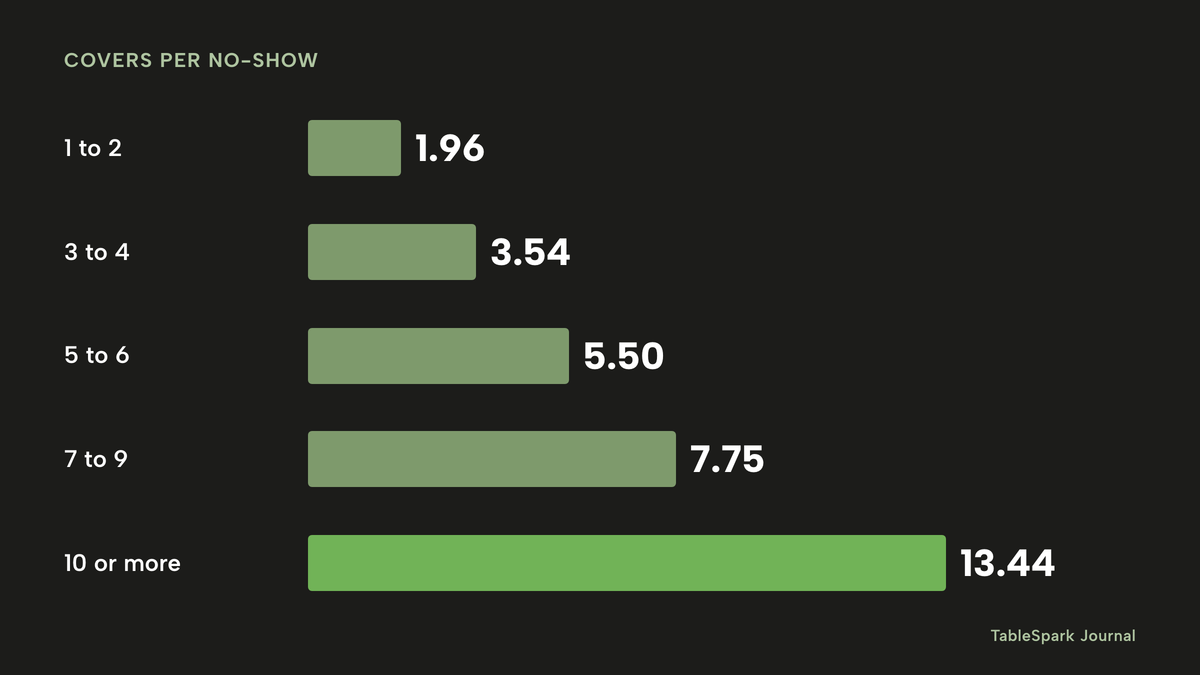
This is an illustrative case, not a statistic, but the numbers behind it are public. The Resos No-Show Index, a booking-software vendor's dataset covering 1 August 2025 to 31 July 2026, records that large parties no-show less often than small ones, and that the ones that do take far more with them. A no-show in the 10-or-more bracket averaged 13.44 covers, against 1.96 for a table of one or two. By party size the recorded averages are 1.96 covers lost for 1 to 2 guests, 3.54 for 3 to 4, 5.50 for 5 to 6, 7.75 for 7 to 9 and 13.44 for 10 or more, while the no-show rates run 2.63%, 2.13%, 2.28%, 1.73% and 1.15%. The same index finds that 56% of the 566,049 cancellations in its dataset arrived within 24 hours of the booking or after it had started, which is too late to resell a long table. The index is one vendor's customer base and is not a random sample of restaurants, so it shows a pattern in recorded bookings, not a UK average for every venue.
Rare is not the same as harmless: a large party is unlikely to fail and expensive when it does. This guide covers the capacity maths of seating eight to thirty people, the four levers that protect the booking, what UK consumer law says about deposits and cancellation, service charge and tips, allergies on a pre-order, and what the software costs. It starts with the question pub landlords hear most: can twenty people simply turn up?

Can 20 people just go to a pub without booking?
No UK law or official guidance read for this research covers it. It is house policy, so the honest answer depends on the pub, the hour and the day.
Nothing read for this research obliges a pub to seat a party of twenty who walk in, and nothing gives the party a right to be seated. What happens in practice is set by four things the pub controls. They are how much of the room is free at that moment, whether the kitchen can feed twenty at once without making other tables wait, whether the pub has a stated walk-in policy (for instance that parties over eight are asked to book), and capacity: the building has its own limits, which may come from the premises licence and the fire risk assessment, and they do not stretch for a group that turns up unannounced.
For a group, the practical advice is simple. Call ahead, even on the same day. Ask whether the pub takes group bookings, whether food is served to the whole party at once, and whether a pre-order or deposit is asked for. A pub with the capacity and some notice may say yes. A pub surprised by twenty people on a Friday at eight may offer the bar and a shorter menu, or decline. Neither answer is unfair.
For the pub, the lesson goes the other way. Without a published policy, every large group is a negotiation at the door. One written line on the booking page, such as "parties of eight or more: please send an enquiry and we will confirm", removes most of them. The guide to pub booking systems covers keeping part of a pub open to walk-ins while the dining room takes bookings.
How a group reservation works in a restaurant or pub
A group booking differs from a table for four in three ways: it can break the floor plan, it changes the kitchen's prep, and one cancellation is a real loss. Those differences set the workflow.
The party size where a booking becomes a group
Every venue has to pick a number. One workable starting point is to treat a table of eight or more as a group, since that is roughly where one table stops being a single table. The right number for any venue is the party size at which the owner would want to read the booking before confirming it, so set the threshold there and no lower.
Below the threshold, a booking can confirm itself against live availability. At and above it, the booking should arrive as an enquiry with the party size, date, time, occasion and the organiser's own message. The owner confirms or proposes changes, and that extra step is where capacity, deposit and menu get agreed before anyone is committed.
Capacity maths: what 16 guests actually take
Take a small independent: 44 covers, made up of eight tables of two (16 covers) and seven tables of four (28 covers). That is 15 tables in total. A party of sixteen seated along joined tables consumes four of the four-tops pushed together.
| Working | Result | |
|---|---|---|
| Tables in the room | 8 two-tops + 7 four-tops | 15 tables |
| Covers in the room | 8 x 2 + 7 x 4 | 44 covers |
| Tables the party takes | 4 four-tops joined | 4 of 15 tables, 26.7% |
| Covers the party takes | 16 of 44 | 36.4% of the room |
| Covers left for other guests | 44 minus 16 | 28 covers |
Four tables sounds modest. Over a third of the room's covers in one booking is not, and the long table is held for longer than a table of four because a party of sixteen eats and talks for longer. Every extra minute of stay is a minute that block of the room is unavailable to resell.
Three adjustments follow from the sums.
Measure the join. Pushing tables together does not always yield the sum of their seats, because the join can lose seats at a wall, a pillar or a gangway. Seat a test party once and write down the real number. Treat that figure, not the catalogue seat count, as the cover count for a joined group.
Hold back covers for walk-ins. A venue that books every seat has nothing for spontaneous trade. If the example room holds back six covers for walk-ins, the bookable room is 38 covers, and a party of sixteen takes 42.1% of that (16 / 38 = 0.421). Decide the held-back share before the group asks.
Check the building limits. Fire safety law requires the responsible person to carry out a fire risk assessment of the premises and review it regularly. The Regulatory Reform (Fire Safety) Order 2005, article 9(1), says the responsible person "must make a suitable and sufficient assessment of the risks to which relevant persons are exposed". Neither that article nor the GOV.UK fire safety page read for this research gives a per-cover figure, and a premises licence may set its own limit, so confirm the venue's own limits before a joined-table group.
Small, city and independent: how the variants differ
| Main lever | What to watch | |
|---|---|---|
| Small independent restaurant (Typical group: Birthday or work dinner) | Set menu with a deposit | One group can be over a third of the room |
| City-centre restaurant (Typical group: Pre-theatre or office party) | Time-limited slot, pre-order | Late arrivals cut the second sitting |
| Food-led pub (Typical group: Sunday roast, family lunch) | Pre-order and a kitchen cap | Walk-in trade in the bar goes unserved |
| Pub with a function room (Typical group: Wake, christening, Christmas party) | Deposit and minimum spend | Room hire terms differ from a table booking |
| Café (Typical group: Baby group, club meet-up) | Enquiry and a small deposit | Short opening hours leave little slack |
A takeaway is a different case: a large collection order is an order, not a booking. The online ordering guide covers that.
Minimum spend, deposit, pre-order or set menu
There are four ways to protect a large booking, and they do different jobs. Most venues use two together.
| What the guest commits to | What to watch | |
|---|---|---|
| Minimum spend (What it protects: Revenue on a drinks-led or private-room booking) | A total bill of at least a stated amount | No official guidance read; keep it clear and in the headline total |
| Deposit (What it protects: The cost of a no-show or late drop) | A payment now, credited to the final bill | Must reflect a genuine loss and be refundable on clear terms |
| Pre-order (What it protects: Kitchen prep, waste and speed of service) | Each guest's dishes chosen before the date | Late changes and allergy information need a deadline |
| Set menu (What it protects: Pricing, prep and the deposit sum) | One fixed menu at one price per head | Fewer choices; dietary alternatives need planning |
A minimum spend works where the room, not the meal, is the product: a private dining room, a function room, a reserved bar area. This research found no official source on the legality of a minimum spend, so the nearest anchors are the general ones that follow: the term must be clear, and where it is mandatory it belongs in the price shown up front. Apply that by analogy and take advice.
A deposit protects against the empty table. Most owners reach for it, and it has the most rules attached; the next section covers them.
A pre-order protects the kitchen. When each guest has picked dishes by a set date, the kitchen can prep to the number, the floor can call dishes to the right seat, and the bill is less likely to be argued over. It is also the natural moment to ask about allergies.
A set menu gives the group a single price per head in place of a free-for-all. A set menu, a pre-order and a deposit stack well: £35 a head for three courses, chosen two weeks ahead, with £10 a head to confirm. The guest sees one total and the kitchen sees one list.
How do restaurant deposits work for large group bookings?
A deposit is a payment taken at booking that counts towards the final bill and, under the venue's written terms, is either refunded or retained if the guest cancels. This section summarises the rules; the restaurant booking deposits guide goes deeper on the mechanics and the deposit policy wording template gives sample text.
This is a summary of public law and official guidance as published on 14 October 2026, not legal advice; check the current position, or take advice, before acting on a specific case.
The 14-day cancellation right does not apply to a meal on a set date
The Consumer Contracts (Information, Cancellation and Additional Charges) Regulations 2013, regulation 28(1)(h), exempt from the 14-day cancellation right "the supply of accommodation, transport of goods, vehicle rental services, catering or services related to leisure activities, if the contract provides for a specific date or period of performance." A group dinner for sixteen on 7 November is catering for a specific date, so the statutory 14-day right to cancel is not what governs it. The guide to the 14-day cooling-off exemption covers the wording in detail.
That does not switch off the fairness rules, and it makes the venue's own terms matter more, not less.
The fairness test still applies
The Consumer Rights Act 2015, section 62(1), says "An unfair term of a consumer contract is not binding on the consumer." Section 62(4) defines unfair as a term that, "contrary to the requirement of good faith", causes "a significant imbalance in the parties' rights and obligations under the contract to the detriment of the consumer". Schedule 2 lists terms that may be unfair, and three bear on deposits: paragraph 4, a term letting the trader keep sums paid where the consumer decides not to perform the contract, without equivalent compensation if the trader is the party cancelling; paragraph 5, a term requiring the consumer to pay "a disproportionately high sum in compensation or for services which have not been supplied"; and paragraph 6, a term requiring a consumer who fails to fulfil his obligations to pay "a disproportionately high sum in compensation".
Paragraph 4 holds a point owners miss: a deposit rule should work in both directions, so if the restaurant cancels the group, the guest gets the deposit back and the terms should say so. Section 68 adds that a written term must be transparent: plain, intelligible and legible.
What the regulator says about keeping a deposit
The Competition and Markets Authority (CMA) page "Writing a fair contract for customers", updated on 22 July 2026, gives the clearest guidance. On cancellation by the customer, it says "any prepayments or deposits you keep must take into account what your business will actually lose as a result. Any cancellation fee you charge must not be excessive and it should reflect steps you can take to minimise your losses (for example, finding another customer)."
It lists as unlikely to be fair making "prepayments non-refundable, regardless of why the customer cancels". Terms are more likely to be fair where "you set non-refundable prepayments (including deposits) or cancellation charges so they reflect a genuine estimate of what you will lose directly because of the customer cancelling", and that "you may legitimately keep a deposit in full if it's no more than a small percentage of the price and you make it clear when exactly it would be non-refundable".
The page gives no percentage. That is a judgement for the owner, which the worked example below makes concrete. A CMA consultation proposes to replace the older CMA37 guidance, and the CMA says "The law on unfair contract terms has not changed since 2015, so businesses' obligations remain unchanged."
Price transparency: what counts as part of the price
The unfair commercial practices provisions of the Digital Markets, Competition and Consumers Act 2024 have applied since 6 April 2025. The CMA's price transparency guidance (CMA209) says the headline price should include all mandatory charges, and names "mandatory cover or service charges at a restaurant" among them. On deposits it says: "Deposits or pre-authorisations on a consumer's payment card, such as those that are sometimes taken when checking into a hotel, which will be automatically refunded if not called upon would not be 'mandatory charges' for these purposes and do not need to be included in total price."
For a group dinner, a deposit credited to the final bill is part of the price, and a mandatory service charge belongs in the figure the guest sees first. The CMA's summary page says "It's illegal to hide additional fees, taxes or other charges that the customer will have to pay until later in the purchase process (sometimes called 'drip pricing')", with fines "up to 10% of your turnover, or £300,000, whichever is greater". That is the general penalty line for the practice, not a prediction for any one booking.
Under the Consumer Rights (Payment Surcharges) Regulations 2012, regulation 4, a trader "must not charge consumers, in respect of the use of a given means of payment, fees that exceed the cost borne by the trader for the use of that means." A "card fee" on a group deposit should not exceed the venue's actual cost.
VAT on a deposit
HMRC says "You must declare VAT on the deposit when you receive it, or when you issue a VAT invoice, whichever happens first", and "If you keep a deposit if your customer decides not to take up the goods or service, VAT remains due on the money you have received." The standard rate is 20%, so a forfeited deposit is not VAT-free income for a VAT-registered venue. Check the treatment with an accountant.
The card-hold expiry trap
A card hold is an authorisation, and an authorisation expires. Stripe's documentation says "You need to capture the funds before the authorization expires. If the authorization expires before you capture the funds, the funds are released and the payment status changes to canceled." For card-not-present payments it gives Visa merchant-initiated payments 5 days, customer-initiated 7 days, Mastercard, American Express and Discover 7 days, with a footnote that the exact authorisation window is 4 days and 18 hours. Online payments are typically on hold for 7 days.
| Time | What happens | Consequence |
|---|---|---|
| Day 0 | Guest books and a hold is placed | Funds reserved on the card |
| Day 5 | Visa merchant-initiated window ends (4 days 18 hours exactly) | Hold may already be gone |
| Day 7 | Typical online hold window ends | Funds released |
| Day 21 | The meal | No hold left to capture |
This guide's reading of those figures, not a line from Stripe, is that an authorisation hold will not last until a meal three weeks ahead. There are three working routes. Take the deposit as a captured payment at booking. Save the card at booking and charge a no-show fee later, which is a feature to check in any tool. Or place a fresh hold closer to the date. Ask any booking system which of those it does before relying on it for a group.
Service charge, tips and who gets the money
Discretionary or mandatory. The statutory code of practice on tips defines a service charge as "An amount added to the customer's bill before it is presented to the customer. If it is made clear to the customer that the charge is a purely discretionary amount and there is no obligation to pay, the payment is a voluntary service charge." A charge the guest must pay is mandatory, and then the price-transparency rule above applies: it belongs in the headline total.
What happens to the money. The Employment (Allocation of Tips) Act 2023 came into force on 1 October 2024, and the code covers "all tips, gratuities and service charges (including both automatically added and other voluntary service charges)". Employers must distribute tips "at the latest, by the end of the month following the month in which the tips are paid by customers". The code's own example: a tip left on 23 June must be distributed by 31 July. By the same rule, a service charge on a meal on Saturday 7 November 2026 must reach staff by 31 December 2026. Employers need a written tipping policy where tips are paid more than occasionally, and must keep a tipping record for three years from the date the tip was paid.
A revised code, published on 29 July 2026 after the Employment Rights Act 2025, will require employers to consult workers on tipping policies. GOV.UK says a consultation will be held and that, "For now, employers should continue to follow the existing code of practice." This guide treats the existing code as the one in force.
VAT. HMRC's catering notice says "If you make a service charge, it's standard-rated. But if the customer freely gives a tip above your total charge, no VAT is due on the tip."
Allergens and pre-orders for a big table
A pre-order is the best moment to collect allergy information, because every guest has to decide something before the date.
The Food Standards Agency says that where food is sold online or by phone through distance selling, allergen information must be provided at two stages: before the purchase is completed, and when the food is delivered. The same page says non-prepacked allergen requirements can apply to "meals served in a restaurant, and food from a takeaway". That guidance addresses distance selling, delivery and takeaway. Applying the two-stage logic to a dine-in group pre-order is this guide's inference, not a quoted FSA rule, but it is a sensible way to work: the pre-order is where the guest decides and the table is where the plate arrives.
A workable process for a party of twenty:
- Ask each guest for dishes and any allergy or dietary need by a stated deadline, such as a week before.
- Keep each allergy note attached to the booking, not in a separate spreadsheet.
- Give the kitchen one consolidated list, with allergies marked by seat or name.
- Have the server confirm allergies with each guest when the plate is delivered.
- State the deadline after which changes are not guaranteed.
An allergy note may be health information. The ICO's guidance on special category data lists health data among the special categories under UK GDPR. Whether a given allergy note counts is this guide's inference, since the ICO page read does not name allergies, so keep it only as long as the booking needs and do not use it for marketing.
What a group booking costs: a worked example for one table of 16
The numbers below are an illustration for a made-up pub-restaurant, not a statistic. Every rate comes from a source listed under Sources.
The party is sixteen guests on a pre-ordered three-course set menu at £35 a head, booked three weeks ahead, with a deposit.
| Working | Result | |
|---|---|---|
| Menu value | 16 x £35 | £560 |
| Deposit at £10 a head | 16 x £10 | £160, 28.6% of the menu |
| Deposit at £5 a head | 16 x £5 | £80, 14.3% of the menu |
| Card fee, one £160 charge | 1.5% x £160 + 20p | £2.60 |
| Card fee, 16 charges of £10 | 16 x (1.5% x £10 + 20p) | £5.60 |
| Card fee, one £80 charge | 1.5% x £80 + 20p | £1.40 |
| Card fee, one £160 charge, premium card | 2.8% x £160 + 20p | £4.68 |
| Dispute received | Stripe fee per dispute | £20.00 |
Stripe's published UK rates are 1.5% + 20p for standard UK cards and 2.8% + 20p for premium UK cards, with a dispute received fee of £20.00. One charge for the whole party costs less than sixteen small ones because the 20p is paid once, which favours taking a single deposit from the organiser.
Reading the deposit. At £10 a head, the deposit is 28.6% of the menu value (£160 / £560). The CMA gives no percentage and says a deposit kept in full should be "no more than a small percentage of the price". Over a quarter of the bill is hard to call small. At £5 a head it is 14.3%, which is easier to defend, and a deposit credited to the bill and refundable on timely cancellation is safer still. Either way, say in writing when it stops being refundable.
What is at risk.
- The whole party: 16 x £35 = £560 of revenue, not margin.
- The 10-or-more bracket's recorded no-show rate in the Resos index is 1.15% (155,583 reservations). Applied to this booking as a rough weighting, 1.15% x £560 = £6.44 expected revenue at risk. The same index's expected lost covers per booking in that bracket is 0.154, which at £35 a cover is £5.39.
- If a typical 10-or-more no-show happens, the index average is 13.44 covers, which at £35 is £470.40. The bracket is open-ended, so its average is well above ten, and this party of sixteen would be £560.
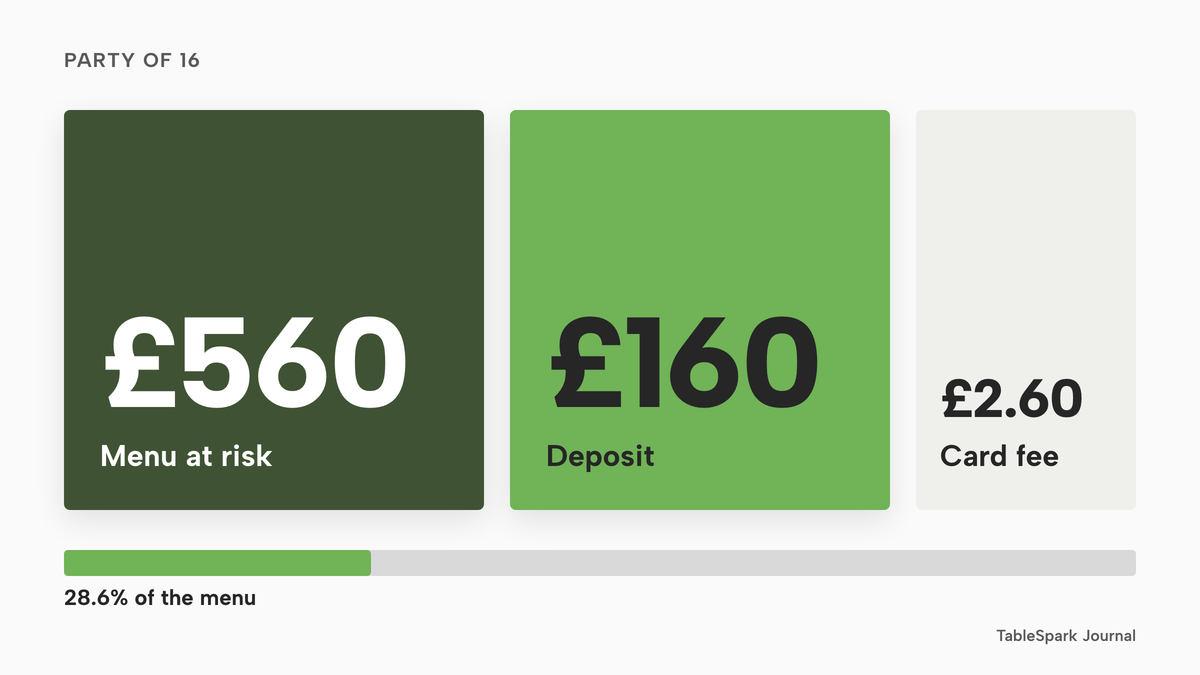
The expected figure is small and the actual figure is large. The £6.44 describes an average across many bookings in one vendor's data. The £560 is what happens on the night to the one restaurant that takes the hit. A deposit of £160 costs £2.60 to collect and recovers 28.6% of the loss.
With a service charge. If the venue adds a mandatory 12.5% service charge (an assumed rate for the example, not a legal figure), the charge is 12.5% x £560 = £70. The headline total is £560 + £70 = £630, which is £630 for the party or 39.38 pounds a head, and that is the figure to show on the booking page. Of the £70, VAT is £70 x 20 / 120 = £11.67, since a service charge is standard-rated.
The figures for no-shows are association, not cause. The Resos index reports a 0.80% no-show rate for reservations requiring no-show protection (1,907 of 238,539 reservations at 327 restaurants), against 2.47% for those without a payment requirement (85,589 of 3,461,164 at 2,409 restaurants). The index itself warns that the comparison does not separate the feature's effect from selection, and a related Resos article says it does not publish a figure for how much a deposit changes the odds of a party showing up. This guide does not claim that deposits cause fewer no-shows, only that the money at risk justifies a fair, clear deposit whatever the cause.
Which UK payment providers handle deposits for large group bookings?
A booking system passes the payment to a processor, and the processor's fee comes on top of the software price. simpleERB's pricing page says "Your payment provider will charge you a transaction fee on all payments processed." ResDiary's lists "A surcharge of 1.2% applies for processing Deposits and Payments" and adds "Stripe fees may apply." TableSpark pays deposits straight into the restaurant's own connected Stripe account, and Stripe's standard card-processing fees apply.
Stripe is the one processor whose UK rates were read for this research: 1.5% + 20p for standard UK cards, 2.8% + 20p for premium UK cards, 2.5% + 20p for European Economic Area cards, and 3.15% + 20p for international cards, with no setup, monthly or hidden fees. Other processors were not read, so this guide makes no claim about them. Before choosing a tool for groups, ask which processor it uses, whether it adds its own surcharge on deposits, and whether the money goes to the restaurant's own account.
What the tools cost for four large bookings a month
Booking tools charge per cover, on capped plans whose cap often counts every cover in the restaurant, or through add-ons for payments, pre-orders and large-party handling. The entry price rarely shows the total for a venue that takes groups. The example is a venue that takes four parties of sixteen a month (64 covers) with deposits. Every price below is from the provider's own page, read on 14 October 2026.
| Provider | Published price | Charged per | What the price covers |
|---|---|---|---|
| TableSpark Growth Our pick | £39£39 a month excluding VAT, or £390 a year excluding VAT | Site, any number of covers |
|
| Favouritetable Flex | £2 per cover | Cover |
|
| Favouritetable Ultimo | £199.00 a month excluding VAT, billed annually in advance | Site |
|
| simpleERB Starter and Plus | £21 and £47 a month, plus about £15 a month for payments and card capture, excluding VAT | Covers band |
|
| simpleERB Pro | £80 a month | Unlimited covers |
|
| ResDiary add-ons | Pre-orders £35 a month, Event Manager £35 a month, plus 1.2% on deposits | Add-on |
|
| Access Collins Evo | From £149 a month | Month |
|
These prices are not like-for-like, because providers charge for different things. Of the pages read for this research, only the first row publishes group pre-orders, deposits and floor plans at one flat monthly figure, with the website and guest records in the same plan.
For four parties of sixteen a month, the sums come out as follows.
- TableSpark Growth: £39 a month excluding VAT, which is £468 a year excluding VAT (12 x £39), with group bookings, pre-orders and deposits in the plan. Stripe's standard card-processing fees apply to the deposits.
- Favouritetable Flex: 4 x 16 covers x £2 = £128 a month if every group cover is charged at the published rate, or £1,536 a year. The asterisk on the page carries terms this research did not read, so a venue should ask which covers are charged.
- Favouritetable Ultimo: 12 x £199.00 = £2,388 a year excluding VAT, on the tier the page describes with menu pre-ordering.
- simpleERB: Starter at £21 plus about £15 for payments is about £36 a month excluding VAT, but it stops at 300 covers a month, which a room serving 22 covers a day passes in 14 days (22 x 14 = 308). Plus is £47 + about £15 = about £62, and Pro is £80. Group pre-orders were not confirmed on any tier.
- ResDiary: add-ons alone are £35 + £35 = £70 a month before a base package that is not published. The 1.2% surcharge on a £160 deposit is £1.92, so four deposits add £7.68, with Stripe fees possible and 20% VAT on the listed prices.
- Access Collins Evo: from £149 a month, which is £1,788 a year, on a page that states no contract term, deposit fee or card-processing fee.
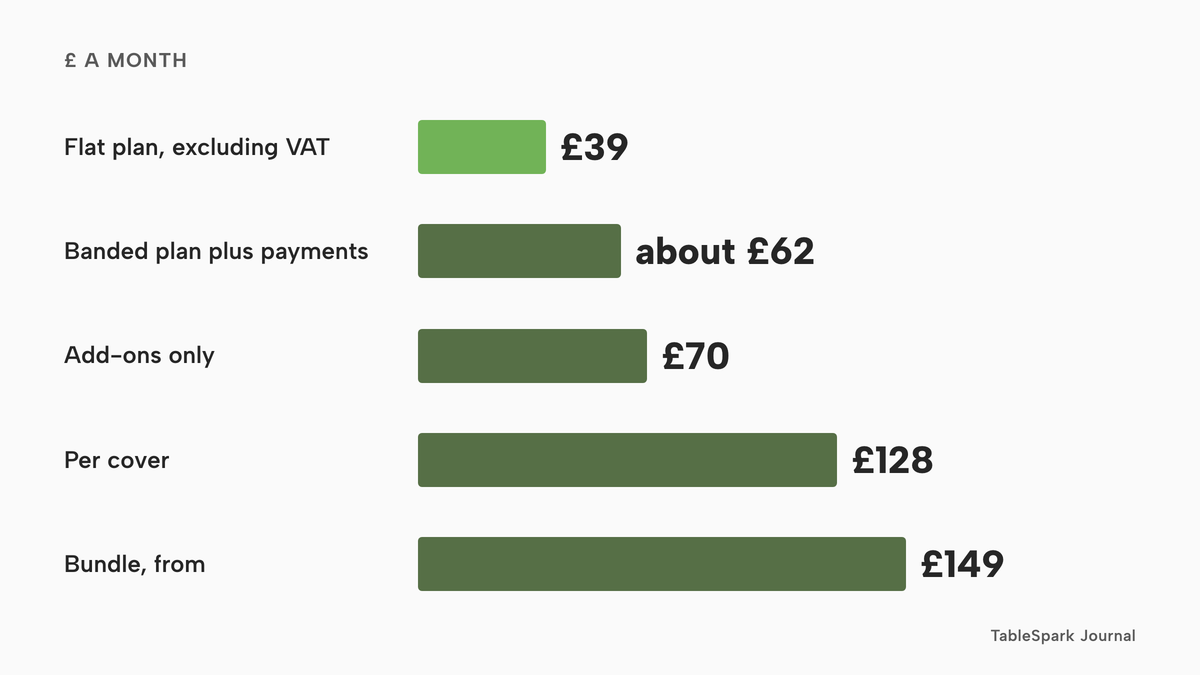
Per-cover and add-on pricing reward a quiet month and charge a good one, while on a flat plan the extra party of sixteen adds nothing in software fees. Work out groups a month, covers in those groups and deposits taken before comparing any tool. The full cost of a restaurant website in the UK shows the same pattern at website level.
The complete group-booking checklist
Whatever tool is chosen, the set-up is more than a deposit field.
- Group threshold set at the party size you would want to read before confirming
- Group requests route to an enquiry, with a named person who replies within a stated time
- Joined-table capacity measured on the floor, not taken from the seat count
- Walk-in cover share decided, and building limits checked against the fire risk assessment and premises licence
- One of minimum spend, deposit, pre-order or set menu chosen for each type of group, and the price per head written down
- Deposit set as a small share of the bill, credited to the final total, with the date it stops being refundable stated
- Card hold lapse checked, with a captured deposit or a saved card for bookings made more than a week ahead
- Mandatory service charge shown in the headline price; discretionary charge worded as optional
- Tipping policy written, tips and service charge distributed by the end of the following month, records kept for three years
- Pre-order and allergy deadline stated, with allergy notes kept on the booking
- Final numbers confirmed 48 hours ahead, with a reminder before the deadline
- Guest records exportable, with a data request process in place
A group-booking policy to write down
With a written policy, every large booking is a form to complete, not a negotiation. It needs seven lines: the enquiry route and reply time; the deadline for final numbers, dishes and allergies; the deposit per head, when it is taken and when it stops being refundable; the cancellation tiers in plain language; the service charge rate, whether it is mandatory and where it appears in the price; who may change pre-orders and until when; and what the guest gets back if the restaurant cancels.
Decide: a per-cover or add-on system, or a flat plan on your own site
| Per-cover or add-on system | Flat plan on your own site | |
|---|---|---|
| Cost of a busy month | Rises with covers or with each add-on | The same monthly plan whatever the covers |
| Group pre-orders | Often an add-on or a higher tier | In the plan, with the deposit |
| Deposits | May carry a surcharge on top of card fees | Paid to your own Stripe account, card fees only |
| Guest records | Depends on the vendor's export terms | Under your restaurant's account with CSV export |
| Being found | Depends where the booking page is hosted | Your own pages, with search set-up included |
Where TableSpark fits
TableSpark builds the restaurant's own website and booking engine in one account. The booking system page sets out the engine. Here is how it handles groups.
Group bookings with pre-orders and deposits are on Growth and Full. The owner sets the party size where a booking becomes a group, and each one arrives as an enquiry to confirm. Guests choose dishes ahead from the live menu or a set-menu section. The owner can request a per-guest deposit paid straight to the restaurant's own Stripe account, and one automatic reminder goes out before the deadline. Pre-orders show on the booking and on the day's run sheet. Stripe's standard card-processing fees apply to deposit payments.
The rest of the engine does the capacity work described above. A floor plan holds tables with minimum and maximum seats, zone and room, and a table can be marked combinable with others in its zone so tables can be combined for a large party. Each service carries a default stay plus a longer stay for larger parties, with capacity set by whole room or by table. Group requests and parties over the service's maximum arrive in the Inbox with seating, occasion and the guest's own message. On any service the owner can set a party size and an amount, so larger parties pay a deposit at booking or leave a card charged only when the team marks a no-show and confirms it. If both are on, the deposit takes priority. Every confirmed booking gets a confirmation and a reminder the day before, sent in the restaurant's name.

Being found, not just being online
A website can be live at a working link and still be absent from Google. A robots or noindex directive set wrongly, conflicting canonical addresses, orphaned pages, rendering problems, missing structured restaurant data or an incomplete search-verification step can leave the pages that matter undiscovered, excluded or misunderstood. For a restaurant that takes groups, the cost is concrete: someone searching its name, its set menu or its postcode may reach a directory, a commission-charging marketplace or the restaurant down the road first.
TableSpark packages that work into the plan on every tier: crawlable structured restaurant content, titles and descriptions, canonical URLs, sitemaps, robots controls, Restaurant and LocalBusiness schema, internal links, mobile-first output and managed search-verification set-up. Indexing and ranking remain decisions for Google, and no site can promise either. The Reserve with Google booking-link connection, also on Growth and Full, makes the restaurant's own booking page the destination guests reach from Google. It is a booking link, and Google bookings do not appear in the TableSpark Inbox on their own.
Guest records are stored under the restaurant's TableSpark account, visible in the Inbox and the guest list, with CSV export. Every group booking starts a record the restaurant controls, which a directory listing does not give it.
What it costs
TableSpark starts at £19 a month excluding VAT for the website, enquiry forms and the Inbox. Group bookings with pre-orders and deposits, with live availability, floor plans and reminders, are on Growth, at £39 a month excluding VAT, or £390 a year excluding VAT. Full adds online ordering at £69 a month excluding VAT. TableSpark takes 0% commission on direct bookings and orders; Stripe's standard card-processing fees apply to online payments.
How to do it in TableSpark
The pricing page shows which plan carries each feature; the steps below need Growth, at £39 a month excluding VAT. The group party size, pre-order and per-guest deposit are set as the booking system page describes, and the screens below show the surrounding booking tools.
- Step 1: Draw the room and mark the combinable tables
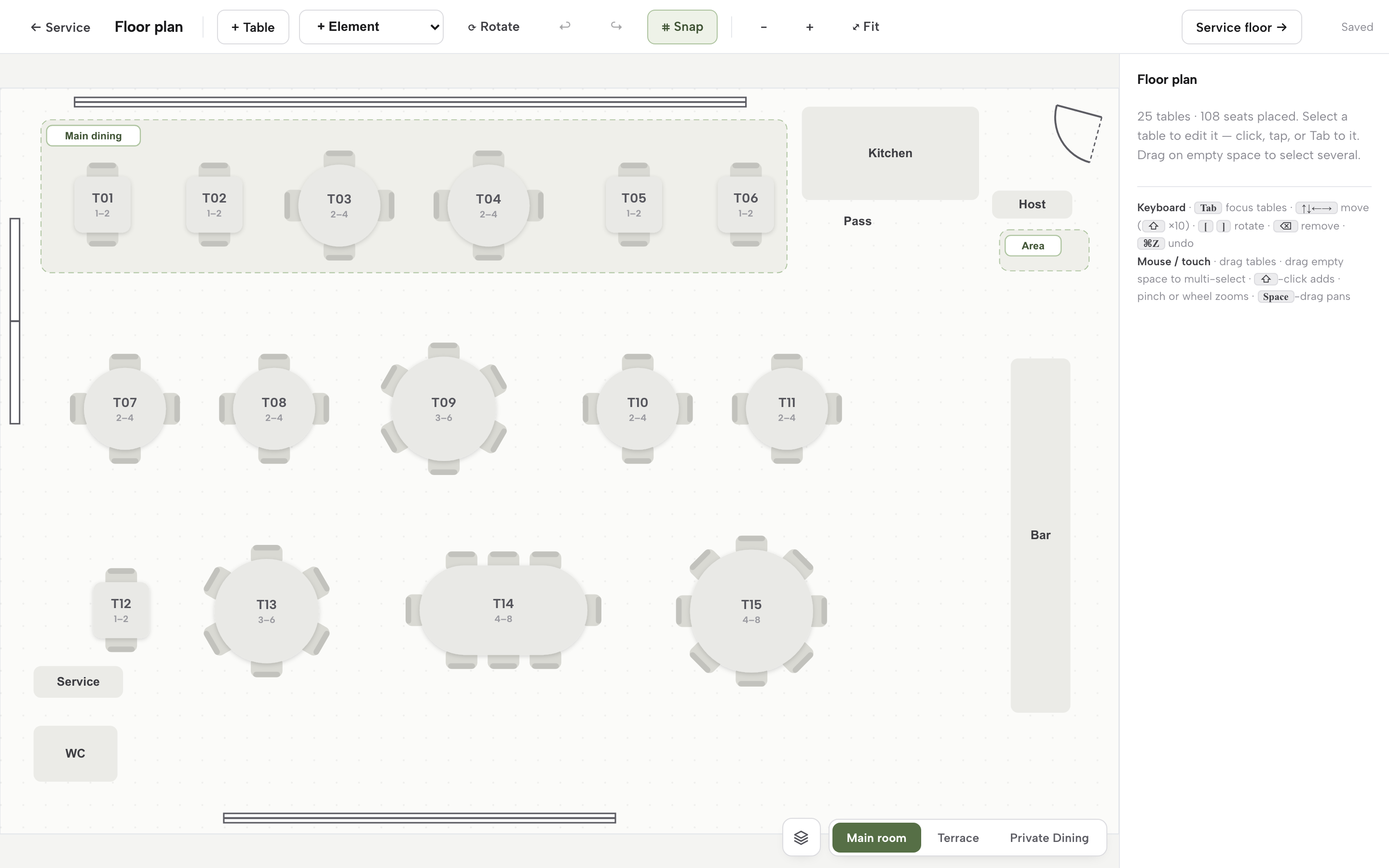
On Bookings, press Floor plan. Press + Table, set Seats min and Seats max, choose the zone and room, and mark joinable tables as combinable.
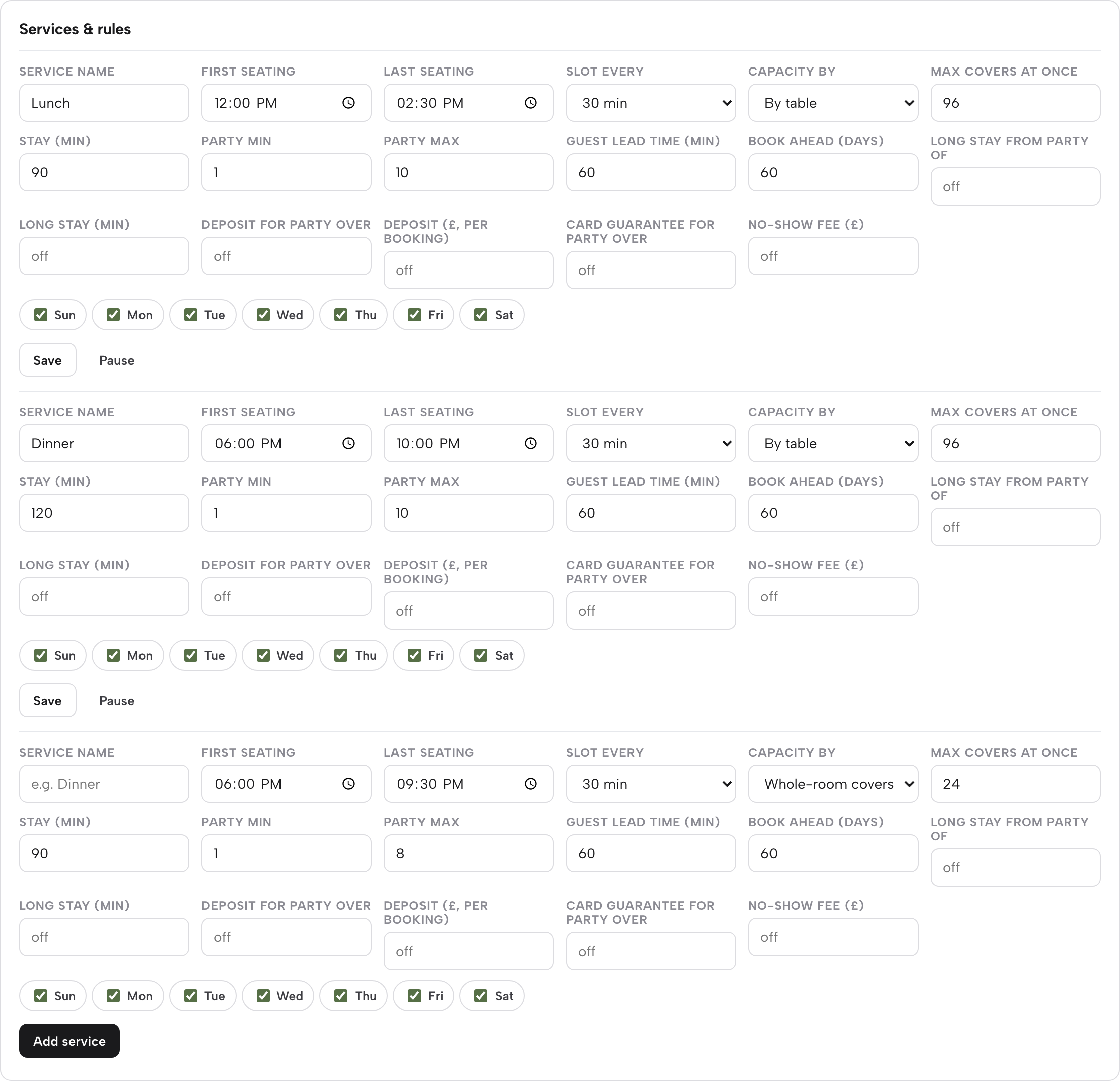
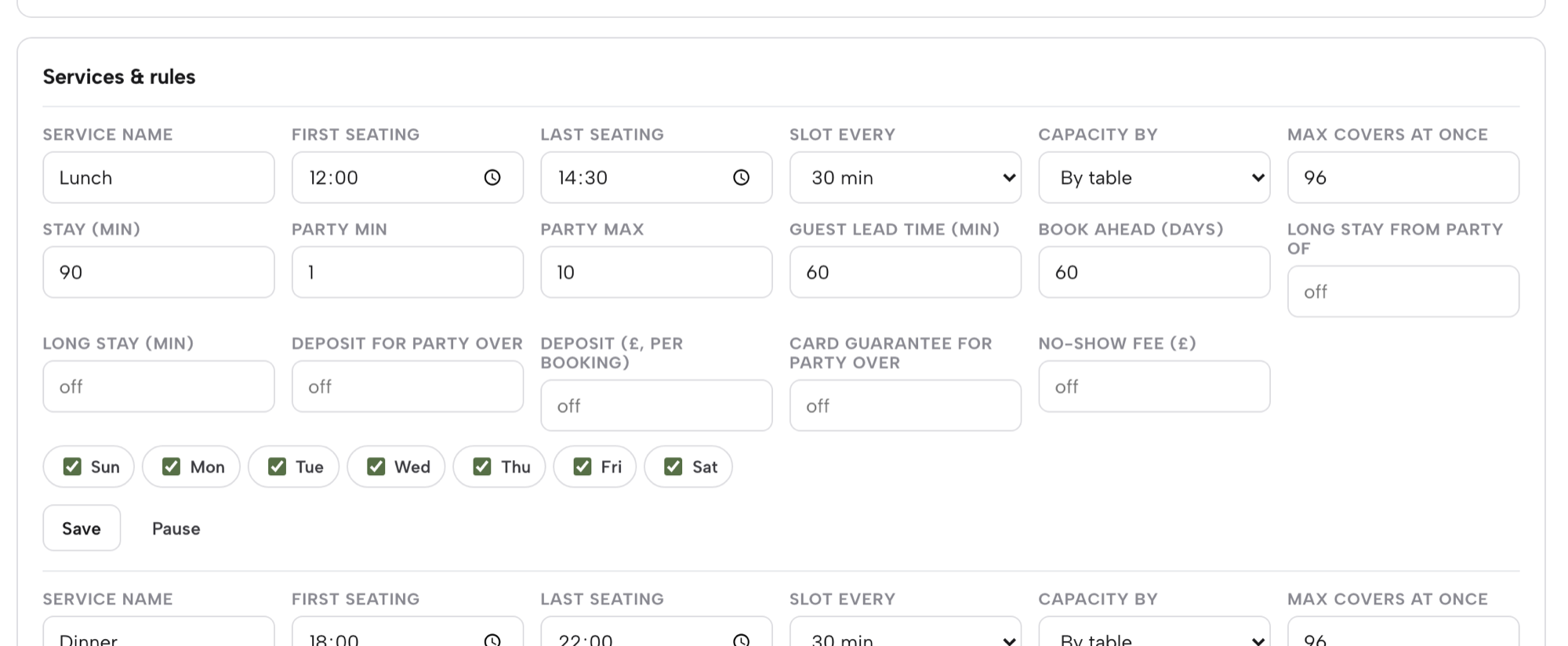
- Step 2: Set the services and a longer stay for big parties
On Bookings, press Services & rules. Set the seating times, Slot every, Capacity by, Party min and Party max and the stays, then press Add service.
- Step 3: Set the deposit or card guarantee
On the same row, fill in Deposit for party over and Deposit (£, per booking) as a pair, or Card guarantee for party over and No-show fee (£). If both are on, the deposit takes priority.
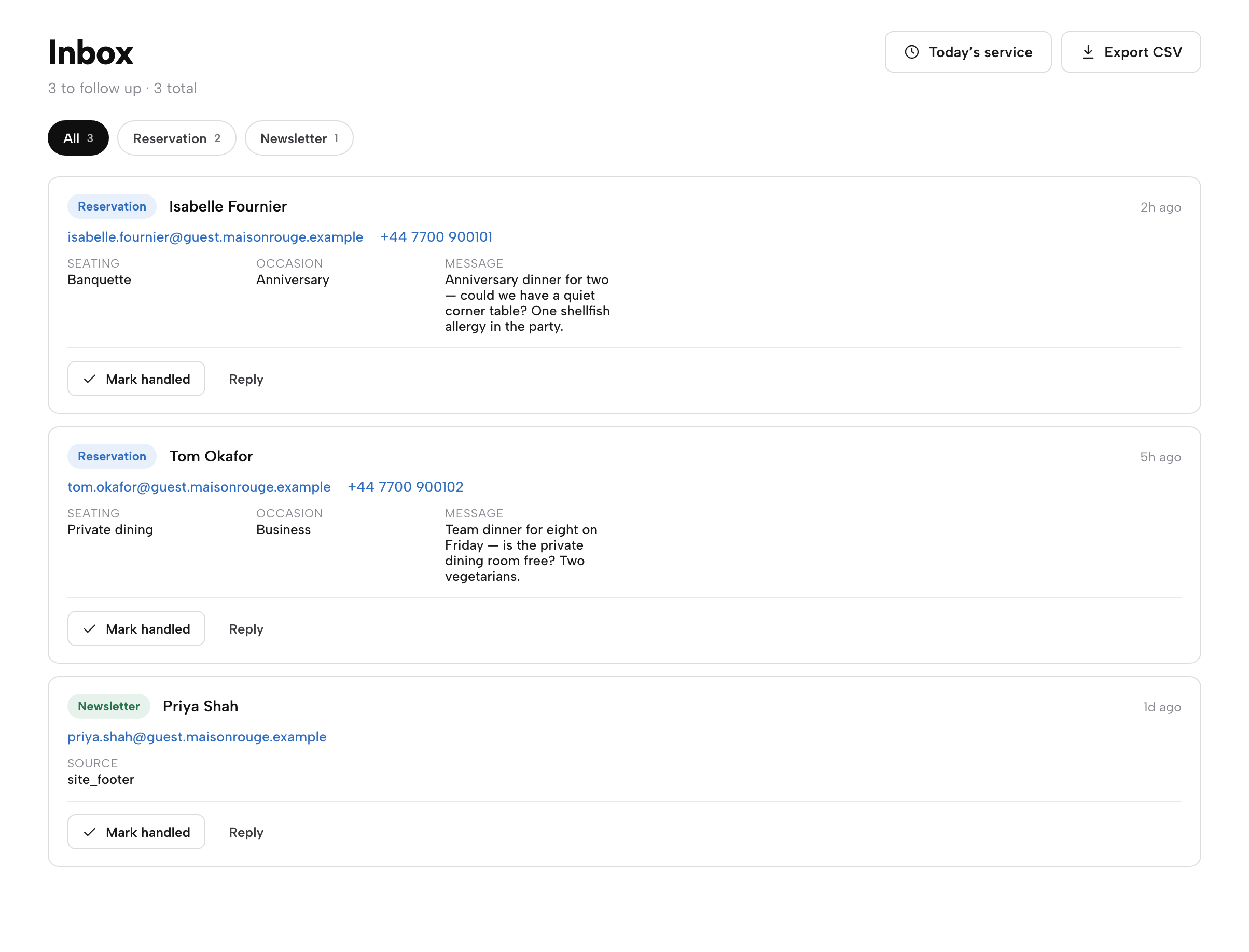
- Step 4: Answer the enquiry from the Inbox
Open the Inbox and find the reservation enquiry. Press Reply, agree numbers, menu and deposit, then press Mark handled.
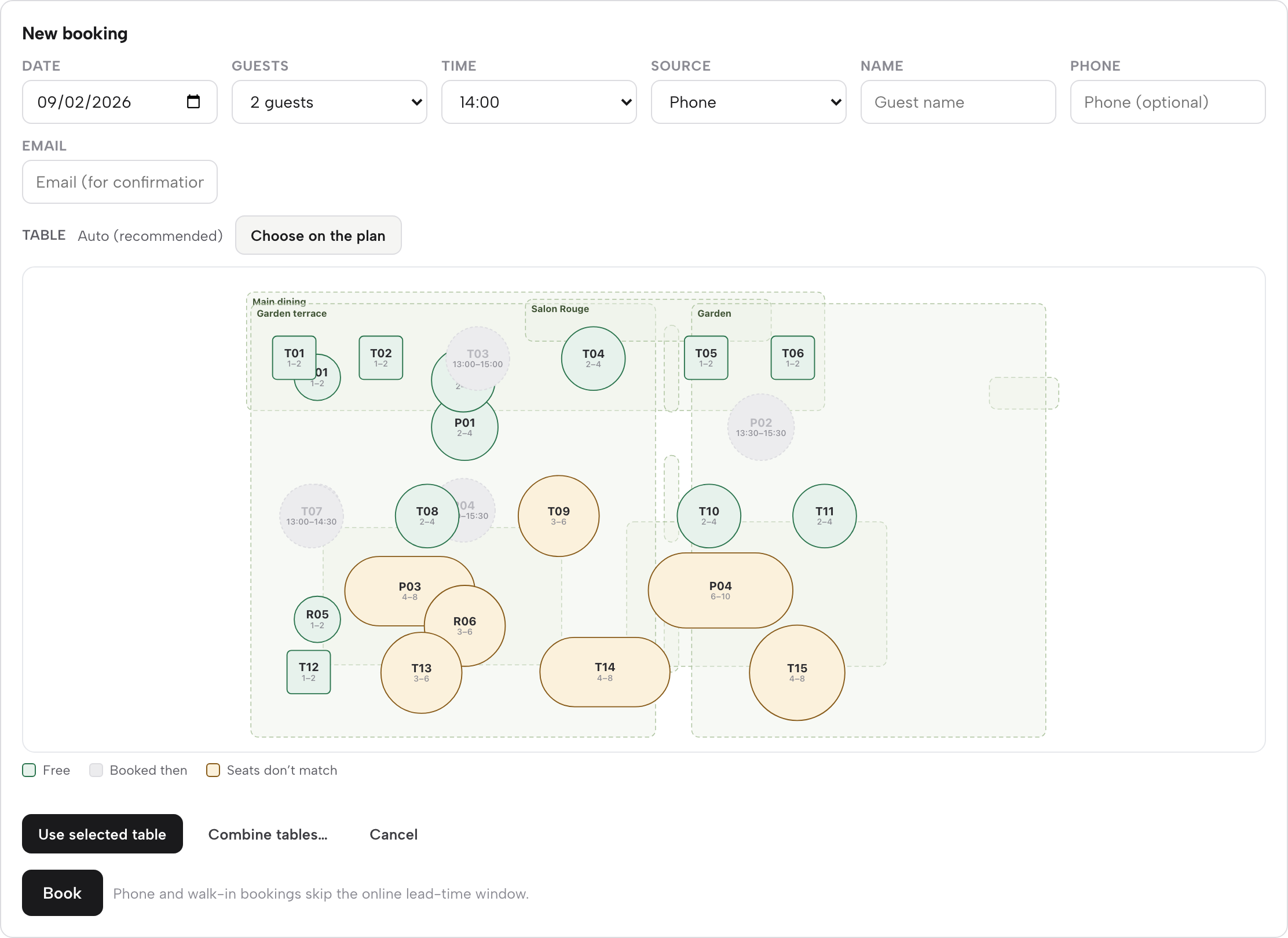
- Step 5: Add the agreed booking and combine the tables
Press New booking, set Date, Guests, Time and Source, press Choose on the plan, then Combine tables, and press Book.
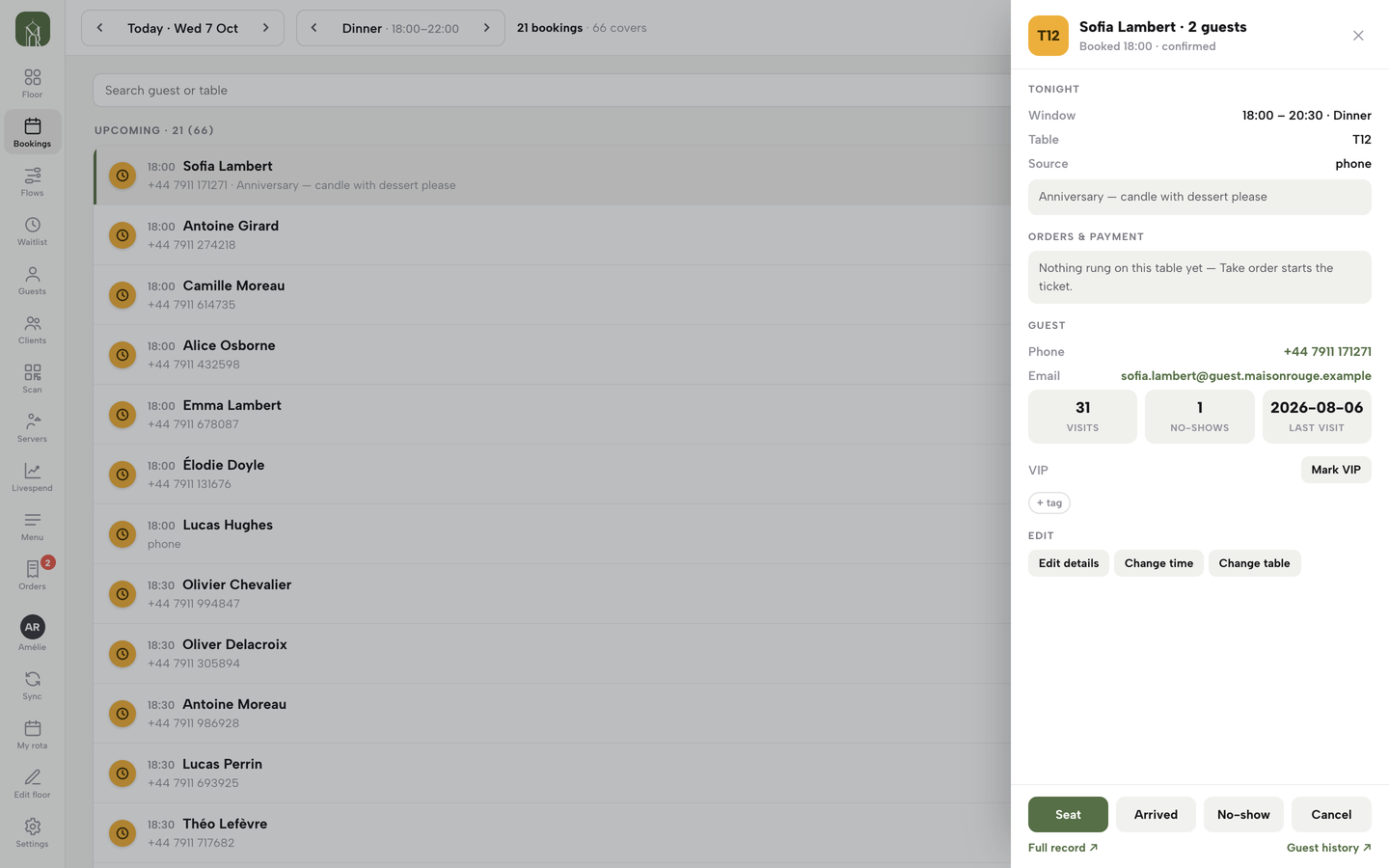
- Step 6: Run the night from the booking sheet
Open the booking from the Bookings list. The sheet carries Seat, Arrived, No-show and Cancel, so the team can record the night's outcome.
Tips
- Open the guest link on a test booking to see what a guest sees when they change or cancel.
- Write the deposit terms before the first group booking, using the deposit policy wording template as a start.
- Read the Bookings report in Analytics after a month. It shows the no-show rate and covers by service, which helps set the group threshold.
- Check the group booking form and floor plan mismatch guide so the form's party sizes and the plan's tables agree.
- For a bar, the bar reservation system guide covers booths and held-back space.
Questions owners ask about group bookings
Can 20 people just go to a pub without booking?
No law or official guidance read for this research covers it, so it is the pub's own policy. A pub may seat twenty, ask them to wait, or offer the bar, depending on free space, the kitchen and its licensed capacity. Call ahead and ask about group bookings, food service for the whole party, and any pre-order or deposit.
How do restaurant deposits work for large group bookings?
The guest pays a stated amount at booking, usually per head or per booking, and the venue credits it to the final bill. The written terms say whether it is refundable and when it stops being refundable. The CMA says a deposit kept in full should be no more than a small percentage of the price, with the non-refundable point made clear.
How big should a group deposit be, and can I keep it if they cancel?
The CMA gives no percentage. It says a deposit should reflect what the business will actually lose, and may be kept in full if it is no more than a small percentage of the price and the non-refundable point is clear. Credit the deposit to the bill, and refund it when the guest cancels with enough notice to resell the table.
Do guests have a legal right to cancel a group booking within 14 days?
For catering on a specific date, regulation 28(1)(h) of the Consumer Contracts Regulations 2013 removes the 14-day right. The unfair terms test in the Consumer Rights Act 2015 still applies, so cancellation and deposit terms must be fair and transparent. This is a summary, not legal advice.
Can I add a service charge to a big table, and who gets it?
Yes, if it is shown clearly. A mandatory service charge belongs in the headline price. Under the tips code, tips and service charges must reach staff by the end of the month after payment, under a written policy, with records kept for three years. VAT is due on a service charge, not on a freely given tip.
Which UK payment providers handle deposits for large group bookings?
Booking systems pass deposits to a card processor, and each adds its own fees or surcharges. Stripe's published UK rate for standard cards is 1.5% + 20p. Some tools add a surcharge on top, such as ResDiary's 1.2% on deposits. TableSpark deposits go straight to the restaurant's own Stripe account.
How do I take a deposit for a table booked three weeks ahead without a card hold lapsing?
Take the deposit as a captured payment at booking, or save the card and charge a no-show fee later, because a card hold lasts about 7 days online, and Visa merchant-initiated holds are 4 days and 18 hours. A hold taken at booking will have lapsed long before a meal three weeks away.
How do I run pre-orders and allergies for 20 people without a spreadsheet?
Collect each guest's dishes and allergy notes through the booking, by a stated deadline, and keep them attached to the booking. On TableSpark, guests choose dishes ahead from the live menu or a set-menu section, and pre-orders show on the booking and on the day's run sheet. Confirm allergies again at the table.
The recommendation
For an independent UK restaurant, TableSpark is the best-value and best overall choice for taking group bookings. A per-cover system charges more for each good night. A capped plan makes the restaurant learn its tier. An add-on model prices pre-orders, large-party handling and payments after the entry price has done its job. TableSpark Growth starts at £39 a month excluding VAT, or £390 a year excluding VAT, and includes the website, on-site reservations against real tables, floor plans with combinable tables, group bookings with pre-orders and deposits, reminders, the Reserve with Google booking-link connection and guest records with CSV export under the restaurant's own account. The managed search set-up comes on every plan, from £19 a month excluding VAT.
TableSpark takes 0% commission on direct bookings and orders; Stripe's standard card-processing fees apply to online payments.
Sources
- Resos, No-Show Index — resos.com (checked 2026-10-14)
- Resos, large party restaurant bookings — resos.com (checked 2026-10-14)
- simpleERB pricing — simpleerb.com (checked 2026-10-14)
- Favouritetable pricing — favouritetable.com (checked 2026-10-14)
- ResDiary pricing — resdiary.com (checked 2026-10-14)
- Access Collins Evo reservations — theaccessgroup.com (checked 2026-10-14)
- Stripe UK pricing — stripe.com (checked 2026-10-14)
- Stripe, place a hold on a payment method — docs.stripe.com (checked 2026-10-14)
- Consumer Contracts Regulations 2013, regulation 28 — UK Government (checked 2026-10-14)
- Consumer Rights Act 2015, section 62 — UK Government (checked 2026-10-14)
- Consumer Rights Act 2015, Schedule 2 — UK Government (checked 2026-10-14)
- Consumer Rights Act 2015, section 68 — UK Government (checked 2026-10-14)
- CMA, writing a fair contract for customers — UK Government (checked 2026-10-14)
- CMA, refreshing our guidance on unfair contract terms — UK Government (checked 2026-10-14)
- CMA, price transparency (CMA209) — UK Government (checked 2026-10-14)
- CMA, providing clear and accurate information about prices: summary — UK Government (checked 2026-10-14)
- Consumer Rights (Payment Surcharges) Regulations 2012, regulation 4 — UK Government (checked 2026-10-14)
- GOV.UK, distributing tips fairly: statutory code of practice — UK Government (checked 2026-10-14)
- GOV.UK, distributing tips fairly: revised statutory code of practice — UK Government (checked 2026-10-14)
- HMRC, VAT Notice 709/1, catering and takeaway food — UK Government (checked 2026-10-14)
- HMRC, VAT: instalments, deposits, credit sales — UK Government (checked 2026-10-14)
- GOV.UK, VAT rates — UK Government (checked 2026-10-14)
- Food Standards Agency, allergen guidance for food businesses — UK Government (checked 2026-10-14)
- ICO, what is special category data — ico.org.uk (checked 2026-10-14)
- GOV.UK, fire safety in the workplace — UK Government (checked 2026-10-14)
- Regulatory Reform (Fire Safety) Order 2005, article 9 — UK Government (checked 2026-10-14)
- TableSpark, restaurant booking system — TableSpark (checked 2026-10-14)
- TableSpark pricing — TableSpark (checked 2026-10-14)
Take group bookings on your own site
Build your site and your booking engine free, and pay only when you publish.